



Bank of America strategist Michael Hartnett, who had previously called the drop in technology stocks with notable accuracy, says his “sell signal” has now ended. He is not calling a buy yet. In his view, whether investors move back into tech stocks in mid-November will depend largely on one variable: semiconductor prices.
In the latest edition of his Flow Show report, Hartnett said BofA’s Bull & Bear Indicator fell sharply from 8.1 to 7.4, breaking below the 8.0 threshold and formally ending the sell signal that had been triggered on May 26. Even so, he said he remains tactically defensive. He listed two conditions for returning to risk assets: a Federal Reserve rate hike on Oct. 28 to restore credibility, and easing concerns over AI financing. Neither condition has been met.
The sell signal is over, but no buy signal has appeared
Market pricing for a Fed rate hike in October has dropped from above 50% to 14%. At the same time, the AI credit market has just gone through its worst week of the year. CoreWeave bonds fell into distressed territory, and its 5-year credit default swap spread implied roughly a 63% probability of default. The Nasdaq 100 lost nearly 6% for the week, its worst performance since “Liberation Day.”
Hartnett warned that if semiconductor prices start to fall, that would point to tighter AI credit and a peak in capital spending growth. In that scenario, market returns in 2027 would shift from capital appreciation toward income.
BofA’s Bull & Bear Indicator dropped 0.7 points this week to 7.4. The decline was driven by weaker breadth in global equity indexes, hedge fund short positions in crude oil and S&P 500 futures, reduced long positioning in gold futures, and softer inflows into high-yield debt and emerging-market debt. The only factor still pushing the indicator higher was continued net inflows into technology stocks.
Hartnett also said the “old” version of the Bull & Bear Indicator fell from 5.6 to 5.1, below the recent high of 8.0 reached on Sept. 1. Both versions are sending the same message: the extreme optimism seen over the summer has ended.
That cooling in sentiment does not mean money has actually left the market. Under BofA’s breadth rule, a net 52% of global equity indexes are now in “oversold” territory, meaning they are below both their 50-day and 200-day moving averages. That is the highest reading since April 2025. A contrarian buy signal, however, would require the oversold share to reach a net 88%. Hartnett said that threshold is unlikely to be reached soon unless the U.S., Taiwan and Brazilian stock markets, which are still “overbought,” fall another 6% to 10%.
Positioning remains crowded, especially in tech
Even with sentiment fading, portfolio exposure is still concentrated. EPFR weekly data through Wednesday showed $64.4 billion of net inflows into equity funds, $11.8 billion into bond funds, and $53.1 billion of outflows from cash. The selloff in technology shares has not left a clear mark in the flow data.
BofA private clients currently hold a record 66.4% of assets in equities, while cash allocations have fallen to a record low of 9.3%. On a full-year basis, annualized net inflows into global equity funds in 2026 are running at $1.3 trillion. Technology funds account for an annualized $196 billion, more than 2.5 times the previous record. BofA’s October fund manager survey also showed the biggest overweight in tech stocks since August 2020.
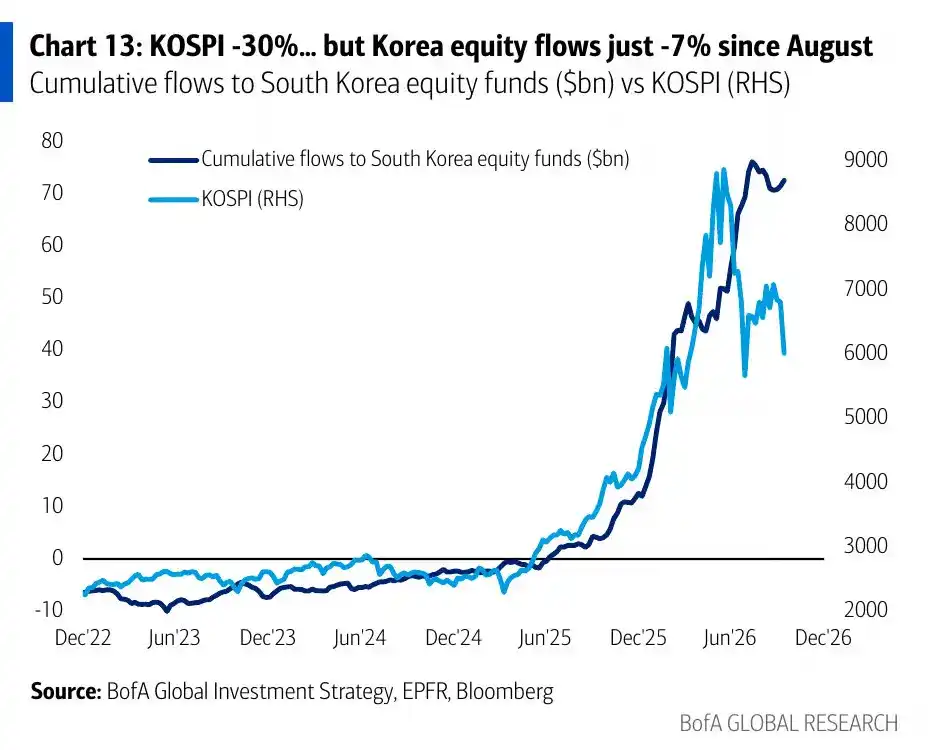
South Korea stands out for the gap between positioning and price action. The KOSPI has fallen 30% from its June high, yet after the August peak, only $7 left for every $100 that had flowed in. Hartnett said foreign investors were the main sellers this week, while the stock buyback window is also nearing closure, suggesting the real withdrawal of capital may not have started yet.
AI financing stress is widening as real yields approach a warning zone
Hartnett’s defensive stance rests on three main points.
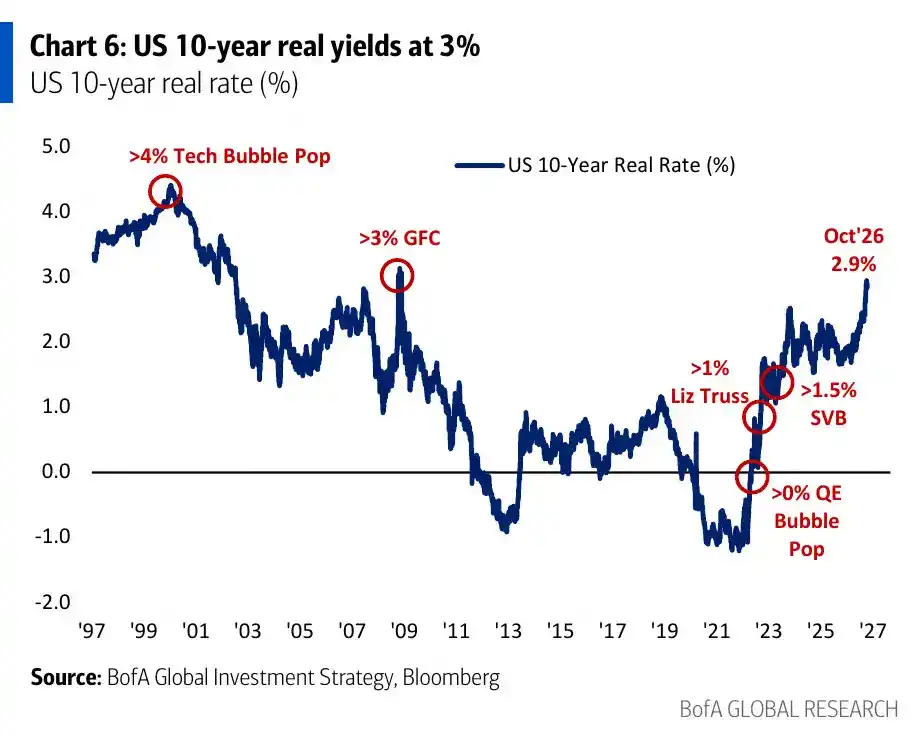
- First, the U.S. 10-year real yield is close to 3%, a level that has historically lined up with major risk events including the dot-com bust, the global financial crisis and the SVB episode.
- Second, the private equity ETF PSP and the business development company ETF BIZD have both fallen back to their lows from the first half of 2026.
- Third, Oracle’s 5-year CDS has risen almost vertically, while spreads on investment-grade tech debt have barely moved, showing that the most leveraged borrowers are under the greatest pressure.
According to Goldman Sachs rates strategist David Curtin, the cost of financing AI infrastructure is one of the market’s main pressure points right now. For below-investment-grade borrowers, all-in funding costs of 6% to 8% “bite faster” in a high-rate environment.
Goldman Sachs data showed the spread on CoreWeave’s 2031 bonds at one point widened to more than 1,100 basis points over U.S. Treasuries.
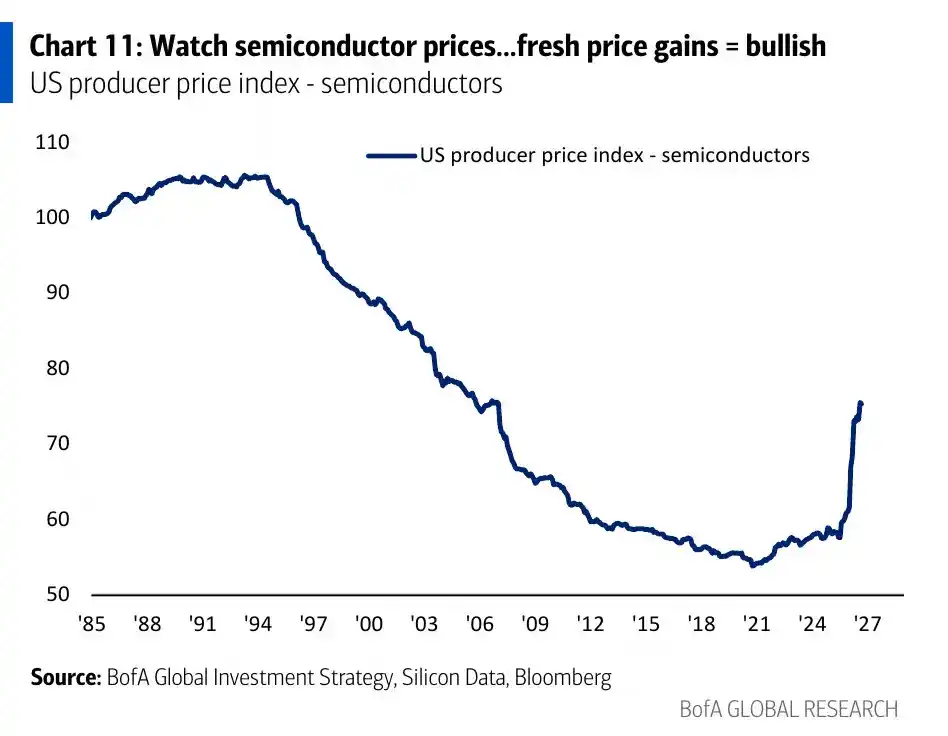
Hartnett also cited consensus estimates showing capital expenditure by hyperscale cloud companies reaching $807 billion in 2026 and rising to $1.16 trillion in 2027. Free cash flow, meanwhile, is expected to turn negative by $63 billion this year and widen to negative $163 billion next year. Goldman data also showed the producer price index for semiconductors has jumped sharply after nearly 30 years of decline.
Chip prices are the key market variable for 2027
Hartnett’s central forward-looking call is that semiconductor prices will shape both the macro backdrop and market structure heading into 2027.
If chip prices keep rising, that would suggest the U.S.-China AI arms race is still running and that expectations for implicit support from the U.S. government for bond and equity prices remain intact. In that case, investors could return to technology stocks in mid-November and reverse “short tech, long bonds” positions as 2027 approaches.
If semiconductor prices fall, the message changes. It would point to tighter AI credit, a peak in AI capital expenditure growth, and a weakening of the logic supporting the current boom in nominal GDP. U.S. nominal GDP has risen 63% from its pandemic low to $33 trillion, and Hartnett sees surging chip prices as an important driver. In that setup, bonds could outperform, while assets priced on the AI capex narrative would face clearer pressure. The main driver of returns in 2027 would shift from capital gains to income.
Defensive in the short term, adding exposure to rate-peak beneficiaries
On positioning, Hartnett said he is adding assets that would benefit from peak yields, including small caps, REITs, and the consumer discretionary sector, which BofA’s October fund manager survey showed is the most underweight since July 2008. He said plainly that he is not adding to technology stocks for now.
Over a longer horizon, Hartnett remains overweight gold, commodities and emerging markets. He also said long-running short bond positions and underweight China positions should both be reduced gradually, marking a clear shift in his stance.
He also pointed to “price signals” inside the S&P 500: 355 constituents are down more than 10% from their 52-week highs, 188 are down more than 20%, and 93 are down more than 30%. The index may still look calm on the surface, but the damage beneath it is already substantial.