
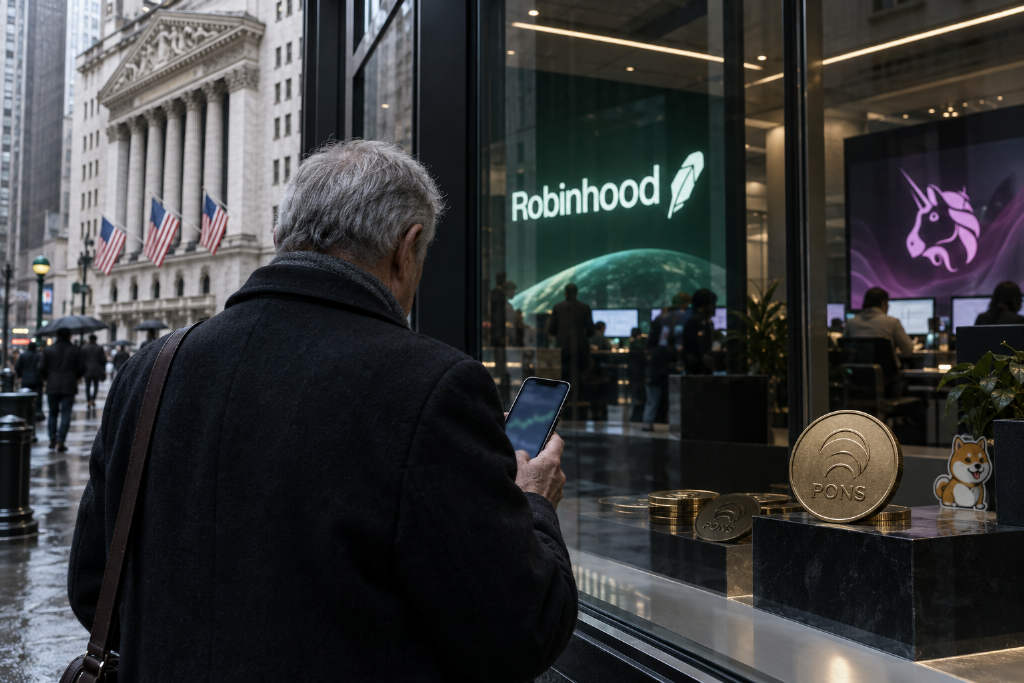
On Sept. 3, crypto KOL Rune said Bonk Guy, the top trader on social trading platform fomo’s profit leaderboard, is now 64 years old. According to position screenshots shared by Bonk Guy, he put roughly $67,000 into PONS, the platform token of Robinhood Chain launchpad Pons, and that position was showing a paper gain of nearly 9,100%.
That trade has become one of the clearest examples of a larger battle now playing out on Robinhood Chain, where launchpads are fighting over issuance volume, trading flow and user attention.
Bonk Guy returns to the top of the leaderboard
Bonk Guy (@theunipcs) previously turned heads three years ago by going long BONK with $16,000 in capital and 6x leverage. At one point, that trade produced an eight-figure unrealized profit, before he was fully liquidated during the black swan market move in October last year.
This time, he has climbed back near the top by holding a group of Robinhood Chain tokens including PONS, USELESS and Marscoin. Data he disclosed in late August showed cumulative spot trading profit above $10 million, profit of more than $5.7 million over the last 30 days, and total account holdings that at one point reached $15.74 million.
The roughly 9,100% gain in PONS came from a pricing loop on Robinhood Chain that has been reinforcing itself.
How the Pons model works
Pons is operated by Pons Labs. Each new token launched on the platform has a fixed supply of 1 billion tokens, the creation cost is 0.0005 ETH, and the trading fee is 1%. Of that fee, 70% goes to the token creator and 30% goes to the protocol. From the protocol share, 80% is used to buy back and burn PONS on the secondary market, while the remaining 20% is kept for team operations.
The structure directly links new token issuance and trading frequency to buybacks and burns of PONS. More launches and more active trading generate more fees, and part of those fees is continuously turned into market buy pressure and token destruction. That ties platform activity to the token’s supply-demand balance.
Pons captured the biggest wave of traffic after early platform NOXA halted token issuance in mid-July, then kept expanding its share. By early September, Pons accounted for about 66% of token issuance on the chain, and tokens launched through Pons were responsible for 78% of all new-token trading volume across the chain.
On Sept. 3, Pons generated more than $6 million in daily protocol fees, above Pump.fun. PONS then reached a record valuation of about $970 million, rose more than 200% over one week, and had already seen about 29% of its total supply bought back and burned.
After Pons rolled out V2 in August, newly launched tokens could also be paired for trading with stock tokens tied to Nvidia, Apple and Robinhood after completing their graduation phase.
LONG pushes stock-token meme pairings
If Pons is built around fee-driven buybacks, LONG has centered its model on narrative from the beginning by combining stock tokens and memes into one product.
LongX, which went live in early September, packaged a 3x leveraged Nvidia position into a token and opened trading pairs against meme tokens. The largest meme token on the LONG platform, Artificial Inu, is paired with a Nvidia stock token. Its market capitalization at one point topped $200 million, and its gains at one stage far outpaced Nvidia’s spot stock performance over the same period.
Because the product combines a leveraged equity position with meme-style trading, its price does not simply track the underlying stock. It is also shaped by the leverage mechanism and speculative sentiment on-chain.
LONG has also introduced a community model in which part of the fees are automatically burned and another part is locked into a treasury. The platform is trying to turn stock-paired meme assets into a distinguishing label of its own. Beyond Artificial Inu, meme tokens paired with Costco, Micron and SpaceX references have also reached market capitalizations in the tens of millions of dollars and are competing for the second spot on the platform.
Pools takes the low-fee route
In early August, Uniswap Labs brought its own launchpad to Robinhood Chain. On the day Pools went live, Uniswap founder Hayden Adams publicly described high-take-rate launchpads as 「predatory」, a remark aimed at the 1% fee model used by platforms such as Pons.
Pools took the opposite approach. Its trading fee is only 0.25%, and creators can choose to keep 0.05% of that amount. The rest is automatically reinvested into a permanently locked liquidity pool, with no extra launchpad fee charged. Tokens launched through Pools are immediately connected to the Uniswap web app, wallet, routing API, and third-party integrations including MetaMask and Ledger. In practice, a token can be seen across the broader Uniswap ecosystem from day one.
On launch day, Pools briefly captured 40% to 50% of the chain’s issuance volume and trading share with the help of official trust and distribution. That put real pressure on Pons. Pons has leaned on first-mover advantage and the stickiness created by its buyback model, while Pools has relied on the Uniswap brand and lower fees. The two approaches are still in direct competition.
They are not alone. Robinhood Chain also has more than 10 other launchpads active in different niches, including PAIR for stock-basket pairings, CLUTCH for community-plus-NFT projects, Sushi-partnered Pools fun, and developer-focused Hood Dev.
Uniswap Labs becomes a PONS buyer
Pools came in hard at the start of August and briefly seized 40% to 50% of issuance volume and trading share on its first day. That edge did not last. By early September, Pons had moved back ahead, with roughly 66% of issuance volume and about 78% of new-token trading volume on the chain. Pools’ lower fee structure and distribution edge did not dislodge Pons from the lead.
Then the competitive picture took another turn.
On Sept. 4, Uniswap Labs said it had bought PONS. The company did not disclose the amount purchased or the size of its holding. After the announcement, PONS rose about 40% within hours.
That left the market with a striking split screen: Uniswap Labs was still pushing Pools as a rival launchpad on Robinhood Chain, while at the same time becoming an investor in PONS. The move was quickly framed by the market as a case of joining what it could not beat.
Still, the article suggests Uniswap Labs may be looking beyond Pons as a direct competitor. What stands out is the flywheel already taking shape on Robinhood Chain, where token launches, trading, fee generation and platform-token value capture reinforce one another. Pools can keep competing for launch flow, while ownership of PONS gives Uniswap Labs exposure to what is currently the chain’s strongest traffic hub.
The real test is whether meme activity lasts
At its core, the launchpad fight on Robinhood Chain is a fight for traffic. Pons turns issuance and trading volume into buy pressure for PONS through fee-funded buybacks. LONG tries to convert volatility in traditional assets into new speculative products by tying stock tokens to memes. Pools is betting on lower fees and Uniswap distribution. The mechanisms differ, but they are all competing for the same pool of users.
Robinhood Chain’s own data points in that direction. As of Aug. 10, about 92.9% of accounts had interacted only with meme coins, while only about 3.7% had used tokenized stocks. Robinhood Chain may want to build on-chain finance, but what took off first was still a meme wave.
That is also where the main risk sits for platform tokens such as PONS and LONG. Their gains are not only a bet on which launchpad wins. They are also a bet that meme trading on Robinhood Chain keeps expanding. More launches and more trading strengthen fee buybacks for Pons. More meme capital moving into stock-paired trading widens the narrative room for LONG.
The problem is simple: every one of these flywheels currently depends on speculative heat staying in place.
Robinhood’s 90-day gas subsidy for some wallets is due to expire at the end of September. Once that subsidy is gone, it remains unclear how much of today’s DEX volume, which has climbed into the billions of dollars, will stay. The same question applies to launchpad fee income tied to meme-driven traffic, and to whether users drawn to Robinhood Chain by the wealth effect around Pons and LONG will remain for lending, stock tokens and other on-chain financial products.
That is where the real dividing line sits for this launchpad war. If the meme wave fades and traffic leaves with it, the current fight among Pons, LONG and Pools will mostly amount to a scramble for more chips in one speculative cycle. If these platforms can retain meme users and guide them toward lending, tokenized stocks and other on-chain finance products, the contest becomes something larger: control over the next financial entry point on Robinhood Chain.