
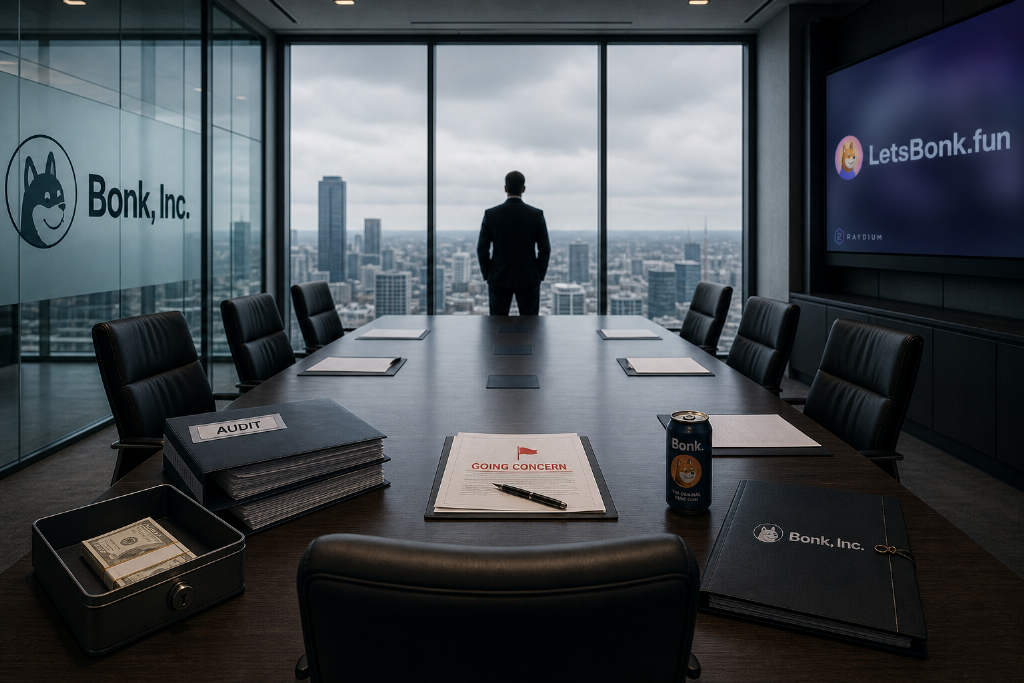
Bonk, Inc. (NASDAQ: BNKK) reported first-half revenue of $5.5 million, a 6,218% increase from a year earlier, but the company still posted a net loss of $7.88 million and finished the period with only $214,000 in cash. In its filing, both auditor M&K CPAS and management said the company’s condition raises substantial doubt about its ability to continue as a going concern.

The revenue mix stood out as much as the loss. Of the $5.5 million total, $1.579 million came from the beverage business, while the remaining $3.921 million came from related-party revenue sharing, accounting for 71% of total revenue. That income was tied to LetsBonk.fun, a Solana-based meme coin launchpad linked to the BONK ecosystem.
As described in the source article, BONK is one of the best-known meme coins on Solana. It began with a community airdrop in late 2022 and does not itself have a corporate entity. Bonk, Inc., by contrast, is a Nasdaq-listed company formerly known as Safety Shot, an energy drink business. The company changed its name in October 2025 and said it was shifting toward a digital infrastructure model intended to connect public markets with the decentralized economy. That strategy includes holding BONK tokens in treasury and taking a share of revenue from LetsBonk.fun.
Revenue surged, but losses and balance-sheet strain remained
The company released its half-year results on Aug. 17, and a subsequent 10-Q laid out the fuller financial picture. Revenue reached $5.5 million for the first half, up 6,218% year over year. Net loss came to $7.88 million, mainly because the company marked down the value of BONK tokens it held and recorded an unrealized loss of $8.17 million.
As of June 30, Bonk, Inc. had $214,000 in cash, working capital of $203,000, and an accumulated deficit of $191.4 million. The 10-Q, citing M&K CPAS, said the accumulated losses, continued operating cash outflows, and low levels of cash and working capital had created substantial doubt about the company’s ability to continue as a going concern.
Most of the new revenue came from LetsBonk.fun
The company’s $5.5 million in first-half revenue came from two sources. Beverage sales contributed $1.579 million. The other $3.921 million came entirely from related-party revenue sharing.
That revenue stream came from LetsBonk.fun. The platform, according to the source material, was launched through cooperation between the BONK community and decentralized exchange Raydium. It runs on Solana and uses a model similar to pump.fun: users can launch a token with a small amount of SOL, trading takes place on a bonding curve, and once a project reaches a certain scale it moves into a Raydium liquidity pool. The platform charges a 1% fee on trading, with part of that revenue used to buy back and burn BONK.
The source article said that from late 2025 into early 2026, LetsBonk.fun exceeded pump.fun several times in daily token launch volume and at one point became one of the most active launchpads on Solana.

The 10-Q says that on Aug. 8, 2025, Bonk, Inc. signed a revenue-sharing agreement with related party Bonk Digital, Inc., giving it rights to a portion of future revenue from the platform. On Dec. 10, that agreement was amended to 51% of LetsBonk.fun gross revenue, while also allowing the parties to agree to revert to 10%. The filing did not disclose Bonk Digital’s shareholder structure. It said only that the company was related through common ownership and governance.
That leaves the company heavily dependent on the performance of a platform inside the founder’s own ecosystem.
Founder influence runs through ownership and board rights
The same group of people sits behind the company’s largest ownership block and the related platform. Mitchell Rudy, known in the crypto market as Nom, is the founder and a director of Bonk, Inc. According to the company’s December 2025 proxy statement, Rudy-controlled Lucky Dog Holdings beneficially owned about 40.2% of the common stock and all 135,000 shares of Series C preferred stock, representing about 35.5% of total voting power.
The Series C preferred stock carries unusual governance rights. Under the 10-Q terms, as long as those shares remain outstanding, the holder can vote as a separate class to elect 50% of the company’s directors. The remaining directors are elected by common shareholders.
Rudy also holds shares directly through Nom Capital ULC. In April 2026, the source article said, he bought 31,055 shares in the open market at $2.82 per share.
The board has seven seats in total, and management plus directors collectively hold 51.6% of the common stock. Under that structure, minority shareholders have limited influence over the company’s governance.
Two stock deals totaling $50 million were paid in BONK
The proxy statement also described two related-party transactions, both settled in BONK tokens. In the first, Lucky Dog bought 35,000 shares of Series C preferred stock with BONK valued at $25 million. In the second, Lucky Dog agreed to buy 51,921,080 common shares with BONK valued at another $25 million. The common-share purchase still requires shareholder approval.
That means the company sold $50 million worth of stock and received BONK rather than dollars. The BONK received was booked on the balance sheet as digital assets, and swings in token value then flowed through the income statement.

In the first half, the fair value of the company’s digital assets fell from $17.975 million to $11.544 million. That line item alone resulted in an unrealized loss of $8.17 million, the main driver of the period’s net loss.
Cash fell from $2.28 million to $214,000
Liquidity looked even tighter than earnings. The source article said the company had $2.28 million in cash at the end of 2025. Six months later, that figure had dropped to $214,000, a decline of more than 90%.
Net cash used in operating activities was $4.17 million in the first half, including $2.226 million in the second quarter alone. At that pace, the company’s remaining cash would cover roughly nine days. Bonk, Inc. had no long-term debt, but the filing did not show much room on liquidity.
The 10-Q repeated the auditor’s view that the accumulated deficit of $191.4 million, continued operating losses, and very low cash and working capital levels had created substantial doubt about the company’s ability to continue as a going concern.
Rudy had publicly argued the stock was mispriced
The source article also noted that in April, Rudy said he had increased his BNKK position because he believed there was a large disconnect between the company’s trading price and its actual condition. He also said the company’s rights to 51% of LetsBonk.fun revenue implied a valuation of about $30 million.
That purchase cost him about $87,600, according to the article, while the company burned $4.17 million in operating cash during the first half.
At the time referenced by the source article, the public company behind an approximately $22 million market capitalization had only about $214,000 left in cash, while its revenue base, board structure, and liquidity position were all closely tied to the same founder and his related arrangements.