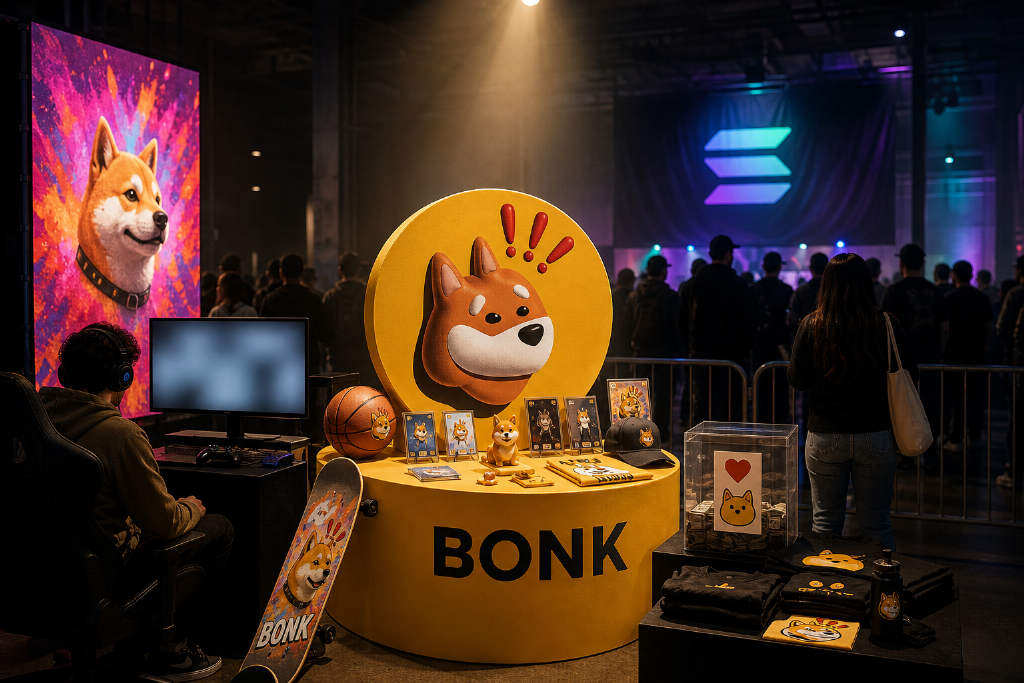
For a crypto-native project, growth does not stop at adding more on-chain users. The bigger test is whether people with no prior connection to crypto can encounter it in a way that feels natural. That is the path BONK is trying to build.
BONK started inside the Solana community, but its reach is no longer limited to trading, wallets, and on-chain applications. As its ecosystem expands, the project is moving through digital art, gaming, sports, charity, collectibles, and offline events to create links with Web2 users.
That shift changes the logic of growth. Instead of asking users to enter Web3 first, BONK is trying to place a Web3 asset inside environments users already know. A person does not need to understand wallets, SPL tokens, or DeFi before recognizing BONK. The first contact may come through an artwork, a sports event, a game, a set of collectibles, or an offline experience, with the Solana community and broader Web3 ecosystem coming into view later.
Web2 expansion is about entering familiar environments
The article says one common mistake in discussions around BONK’s mainstream adoption is to treat Web2 expansion as little more than making BONK visible on more traditional platforms. In that framing, distribution is the main story. The article argues that this misses the harder part.
For a community asset that comes out of Solana, the more important question is whether it can move into the cultural, entertainment, consumer, and social settings people already use. That is a different challenge from adding another channel.
Most Web3 products still expect users to complete a sequence of deliberate steps: create a wallet, learn how on-chain assets work, connect to a protocol, and then enter the application itself. Web2 users tend to arrive another way. They may stop because of an event, get interested because of a character, recognize something through an artwork, or start paying attention to a brand through gaming, sports, or collecting.
BONK’s move toward Web2 is described as an attempt to build that kind of path: experience first, understanding later.
The article notes that BONK has already established a public brand asset system, including a logo, character visuals, color rules, and collaboration guidelines. Those standards are meant to give the community, creators, and partners a consistent framework for using the brand.
On the surface, that looks like standard brand work. In practice, the article treats it as infrastructure for cross-audience communication. Technical standards answer whether something can be used. Brand standards answer whether people can recognize it. For a crypto project trying to reach a larger market, both matter.
From on-chain addresses to real-world user touchpoints
BONK’s native base remains Solana. Citing BONK’s official information, the article says more than half of the token’s early supply was allocated to developers and creators in the Solana ecosystem. Its website currently shows more than 1.1 million on-chain holder addresses, with activity spanning DeFi, digital art, sports, charity, and consumer applications.
Those figures are not presented as proof of mass adoption. The article is careful on that point. What they do show, it argues, is that BONK is moving beyond the role of a single on-chain asset and developing multiple points of contact with users.
BONKUJI is one example, extending BONK’s intellectual property into trading cards and collectible experiences. In that setting, what users meet first may be cards, characters, and collecting culture rather than a complicated on-chain workflow.
Exchange Art brings BONK into digital art by connecting creators and collectors. BONK Arena carries related culture into game interaction. Moonwalk Fitness tries to combine on-chain incentives with exercise challenges.
These products do not all share the same operator, and the article does not say that every service is run directly by BONK. Still, from the user’s point of view, they perform a similar function: they give people different ways to encounter BONK.
- For crypto-native users, the entry point may be a wallet or a trading tool.
- For digital art audiences, it may be a piece of work.
- For players, it may be a game session.
- For sports and fitness users, it may be an event or a challenge.
The route changes. The connection point is still BONK.
IP as the translation layer between crypto and a wider audience
Blockchain still speaks in highly specialized language. Terms such as SPL token, liquid staking, non-custodial wallet, and smart contract are familiar inside crypto-native circles, but they are rarely effective first touchpoints for the average consumer.
The article says brand IP helps translate that technical background into a more direct cultural identity. BONK’s brand system is built around a consistent character image, visual language, and community culture, allowing it to stay recognizable across different media and settings.
A user does not need to understand Solana’s underlying architecture or know every BONK-related product before forming a basic impression through visuals and content. That recognition can then expand in stages:
- from content to community;
- from community to product;
- from product to on-chain experience.
The article presents that as a more natural route than asking people to learn crypto first and understand the brand afterward.
In that sense, IP is not described simply as a marketing tool. It acts more like a translation mechanism across different audiences. Crypto-native users may see a Solana community asset. Creators may see a cultural symbol that invites ongoing derivative work. Partner brands may see a recognizable community IP. Ordinary internet users may just see a brand that is easy to understand and remember. The meanings differ, but the first point of entry can be the same.
Why sports, art, and charity matter in this model
The article argues that if BONK wants to move past the crypto-native audience, adding more on-chain products alone may not be enough. Most Web2 users do not become users of a project simply because it runs on a more efficient blockchain. Their first relationship is more likely to come through culture, interest, and lived experience.
That is why BONK continues to explore sports, art, and charity. Sports create shared emotion. Art creates aesthetics and expression. Charity creates common causes. Offline events create face-to-face connection.
The BONK website already lists sports, art and culture, charity, and consumer applications among its expansion directions. The article also mentions community initiatives such as Buddies for Paws, which extend BONK’s culture into public-interest topics including animal welfare.
The point of those settings is not that every participant immediately becomes a BONK user. Their value lies in creating a first opportunity to encounter BONK. The article treats that as especially important for broader adoption. A person’s first contact with crypto does not have to come through a white paper, an exchange, or a wallet. It can come through something they already care about.
When a crypto asset appears inside a cultural environment users already recognize, the distance between Web3 and Web2 narrows.
Adoption here means expanding exposure, not only ownership
For that reason, the article says BONK adoption should not be reduced to a simple question of how many more people buy or hold BONK. A better question is how many people from different backgrounds can encounter BONK across different settings.
- Some enter through the Solana ecosystem.
- Some enter through trading tools.
- Some enter through digital art.
- Some enter through gaming.
- Some enter through sports activities.
- Some may first recognize BONK through charity projects or offline events.
Those paths may look unrelated, but together they widen BONK’s user reach. Once interest forms, on-chain products can support the next stage of participation.
The article lays out a full route: cultural recognition, user interest, community participation, product experience, and then deeper Web3 engagement.
Within that structure, Web2 is not treated as a substitute for Web3. It serves as the front-end entry point to a larger user market, while Solana, wallets, DeFi, trading tools, and other on-chain infrastructure continue to provide the back-end product layer.
From a crypto-native asset to a cross-audience community asset
The article presents that distinction as the key to BONK’s Web2 strategy. BONK is not trying to shed its Web3 identity. Its community base, the Solana ecosystem, and its on-chain products remain central to the whole system. What is changing is the user entry point.
In the past, users may have come to BONK because of crypto itself. In the future, more users may come to BONK through culture, art, gaming, sports, or other consumer experiences.
That matters for a community asset because a community’s boundaries should not be fixed by a single type of user profile. Developers can participate. Creators can participate. Traders can participate. Players can participate. Art audiences, sports users, and ordinary internet users can also take part from different angles.
A mature community asset does not require everyone to use it in the same way. It creates room for different forms of participation. The article says BONK is trying to build exactly that kind of cross-audience community network.
The next phase is not just more users, but more entry points
Moving from Web3 into a broader mass market has never been as simple as listing a token on more platforms. The difficult part is designing an experience that different kinds of users can enter naturally.
The article argues that BONK already has some of the pieces needed for that effort: a relatively mature community culture, a clear brand identity, and an expanding ecosystem network. On-chain, it can connect Solana users, trading tools, DeFi, and developers. Off-chain, it can reach wider groups through art, gaming, sports, charity, collectibles, and offline events.
Those two sides are not separate systems. Web2 provides an easier point of entry. Web3 provides deeper room for participation. BONK is trying to connect them through a single community asset.
That is why the article treats BONK’s push beyond crypto-native users as worth watching. It does not require everyone to understand Web3 before understanding BONK. Instead, it opens more routes for users to recognize BONK through culture, join the community through interest, and then enter the on-chain ecosystem according to their own needs.
Seen this way, BONK’s expansion into Web2 is not a move away from Web3. It is an attempt to bring Web3 culture and products into everyday life in a form that a broader audience can understand.
From on-chain asset to cultural brand, and from a crypto-native community to a cross-audience community asset, BONK is exploring a path that links Web3 with a much larger user market.