
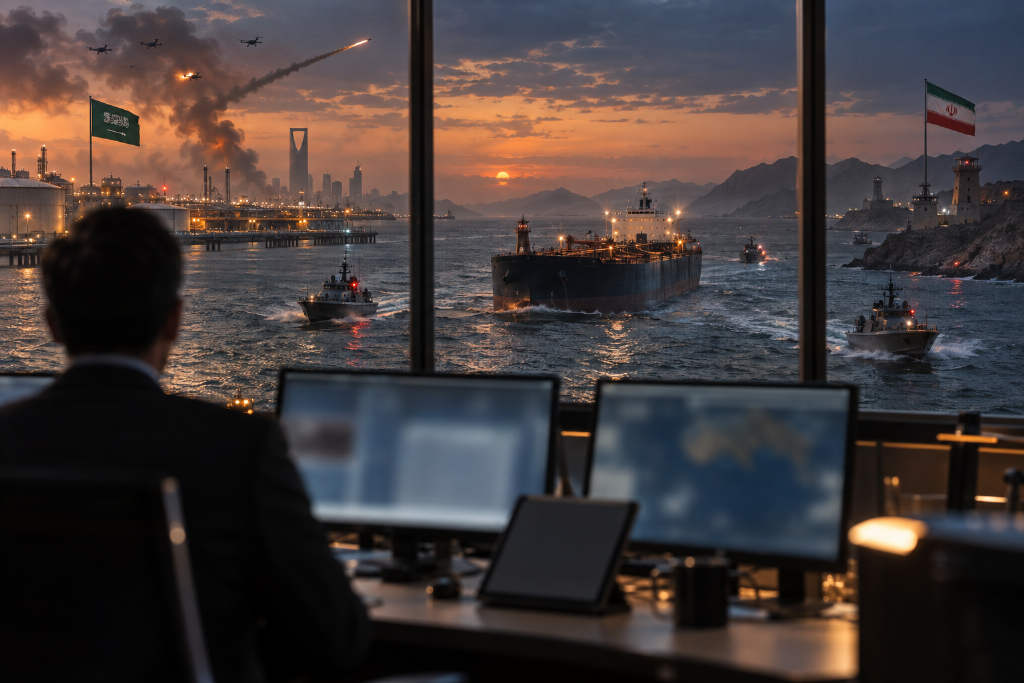
Oil prices extended gains on Tuesday as traders responded to a new wave of attacks on Saudi Arabia by Yemen’s Houthi forces and to Iranian actions involving vessels in the Persian Gulf.
Brent tops $107 a barrel
According to CNBC, November Brent crude futures rose 1.25% to $107.00 a barrel. October West Texas Intermediate crude futures added 1.27% to $102.68 a barrel.
The move reflected supply concerns on both sides of the Arabian Peninsula.
Saudi Arabia faces pressure on both flanks
On the western side, Al Jazeera reported that Yemen’s Saudi-led coalition said Houthi forces launched a round of ballistic missile and drone attacks on Saudi Arabia on Monday, injuring 13 civilians.
On the eastern side, Saudi Arabia had already shut the East-West pipeline that allows crude exports to bypass the Strait of Hormuz after damage caused by a drone from Iraq. The pipeline is a main route for moving Saudi crude around the strait, and its closure added another layer of supply disruption to an already tight market.
U.S. Central Command disputes Iran’s mine claim
Washington also publicly challenged Tehran’s version of a separate shipping incident. Iran’s Islamic Revolutionary Guard Corps said the Panama-flagged tanker El Gaia hit a mine in the Strait of Hormuz. U.S. Central Command rejected that account.
Central Command said: "The Panama-flagged oil tanker El Gaia was struck by an Iranian missile last month and lost power. The Revolutionary Guard’s false claim is another example of its efforts to obstruct commercial shipping in the strait while lying and intimidating at the same time."
The rebuttal addressed the mine claim tied to the tanker. It did not address a separate Iranian military claim that it had destroyed an advanced U.S. drone over the Strait of Hormuz. ChainNews reported that drone claim on Sept. 14, and at the time neither the U.S. military nor Central Command had made a public statement.
Inflation concerns tied to pipeline disruption and tariffs
U.S. President Donald Trump said on Sunday that the United States could continue taking action against Iran and could potentially obtain its oil.
Komal Sri-Kumar, president of Sri-Kumar Global Strategies, said on CNBC’s Squawk Box Asia that inflation would heat up with pipelines under attack and Saudi Arabia’s East-West pipeline shut. He also said a tariff war was accelerating.