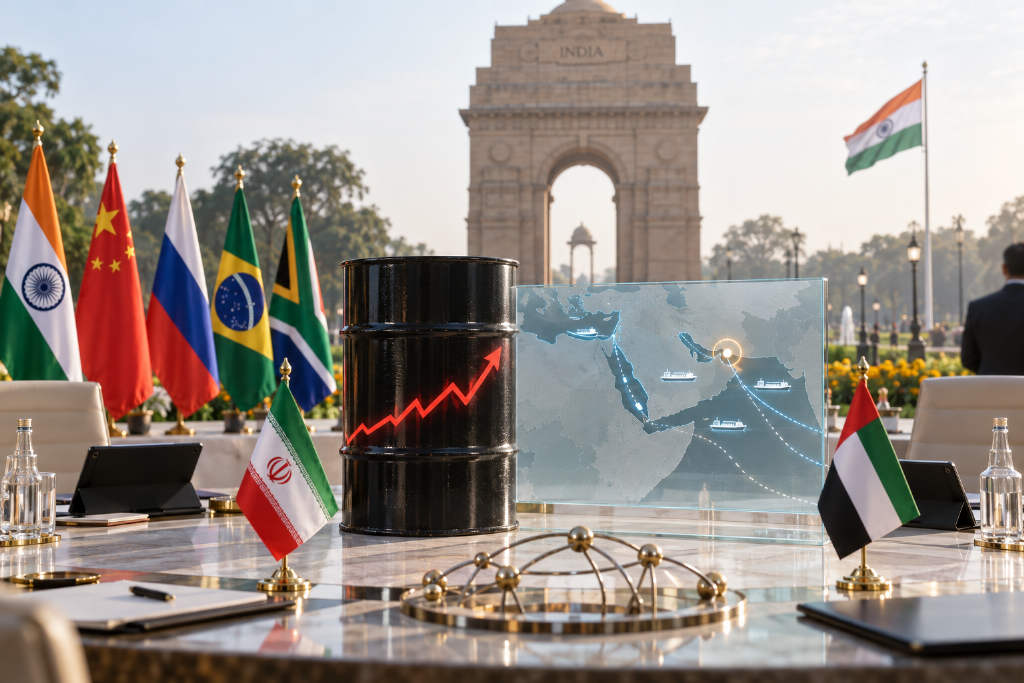
BRICS leaders met in New Delhi, India, on Sept. 12 with Iran emerging as one of the summit’s central issues after the ongoing Iran war continued to disrupt shipping through the Strait of Hormuz and the Red Sea, pushing international oil prices above $100. According to BlockBeats, China, Russia and India all have direct channels of communication with Iran, giving the grouping a diplomatic line that the United States does not currently have.
Ahead of the summit, Iranian President Pezeshkian called on BRICS members to build alternative financial tools to reduce reliance on the Western financial system and criticized the U.S.-led global order. Russian President Vladimir Putin, for his part, argued for a BRICS platform that is more independent from Western rules, with a focus on payments, investment, technology and infrastructure cooperation.
Even so, the bloc faces clear internal constraints. Iran is already in conflict opposition with fellow BRICS member the United Arab Emirates, which had previously suspended trade and financial ties with Tehran. India also needs to preserve ties with the U.S., Gulf states, Russia and Iran at the same time. Those differences had already prevented BRICS foreign ministers from issuing a joint statement, leaving markets focused on whether the group can reach even a minimum consensus on energy security, cross-border payments and the Middle East situation.
BRICS leaders gathered in New Delhi, India, on Sept. 12, with Iran becoming one of the summit’s main issues as the ongoing Iran war continued to disrupt the Strait of Hormuz and the Red Sea and pushed international oil prices above $100.
According to BlockBeats, China, Russia and India have direct channels to communicate with Iran, giving them a diplomatic advantage that the United States does not currently have.
Iran and Russia laid out their proposals before the meeting
Before the summit, Iranian President Pezeshkian called on BRICS members to establish alternative financial tools to reduce dependence on the Western financial system. He also criticized the U.S.-led global order.
Russian President Vladimir Putin said BRICS should build a platform that is more independent from Western rules, with a focus on stronger cooperation in payments, investment, technology and infrastructure.
Internal divisions remain a constraint
That said, it will not be easy for BRICS to position itself as a mediator in the Middle East crisis. Iran and fellow BRICS member the United Arab Emirates are already on opposing sides of the conflict, and the UAE had previously suspended trade and financial exchanges with Iran.
India, meanwhile, needs to maintain relations with the United States, Gulf countries, Russia and Iran at the same time. Differences among members had already led BRICS foreign ministers to fail to issue a joint statement.
Markets are watching for a minimum consensus
The immediate focus is whether BRICS can reach at least a basic consensus on energy security, cross-border payments and the Middle East situation. With transport through the Strait of Hormuz still under disruption, whether the summit can produce a unified position is also being watched as a signal for broader energy and geopolitical trends.
This article was originally published by Bit.Fan. For more cryptocurrency news and market insights, visit www.bit.fan. Disclaimer:
The market information, project data, and third-party content displayed on this platform are for industry information sharing only and do not constitute any form of investment advice or return commitment.
Cryptocurrency trading carries high risks. Users should fully assess their risk tolerance and make independent decisions. All profits, losses, and legal responsibilities are borne by the users themselves.