
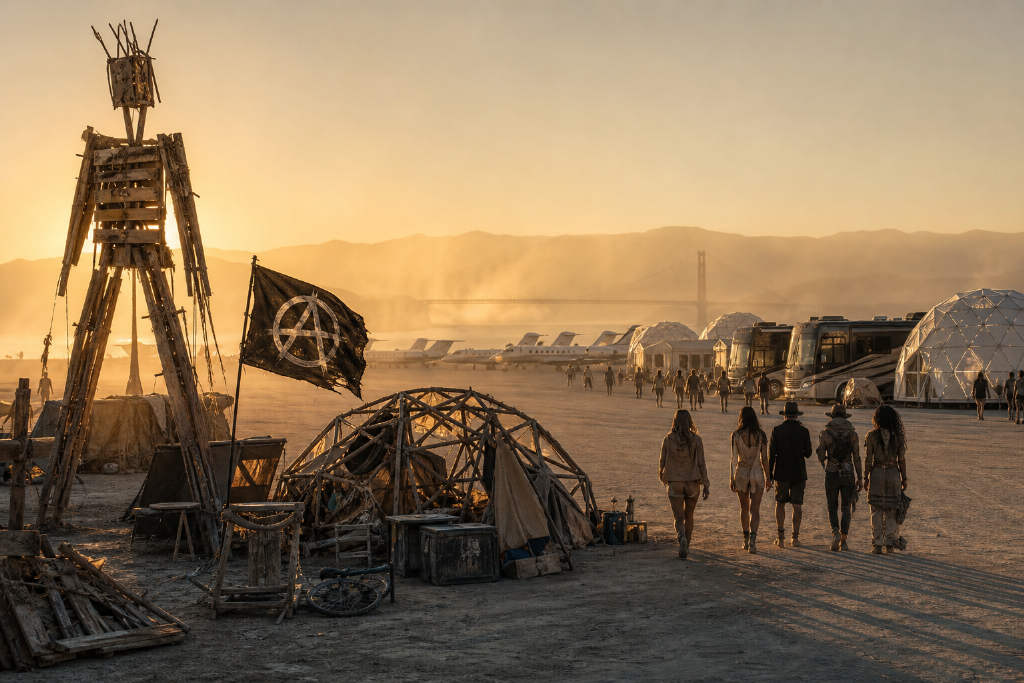
Burning Man co-founder John Law says the event that began as an anarchist desert experiment has lost the spirit that once defined it after an influx of Silicon Valley elites and capital.
In a recent essay for SF Standard, Law wrote that today’s Burning Man is "almost unrecognizable from what we built back then," adding that it has long since shed its anarchist soul. Law has not returned to Nevada’s desert since 1996 and, over the past 36 years, has rarely spoken in public about the gathering he helped bring into being.
Roots in San Francisco’s underground scene
Law traced the event’s origins to late-1970s San Francisco, which he described as one of the easiest places in the US for people to reinvent themselves. He arrived in the city in 1976 as a teenager and immersed himself in an underground creative scene shaped by Dadaism, surrealism, punk and hippie culture.
He later helped form loose collectives including Suicide Club and Cacophony Society. Those groups were held together by a member-produced newsletter listing activities. They had no business model and rejected hierarchy and formal structure.
Law linked that style of gathering to author Hakim Bey’s idea of the Temporary Autonomous Zone: a group of people collectively conjuring a world in an unregulated place, creating freely, then packing up before control arrives.
During the Labor Day weekend in 1990, Cacophony Society brought a giant wooden effigy to the Nevada desert and burned it. Law identifies that moment as the birth of Burning Man. In 1993, photographer William Binzen’s immersive arts gathering Desert Site Works added performance, ritual and installation art, helping shape the version of Burning Man that later became widely recognized.
Law disputes the idea of an original official philosophy
Law also challenged the common view that Burning Man began with a coherent philosophical framework. He noted that the organization now maintains a page devoted to its "Ten Principles," but said that structure was added after the fact.
In his account, the closer thing to an early template was Gary Warne’s "Twelve Chaos Rules," written in 1977 by the Suicide Club member with a tone of self-mockery. Among them were lines such as "Abandon your expectations" and "You can never completely control the whole thing."
For Law, early Burning Man did not rest on a grand founding text. It was a collective adventure built through improvisation.
Wired cover and the Silicon Valley influx
Law said the break came with the rise of the internet industry in the 1990s. Wired put Burning Man on its cover in 1996, and attendance climbed from about 70 people in 1990 to 25,000 in 1999.
He named Elon Musk, Sergey Brin, Larry Page, Mark Zuckerberg and Jeff Bezos as regular attendees from the new economy elite. He also wrote that Google at one point considered whether candidates for chief executive had attended Burning Man.
Law’s description of what the event became was blunt. For Silicon Valley, he said, Burning Man was treated almost like a "company-approved stress release therapy": dress up, take drugs, fall in love with strangers, then go back and work for the boss for another 51 weeks.
From egalitarian experiment to a status-driven machine
As attendance and money arrived together, Law argued that Burning Man changed from an "anarchist alliance of equals" into a top-down machine preoccupied with status and display.
He pointed to ticket prices nearing $1,000, luxury gated camps staffed with private chefs and stylists, and even chartered flights directly into the event. He also said the organizers bought land around the desert site and properties in a nearby town, and formed a professional public relations department in the late 1990s, giving the organization the full appearance of a large commercial institution.
Law said he consistently opposed that commercialization. He even took part in litigation, arguing that the trademark should be placed in the public domain because "no one should own this thing."
What Law says can no longer be recreated
Law did not deny that Burning Man can still be enjoyable, or that for many attendees it remains the most immersive and relaxing week of the year. His point was narrower and sharper: it is no longer the thing he and others made in the beginning.
In the early years, he wrote, there was no principles handbook, no billionaires and no concierge-style luxury camps. Participants had to make their own costumes and build their own art cars. That condition — no owner, no central authority — was what gave the gathering its creative force and let it capture a specific cultural moment, something Law says cannot be reproduced with a bigger budget.
The piece closed with a line from Burning Man’s philosopher-in-residence Stuart Mangrum: "Anything worth doing is worth doing to excess." Law used that reflection to frame a broader point: an anarchist experiment born from underground counterculture was eventually absorbed by capital, celebrity and fenced-off display, a trajectory many readers in crypto will find familiar.