


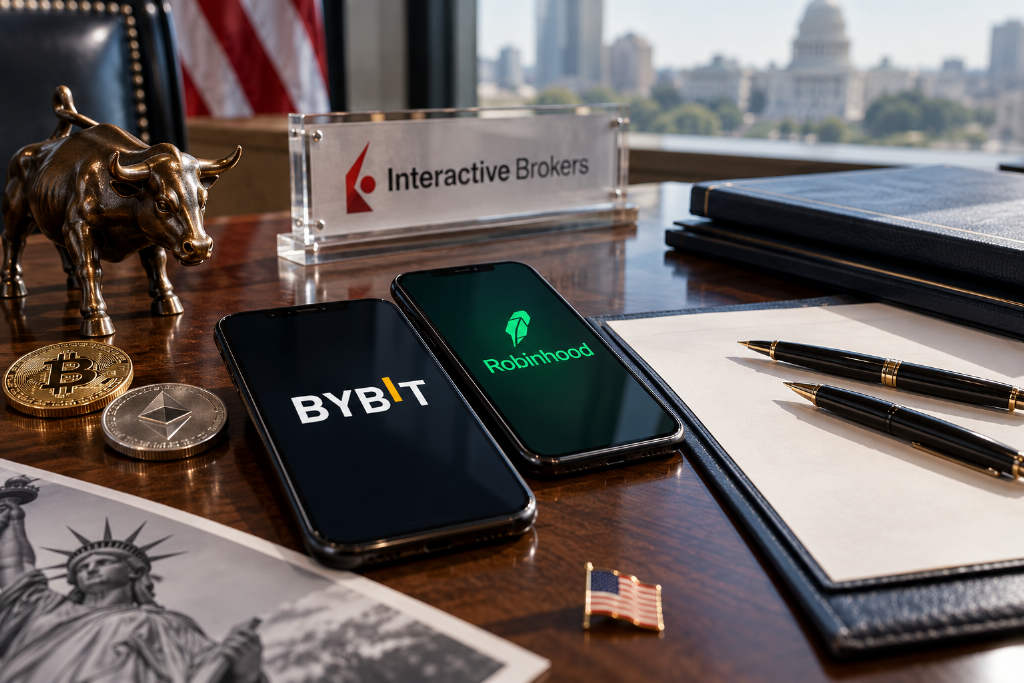
Bybit plans to partner with established local companies when it enters the U.S. market, a strategy CEO Ben Zhou said would help the exchange compete with the reach of platforms such as Robinhood, according to CoinDesk.
Zhou said working with local partners is Bybit’s standard approach when expanding into new regions. In the U.S., that could include firms such as Interactive Brokers. He said, 「At this stage, it is best to work with partners that want to enter crypto and already have a customer base in the United States, such as IB or similar companies that have not yet moved into crypto but have strong U.S. clients.」
U.S. market strategy
Bybit is the world’s second-largest cryptocurrency exchange by trading volume and has more than 80 million registered users across over 180 countries and regions. The exchange is continuing to obtain licenses around the world as it builds a range of new regulated products.
Zhou said a partnership model could allow Bybit to avoid the state-by-state money transmitter licensing process that companies such as Coinbase have had to go through in the U.S. He said that process can take two to three years.
He also said the company could wait for the Clarity Act to pass, or for a clearer understanding of new laws. Under that scenario, regulation could fall under the U.S. Securities and Exchange Commission, with a single license covering the federal level.
Europe and U.K. plans
In Europe, Bybit plans to launch a “super app” as early as the first quarter of next year. Zhou said the offering would include derivatives and tokenized stocks.
He added that the U.S. market is highly competitive and increasingly saturated, with Coinbase firmly established and Robinhood becoming more important. By contrast, he described the U.K. as a market where competition is less concentrated and development is less complete, though entry costs are high and comparable to obtaining a Markets in Crypto-Assets, or MiCA, license in the European Union.
Zhou also said he was invited earlier this year to meet with the U.K. Financial Conduct Authority and related bodies in the House of Lords. Bybit is now looking for office space in London, though no specific location has been decided.