
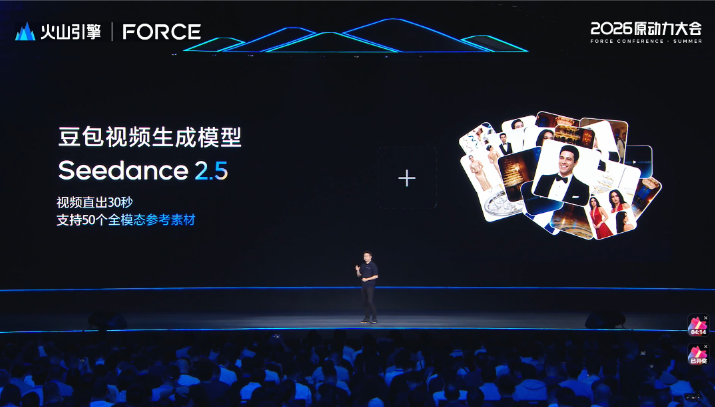
ByteDance officially unveiled Seedance 2.5 at its Volcano Engine FORCE conference in Beijing on July 23. The key upgrades: single-clip video generation extended from 15 seconds to 30 seconds, the number of reference inputs increased from 12 to 50, and native 4K output is now supported.
From 15 Seconds to 30 Seconds
Seedance 2.0's 15-second cap meant that any video with a complete narrative required multiple takes and manual stitching. Doubling the native generation length removes that friction. ByteDance says the model can now produce a full short story in a single pass, eliminating the need for manual splicing of AI clips.
The input limit jump from 12 to 50 references, combined with support for images, video, audio, and text in any mix, gives the model more context to understand the creator's intent. Richer inputs lead to more accurate outputs with less deviation from the desired result.
A new local editing feature lets creators replace specific subjects in a frame without altering original motion, camera angles, or lighting. A 3D white-box preview enables pre-generation simulation of shot composition and camera movement. Both tools are designed to streamline compliant adaptation of copyrighted video material.
Commercial Solution to Copyright Headaches
After Seedance 2.0 launched globally in March, it sparked copyright disputes with multiple Hollywood studios and streaming platforms, forcing ByteDance to halt the worldwide rollout. When it resumed later that month, the company imposed a ban on generating real human faces to sidestep portrait rights infringement — a negative-list approach that told users what not to do but failed to address whether copyrighted content could be used at all.
Seedance 2.5 pivots to a different strategy: bringing copyright holders directly into the fold. The first partnership is with Stephen Chow: ByteDance has turned the signature styles of his classic films into standardized creation templates, integrated into its editing apps Jianying, Jimeng, and Doubao. The compliance templates are intentionally low-friction, requiring no understanding of licensing mechanisms — users simply pick a template and adapt it. Daily generation volume for these templates has already surpassed 100,000 clips.
Proactively negotiating licenses and converting infringement risk into a revenue-sharing model creates a sustainable “legal copyright + AI generation” combo, building a differentiation moat in the compliant market. Whether this model can be replicated with other rights holders remains the key question.
AI Video Race Gets Brutal
Just 24 hours before Seedance 2.5's unveiling, Alibaba released HappyHorse 1.1. In April, HappyHorse briefly topped the AI video generation rankings, overtaking Seedance 2.0. The launch of Seedance 2.5 is ByteDance's direct response to that ranking reversal.
Two giants releasing upgraded models within a day reflects a structural shift: AI video generation has moved past the “can we build it” phase and into the “who builds it better” stage. Technical specs are converging; the real moats now are copyright compliance capabilities, ecosystem integration depth (Jianying, Jimeng, Doubao's distribution network), and creator community stickiness.
ByteDance also unveiled the Doubao 2.1 Pro language model (positioned against Claude Opus 4.6) and the Seedream 5.0 image generation model at the same event.