
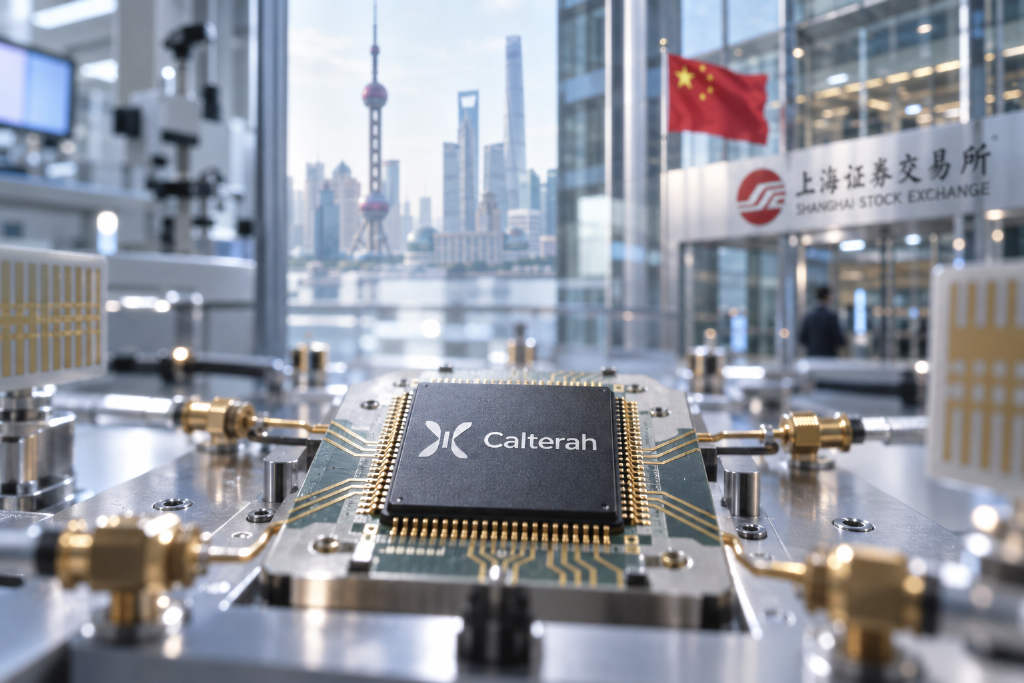
Calterah Microelectronics (Shanghai) Co., Ltd. has moved a step closer to a STAR Market listing after the Shanghai Stock Exchange accepted its IPO application and placed the company into the inquiry stage.
The filing presents a company with strong operating metrics and unresolved profitability questions at the same time. Calterah said its share of China’s automotive millimeter-wave radar chip market reached 31.1% in 2025, its revenue doubled that year, and its core business gross margin stayed above 47% for most of the reporting period. Yet the company remained loss-making, with cumulative losses of about 910 million yuan from 2023 through the first quarter of 2026. Revenue growth also slowed to 8.1% in the first quarter of 2026.
Business focus: automotive-grade sensing and connectivity chips
Founded in February 2014 and headquartered in Shanghai, Calterah develops, designs, and sells automotive-grade wireless sensing and communication chips. The company uses a fabless model, outsourcing wafer manufacturing and packaging and testing to external partners while keeping chip R&D, product design, and sales in-house.
Its current product portfolio is built around two main lines: millimeter-wave radar chips and ultra-wideband, or UWB, chips.
On the radar side, Calterah has three major platforms — Alps, Andes, and Kunlun. These products are used in advanced driver-assistance systems and autonomous driving applications, including front radar, corner radar, and imaging radar. They also cover in-cabin radar, door radar, side radar, and tailgate radar, and extend into robotics, smart home, and smart city use cases across industrial and consumer markets.
Its UWB products are centered on the Dubhe platform. The chips are aimed at automotive scenarios such as digital keys, automated parking, in-cabin radar, kick sensing, and sentry mode, while also targeting consumer applications including wearables and smart home appliances.
Domestic market share exceeds 30%
The global automotive millimeter-wave radar chip market has long been dominated by overseas suppliers such as Infineon, NXP, and Texas Instruments.
Calterah said it achieved mass production of automotive-grade 77GHz millimeter-wave radar RF front-end chips based on CMOS technology in 2017. Compared with the GaAs and SiGe processes widely used in the sector before that, CMOS helps improve chip integration and offers a path to lower costs and broader adoption.
As shipments expanded, the company’s market position improved. According to Yole, Calterah ranked fourth in the global automotive millimeter-wave radar chip market in 2025, including ADAS and child presence detection applications, with a market share of about 4%.
Its position in China was stronger. Data from the Shanghai Integrated Circuit Industry Association showed that Calterah held 31.1% of China’s automotive millimeter-wave radar chip market in 2025, second only to Texas Instruments.
To date, the company said cumulative shipments of its millimeter-wave radar chips have exceeded 30 million units. Customers include major Chinese automakers such as BYD, Geely, Changan, Chery, SAIC, FAW, Dongfeng, Leapmotor, Seres, and NIO.
Revenue more than tripled in two years, but profit has not arrived
Demand growth in the automotive radar market has driven a rapid expansion in Calterah’s business, though the company has yet to report a profit.
Revenue came in at 206 million yuan in 2023, 303 million yuan in 2024, and 632 million yuan in 2025. That was more than a threefold increase over two years, with a compound annual growth rate of about 75.2%. In 2025, revenue topped 600 million yuan for the first time and doubled from the previous year.
The increase was mainly tied to ADAS applications. As vehicle intelligence levels rose in China and millimeter-wave radar was used more widely in driver-assistance systems, shipments of the company’s related products continued to grow. In 2025, revenue from ADAS applications accounted for about 90.64% of total operating revenue.
Gross margin remained high during the same period. Calterah’s core business gross margin was 47.84% in 2023, 43.81% in 2024, 47.25% in 2025, and 48.97% in the first quarter of 2026. Aside from 2024, the figure stayed above 47% throughout the reporting periods and moved close to 49% in the latest quarter.
The company also outpaced the average gross margin of the listed peers selected in its prospectus. Over the same periods, the average gross margins of comparable companies including Nano Micro, Allwinner Technology, Rockchip, 3Peak, and NationStech were 35.72%, 34.77%, 35.65%, and 37.50%, respectively. Calterah’s margin was higher by about 12.1, 9.0, 11.6, and 11.5 percentage points.
Still, strong gross margin did not translate into profit. Net profit was negative 323 million yuan in 2023, negative 334 million yuan in 2024, negative 193 million yuan in 2025, and negative 60.2866 million yuan in the first quarter of 2026. Cumulative losses for the reporting period were about 910 million yuan.
Heavy R&D spending was a major factor. The company’s R&D expense ratio stood at 147.75%, 120.17%, 58.55%, and 63.67% across the reporting periods. In 2023 and 2024, R&D spending exceeded revenue.
That ratio has started to come down as revenue expanded. In 2025, the R&D expense ratio fell to 58.55%, and net loss narrowed from 334 million yuan in 2024 to 193 million yuan. For a company still in an investment-heavy stage of technology development and business expansion, the key question is whether future scale can absorb R&D costs and turn revenue growth into sustained profitability.
Growth slowed to 8.1% in the first quarter of 2026
After a period of rapid expansion, Calterah is now facing slower growth.
Revenue in the first quarter of 2026 was 154 million yuan, up 8.1% year over year. That marked a sharp cooldown from the more than 100% growth recorded in 2025.
The prospectus linked the slowdown to high customer concentration. Revenue from the top five customers accounted for 99.77%, 99.07%, 99.90%, and 99.97% from 2023 through the first quarter of 2026.
Those direct customers are mainly integrated circuit distributors, so the direct-customer view does not fully show the company’s dependence on downstream end users. Looking through the distribution model, concentration appears even higher.
In 2025, the largest direct customer, Lubikang Electronics, contributed 64.83% of sales revenue, and its corresponding key end automotive brand was BYD. In the same year, the largest end customer accounted for more than 50% of sales revenue.
Calterah’s revenue doubled to 632 million yuan in 2025 in close connection with rising millimeter-wave radar demand from a core downstream customer. In 2026, the risks of that concentrated structure became more visible. The company said in its prospectus that sales to its largest end customer came under pressure after downstream automakers introduced a second supplier, and that this affected revenue growth in the first quarter of 2026.
Customer concentration is not unusual for automotive-grade chip suppliers. But when one end customer contributes a large share of revenue, changes in procurement strategy, vehicle sales, and supplier allocation can have a significant effect on upstream chip makers. Whether Calterah can offset any share changes by expanding shipments to other automakers and radar module customers will be central to the durability of its growth.
IPO plan: 3.489 billion yuan for radar, UWB, and headquarters projects
Calterah plans to raise 3.489 billion yuan in the STAR Market IPO.
- 2.093 billion yuan is earmarked for a high-performance millimeter-wave radar chip R&D and industrialization project.
- 695 million yuan is set aside for a high-precision advanced UWB connectivity chip R&D and industrialization project.
- 702 million yuan will go to a frontier technology innovation center and headquarters construction project.
UWB is one of the company’s key new product directions. But compared with the millimeter-wave radar business, which already generates meaningful revenue, UWB remains at an early commercial stage. Calterah reported just 5,400 yuan in UWB chip revenue in 2025 and no revenue from the segment in the first quarter of 2026.
That leaves UWB with a dual role. It is meant to broaden the company’s product scope and reduce dependence on a single business line, but it will still take time to move from R&D and customer validation to meaningful revenue. The pace of commercialization remains uncertain.
The next growth curve is still unproven
At the industry level, the automotive millimeter-wave radar market still has room to grow as vehicles become more intelligent, radar units per vehicle increase, and new applications such as 4D imaging radar and in-cabin sensing gradually move into production.
For Calterah, the next question is no longer only whether the market can keep growing. It is whether the company can maintain momentum in its core radar business as key customers diversify their supply chains, and whether products such as UWB can become a real new source of revenue.
The original article was published by the WeChat account Paicaijinguanwei (ID: paicj314) and written by Wang Zheping.