
Cango Inc. (NYSE: CANG) reported unaudited financial results for the second quarter ended June 30, 2026, saying it is continuing to build an integrated energy and AI compute platform through its global operating footprint.
Revenue and net loss in the second quarter
Total revenue for the quarter was $50.8 million. Bitcoin mining contributed $47.4 million, making it the company’s primary revenue source, while other revenue totaled $3.4 million.
Cango posted a net loss of $81.6 million for the quarter, which it said was mainly caused by non-cash impairment on mining machines and losses from disposals. On a continuing operations basis, net loss was also $81.6 million, compared with $261.1 million in the first quarter of 2026.
Operating loss was $80.6 million, versus $254.4 million in the first quarter. Adjusted EBITDA was negative $10.7 million, including a $4.1 million loss from changes in the fair value of crypto assets. In the first quarter of 2026, adjusted EBITDA was negative $154.1 million.
Why revenue fell and how costs changed
Compared with the first quarter of 2026, total revenue declined about 50%. The company said the drop mainly reflected its decision to reduce operating hash rate, phase out older and less efficient S19 mining machines, and shift part of its capacity to a hosted leasing model. Cango said the move weighed on revenue in the short term but lowered operating costs and improved overall cash flow.
Total operating costs and expenses for the quarter were $131.4 million. The company said those costs were mainly tied to its bitcoin mining business, recognized impairment losses on mining machines, and losses from changes in the fair value of crypto assets.
- Cost of revenues, excluding depreciation discussed below, was $50.7 million, down from $99.6 million in the first quarter of 2026.
- Depreciation was $16.9 million, down from $29.4 million in the first quarter.
- General and administrative expenses, including related-party expenses, were $8.4 million.
- Impairment loss on mining machines was $42.9 million.
- Loss on disposal of mining machines was $8.5 million.
- Loss from changes in the fair value of crypto assets was $4.1 million, compared with $151.8 million in the first quarter of 2026.
The company said the change in fair-value losses was mainly due to stabilization and a moderate rebound in the bitcoin market price during the quarter, along with the initial effect of its newly launched bitcoin hedging plan.
Mining operations: 27.58 EH/s and 656 BTC mined
Cango said it kept optimizing the size of its mining operation during the second quarter as part of tighter cost control, disposing of lower-efficiency machines and using a leasing model for part of the business.
As of June 30, 2026, total operating hash rate was 27.58 EH/s, including 19.84 EH/s of self-operated hash rate and 7.74 EH/s of leased hash rate. The company mined 656 BTC during the quarter.
It said average cash cost per bitcoin fell about 5% quarter over quarter to $73,313, helped by fleet optimization and tighter execution. Cango also said it had started selectively implementing hedging strategies to reduce the effect of price volatility on operations.
Management comments on mining discipline and AI buildout
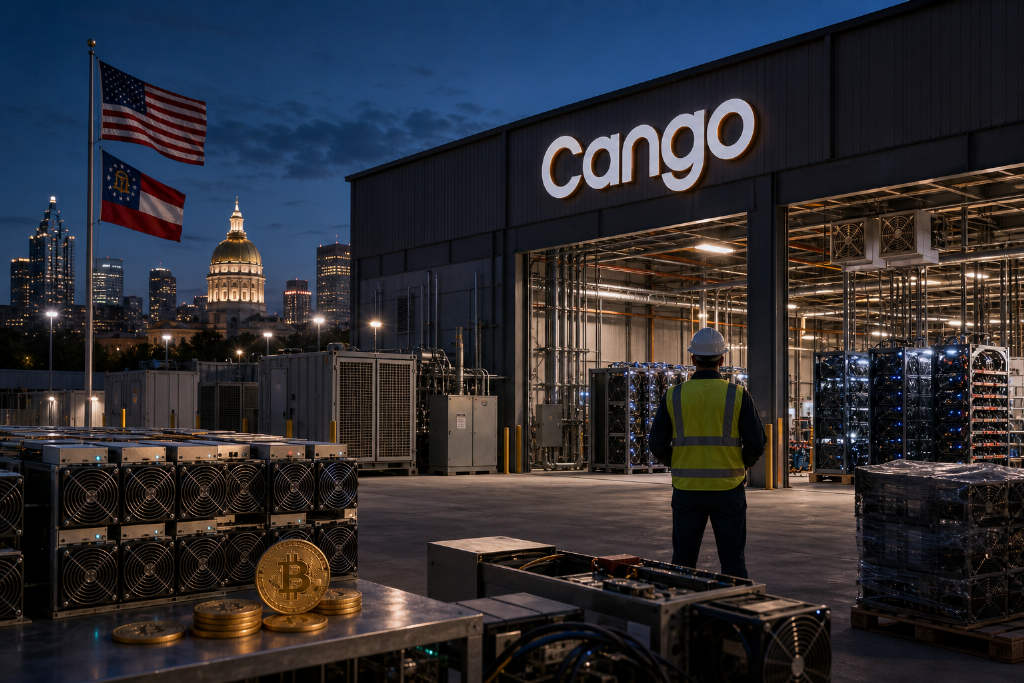
CEO Paul Yu said: “In our bitcoin mining business, we remain focused on unit economics rather than scale expansion. At the same time, we are continuing to advance AI modular construction at the LN mining site. Our Georgia site completed its renovation in early July, and the infrastructure now supports up to 3 megawatts, with room for future expansion. Cabinets have been delivered and installed, and GPU hardware has been purchased and delivered in batches to support a phased ramp-up.”
Yu said the company plans to roll out two business models: bare-metal GPU hosting, using its infrastructure to provide a standardized deployment environment, and colocation services designed to improve overall infrastructure utilization. He said the Georgia site is onboarding customers and revenue is expected to be recognized in the third quarter. To support customers that need nearby deployment, Cango has also started operating test nodes in Texas and on the West Coast as part of the phased ramp-up. The company said it is continuing to evaluate potential new sites and the possibility of self-built facilities.
CFO Simon Tang said: “We recorded a net loss of $81.6 million this quarter, mainly due to non-cash impairment and disposal losses on mining machines. During the quarter, we also launched a bitcoin hedging plan aimed at managing bitcoin price volatility risk and improving the predictability of operating cash flow. We treat hedging strictly as a risk-management tool, not for speculative purposes. The related short positions have been reflected on the balance sheet and will be adjusted as we continue to execute this plan with discipline.”
Balance sheet figures
As of June 30, 2026, Cango held $10.1 million in cash and cash equivalents, up from $7.2 million as of March 31, 2026.
- Digital asset reserves stood at 1,056 BTC.
- Net book value of mining machines was $58.7 million.
- Long-term debt due to related parties was $31.2 million, compared with $30.6 million as of March 31, 2026.
The company said its balance sheet structure improved by the end of the quarter.