
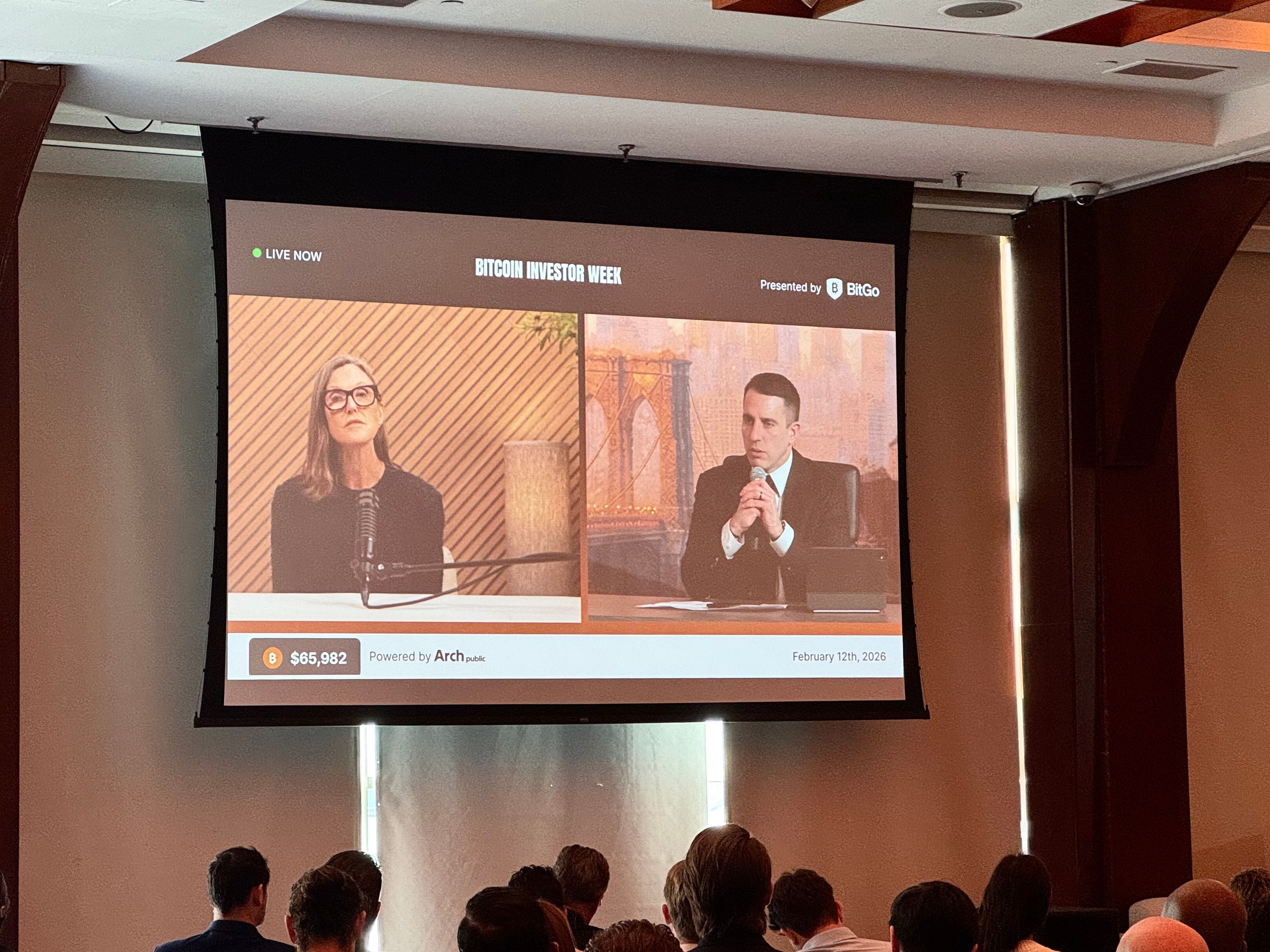
ARK Invest CEO Cathie Wood said bitcoin could benefit from a wave of AI-driven deflation that traditional financial systems may struggle to handle. Speaking with Anthony Pompliano at Bitcoin Investor Week in New York, she argued that artificial intelligence, robotics, and other exponential technologies are creating a productivity shock that can push prices lower while putting legacy business models and financial institutions under strain.
Falling AI costs reshape the inflation debate
Wood said the deflation she is describing is not tied to economic collapse. In her view, it comes from breakthroughs that sharply reduce costs and increase output. She pointed to data showing AI training costs falling by 75% per year, while inference costs — the cost required to generate an AI response — can drop by as much as 98% annually. Companies are producing more with fewer inputs, and lower prices follow.
She added that the traditional economy has been built around an environment of 2% to 3% inflation. Adjusting to technology-led deflation will be difficult, especially for institutions and business models that depend on stable margins and debt-driven growth.
Warning that the Fed may be looking backward
Wood argued that the Federal Reserve is still relying on backward-looking data and could misread this shift. If policymakers and incumbent financial institutions fail to recognize innovation-led deflation early enough, they may end up reacting only after broader damage has already appeared.
She also contrasted the current moment with the tech and telecom bubble. Her point was direct: back then, investors poured money into technologies that were not ready. Now the technologies are real, and markets are dealing with a very different phase.
Why bitcoin stands out in a deflationary disruption
In that setting, Wood said bitcoin becomes easier to understand as a hedge against both inflation and deflation. She tied the “chaotic” part not only to falling prices, but also to disruption across sectors, including weak performance in software-as-a-service stocks and counterparty risk emerging in areas such as private equity and private credit. “Bitcoin doesn’t have that problem,” she said.
Her argument is that bitcoin offers a trustless alternative that is insulated from weaknesses inside traditional finance. As central counterparties and legacy institutions come under pressure, bitcoin’s decentralized design and fixed supply can become more valuable. She also said bitcoin’s simplicity contrasts with the complexity of layered financial systems that may struggle as deflation compresses margins.
Wood added that ARK has built its portfolios around converging disruptive technologies, including blockchain, for years. She said the firm remains one of the largest holders of Coinbase (COIN) and Robinhood (HOOD) among its positions in crypto-related companies.