
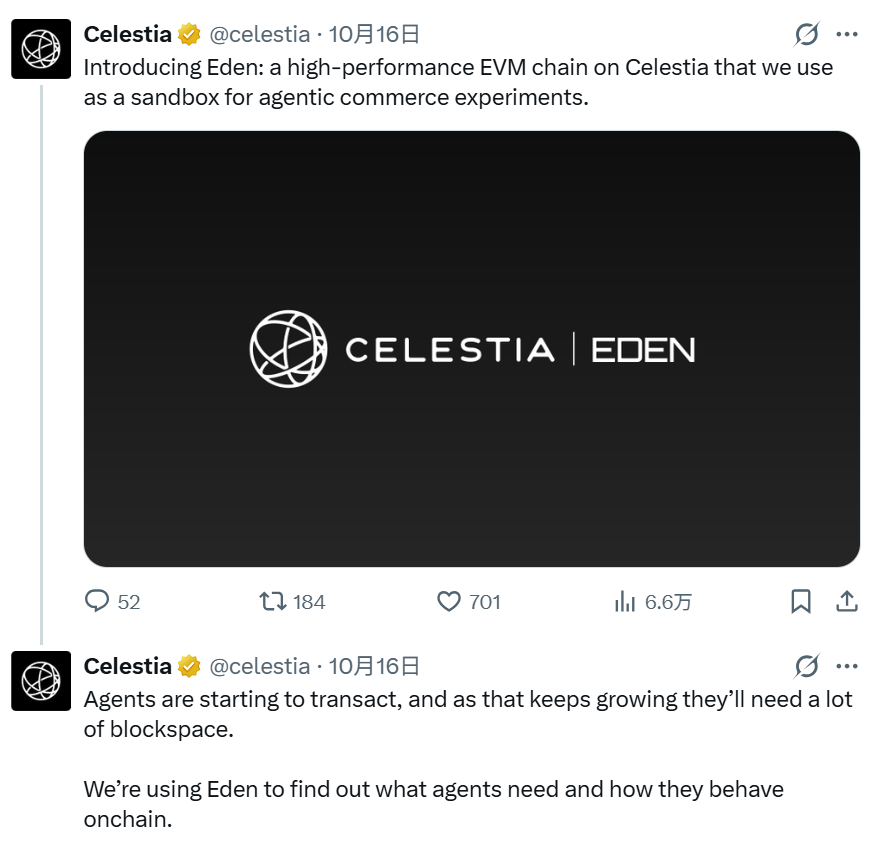
Celestia is making AI payment settlement a central part of its next push. On Oct. 16, the modular blockchain project introduced Eden, a high-performance EVM chain that it describes as a sandbox for agentic commerce. The company said AI agents have already started transacting onchain, and that growing activity will place heavier demands on blockspace. Eden is meant to test the transaction environment those agents need and observe how they behave onchain in practice.
Eden executes and orders transactions while Celestia stores the data
Eden is not being presented as just another EVM-compatible chain. It handles execution and sequencing on its own, while the Celestia mainnet is used only for data availability.
In practical terms, operations initiated by AI agents or users on Eden are processed and confirmed by Eden itself, and the resulting data is then posted back to the Celestia mainnet for storage. Users need to bridge TIA through the official bridge before using the network, and TIA also serves as Eden’s native gas token.
According to official documentation, Eden runs with 100-millisecond block times and a 50 million block gas limit. Celestia says that makes it better suited to continuous, fast interactions than most EVM chains. The network also supports native batch transactions and app-sponsored gas, so agents or users do not need to sign every action one by one.
Eden currently uses a single sequencer, meaning one entity determines transaction ordering, and transactions are not publicly visible before confirmation.
Botfun is the first public test, with x402 used for onchain micropayment settlement
The first public experiment is a closed test with Botfun. In that setup, participating agents can issue their own tokens and trade around narratives generated by other agents. Every model inference call is settled onchain through x402, a machine-native micropayment protocol based on the HTTP 402 status code and incubated by Coinbase.
On the technical side, Eden uses the Evolve stack, which the report describes as an upgraded iteration of Rollkit, Celestia’s original rollup framework. In Botfun’s closed test, which runs on its Houston infrastructure, each AI agent has its own wallet. Those agents can provide liquidity on a native DEX and earn fees settled in TIA, while each large language model, or LLM, inference payment is transferred in real time in TIA through x402.
Onchain data cited in the report shows Eden has processed 2.59 million cumulative transactions since stealth testing began in July, including a weekly peak of 516,000 in that month. Celestia has not yet separated and verified how many of those transactions were x402 settlements.
A July 2026 strategic shift put agentic payments at the center
Celestia’s move into this area follows a broader strategic change. In July 2026, Celestia Labs acquired high-performance blockchain framework developer Sovereign Labs. Preston Evans, co-founder of Sovereign Labs, then became chief technology officer at Celestia Labs.
At the same time, Celestia Labs CEO and co-founder Nick White said the company’s custom high-performance blockchain business would focus on two verticals: agentic payments and onchain markets. He said agentic payments are intended to support high-frequency, high-volume micropayments with instant settlement and without the need to establish billing relationships in advance.
White also said Celestia had changed its go-to-market strategy. Instead of working mainly with startups and independent developers, the company is now targeting larger applications and enterprises that already have real business demand and distribution, offering them full-stack blockchain infrastructure.
Unlike earlier efforts that relied on external ecosystem teams to launch chains, Eden is being built directly by Celestia Labs after combining the original Rollkit team with the engineering team from Sovereign Labs, which it acquired in July. The report says the effort is backed by what Celestia Labs founder Mustafa had previously described as more than $100 million in treasury reserves.
Chainalysis data points to rapid growth in agent payments
The backdrop to that shift is the expansion of agent payments beyond early experimentation.
According to an October 2026 report from Chainalysis, cumulative payments completed by AI agents on Base through Coinbase’s x402 protocol rose from about 1,500 in mid-2025 to more than 138 million by the third quarter of 2026.
More than 87% of those payments were between $0.0001 and $0.10 each, placing them in a micropayment range that the report says traditional card networks struggle to process economically.
Wallet activity has also increased. Among wallets that made their first top-up in the second quarter of 2026, 89.3% received another top-up within 30 days. The median time from wallet funding to the first x402 payment dropped from 73 days at the end of 2025 to 18 minutes in the third quarter of 2026.
Against that backdrop, Eden is being framed as more than an extra EVM chain. Celestia has mainly operated as a data availability layer for other chains, and its fee income has remained limited. Eden gives the team its own execution environment, uses TIA directly as the gas token, and posts the resulting data back to the Celestia mainnet. The report argues that if the model works commercially, TIA could move from what it calls a “high-inflation governance token” toward a high-frequency consumable asset with direct utility.
Celestia’s website has previously said on its agent payments pages that the large volume of micropayments generated by AI agents may require higher throughput and lower-friction settlement.
The report also says Ethereum and standard layer-2 networks are constrained by the 24 KB contract bytecode cap under EIP-170. Eden raises that limit to 128 KB, which it says allows more complex agent contracts to run.
At the protocol level, Eden combines 100-millisecond block production, 0x76 atomic batch execution and gas sponsorship through Paymaster in an attempt to reduce signature delays and funding friction in high-frequency agent interactions. Whether those design choices match real agent demand still depends on data from experiments such as Botfun, according to the report.
TIA is down about 97% from its high, while daily fee revenue sits at $108
Eden’s launch also needs to be read against Celestia’s earlier trajectory.
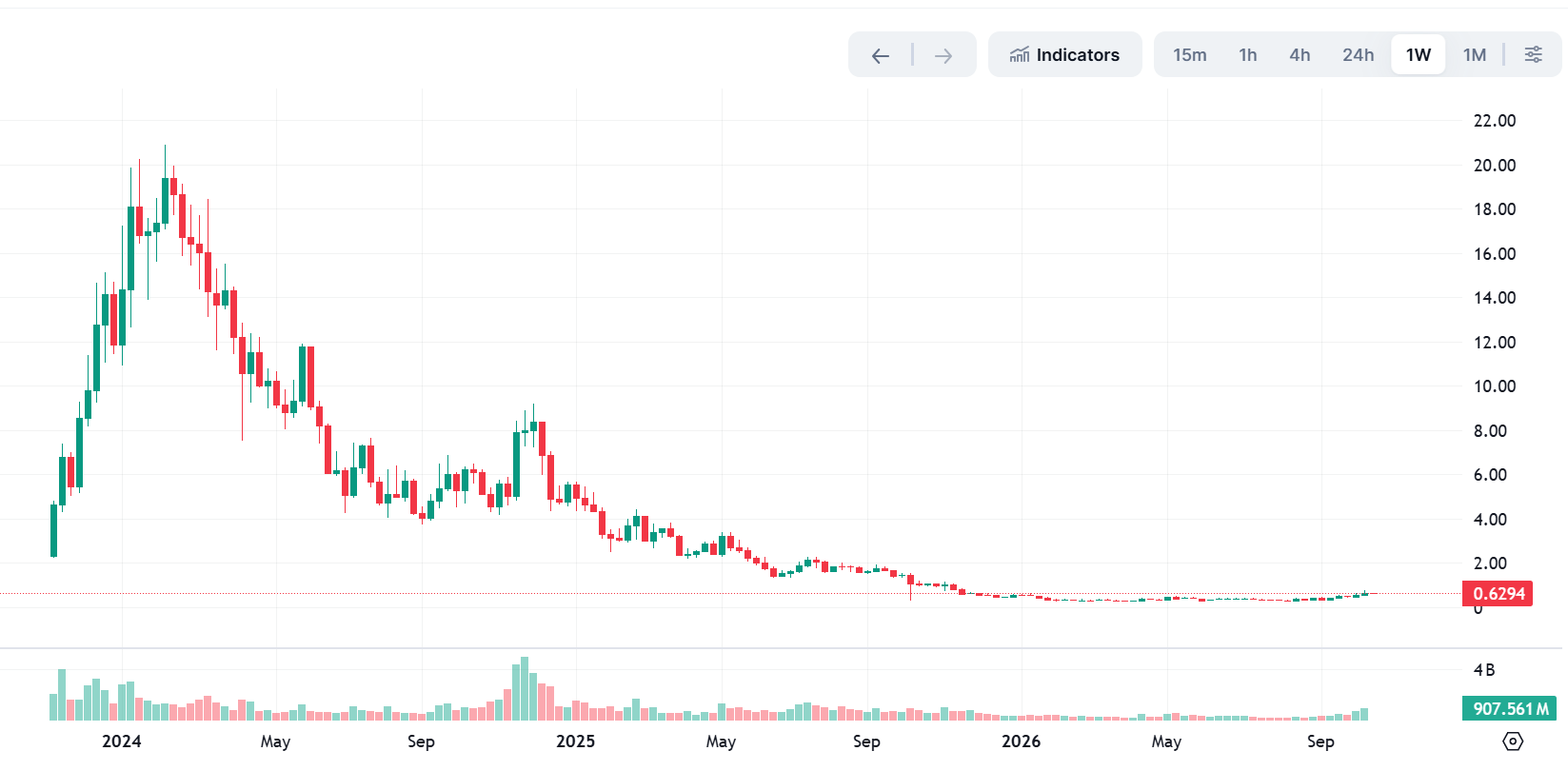
In May 2019, Mustafa Al-Bassam published the LazyLedger paper, proposing a separation between data availability and execution. Later that year, Al-Bassam co-founded the project with Ismail Khoffi and John Adler. It was renamed Celestia in 2021. After the mainnet launch in October 2023, Celestia became one of the best-known modular blockchain trades, and TIA briefly reached a high of $21 in early 2024.
The turning point came with a large token unlock wave in October 2024. The report says a heavy influx of low-cost tokens into the secondary market broke TIA’s price support.
At the same time, protocol fee capture remained minimal. According to the latest DefiLlama data cited in the article, Celestia generated just $108 in chain fee revenue over the past 24 hours. The piece argues that relying on rollup data posting, or blobs, was not enough to support a valuation model built around a much larger fully diluted value.
In June 2025, as TIA had fallen sharply from its 2024 high, X user 0xCircusLover alleged that “the Celestia executive team had fully unlocked all of its tokens by October 2024,” and that founder Mustafa had sold more than $25 million worth of TIA over the counter and moved to Dubai.
Mustafa responded: “I’ve been in crypto since 2010, and I know surviving in this industry requires resilience and the ability to withstand all kinds of tests, because every token goes through a 95% drawdown at some point in its lifecycle. We have more than $100 million in reserves, and we have planned out a development path for more than six years, so we are prepared for a long fight, however long it takes.”
In July 2025, the Celestia Foundation bought back Polychain Capital’s remaining TIA position for $62.5 million. The repurchase covered about 43.45 million tokens at roughly $1.44 each, and the tokens were then reallocated to new investors.
Polychain had previously faced criticism for selling large amounts of staking rewards while the original token allocation was still locked. Around the same period, the market also discussed token sales by team members and early holders. The article says those issues intensified questions about the gap between token economics and actual usage as TIA fell more than 90% from its peak.
TIA is now trading around $0.63, roughly 97% below its all-time high. Its circulating market capitalization stands at $580 million, while its fully diluted valuation is $735 million.
With the token still weak and mainnet daily revenue down to just over $100, Celestia is looking for a use case that can create direct consumption of TIA. Eden is its first concrete answer in that bet on AI agent payments.