
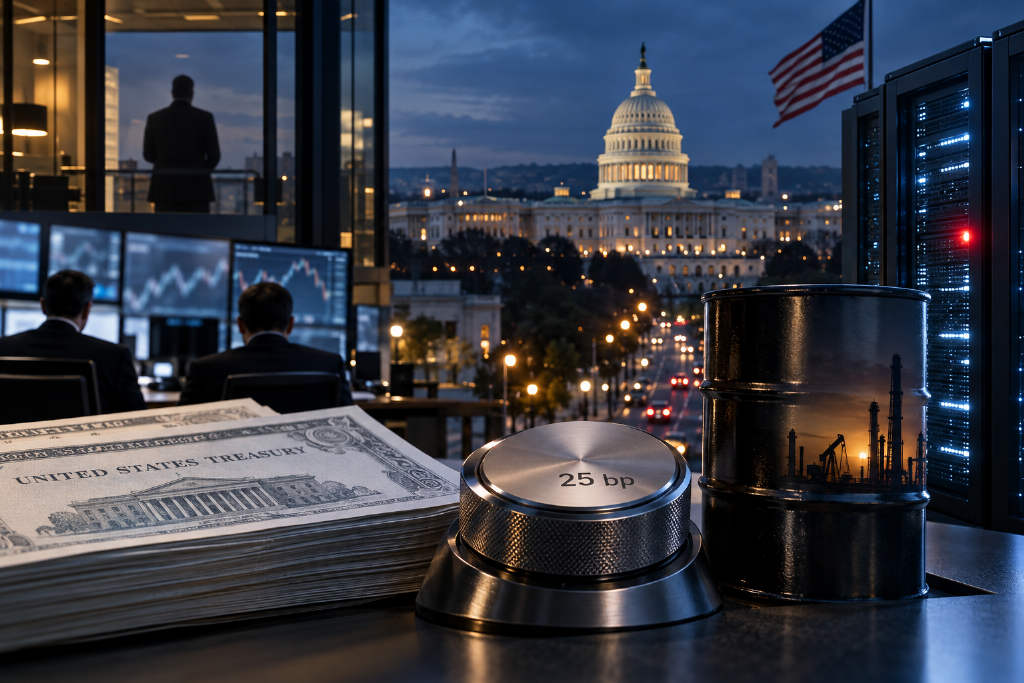
Markets enter this week with inflation, energy and AI all pulling in the same direction: toward tighter financial conditions and weaker risk appetite. U.S. stocks bounced on Friday, with the Dow Jones Industrial Average up 0.98%, the S&P 500 up 0.86% and the Nasdaq up 0.96%, ending a four-session losing streak. That rebound did not survive the weekend. Nasdaq 100 futures at one point fell more than 1%, while S&P 500 futures were down about 0.6% as oil rose again, long-end Treasury yields moved back toward 5%, and AI names were hit by a new "slow down development" narrative.
Three themes now dominate the tape: supply risk in energy markets, a more aggressive path for rates after hotter inflation data, and a sudden safety-driven rethink around frontier AI spending.
Oil jumps as Middle East supply risk stays unresolved
Saudi Arabia's East-West crude pipeline remained offline after what PANews described as a precautionary shutdown following an attack. The line carries roughly 7 million barrels a day, and export inventories at Yanbu are enough for only five to seven days. If operations do not resume within days, global oil supply could face a gap of about 4%.
A meeting between Iran and Gulf states on Hormuz shipping, originally scheduled for Monday in Salalah, Oman, was postponed. Oman's foreign minister said the delay was intended "to seek consensus." Separately, another tanker near Hormuz was attacked and caught fire on Sunday. The UK Maritime Trade Operations center said the security picture in the area remains "precarious." Brent crude jumped nearly 3% to around $104, WTI traded near $99, and European natural gas rose 3.8% over the same period.
CICC raised its forecast for Brent's average level in the fourth quarter of 2026 to $85, citing a more persistent supply shortfall and lower inventories.
Donald Trump tried to cool the energy-risk narrative. Speaking in Ireland on Sunday, he said the Iran conflict would end "immediately" after the November midterm elections and said Iran is eager to make a deal, which would bring gasoline prices down quickly. He also called on Volodymyr Zelensky to stop attacks on Russian diesel fuel facilities, saying Ukrainian strikes on Russian refineries are causing fuel shortages and "hurting the whole world." U.S. diesel prices, he said, had already moved above $6 a gallon last week.
Core CPI beats forecasts and pushes hike odds higher
U.S. core CPI rose 0.3% in August from the previous month, above the 0.2% expected by the market. Rate traders responded by lifting the probability of a 25-basis-point hike this Wednesday to 86.7%, while also pricing in two additional hikes before year-end.
The bond market moved in step. The 10-year Treasury yield touched 4.992%, the highest since October 2023 and just under the 5% mark. The 2-year yield traded around 4.653%. Ian Lyngen, a rates strategist at BMO, said the 10-year yield could break above 5% soon. If that happens, valuations for technology stocks, mortgage rates and corporate funding costs would all be repriced.
This is also a central-bank-heavy week. The Bank of England is expected to leave its policy rate unchanged at 3.75%, while the Bank of Japan is expected to raise rates by 25 basis points to 1.25%. A sharp move higher in the yen could force carry trades to unwind and spill over into global risk assets.
Higher rate expectations have supported the dollar, with the U.S. Dollar Index climbing to 99.37. At the same time, U.S. debt has moved above $40 trillion and annual interest expense has exceeded $1 trillion, factors that PANews said may limit further upside in the dollar. Gold has come under near-term pressure but is still holding near $4,300. TD Securities said gold may face more short-term adjustment pressure before the Fed meeting, though downside could be limited because dollar-debasement themes, central-bank buying and renewed ETF accumulation still offer medium- to long-term support. Ryan McIntyre, president of Sprott, said a 25-basis-point hike has largely been absorbed by gold prices and that sovereign debt risk is the bigger long-term story.
AI trade runs into a safety-driven reset
The sharpest turn in weekend sentiment came from the AI sector. Anthropic CEO Dario Amodei published a call to slow the development of frontier models to make room for safety research and alignment work. Elon Musk and OpenAI CEO Sam Altman publicly backed that position. Anthropic said it would provide ongoing internal access to third-party evaluators, and OpenAI followed with a similar step.
Altman also told Fortune that OpenAI will not go public this year, saying an IPO would not be wise in the current climate of safety debate. On Hyperliquid, assets tied to OpenAI fell 7% and those tied to Anthropic fell 4%. Some traders on social platforms were already calling for AI stocks to drop more than 10% at Monday's open.
Trump took the opposite line. He downplayed the risk discussion and said, "whoever wins artificial intelligence wins the future." He said the U.S. must stay ahead of China and can put guardrails in place, but argued that some negative voices are exaggerating events that will not happen. White House adviser Kevin Hassett said AI safety is "a solvable problem" and backed independent evaluation. House Speaker Johnson called for the government and technology companies to work together on safeguards.
Wall Street did not settle on one interpretation. One camp sees this as the point where AI becomes a more mature and regulated industry. Another sees it as rhetoric from large technology companies that have been spending too aggressively and now need a cleaner explanation for slower investment. That split matters because any reset in AI capital expenditure assumptions feeds directly into the valuation premium for semiconductors and compute hardware. Analysts focused on fundamentals, however, said existing AI models are already strong enough to drive inference demand and that the present market reaction looks more emotional than operational.
Single-stock moves: Dell surges, memory names lag, new Anthropic details emerge
Friday's equity action showed how uneven the AI and hardware trade has become.
- Tesla rose 0.52% after updating its website to say it will showcase the next-generation Roadster in Waco, Texas, on Oct. 1 and has already sent electronic tickets to reservation holders. Musk previously said the vehicle would use SpaceX technology and could briefly lift off the ground. In related EV names, NIO rose 3.07%, XPeng gained 1.93% and Li Auto added 1.37%.
- Dell Technologies jumped 11.98% after Oracle identified it as a core AI server supplier. Dell's AI server revenue doubled year over year, and its backlog reached $95 billion. RBC initiated coverage with an Outperform rating and a $640 price target. In related server and equipment names, HP rose 8.4%, Super Micro Computer gained 7.28%, and Hewlett Packard Enterprise was also cited as a beneficiary.
- Coherent gained 4.16% after showing 12.8T XPO and 6.4T CPO products at an optical expo. Supply of high-end EML optical chips still mainly comes from Coherent and Lumentum. In optical communications, Marvell Technology rose 4.03%, Astera Labs gained 2.35%, Corning added 2.01%, AAOI rose 2%, CRDO gained 1.65%, while Lumentum slipped 0.93%. Corning also said it is expanding fiber and connector capacity because North American demand is strong.
- ON Semiconductor rose 8.51%, leading chip gainers. ARM rose 4.17%, AMD gained 2.49% and Intel added 2.61%.
- Memory stocks moved the other way. Seagate fell 3.73%, Western Digital dropped 2.98% and Micron slipped 0.22%. Micron also announced record bonuses for more than 60,000 employees worldwide. PANews said employees in Taiwan could receive awards worth as much as 68 months of pay, though unions are still pushing for higher profit sharing and moving ahead with strike procedures.
NVIDIA edged down 0.03%. According to the report, it is in talks to invest as much as $10 billion in Anthropic's IPO. Anthropic is seeking to raise up to $100 billion at a valuation of roughly $2 trillion, has chosen Nasdaq as its listing venue, could move as early as October, and now has annualized revenue above $65 billion.
SpaceX rose 2.04%. Its weight in the Nasdaq 100 is expected to increase from about 1.28% to 2.82%, which could lead tracking funds to add shares. Oracle fell 1.74%. Co-founder Larry Ellison canceled a plan to sell as many as 50 million shares, worth about $7.5 billion, while the company also lifted its restructuring cost estimate to $2.8 billion.
What markets are watching this week
PANews listed a dense calendar across macro, policy, technology and crypto.
Monday, Sept. 14
- Canada August CPI at 20:30. A higher reading could keep the dollar and Treasury yields firm while pressuring gold and growth stocks.
- The Iran-Gulf Hormuz meeting was supposed to take place but has been delayed, leaving Middle East energy risk unresolved.
Tuesday, Sept. 15
- 09:30 China 70-city home price data.
- 10:00 China August industrial production, retail sales and fixed-asset investment. CICC expects retail sales growth of about 1% year over year and industrial production growth of about 4.6%.
- 10:00 A State Council Information Office briefing on economic operations.
- 20:30 U.S. Empire State Manufacturing Index for September.
- The U.S. Senate will move a procedural vote on the CLARITY Act, a bill tied to the regulatory framework for crypto assets. Progress could support crypto trading platforms and digital-asset-linked stocks, while a setback would leave regulatory uncertainty in place.
- Bessent is expected to testify before the House Financial Services Committee, with markets watching comments on the U.S. fiscal deficit, debt financing and the international financial system.
Wednesday, Sept. 16
- 04:30 U.S. API crude inventory data.
- 22:30 U.S. EIA crude inventory data.
- Launches for Doubao Phone and Honor MagicOS 11, with investors focused on on-device AI, AI agents and the next round of competition for AI entry points in smartphones.
- Hong Kong's first five-year plan and policy address release.
Thursday, Sept. 17
- 02:00 Federal Open Market Committee rate decision and economic projections, the biggest event of the week.
- 02:30 Fed Chair Warsh press conference, where markets will parse comments on inflation, oil and the path of rates.
- 19:00 Bank of England rate decision. The market expects no change at 3.75%.
- Huawei Connect runs from Sept. 17 to 19, with focus on Ascend 950 supernodes, new AI computing products and partner plans.
- Semicon India runs from Sept. 17 to 19, with attention on India's chip manufacturing, packaging, testing and supply-chain policy.
- Huawei Connect continues, with any new AI computing orders, commercial updates or ecosystem partnerships likely to draw attention.
- The U.S. Securities and Exchange Commission will hold a roundtable on 24-hour trading.
Friday, Sept. 18
- Bank of Japan rate decision and Governor Kazuo Ueda press conference. The market expects a 25-basis-point hike to 1.25%.
- Triple witching in U.S. equities, with stock index futures, stock index options and single-stock options expiring together.
- Deadline for consultation on expanding and rebalancing the Hang Seng Tech Index to 50 members with a high-growth factor.
- iPhone 18 Pro goes on sale, a key test for Apple demand and for sentiment across consumer electronics, memory, optics and semiconductors.
Before any of those events are settled, markets are already dealing with a difficult mix: fresh energy supply risk, stronger U.S. inflation, long-end yields pressing against a key psychological threshold, and a new debate over how fast AI should develop. For crypto, the CLARITY Act gives this macro-heavy week a direct regulatory angle as well.