
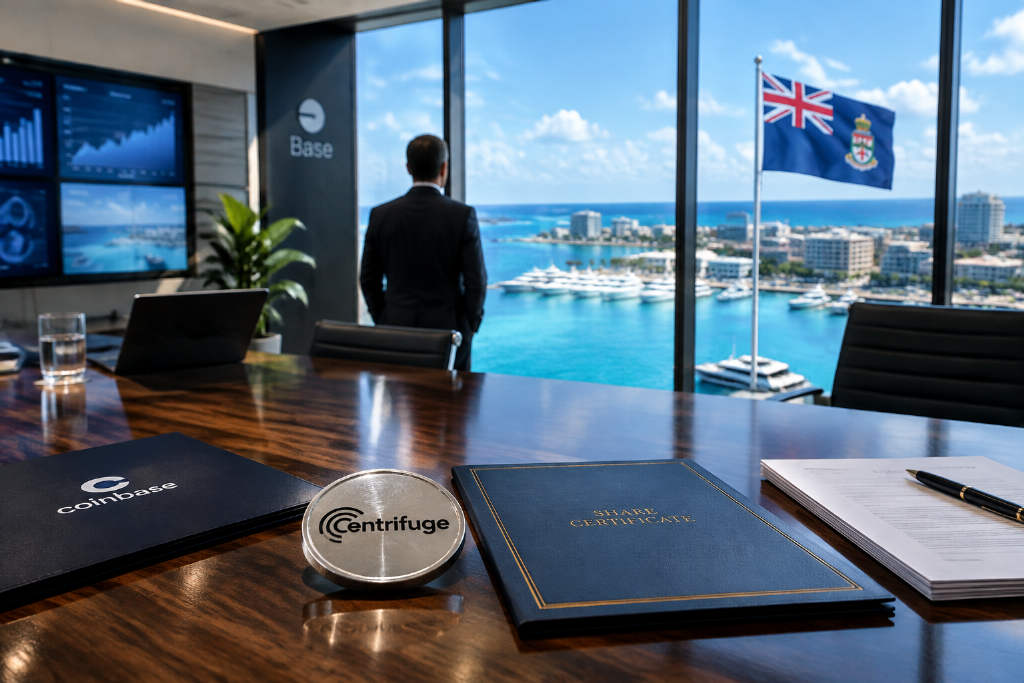
In May 2026, Coinbase said it had made a strategic investment in Centrifuge and named the company a preferred tokenization infrastructure partner. Centrifuge is set to keep providing tokenization infrastructure for ETFs, credit funds, and structured financial products deployed on Base, with the aim of bringing traditional financial assets onchain.
For a company founded in 2017, that marked a notable step. Centrifuge started out trying to use blockchain to solve business financing problems, lived through several crypto market cycles, and has now entered the partnership networks of a major exchange platform and traditional asset managers.
A few months later, though, the company raised a different question about itself.
In August 2026, Centrifuge published CP172, a proposal to explore reorganizing the existing foundation into a Cayman Islands exempted company with shareholders. Under the proposal, eligible CFG holders would be able to subscribe for shares in the new company using CFG, at a proposed ratio of 1 CFG for 1 share. The plan is still going through governance discussion, legal review, and related approvals.
That leads to a broader question: why would a project that has already moved from a niche experiment into institutional partnerships revisit the relationship between its token and the company behind it?
To answer that, it helps to start with Maex Ament. Much of Centrifuge’s path reflects the experience he built earlier in enterprise software and supply chain finance.
Maex Ament and the problem of money moving between companies
Maex Ament, also known as Markus Ament, was born around 1975. He studied mathematics at Technische Universität Kaiserslautern in Germany and earned a master’s degree in mathematics. After graduating, he did not stay in academia. He joined SAP, the German software company.
Founded in 1972, SAP is one of the world’s major enterprise software companies. It is best known for ERP systems that help companies manage finance, procurement, inventory, production, and sales inside connected software environments.
For large companies, invoice entry, approval workflows, and payment timing are not isolated tasks. They are part of the operating system of the business. Ament worked on software development at SAP and dealt directly with those kinds of enterprise processes.
He later shifted his attention from software efficiency inside companies to payments and financing between companies.
Around 2000, Ament founded his first company, Ebydos, which built accounts payable and invoice automation software for businesses. Companies process large volumes of invoices, payments, and approvals every day. Ebydos was built to make that work faster and more automated.
In 2005, Ament left Frankfurt for San Francisco to expand Ebydos in the U.S. Philip Stehlik, who had worked in the Frankfurt office, later moved to San Francisco as well and joined the U.S. business.
Ament later recalled that in the week Stehlik arrived in San Francisco, the two decided to sell the company. In October 2006, Swedish software company ReadSoft formally announced its acquisition of Ebydos.
After the sale, Ament and Stehlik tried a consumer product. Around 2007, they founded Snappr to explore applications that linked QR codes to mobile websites. The product was built, but the market was not ready. QR codes were not yet widely used, and phones that could read them easily were still limited.
That experience reinforced a lesson for both founders: what technology can do and what the market is ready to use are not always the same thing.
After several attempts, they returned to a field they knew well: enterprise financial software.
Taulia and the financing gap in supply chains
Taulia was founded in 2009. It continued in the direction of Ebydos, but it did more than digitize invoice handling. It tried to address working capital problems between companies.
Consider a simple case. A large company buys goods worth 1 million yuan from a supplier. The supplier has delivered the goods and issued the invoice, but the contract says payment will come 60 days later.
For the large buyer, a longer payment cycle helps manage cash flow. For the supplier, those 60 days tie up money that is still needed for payroll, raw materials, and the next order.
If the supplier needs cash sooner, it has to look for financing elsewhere. Smaller businesses usually do not have the same credit profile as large corporates, and they often cannot borrow at the same rates.
Taulia tried to change that.
One of its early products was dynamic discounting. Buyers could use their own cash to pay early, while suppliers would offer a discount based on how early they received payment. The supplier got cash sooner. The buyer got a discount return.
Taulia later expanded into supply chain finance. Large buyers worked with banks or other financing institutions and invited suppliers into the program. Once a supplier submitted an eligible invoice, it could choose early payment. The financing institution advanced the funds and then collected repayment on the due date.
Because the large buyer usually had stronger credit, financing institutions could use that relationship, under certain conditions, to offer suppliers lower-cost financing.
That meant Taulia was not just automating software workflows. It was reorganizing credit, payment timing, and capital flows between companies.
The business grew. According to Ament’s recollection, Taulia’s first customer was Pfizer, initially through a relatively small contract. Coca-Cola, Warner Bros., and John Deere later became customers as well. The platform connected a growing number of suppliers and handled a larger volume of enterprise transactions.
But the experience also showed Ament the limits of traditional supply chain finance.
Taulia could help large companies build financing relationships with their own suppliers. It could not automatically extend the same opportunity to every business. Banks and financing firms preferred clients with larger transaction sizes, stronger records, and economics that justified due diligence costs. For the large number of small suppliers, reviewing each one, signing legal documents, and integrating systems could be too expensive to make sense.
Ament later discussed this issue directly. He described the smaller suppliers in large corporate supply chains that were harder for traditional finance to cover as the “long tail.”
Those businesses still needed capital, but they were often excluded because transaction sizes were too small and onboarding costs were too high.
The problem went beyond any single supplier.
If Company A owes Company B, and Company B owes Company C, each claim reflects a business relationship. But those relationships sit across different corporate systems, contracts, and bank accounts. They are hard to record in a unified way and hard to combine into new financing products.
If transaction records between companies could be shared through a trusted mechanism, could claims be verified and transferred more easily? If financing institutions did not have to build a new system from scratch every time, could businesses that were previously too small to serve gain better access to funding?
Those questions were moving beyond enterprise software.
By around 2016, Taulia had grown to roughly 200 employees. Ament and Stehlik found themselves spending more time on strategy, management, and team coordination, and less time directly involved in product and business work.
They decided to leave a familiar environment again and look for answers to the problems they had identified while building Taulia.
This time, they turned to blockchain.
2017 to 2019: the idea arrived before the market and the technology
Taulia had shown Ament how complex traditional business finance could be. At the same time, Bitcoin and Ethereum made a new idea look possible: could transaction records between companies run on a shared ledger?
Ament, Stehlik, Martin Quensel, and others began building Centrifuge.
The timing coincided with the ICO boom. Crypto markets were expanding quickly, and many people believed blockchain could do more than move money. It might reshape finance, commerce, and even the structure of the internet.
The boom faded quickly. In 2018, crypto asset prices fell sharply, many projects struggled to raise money, and the industry entered a bear market.
For a newly formed Centrifuge, the challenge was not only weaker funding conditions and less market attention. It also had to explain to investors, partners, and potential customers why business transactions should be put on blockchain in the first place.
The technology was not ready either.
Ament later said that trying to move global commercial transactions onto blockchain in 2017 was simply too early. At the time, blockchains still had clear limits in scalability, privacy, and infrastructure maturity.
Business transactions usually involve sensitive information such as pricing, customers, suppliers, and contracts. Companies were not going to expose that data to everyone.
More importantly, blockchain could not solve real-world credit risk on its own.
A company might upload an accounts receivable invoice onchain. The blockchain could record the invoice data and show who it had been transferred to, but that alone could not prove the goods were actually delivered, nor could it guarantee the debtor would pay on time.
If Centrifuge wanted to build a financial system tied to real businesses, it had to deal with technology, data, legal structure, and credit risk at the same time. That was much more complicated than the original vision suggested.
After roughly two years of experimentation, Centrifuge narrowed its target. Instead of trying to move the whole commercial world onchain, it focused on a more specific use case: turning real-world assets into financeable products.
Tinlake in 2019: a narrower and more practical product
In 2019, Centrifuge launched Tinlake. The product allowed businesses to place illiquid assets such as accounts receivable into asset pools and then connect those assets with onchain capital through tokens representing the relevant interests.
Rather than trying to put the entire business world onchain, Tinlake addressed a more concrete problem. Real-world businesses hold assets but cannot always access funding quickly. Onchain investors, meanwhile, may be willing to provide capital in search of yield. Tinlake was built as a financing mechanism between the two sides.
To accommodate different risk preferences, Tinlake used a senior-junior structure. The junior tranche, TIN, absorbed losses first in exchange for higher potential returns. The senior tranche, DROP, benefited from the loss buffer provided by junior capital, took lower relative risk, and earned the corresponding return.
Smart contracts handled share records, return calculations, and repayment allocation. But the authenticity of the underlying assets, the debtor’s ability to pay, and legal enforceability still depended on offchain arrangements.
Tinlake became Centrifuge’s first major product in the shift from enterprise financial software to onchain asset financing.
That did not make the path easy.
In a retrospective post, Ament said he and Stehlik went through a difficult crypto winter from 2017 to 2019. He struggled with founder burnout and intense self-doubt. Stehlik became disappointed with the direction of the crypto industry at the time. They had hoped to use crypto to serve the real world, but many projects were more focused on trading and financial activity around crypto assets themselves.
In 2020, Stehlik stopped working on crypto-related projects. Ament also began stepping back from day-to-day startup work, while Centrifuge continued to push Tinlake forward.
From there, the paths diverged. The next phase belonged to Centrifuge.
2021: MakerDAO and Aave opened larger funding channels
If Centrifuge wanted to scale real-world asset financing, it needed stable sources of capital.
Scattered onchain investors alone were unlikely to support larger and more complex asset pools on a sustained basis. MakerDAO offered an important opening.
MakerDAO is an onchain financial protocol centered on the DAI stablecoin. It initially supported DAI creation mainly through crypto collateral. As the protocol evolved, it also began exploring the use of real-world assets as collateral.
In 2021, Centrifuge’s work with MakerDAO allowed some real-world asset pools to connect to MakerDAO’s funding system. Eligible DROP positions could, within the relevant structure, serve as collateral and help participants obtain DAI.
That meant Centrifuge no longer had to rely only on individuals willing to invest directly into real-world asset pools. It could tap a larger source of onchain capital.
Still, MakerDAO provided a funding and collateral mechanism. It did not remove real-world credit risk. Whether assets were genuine, whether debtors would repay, and whether legal structures would hold up still required separate judgment.
Blockchain addressed financing infrastructure. The quality of the underlying assets still determined the financing outcome.
In December of the same year, Centrifuge and Aave launched RWA Market to push the connection between real-world assets and DeFi further.
Aave is an onchain lending protocol that lets users supply funds and lend to eligible borrowers under protocol rules. RWA Market was designed so that Aave liquidity providers could supply USDC to Centrifuge issuers, giving real-world asset borrowers another source of funding.
At launch, RWA Market included seven asset pools covering real estate bridge loans, trade receivables, freight invoices, inventory financing, and revenue-based financing.
The practical point was clear. Real-world assets did not have to depend on a single funding pool or a single platform. They could also try to access broader onchain capital markets.
That did not mean unlimited liquidity. In a 2022 review, Centrifuge said RWA Market had grown from about $10 million to $19 million before falling back to about $8 million as the bear market and capital outflows hit.
Those figures pointed to a basic reality: even when a product is connected to DeFi, capital does not automatically stay in real-world asset markets.
RWA Market also exposed several issues. Real-world asset due diligence and risk assessment require specialists. Asset duration does not always match the liquidity preferences of DeFi capital. Funding supply is also affected by stablecoin liquidity and broader market conditions.
Why build a dedicated chain
As the business expanded, Centrifuge began building Centrifuge Chain on Substrate.
This was not simply a move to follow a new technical narrative. Asset issuance, share records, yield distribution, subscriptions, and redemptions all involve transaction costs, processing efficiency, and system configuration. The project wanted infrastructure better suited to real-world asset operations than a setup built entirely inside Ethereum’s existing environment.
But running its own chain came with costs.
Centrifuge had to maintain Tinlake, Ethereum contracts, its own chain, and the coordination mechanisms between them. Every additional infrastructure layer added development, auditing, security maintenance, and ecosystem work.
More importantly, infrastructure by itself does not bring customers or capital. A chain can run well technically and still struggle to create business value if issuers, investors, and applications do not want to use it.
That shifted the company’s problem from “can assets be put onchain” to “how do more institutions adopt the system, and how does capital actually move through it.”
That shift helps explain the product and infrastructure adjustments Centrifuge made in the years that followed.
2022 to 2023: from isolated pools to institutional infrastructure
Crypto entered a bear market in 2022. The collapses tied to Terra, Three Arrows Capital, and FTX pushed the market to reassess onchain financial risk.
Demand for real-world business financing, however, did not disappear.
In 2022, Centrifuge worked with BlockTower Credit and MakerDAO on a real-world asset financing arrangement worth about $220 million. MakerDAO provided about $150 million of senior capital, while BlockTower Credit provided about $70 million of junior capital. The deal was formally announced in December 2022, and Centrifuge described it at the time as one of the largest onchain real-world asset investments.
BlockTower Credit had a professional investment team capable of organizing and managing multiple credit assets. Centrifuge provided onchain issuance and financing infrastructure for those assets, while MakerDAO supplied large-scale capital.
Compared with earlier receivables pools, the deal showed that Centrifuge was beginning to handle larger and more institutional credit business. In a later case study, Centrifuge said the structure involved 92 assets and used onchain tokenization and automated processes to manage a structured credit pool. The same case study said securitization operating costs were reduced by 97%.
By that point, Centrifuge was no longer serving only businesses that needed technology and funding. It was also serving professional institutions responsible for asset selection, credit management, and capital allocation.
In 2023, the company pushed further into institutional services.
In May, it launched a new Centrifuge App that brought together previously fragmented products and investment flows. At the time, the company said legacy Tinlake had financed about $387 million in cumulative assets.
In June, it launched Centrifuge Prime, an infrastructure offering for crypto-native institutions such as DAOs, stablecoins, and DeFi protocols seeking real-world asset exposure. The service included tokenization tools, legal frameworks, asset issuance support, credit analysis, and financial reporting.
That marked a change in positioning. Centrifuge was no longer only building financing pools for individual businesses. It was trying to help capital-holding institutions add real-world assets to their portfolios.
In 2023, Centrifuge’s TVL reached about $210 million at one point, and cumulative asset origination exceeded $400 million. Growth did not remove the business model’s constraints.
In its annual review, Centrifuge said regulatory uncertainty slowed institutional adoption, while growth among DeFi-native capital providers came in below expectations, leaving available funding short.
Those two issues hit the core of the RWA model. On one side are real-world assets and financing demand. On the other is onchain capital. The platform can keep scaling only if both sides remain active.
If issuers want to bring assets onchain but cannot find enough funding, growth stalls. If onchain capital is available but real-world assets do not come onchain, investors have nothing to allocate to.
That same year, Centrifuge continued working on multi-chain liquidity so users on different EVM-compatible networks could participate in relevant asset pools. The goal was to widen investor access and reduce the problem of capital being trapped in a single ecosystem.
By then, Centrifuge’s direction was becoming clearer. It wanted to connect asset issuance, capital allocation, and onchain applications. It was also facing more competitors with overlapping goals.
Maple started from institutional credit and focused on borrower selection, credit management, and capital allocation. Ondo entered through tokenized U.S. Treasuries and expanded toward broader tokenized financial products and related infrastructure. Centrifuge started with real-world asset pools and onchain financing, then expanded toward institutional fund issuance, asset-management infrastructure, and multi-chain distribution.
Their starting points were different, but the business boundaries were beginning to overlap.
The competitive question was no longer just who could tokenize assets. It was who could secure high-quality assets, attract durable capital, and make those assets useful across onchain finance.
Centrifuge had accumulated technical and product experience, but its 2023 results also showed that an early lead was not enough on its own. It needed more institutional clients, steadier funding, and a business model capable of producing recurring revenue.
2024 to 2026: from financing assets to distributing institutional products
In 2024, RWA moved again from a niche crypto narrative into a broader institutional market.
This time, attention was not limited to private credit and receivables. It also covered tokenized U.S. Treasuries, fund shares, and investment products tied to traditional indices.
Centrifuge’s earlier experience in asset-pool management began to fit more mature institutional finance settings. Its integration with Fireblocks, along with partnerships involving Anemoy and Janus Henderson, showed the company expanding toward infrastructure for institutional fund issuance and onchain distribution.
The clearest milestone came in 2025.
In July, S&P Dow Jones Indices announced a partnership with Centrifuge to bring the S&P 500 Index into an onchain fund product. In September, the Janus Henderson Anemoy S&P 500 Index Fund, or SPXA, was formally launched.
That was a different market from early receivables financing.
Receivables financing is mainly about short-term funding for businesses, where investors need to assess the credit quality and repayment ability of specific debtors. An S&P 500 index fund combines index licensing, traditional asset management, and onchain distribution, serving a different kind of investment demand.
Centrifuge’s role changed with that shift. It was no longer only helping businesses place claims into onchain asset pools. It was trying to become an infrastructure provider for traditional financial products entering onchain markets.
In March 2026, Centrifuge launched deSPXA, giving eligible non-U.S. users onchain exposure linked to SPXA and exploring ways to connect that exposure to the DeFi ecosystem on Base.
The move addressed a problem that comes after issuance. If fund shares can only be bought and held, blockchain composability remains limited. By connecting those assets to other onchain applications, they may be able to enter lending, trading, and related use cases, subject to product rules.
Tokenization, however, does not create liquidity by itself. Whether an asset can be used as collateral, whether there is enough trading depth, and whether investors can participate all depend on product terms, compliance requirements, and access mechanisms.
In May 2026, Coinbase said it had made a strategic investment in Centrifuge and named it a preferred tokenization infrastructure partner. Centrifuge is set to continue providing infrastructure for ETFs, credit funds, and structured financial products on Base.
That gave the company a new route into a large platform and its client network. It also pushed competition further into product distribution, institutional relationships, and ecosystem integration. Based on current business scale, Centrifuge’s official app showed about $984 million in assets under management in October 2026.
Looking back, Centrifuge started with receivables and private credit, built experience in asset-pool management, onchain fund issuance, and multi-chain infrastructure, and then expanded into broader financial markets through traditional asset managers, index providers, and DeFi protocols.
It did not switch narratives only because RWA became popular. The company has been trying for years to solve the same problem: how to issue real-world financial assets onchain, let investors hold them, and under the right conditions connect them to more financial applications.
That still does not prove the business model is unbreakable. Institutional partnerships, launched fund products, and platform investments are meaningful commercial signals, but the longer-term test is whether Centrifuge can keep attracting quality assets, expand real business volume, and build stable protocol revenue.
Why revisit CFG and the company structure now
In August 2026, Centrifuge proposed CP172 to explore reorganizing the existing foundation into a Cayman Islands exempted company with shareholders and allowing eligible CFG holders to subscribe for shares using their tokens.
The proposal touches a question that has become more important as the company has evolved: when a project moves from a crypto-native protocol toward institutional financial infrastructure, do the original organizational structure and token design still fit the business it is becoming?
Early on, Centrifuge was aimed mainly at onchain investors and DeFi protocols. CFG’s value logic was closely tied to protocol governance, network development, and ecosystem participation.
Now the company works with traditional asset managers, index providers, and large financial platforms. Those relationships involve equity investment, commercial contracts, legal liability, governance rights, and long-term capital planning. Traditional financial institutions are generally more familiar with corporate equity structures and the investment, governance, and risk processes that come with them.
That does not mean the existing token structure necessarily blocks business development. It also does not mean Coinbase’s investment can be treated as the direct cause of the reorganization. The real questions are narrower and more practical: in what ways does the current structure limit capital formation, commercial partnerships, or value distribution? Would corporate equity solve those issues more effectively? What would CFG holders actually gain?
CP172 points in one direction. It explores giving eligible CFG holders a way, directly or through an appropriate arrangement, to participate in the equity structure of the new company. The proposal says the goal is to create a clearer long-term value framework and give early supporters a chance to participate in future development.
Still, the proposed 1 CFG to 1 share ratio is only that: a proposal. It does not mean every CFG already represents one share in the company. Eligibility, legal arrangements, corporate approvals, and the final implementation path all remain to be determined.
More importantly, company equity and protocol tokens represent different rights. Equity usually relates to ownership of the company and the associated economic rights. CFG is the native token of the Centrifuge protocol. Their sources of value, governance arrangements, and risk structures are not the same.
If the reorganization is ultimately implemented, CFG holders would need to understand what rights they are receiving, how the relationship between the token and the new company would change, and how holders who cannot or do not want to participate in the conversion would be affected.
The CP172 FAQ says the shares received may lack liquidity for the foreseeable future, and the company does not expect to pay dividends in the short term. Any future dividends or other distributions would depend on the company’s charter, board decisions, and applicable law. Future fundraising could also dilute equity, affecting all holders of the same class of shares.
The proposal also says that after the share-subscription window closes, Centrifuge would gradually stop funding public-market token liquidity, including related listing agreements, market-maker lending, and supporting infrastructure. The stated reason is that the company wants to redirect those funds toward business growth rather than token buybacks or burns.
That reflects a judgment about where Centrifuge sees itself in its commercial development. In a competitive tokenized finance market, management appears to believe that using capital to expand the business matters more than supporting token prices in the short term.
The two tests ahead for Centrifuge
From 2017 to 2026, Centrifuge’s business path changed several times.
It began by trying to use blockchain to improve efficiency in traditional business financing. It then used Tinlake to package real-world assets into financeable onchain products. After that, it connected to onchain capital sources such as MakerDAO and Aave and built its own infrastructure. In recent years, it moved further into institutional fund issuance, multi-chain distribution, and tokenized traditional financial products.
That path suggests Centrifuge has not simply recycled narratives across market cycles. Its products and customer base have changed, and it has accumulated more institutional experience over time.
But the long-term value of a financial infrastructure company still depends on whether it can keep winning clients, assets, and capital, whether it can hold its position in a competitive market, and whether it can turn that activity into stable revenue.
Viewed that way, Centrifuge faces two separate tests.
The first is a business test: can it grow from a participant with technical experience and institutional partnerships into infrastructure that financial institutions rely on consistently?
The second is a token test: even if Centrifuge’s business keeps growing, through what mechanism does that growth reach CFG holders?
The two should not be treated as the same question. Coinbase’s investment and the launch of SPXA are positive evidence for the first one. They do not automatically answer the second.
That is where CP172 matters. Centrifuge is now reexamining whether a value structure built around a protocol token still fits a project that is developing into institutional financial infrastructure.
The reorganization itself does not prove CFG is undervalued, and it does not prove CFG will necessarily benefit. The real comparison is whether the new structure can deliver clearer rights, a more durable business model, and a more coherent approach to value distribution, and whether those benefits are enough to offset the uncertainty and risk involved in the transition.


