
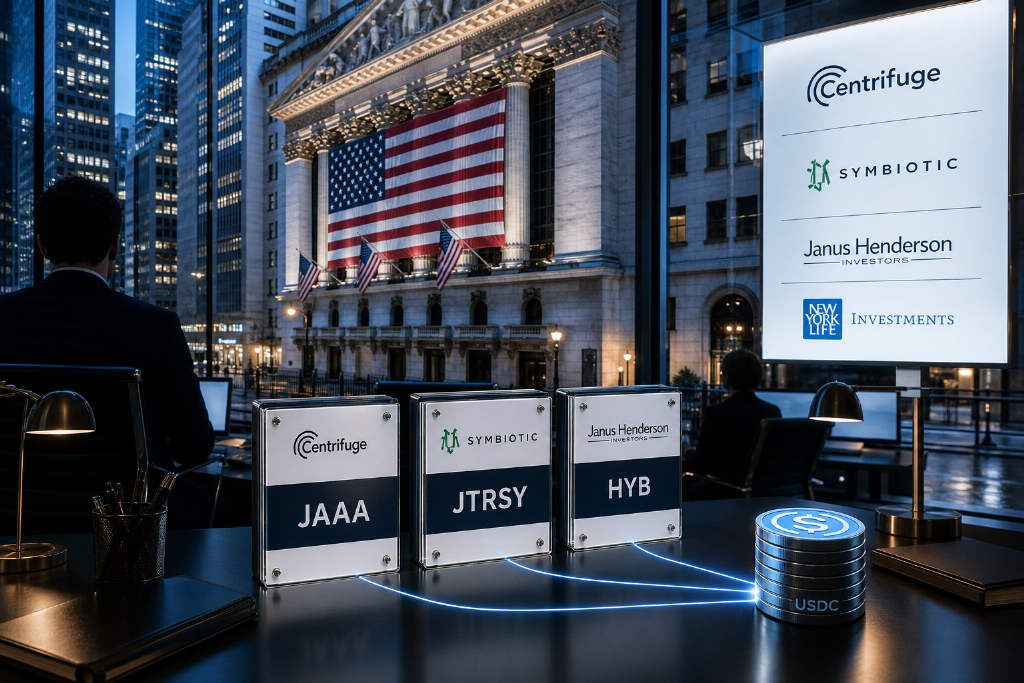
Centrifuge has added Symbiotic’s liquidity network across three tokenized funds that represent about $1.6 billion in assets under management, giving eligible holders another route to exchange their positions for USDC.

The integration covers Janus Henderson’s JAAA, an AAA-rated collateralized loan obligation strategy, JTRSY, a short-duration US Treasury strategy, and New York Life Investment Management’s HYB, a US high-yield corporate bond strategy.
Liquid Lane uses an onchain RFQ marketplace
Symbiotic’s Liquid Lane runs through an onchain request-for-quote marketplace, where market makers can tap liquidity from vaults to fill redemption requests. After acquiring the fund tokens, those market makers can redeem them through the issuer or sell them through another RFQ transaction.
The arrangement gives investors immediate access to USDC, while the funds’ normal redemption process can occur separately.
Centrifuge’s platform and Janus Henderson’s role
Centrifuge is an asset tokenization and vault platform where asset managers issue and manage tokenized funds. According to Cointelegraph, Janus Henderson, a global asset manager with about $500 billion in assets under management, has been a major contributor to the platform’s growth through its JAAA and JTRSY products.
Token Terminal data cited in the report said Centrifuge had attracted about $1.3 billion in new inflows by December 2025, driven primarily by the two Janus Henderson funds. JAAA alone accounted for about $1 billion in total value locked and ranked among the largest tokenized funds in the market.
Symbiotic joins existing liquidity options
Liquid Lane is not the first liquidity route available for Centrifuge’s tokenized funds, Felix Lutsch, Symbiotic’s head of ecosystem, told Cointelegraph.
「We’re not claiming to be first, and other liquidity routes exist. That’s healthy for the market,」 Lutsch said.
Centrifuge announced a partnership with Wintermute in February 2025 to provide 24/7 instant redemptions for JTRSY. HYB, which launched in June, also came with a separate liquidity arrangement for near-instant redemptions.
Lutsch said the distinction with Liquid Lane lies in the capital structure behind the transactions rather than in execution speed. He said the marketplace allows multiple market makers and curators to participate without requiring market makers to pre-fund and hold inventory for individual assets.
He also said the bigger constraint has been flow, adding that low trading volumes in tokenized assets have historically given market makers little incentive to commit capital.
As tokenized funds are used more often as collateral and financing assets in onchain markets, aggregating redemption demand across issuers and asset classes could improve those economics, he said.