ChainFeeds publishes Sept. 1 research briefing
ChainFeeds released a new edition of its research briefing on Sept. 1, pulling together market observations on Bitcoin, social trading, Uniswap’s activity on Robinhood Chain, the debate around Reg CA, and the rapid expansion of meme trading on Robinhood Chain.
The news items listed at the top of the briefing included a reported plan by 1789 Capital to add roughly $300 million to its investment in Polymarket, which could lift the company’s valuation to $21 billion; BitMine’s purchase of 53,501 ETH last week, bringing total holdings to about 5.901 million ETH; the resumption of block production on Cronos and a rollback of chain state to before the Tectonic attack; a statement from Telegram’s founder saying the Gram wallet is ready and already open to some users; and a report from unnamed sources saying Hyperliquid is in talks with Kraken’s parent company about entering the U.S. market.
Bitcoin nears a historical bear-market marker
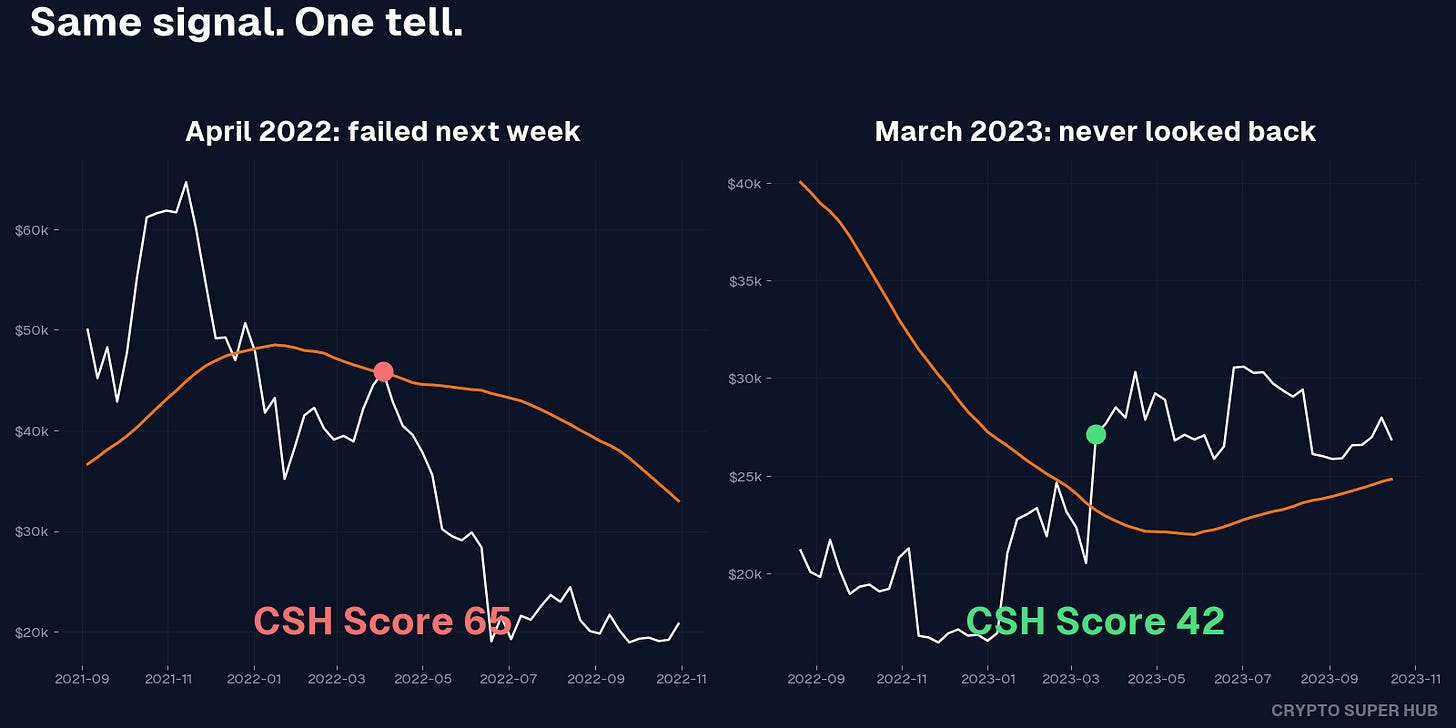
In the first featured piece, Jake Pahor focused on Bitcoin’s 50-week moving average, now sitting at roughly $81,000. Bitcoin briefly touched that level last Friday before falling back to about 3% below it.
Pahor wrote that this line has carried unusual weight across prior cycles. In bull markets, it has often acted as support after pullbacks. In bear markets, it has often marked the end of failed rebounds. Looking across 5,322 days of data since 2012, he found that three bear markets — 2015, 2018 to 2019, and 2022 to 2023 — all ended in the same way: Bitcoin posted its first weekly close back above the 50-week moving average after bottoming. The dates were Oct. 25, 2015, May 5, 2019, and March 19, 2023.
Those three cases shared another trait. In the following six months, Bitcoin did not record a single weekly close back below that moving average, and the cycle low was never revisited. Over the next 12 months, Bitcoin rose 55%, 128%, and 141%, respectively.
There was one false signal. On April 3, 2022, Bitcoin managed a weekly close back above the 50-week moving average during a bear market, but it lost the level again the next week. The final low did not arrive until seven months later, at a price 64% below that level.
Pahor said the distinction between that failed move and the three bear-market endings did not show up clearly on the price chart alone. He pointed instead to the CSH Score. During the April 2022 move, the CSH Score stood at 65.4, suggesting there had been no clear capitulation and that Bitcoin still looked expensive relative to its own cycle history. In the three successful cases, the cycle lows in the CSH Score came at 22.1, 14.6, and 2.3, while the score in the week Bitcoin reclaimed the 50-week average came in at 47.5, 41.9, and 19.5.
The current CSH Score is 37.6, after previously dropping as low as 20.6. By that measure, Pahor said the present setup looks closer to the three genuine bear-market endings than to the 2022 fakeout.
Still, he did not treat the signal as confirmed. The marker that mattered in the prior three bear markets was a weekly close above the 50-week moving average followed by several weeks of holding that level. For now, he said, the market has only met the conditions that usually come before the signal: the CSH Score has already fallen to a relatively low level, Bitcoin has rebounded quickly from its low, and price is now testing the 50-week line.
In the three historical examples, Bitcoin reclaimed the moving average on day 284, day 141, and day 118 after the bear-market low. If this cycle’s low was the July 1 print at $58,551, only about 60 days have passed. Pahor noted that Bitcoin has never before rebounded from a bear-market low and then held the 50-week moving average this quickly. He also wrote that the current bear market’s maximum drawdown was 53.1%, well below the roughly 75% to 83% declines seen in earlier cycles, and that the CSH Score never fell below 20.
Social trading is becoming a crypto business category
A second item, written by Ryan Watkins, argues that crypto trading is shifting from a pure tool into a combined product of trading, social interaction, and content.
Watkins said crypto has spent years searching for a true breakout consumer application without finding one. At the same time, he argued that blockchain has already produced its first killer use case beyond money itself: permissionless, global, 24/7 trading.
He traced that shift to improvements in both wallets and chain infrastructure. Clunky desktop wallet extensions have gradually given way to smoother mobile apps. Blockchains that once had slow speeds, high fees, and limited asset support now handle meme coins, equities, and other assets on higher-performance infrastructure. Out of those conditions, he wrote, social trading is emerging as the next form factor.
Watkins described social trading as a natural extension of onchain markets. Crypto communities have long shared trade ideas on social media and copied each other’s positions in informal ways. Social trading joins those behaviors directly, using blockchains to make trading records, portfolios, and positions visible in real time and with transparency. In his framing, that creates a new type of social network built around finance and trading.
He said the format has already produced some of the fastest-growing applications in crypto over the past few months and has become one of the most effective ways to bring new users into the market. Part of the draw is access to extreme upside scenarios that are hard to find elsewhere, such as trading AI stocks with 20x leverage or meme coins that could rise 1,000x.
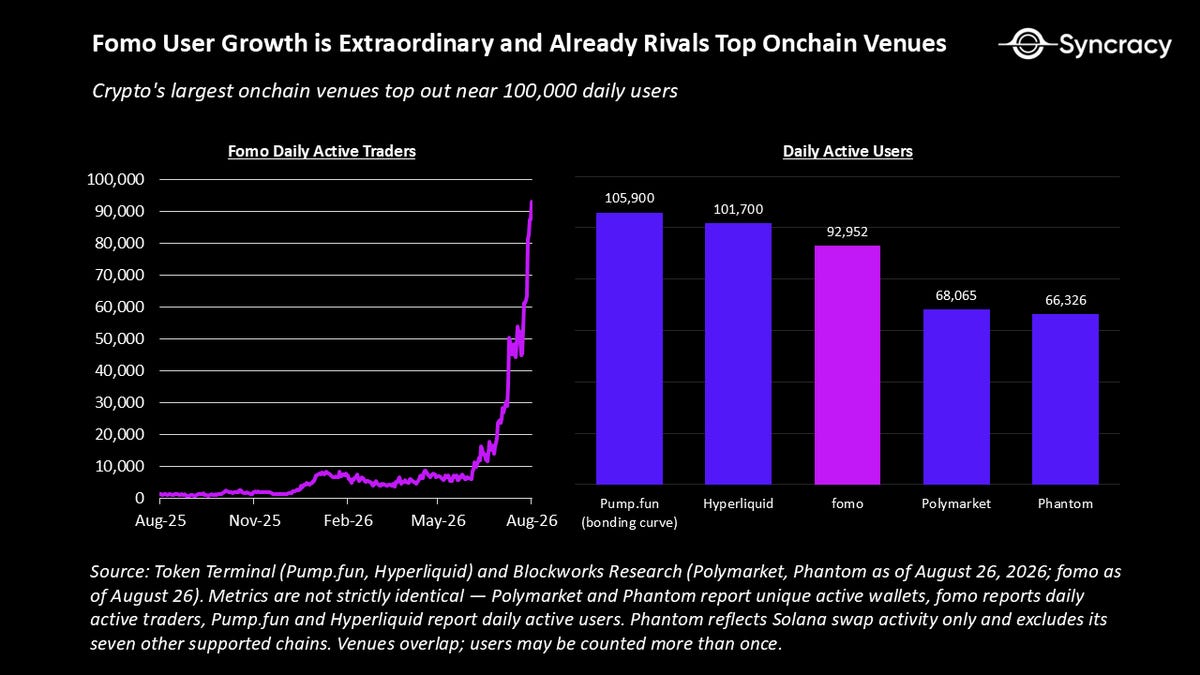
At the same time, newer products are removing much of the wallet friction and operational complexity that earlier crypto apps imposed. Combined with aggressive marketing on platforms such as Instagram and TikTok, that has helped user growth accelerate. Watkins wrote that Fomo and Pump now have daily active user counts close to Polymarket, Hyperliquid, and Phantom, whose DAUs are roughly 60,000 to 100,000. He also said social trading apps are the fastest-growing segment in the Hyperliquid Builder Code ecosystem, contributing about 33% of Builder Code trading volume.
Another point in the piece is that these products are not trying to hide their speculative appeal. Brands such as Pump, Fomo, and Hyperliquid have folded pump culture, fear of missing out, and hype directly into product naming and messaging. Watkins argued that speculation has often been the first spark for useful crypto products.
He pointed to several examples. In the 2010s, one of the earliest major uses of stablecoins was helping traders move funds between exchanges while avoiding crypto price swings. Before the 2024 U.S. presidential election, prediction markets were still niche betting products aimed at retail speculators. For much of the decade leading into 2026, perpetual futures were also mainly a retail tool for leveraged bets on crypto assets.
He extended the same pattern to major blockchains. In 2017, one of Ethereum’s most important functions was sending money to ICO founders. In 2020, Ethereum became the main platform for yield farming during DeFi Summer. In 2023, Solana turned into the representative chain for meme-coin trading thanks to its high-performance base layer. Since 2024, Hyperliquid has become one of the fastest-growing blockchains by letting users trade a wide range of hot assets with high leverage.
Uniswap expands with Robinhood Chain’s tokenized stock flow
The third item, from Foresight News, centered on Uniswap’s position inside Robinhood Chain. Robinhood Chain’s mainnet launched in July. As of Aug. 31, DefiLlama data showed total value locked on the chain had risen above $700 million.
Uniswap said v2, v3, v4, and UniswapX had served as the chain’s public primary AMM from day one of the Robinhood Chain launch, with support also added across its web app, wallet, and API.
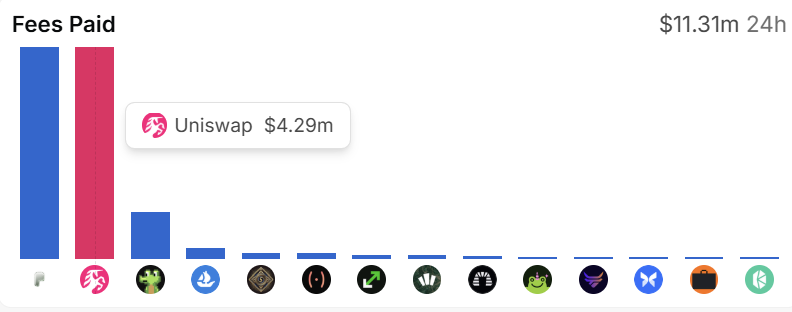
Fresh figures cited in the piece showed that Uniswap generated about $4.29 million of revenue on Robinhood Chain in the past 24 hours, accounting for nearly half of the chain’s fee revenue over that stretch. That placed it behind only the token issuance platform Pons and well ahead of other rivals. Token Terminal data showed that Uniswap’s daily volume in tokenized stocks on Robinhood Chain hit a new high of about $130 million, up roughly 10x over the past month. Volume on v3 and v4 was described as nearly even.
As tokenized stock trading has grown on Robinhood Chain, the report said Uniswap is becoming a key piece of its liquidity and trading infrastructure. The article then tied that growth to UNI’s long-running value-capture debate.
UNI was fully unlocked back in 2024, but the token had struggled for a long period. One reason, the article said, was that fee revenue from Uniswap pools had historically gone almost entirely to liquidity providers, leaving UNI itself with a governance role but no direct cash-flow claim. That shaped years of argument around the so-called fee switch.
In December 2025, a UNI tokenomics reform package passed by vote. Its core pieces were the destruction of 100 million UNI and the formal activation of the protocol fee switch. According to the latest Dune data cited in the article, cumulative UNI burned had reached about 110 million as of Aug. 31, with total burn value at about $630 million.
Since the start of August, UNI has repeatedly posted days with more than 100,000 tokens burned, and the average daily burn value has exceeded $400,000. Robinhood Chain has contributed nearly half of that burn, according to the report.
The mechanism, it said, is not a conventional buyback in which Uniswap directly uses assets such as USDT or USDC to purchase UNI on the open market. Most trading fees still go to LPs, with the protocol taking only a small portion. On Robinhood Chain, that cut is about 6%.
Those protocol fees do not flow into a bank account at Uniswap Labs. They move instead into a contract called TokenJar, which can hold ETH, stablecoins, altcoins, tokenized stocks, and other assets. Anyone who wants to withdraw the assets accumulated in TokenJar must first burn an equivalent value of UNI, in a mechanism called Firepit.
The article said arbitrage bots watch the net asset value inside TokenJar in real time, burn the corresponding amount of UNI to extract the fee assets, and then complete the arbitrage in secondary markets. The more active the trading onchain, the more fees the protocol captures. The more value that builds inside TokenJar, the more incentive arbitrageurs have to burn UNI and extract those assets.
IOSG says Reg CA is not a blanket bull-market switch for token issuance
In an IOSG Ventures weekly note, Reg CA was framed not as a switch that opens a new issuance boom, but as a kind of graduation test for existing tokens. IOSG’s view is that Reg CA will most likely arrive, but later and in a narrower form than many expect.
The note said Reg CA emerged as an administrative alternative after legislation stalled. The CLARITY Act had passed the House in July 2025 and cleared the Senate Banking Committee in May 2026, but had still not reached a full Senate vote. A cloture motion was introduced on Aug. 8, after which the Senate recessed until Sept. 13 and missed the pre-recess window.
IOSG identified Sept. 15 as the next key date, when a motion to proceed will face a 60-vote threshold. If it clears that hurdle, passage in 2026 remains possible. If it does not, the calendar shifts into election season and the odds of passage this year fall sharply. At publication time, Polymarket was pricing the odds of CLARITY passing this year at below 20%.
With legislation stuck, the Securities and Exchange Commission was described as moving ahead with rulemaking. IOSG cited SEC Chair Atkins’ Aug. 18 statement, in which he said forcing crypto assets into existing securities rules was like fitting a square peg into a round hole and had the effect of driving investment overseas while limiting protections available to domestic investors. Atkins said the objective was the “minimum effective dose, maximum constructive freedom, and durable certainty,” adding that “we are building a path to invite innovators back to the United States.”
The note highlighted Rule 200’s startup exemption, which would create a notice-based route for small offerings. If an issuer raises no more than $5 million in aggregate over four years, it would only need to file Form NOR on EDGAR before beginning sales. The SEC would not conduct prior review, and no financial statements would be required. Instead, the issuer would provide principle-based narrative disclosure covering the investment contract structure, token specifications, management team, tokenomics, governance, and risk factors.
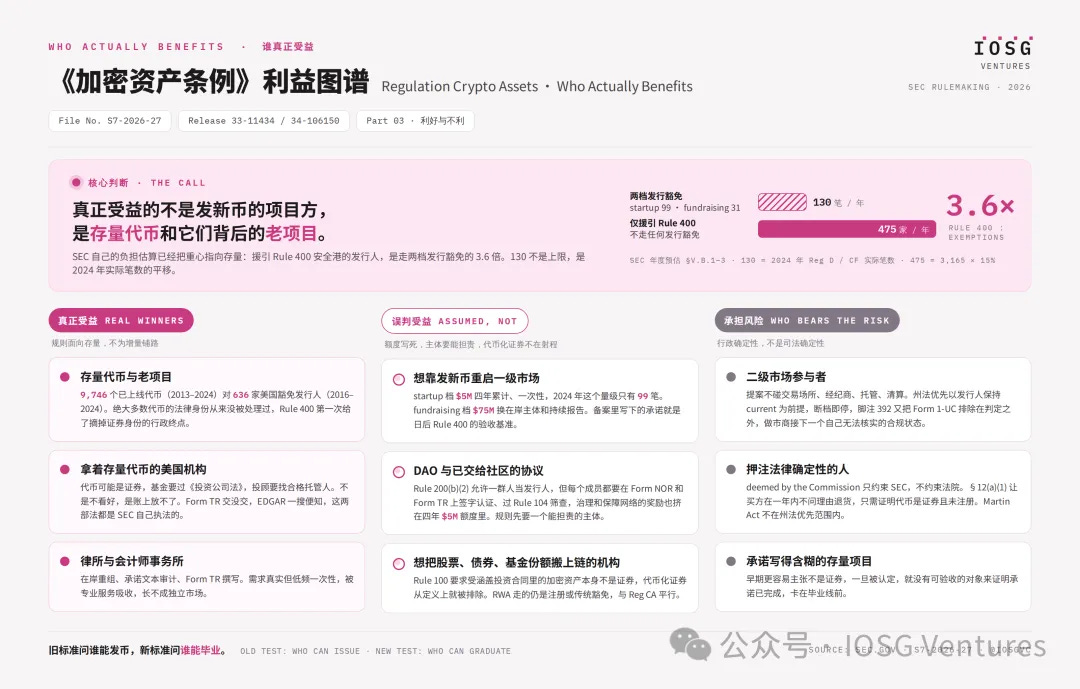
IOSG argued that the most important features are in the details, not the $5 million figure itself. One of those details is that the rule does not require the issuer to be a U.S. entity. The text says the issuer “may be an entity, an individual, or a group of individuals or entities,” and the proposal’s introduction expressly says the startup exemption does not require a U.S. entity. IOSG said that makes it the only channel in the package that is fully open to non-U.S. actors, including Cayman foundations, BVI entities, and even developer teams with no formal entity.
The note also discussed when a token would stop being treated as a security. It gave two conditions: the issuer must have completed or permanently ceased all core managerial work promised under the investment contract and must make no new promises, and it must submit a transition report on Form TR to the SEC. Once those conditions are met, the investment contract “will be deemed no longer to exist,” and the attached crypto asset would no longer be a security for purposes of the Securities Act and Exchange Act definitions.
That would mean future issuance and transfers of the token would not require registration or another exemption; trading venues handling it would not have to register as securities exchanges or broker-dealers because of that token; institutions holding it would not be subject to securities custody rules; and the issuer would no longer face ongoing disclosure obligations under the Securities Act or Exchange Act.
IOSG added a boundary condition. Stripping away securities status does not remove every form of oversight. Federal anti-fraud provisions would still apply, as would commodities regulation, state anti-fraud law, and consumer protection. The proposal also says the safe harbor is not a license. Like any safe harbor, it applies only to the extent an issuer satisfies its conditions, and the Commission would still be able to challenge whether those conditions had in fact been met.
Robinhood Chain’s meme cycle builds around Pons
The final feature, from BitpushNews, argued that Robinhood Chain may be producing a meme-market loop that looks different from previous cycles. Two months after launch, meme activity remains the main attraction on the Arbitrum-based Layer 2.
According to the article, the chain set new records over the weekend. Daily DEX volume reached $875 million, and the network processed 5.52 million transactions in a single day. Pons alone launched about 22,600 new tokens over that period. On revenue, applications on Robinhood Chain generated about $2.66 million over 24 hours, trailing only Solana and running at twice Ethereum’s level and six times Base’s. GMGN, Pons, and Uniswap together accounted for about 88%.
The article said that does not mean Robinhood has surpassed Ethereum. It does show unusual trading intensity for a chain that only went live on July 1. It also said memes on Robinhood are now reaching $10 million, and in some cases $100 million, market capitalizations at scale.
The first breakout token was CASHCAT, named after “Cash Cat” from Robinhood’s early startup history. Within two weeks of launch, its market cap had at one point topped $200 million. As of Aug. 31, CoinGecko showed a market cap of about $214 million, with gains of more than 400% over the previous month.
PONS, the token tied to the Pons launchpad, followed. On Aug. 29, its market cap was still in the $150 million to $200 million range. One day later, it had broken above $260 million. As of Aug. 31, the article put its market cap at about $277 million, with nearly 400% gains over the past seven days and more than $100 million in 24-hour trading volume.
BitpushNews said the structural difference starts with PONS. The community has described Pons as Robinhood Chain’s version of pump.fun: fixed-supply issuance with a bonding-curve model that graduates into a locked liquidity pool. Under the current split, creators receive 70% and the protocol gets 30%. About 80% of protocol revenue is used for TWAP buybacks and burns of PONS. Messari and onchain tracking cited in the report showed burned supply had reached nearly 29% of total supply.
Pons’ own documentation says 30% of fees from new-token trading go to the protocol, and 80% of that protocol revenue is automatically used to buy back PONS through TWAP execution and send it to a burn address. The resulting loop is straightforward: more meme demand leads to more token issuance; more issuance leads to higher platform fee revenue; and that fee revenue becomes steady buy pressure for PONS.
The article drew the comparison sharply. Buying CASHCAT is like placing a bet in the casino. Buying PONS is closer to buying the casino itself.
BitpushNews contrasted this setup with the 2024 Solana meme wave. Pump.fun pushed issuance costs close to zero and produced an extreme PvP market. Robinhood, in the article’s telling, keeps the same fast-rotation energy but layers brokerage distribution, memes, trading infrastructure, and real-world assets together. Instead of a pure meme factory, it looks more like a financial shopping mall that unexpectedly used memes to pull users through the door.
The report also said the culture mix is different this time. Many of the memes are built around discarded broker-era cat names, WallStreetBets references, and “tendies,” with an audience closer to retail traders familiar with U.S. equities. That, it argued, also makes Robinhood more comparable to Base. Base had Coinbase distribution early on, but later spent substantial attention on creator tokens and social assets without cleanly converting that traffic into perpetuals or tokenized finance. Robinhood has taken another route: stock tokens and financial rails arrived first, and memes became the cold-start mechanism later.
Still, the current user split remains heavily meme-driven. Dune dashboard data cited in the article showed that as of Aug. 10, 2026, 92.9% of accounts on Robinhood Chain had interacted only with memes. Another 3.7% had interacted only with tokenized stocks, and just 3.4% had used both categories.
The article ended by pointing to a coming test. Robinhood has been subsidizing gas for some in-wallet transactions during the first 90 days after launch, and that window is expected to end around late September. BitpushNews said late September to early October may become an important point for judging retention among Robinhood-native users.