
ChainFeeds dropped its latest research roundup on Sept. 21, pulling together market takes and policy notes that ran from U.S. regulation to token issuance mechanics. The big themes: Michael Saylor arguing the digital-asset business should not sit around waiting for the CLARITY Act, a look at the $269 million borrowed on day one after Hyperliquid switched on lending against HYPE, Glassnode warning that Bitcoin has slipped under an important cost basis as new demand cools off, Bankless co-founder David Hoffman insisting altcoin season is already underway, and GSR explaining why low-float, high fully diluted valuation token launches have usually done badly.
Michael Saylor says the industry should not wait for CLARITY
In the first long-form piece, Michael Saylor argued that the best defense for digital innovation is simple: make sure ordinary people get real benefits from it. His view was that the digital asset industry should keep moving forward under the friendlier rules already emerging from the Securities and Exchange Commission, the Commodity Futures Trading Commission, the Treasury Department and banking regulators, instead of signing off on the restrictions built into the final compromise version of CLARITY.
Saylor said the U.S. government now has an administration willing to modernize financial markets, and he argued the next two years should be spent getting better financial products into people’s hands. Legal certainty matters, he wrote. But free competition matters too. A law can lock in a right for a very long time. It can also lock in a restriction for a very long time. So before anyone cheers permanence, he said the industry needs to ask what exactly is being made permanent.
According to the summary, the September compromise version of CLARITY would have barred service providers from paying users yield just for holding payment stablecoins, while still permitting qualifying activity-based rewards. It also would have told the Treasury to restrict certain rewards if community banks suffered large and harmful deposit outflows. Saylor drew a line between protecting banks from liquidity crises and protecting banks from better competitors. In his view, financial stability needs sound regulation. Competition means customers should be free to pick the better service. If technology cuts the cost of financial services, consumers should get part of that benefit.
He pointed to steps regulators have already taken. On Sept. 17, the SEC used existing authority to provide conditional regulatory relief for on-chain trading in some tokenized stocks. SEC Chair Paul Atkins described the method as letting the market develop first, learning from how it works in practice, and then turning temporary exemptions into long-term rules, while investor protections and anti-fraud provisions in securities law stay in force. CFTC Chair Michael Selig, though supportive of CLARITY, also said he would use existing authority if the bill stalled. He has already asked staff to examine how leveraged or margined crypto trading could be offered through regulated markets, and how developers could build compliant on-chain finance. Treasury Secretary Scott Bessent, the piece said, has linked stablecoin rulemaking to innovation, U.S. economic growth and the dollar’s global role.
Saylor also took on one of the strongest pro-CLARITY arguments: the idea that the industry needs a law to shield itself from some future hostile administration. Durable laws can protect rights, he said, and some reforms still need Congress. But no law can fully strip politics out of regulation. Future governments will still make big calls on rulemaking and enforcement. What the industry also needs, he argued, is a broad public base that makes hostility toward digital assets politically costly.
He put it in practical terms. If 50 million American voters were using digital financial products that plainly made life better — cheaper payments, easier access to Bitcoin investing, useful securities products, transparent yield products and competitive credit services — those users would have real interests to defend. Taking away a technology people barely understand is politically very different from taking away services millions already depend on. His target was 50 million satisfied users with a direct stake in preserving financial choice. Broad adoption pushes up the political price of reversing policy, while sound rulemaking strengthens the legal base.
$269 million in day-one borrowing puts HYPE into a new role
The second item zeroed in on Hyperliquid’s new lending feature and what it means for HYPE. TechFlow said $269 million was borrowed on the first day. Hyperliquid did not publish a detailed breakdown, but the report inferred a few likely uses from how the platform is built.
First: recursive leverage. Deposit HYPE, borrow USDC, buy more HYPE, deposit again. Old DeFi playbook. Also one of the most dangerous. With a 65% loan-to-value ratio, the report said, $1 of HYPE can theoretically be turned into roughly 2.86x exposure through repeated looping.
Second: margin funding for derivatives trading. Hyperliquid was described as the world’s largest perpetual futures DEX, averaging about $5.5 billion in daily volume. Traders can post HYPE, borrow USDC and move it straight into their derivatives margin accounts without selling the token. For big holders, that means better capital efficiency: they keep their HYPE exposure and still get borrowed funds to trade with.
Third: arbitrage and market making. Market makers can borrow stablecoins against HYPE and BTC positions, then use that liquidity on other venues or in other trading pairs. Of those three uses, the first two raise leverage inside Hyperliquid itself. The third sends capital outward.
From a protocol health angle, the report said recursive leverage is the ugliest risk because it builds a self-reinforcing reflexive loop. Once HYPE becomes collateral, its price stops being just a market variable. It also starts depending on leverage inside the lending system. On the way up, a rising HYPE price increases collateral value, allows users to borrow more USDC, and gives them more firepower to buy HYPE. On the way down, a falling HYPE price cuts collateral value, pushes some positions toward the 82.5% liquidation threshold, forces liquidators to sell HYPE for USDC to repay debt, and can drag still more positions into liquidation.
Hyperliquid does have some defenses. The 82.5% liquidation threshold kicks in earlier than on many protocols, a 10% interest reserve can absorb part of liquidation losses, and a $500 million cap on USDC borrowing limits total system leverage. But the report said those protections still depend on HYPE’s market depth. In a fast selloff, if a large amount of HYPE has to be liquidated at once and buyers cannot take the other side, the price could gap through liquidation levels and leave bad debt behind.

The wider point: lending changes what HYPE is. Before this feature went live, the token had support from three places — fee buybacks and burns, expectations for perpetual DEX market-share growth, and development of the HyperEVM ecosystem. Lending adds a fourth leg: collateral utility. In the report’s telling, HYPE has shifted from a token representing the value of the Hyperliquid platform to an on-chain asset that can produce dollar liquidity. It compared that change to ETH’s role in DeFi lending, where owning ETH is not just exposure to the Ethereum network but also ownership of collateral that can be turned into dollar liquidity without selling.
And that matters for valuation. A standard exchange token is often valued against fee income. A native Layer 1 token with collateral utility can get a higher multiple because holders do not need to sell it to access liquidity, which reduces the opportunity cost of holding the asset.
Glassnode: Bitcoin has slipped below a key cost basis as fresh demand fades
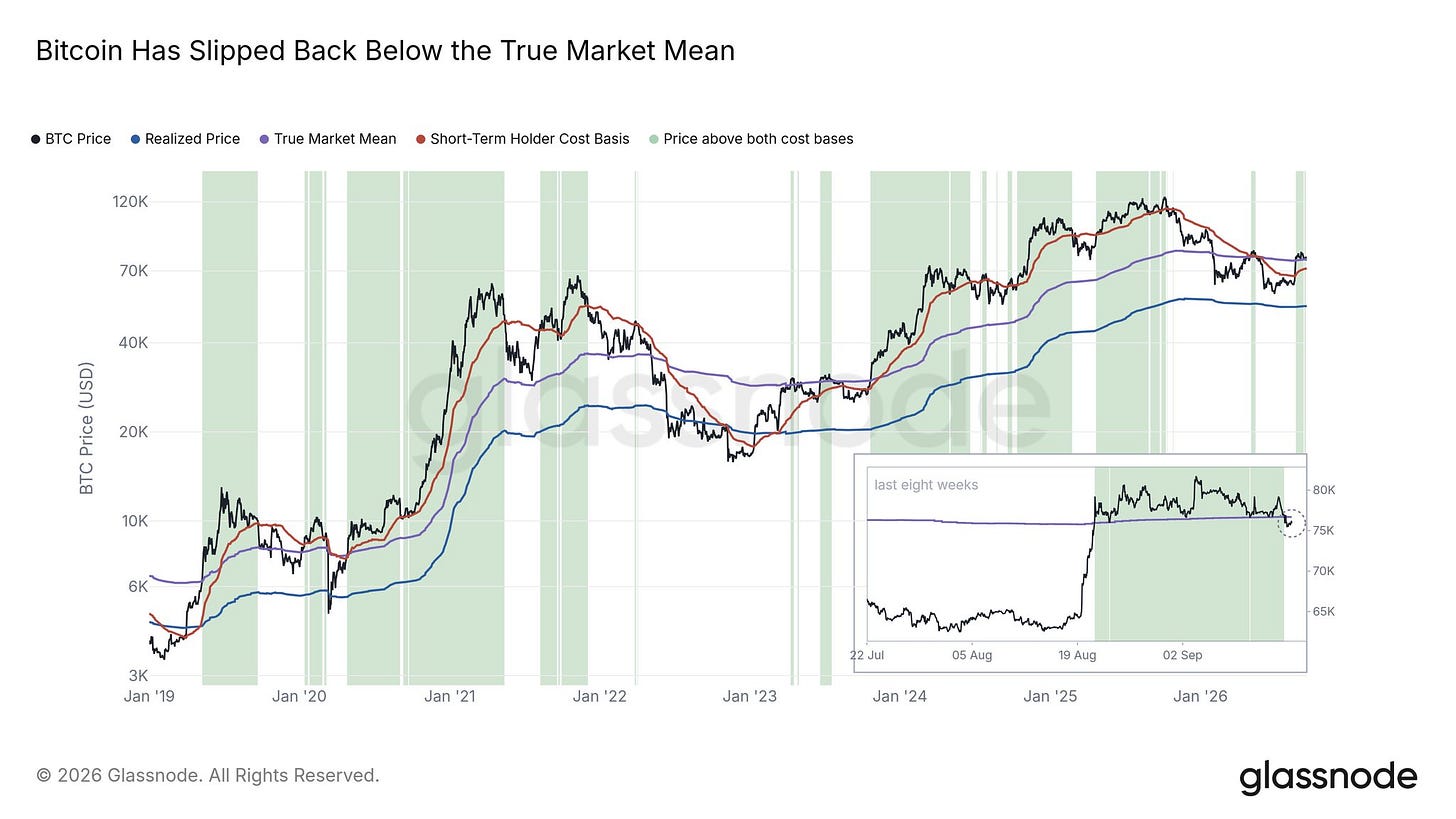
Glassnode’s weekly note said Bitcoin was trading around $76,000, down about 4.6% on the week. That move pushed it below the lower edge of the range that had held since late August and about 1% under the true market mean of $76,700. Given the week’s news flow, the report said, the drop was not especially dramatic.
It pointed to the failed Sept. 15 U.S. Senate vote on the CLARITY Act, bond markets pricing in Federal Reserve rate-hike expectations, and steeper losses in altcoins than in Bitcoin. On Aug. 23 and Sept. 10, Bitcoin briefly fell below the same level and then bounced back. Sept. 15 was the first close below it. If Bitcoin closes below that level again, the current move could stop looking like a temporary break and start looking like a confirmed range breakdown.
The next major cost basis sits at $71,300, which Glassnode identified as the average acquisition price for short-term holders who bought during the past five months. The report said the fresh capital that had supported the earlier rebound is now fading. Bitcoin’s realized cap had risen for 27 straight days through Sept. 14, but that streak ended. Sept. 15 brought the first capital outflow in 28 days, and incomplete data for Sept. 16 was negative too.
At the same time, exchange balances are still lower than they were a month ago, which suggests Bitcoin continues to leave exchanges. But here is the problem: the new capital that had been absorbing those coins has paused. U.S. spot ETFs show the same pattern. From Sept. 8 to Sept. 14, they posted about $334 million in net outflows after recording nearly $1 billion in net inflows over several days earlier in September.
Stablecoins, another possible source of incremental demand, have not grown in a meaningful way either. Total stablecoin market capitalization stands at about $301 billion, roughly flat on the week and about 4% below the April 2026 peak. Supply has stopped shrinking after the summer contraction, but it has not broken to new highs over the past five months.
Glassnode’s bottom line was that Bitcoin has lost the lower end of its range, but the break is not confirmed yet. Price is only about 1% below the true market mean of $76,700, and the decline has stayed fairly limited despite a week full of bad headlines. That resilience is the bulls’ main support. The trouble is there is not much fresh money around to keep that resilience alive. On-chain capital flows and ETF inflows have stalled, stablecoin supply is flat, corporate treasuries are underwater on aggregate and have slowed purchases, altcoins weakened first, and the options market is starting to charge a higher premium for downside protection while a large amount of call open interest hangs overhead.
The report laid out two conditions to watch. If Bitcoin can reclaim $76,700 for two straight trading days and realized cap growth resumes, the prior range may be restored. If it closes below that level again, the breakdown would be confirmed, putting $71,300 and then the $62,000 to $65,000 zone in focus.
Bankless co-founder says altcoin season has already started
In the project-profile section, Odaily said Bankless co-founder David Hoffman made a blunt call on Sept. 18: “We are already in altcoin season, and the real move has arrived earlier than expected.” The piece also said Hoffman had stated in May that he had fully exited ETH and rotated into altcoins including VVV, NEAR, ZEC, HYPE and LIT. According to the report, all of those tokens have strongly outperformed ETH since then.
With recent policy support from the SEC and other U.S. regulators, the article described a broad market jump. BTC broke above $81,000 the previous day. ETH moved above $2,600. UNI surged nearly 35% in a single day. ARB, NEAR and other second-tier tokens climbed more than 20%, and the DeFi sector as a whole was repriced. The report said that even though the Fed’s rate-hike cycle has ended, the engine for a crypto bull market now seems to be in place, and the window for capital rotation from BTC into altcoins is gradually opening.
It also cited Glassnode as saying altcoin leverage remains below the risk threshold. Markets usually get overheated when the gap between altcoin open interest share and Bitcoin’s shrinks to within a few percentage points. That setup, the report said, has not appeared yet.
Among the projects highlighted, Hyperliquid came first. The report called it the clear leader in on-chain perpetual DEXs, with several business lines expanding at the same time. Open interest on Hyperliquid reached $16.36 billion that day, a record high. Markets built on HIP-3 made up nearly 50% of the platform’s perpetual volume in the summer of 2026, up from about 2% at the start of the year. TradeXYZ’s stock market products, including Nasdaq 100 index and single-stock contracts, were said to dominate that segment. HYPE rose above $94 the previous evening, setting another all-time high, versus roughly $73 a month earlier. The article cited HyperliquidNews as saying cumulative buybacks and burns funded by the Hyperliquid assistance fund had topped $1.3 billion, making it the largest ecosystem token buyback program in crypto.
The piece also said Donald Trump had previously mentioned Hyperliquid in public, saying the CFTC chair was helping push its compliant entry into the U.S. market. Hyperliquid’s policy center and the official team were also described as steadily advancing related efforts tied to the U.S. equity market.
ZEC was another main focus. The report called it the only privacy token in this cycle to break above $1,000. Over the past year, ZEC has gained more than 2,500%. Its intraday high was reported at $1,595, close to $1,600, and its market-cap ranking had risen to No. 8 in the crypto market. In what the article called the “post-BTC era,” privacy features may still attract criticism, but the privacy-token story around ZEC has remained popular, with institutional capital supporting it as a “compliant privacy token.”
The report added several related items. Fortitude, a mining company focused on Zcash, is moving toward a listing and has named former Hut 8 CEO Jaime Leverton as chief executive, with plans to list on Nasdaq. It also said recent NFT and meme coin projects tied to ZEC have shown strength. Garret Jin, described in the article as the “10·11 insider whale” and long viewed as ZEC’s biggest bear, disclosed holdings worth more than $300 million, or about 202,100 ZEC. The report said his earlier ZEC short positions worth tens of millions of dollars may have been hedges.
GSR reviews token launch structures and the weak record of low-float, high-FDV deals
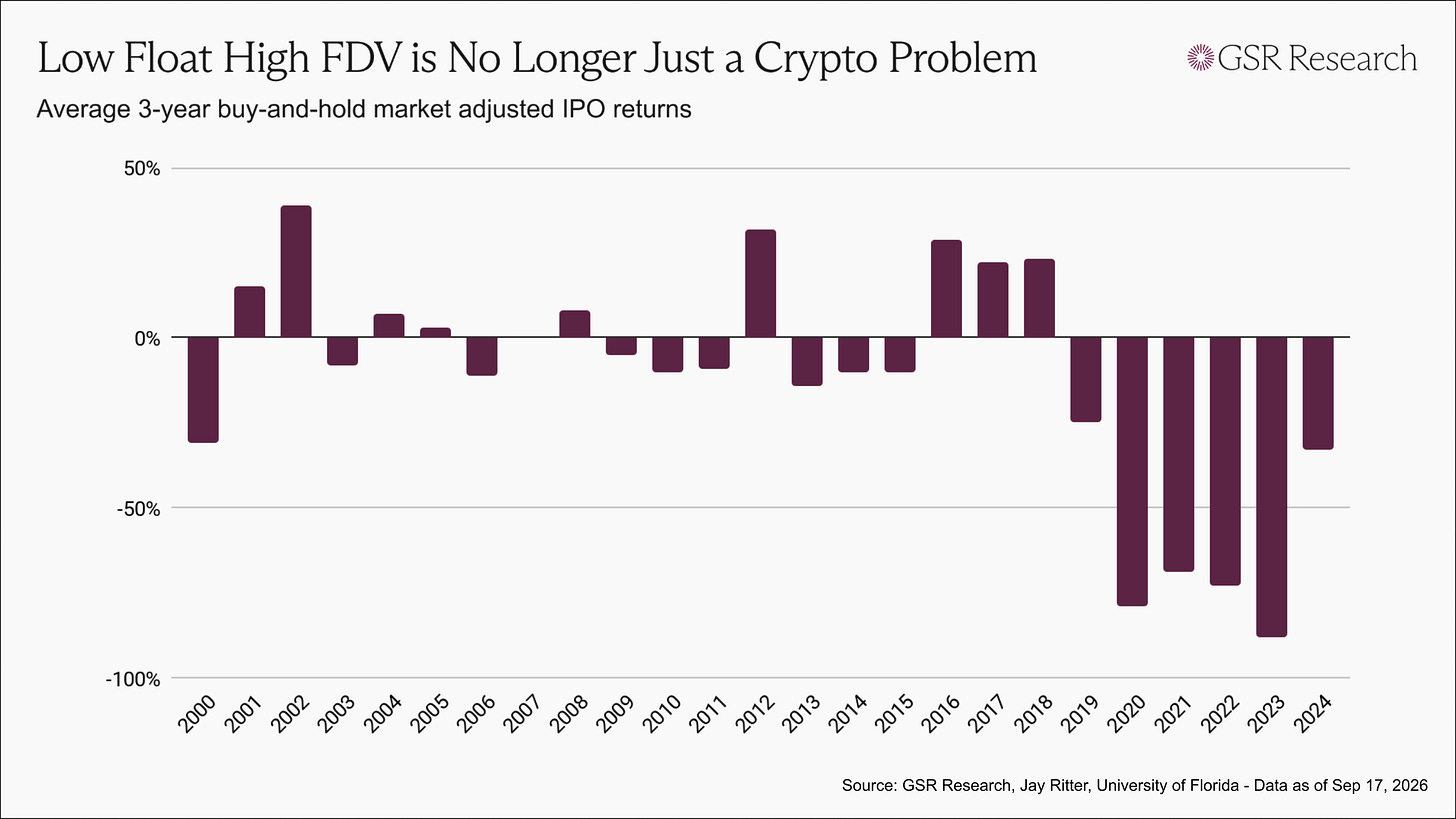
In the final research section, GSR’s research and advisory team went through token listing data from major exchanges going back to 2013. The dataset covered more than 2,300 token launches and tracked post-listing price performance, circulating supply ratios, fully diluted valuation and sector classification.
The data showed that during the ICO era, the median circulating ratio at first listing reached 38% to 41% in 2017 and 2018. As fundraising shifted toward private rounds, venture valuations became the benchmark, and points systems and airdrops replaced public sales, the median initial circulating ratio fell to about 13% by 2020. After that it only partly recovered, with most years sitting around 20%.
GSR also found a clear link between valuation and float. The higher the launch valuation, the lower the initial circulating ratio usually was. Tokens with FDV below $10 million had a median circulating ratio of 97%. Those between $10 million and $100 million sat at 28%. Projects between $500 million and $1 billion were at 16%. Projects above $1 billion were just 13%. In GSR’s view, high valuation and low float has become the industry’s default issuance model.
The problem with that setup is pretty plain. When only a small amount of supply is circulating, even modest demand can support a high headline valuation. On listing day, venture holdings and team allocations are marked at the market price, giving them a bigger paper value. Exchanges also get a newly listed asset with a large valuation. Public market buyers are the only group that can benefit from a lower entry price. Then the unlock schedule starts, and tokens that were previously illiquid begin hitting the market and getting sold against a price that was originally formed on very limited supply.
GSR’s numbers show how fast that usually happens. In less than three days after listing, the median token price is already below the issue price. After one month, the typical decline is about 20% to 25%. After 90 days, the drop nears 50%. The worst performers are projects launched above $1 billion FDV: every $1 invested in those names is worth a median of only about $0.19 one year later. Projects with initial circulating supply below 20% keep only about $0.23 to $0.26 per $1 after a year. Projects with 30% to 50% initial circulation keep about $0.55, more than double the low-float group.
GSR laid out three broad ways to improve things. First, projects should come to market at prices that leave room for both holders and traders to make money. Assets with long-term community support often let the public in early at lower prices. If the first public allocation is priced at the highest private-round valuation, holders begin from a disadvantage. Second, projects need to release enough supply for real price discovery. Initial circulating ratios should be meaningfully above the 13% to 20% lows seen from 2020 to 2022, and circulation should be judged together with valuation, not by itself. As a reference point, traditional IPOs usually float about 30% of shares, while 50% is already considered high. Third, the pool of people who can access early issuance should be widened. GSR listed co-investment platforms that let small investors participate on venture-style terms, reputation-gated allocations for real users, public sale platforms, on-chain auctions and fully circulating fair launches. Each model has trade-offs. Still, all of them move token issuance toward broader public participation.
Other headlines listed by ChainFeeds
ChainFeeds also included a separate list of daily headlines. It said the Uniswap founder claimed SBF had once bought the Uniswap domain name before the project’s legal team recovered it without payment. SlowMist founder Cos warned users about malware-style theft risks from apps such as ComeCome that disguise themselves as normal applications. The ZetaChain community approved a proposal to migrate ZETA to Solana. The TRUMP team moved 8.73 million TRUMP to BitGo, worth about $17.99 million. And the Fetch.ai attacker incident expanded in scope, with the attacker currently holding about $16.77 million in stolen assets.