
ChainFeeds published a new edition of its Daily research briefing on Sept. 29, pulling together market commentary, token design, onchain finance product competition and a Robinhood Chain meme scam case study. The issue centered on five topics: Lao Bai’s cycle view, Michael Saylor’s thoughts on digital financial infrastructure, the rise of crypto token buybacks, the battle for the onchain finance “super app,” and a scam pipeline that moved launch capital from one token to the next in as little as 16 seconds.

Lao Bai says RWA, perpetuals and privacy are the three lines to watch
In a featured conversation titled Is this the last meaningful crypto bull market? RWA, Perp and Privacy as three main lines, Lao Bai argued that the easy opportunities have largely been taken and that alpha is moving away from narrative alone and toward cash flow, distribution and product-market fit.
He said that, in terms of asset quality, he still sees BTC as the stronger asset, but in this cycle he personally expects to hold more ETH than BTC. Lao Bai said he does not rely much on complex chart indicators, yet the long-term downtrend line on the ETH/BTC weekly chart looks obvious to him, with a breakout level around 0.03. If the bull market continues for a few more months, he said, he does not believe ETH would break such a long-term trend line only to fall straight back below it, which is why his allocation would lean more heavily toward ETH.
For BTC, he laid out three scenarios: an optimistic case of $200,000, a neutral case of $150,000 and a bearish case of around $120,000, roughly back to the previous cycle high. If BTC reaches $150,000, he said, ETH should be able to outperform by another 50% to 60% after breaking its long-term downtrend against BTC. Even so, he added that ETH’s ceiling still depends on how far BTC can go, and that ETH is unlikely to lead the whole market on its own.
Lao Bai described HYPE and BNB as the most stable names in his view. On BNB, he said Binance has been the clear market leader for years and compared the token to Coca-Cola in beverages or NVIDIA in AI. In his words, it is “definitely very stable,” though its upside may be smaller than that of newer assets.
On HYPE, he said Hyperliquid is the leader in the perpetuals niche. He acknowledged that it already looks expensive, but argued that if Hyperliquid reaches the state it originally envisioned, with permissionless trading across all kinds of assets, continued HIP-3 expansion and solid data after HIP-4 goes live, then its theoretical upside could still exceed BNB’s. In the short term, he said he does not see a particularly clear reason for a sharp downside move.
He called SOL the most elastic of the three. Lao Bai pointed to its move from $2 to $250 in the last cycle, then back to single digits, and then back above $200. He said the chain has a very strong grassroots base, including the Foundation, developers and a group of Western Solana KOLs and users who have remained loyal. In his view, Solana’s biggest strength and weakness are the same thing: after FTX collapsed, no centralized exchange provided it with an absolute exit path, so much of the ecosystem had to rely on native onchain DEX infrastructure. That, he said, gave it a more crypto-native, cyberpunk and grassroots character.
He also discussed exchange competition. Lao Bai said the endgame comes down to user experience and resources. Using tokenized stocks as an example, he argued that if platforms ultimately connect to brokers such as Alpaca and route trades to Nasdaq or the New York Stock Exchange, then the stock itself is not the differentiator. Users are buying the same NVIDIA shares everywhere. The remaining differences are front-end UI and UX, fees and where users already keep their assets. The first platform to list such products can capture early curiosity, he said, but once everyone offers the same access, the advantage shifts back to the largest exchanges. If a user already keeps funds on Binance and wants to trade both crypto and stocks, while Binance still offers the best token selection and depth, that user will probably keep assets there. Only users focused solely on tokenized stocks may ignore crypto liquidity and choose the cheapest or safest platform instead. His conclusion was that once everyone has access to the same asset, the asset itself is no longer the moat.
Michael Saylor argues for always-on financial rails in a software economy
Another long-form section summarized Michael Saylor’s view that digital assets could grow into a $100 trillion industry.
Saylor wrote that digital intelligence will automate work, reshape industries and make existing products obsolete. Future prosperity, he said, will depend on whether society can create new companies and new opportunities at a faster pace. Someone who can build a product with AI should also be able to finance the company needed to bring that product to market. As the technical barriers to starting a company fall, the cost, complexity and time required to raise capital should fall as well. In his view, digital tokens offer a faster and cheaper way to form capital, and policymakers should create clear, workable issuance rules, disclosure requirements that match actual risk, and direct, simple channels for founders to reach potential investors.
He said small-business financing should not be limited to those who can afford large legal teams, and that the goal should be to let 10 million new companies access funding. Without that, he argued, the productivity gains from digital intelligence will not translate into new jobs, new products and more broadly shared prosperity. If policymakers protect existing business models while making it hard for the next generation of companies to raise money, the economy will not be prepared for technological change.
Saylor also said the economy is moving toward a system in which software performs more and more work. Tasks once handled through phone calls, websites and face-to-face interaction will increasingly be executed by software. AI agents, he wrote, will conduct research, negotiate, make purchases and coordinate with other agents. That kind of economy needs financial infrastructure that can run continuously. Money and capital must move at software speed and remain available 24 hours a day, 365 days a year.
Traditional finance, he said, was built around human identity, human interfaces and human working hours. As individuals and companies hand more activity to AI, they will need a practical way for their agents to transact on their behalf. That implies digital wallets, programmable payments, transferable assets and financial services that software can access directly. Bitcoin and other digital assets are naturally suited to that environment, he argued, because an internet-based agent needs capital it can identify and use digitally. It cannot move a gold bar at the speed of light, and it cannot wait months for a real estate transaction every time it needs to allocate resources.
He added that digital intelligence will increase the amount of productive activity that can happen across the economy, while digital assets can help finance and coordinate that activity. The intersection of the two, he said, is likely to be where the next wave of innovation clusters.
On tokenized securities, Saylor said they can allow stocks and credit to move across markets around the clock, but their biggest promise lies in giving asset owners more ways to use what they own. Investors should be able to hold tokenized securities directly, move them to service providers of their choice and use them in competitive custody and credit markets. Companies, he said, should have the same rights.
He gave the example of an investor holding $1 million in stock. One provider may offer better financing terms, another may offer yield opportunities, and a third may offer better service. Investors should be able to compare those options and move assets freely based on their own needs. Even if someone ultimately chooses a custodian, the ability to self-custody still matters because the option to leave gives customers bargaining power. If assets can move freely, providers have to compete to retain clients. That competition can improve service, lower borrowing costs and allow asset owners to capture more of the economic value generated by their assets. If securities are merely placed onchain but remain trapped inside the same closed intermediary structure, he said, much of tokenization’s potential is left unrealized. The real policy goal, in his view, should be to expand the choices available to asset owners.
Crypto buybacks are spreading, but the word alone says little
An English thread titled Crypto buybacks are here? 12 tokens worth watching focused on which projects are actually linking protocol revenue to token value.
The piece said the industry spent years creating tokens that had little connection to the businesses behind them: a protocol could make $100 million while token holders got governance rights and little else. That model is now changing, the author wrote, as more protocols begin using real revenue to buy back their own tokens from the market. A protocol that actually spends $10 million to buy and burn tokens is very different from one that announces a possible future buyback proposal that still needs governance approval. As revenue returns to the center of crypto narratives, the key question is which projects have built a real connection between product usage, protocol revenue and token demand.
Hyperliquid was one example. User trading generates fees, and roughly 99% of those fees currently go through the Assistance Fund to buy HYPE, with the purchased tokens leaving active circulation under the current mechanism. In practical terms, the article said, users trading BTC, ETH or other perpetuals at 3 a.m. generate revenue for Hyperliquid, and a large share of that revenue becomes buy pressure for HYPE. The variable to watch is Hyperliquid’s trading volume and revenue. If it keeps gaining meaningful market share, the capital supporting HYPE purchases should keep growing. If trading activity contracts sharply, that buying power should fall as well.
Aave was presented as a different case. Revenue comes from lending markets, and the DAO uses part of protocol income to buy AAVE on the market. The original plan was about $50 million per year, though discussions in 2026 considered lowering that to around $30 million as revenue conditions changed. The article stressed one major difference from HYPE or a classic buy-and-burn model: the AAVE purchased by the DAO goes into the Ecosystem Reserve. That means the DAO is accumulating its own assets, and those tokens can later be used for incentives, staking, grants or other purposes. In other words, the word “buyback” is not enough on its own. What matters is the full balance sheet and where the bought tokens end up.
EtherFi uses another structure. Rather than emphasizing permanent destruction of ETHFI, it directs the value created by buybacks toward participants in the token economy. Part of the withdrawal fee revenue from eETH is used to buy ETHFI every week, and part of the revenue from other Ether.fi ecosystem products can support additional monthly purchases. The ETHFI bought is mainly distributed to sETHFI holders. The article described this as something closer to a token-denominated dividend: EtherFi earns revenue, uses that revenue to buy ETHFI, and people who lock ETHFI receive part of that value. Those tokens still exist, of course, and recipients can eventually sell them. That leads to a broader question for all buyback models: is it better to destroy assets permanently, or to use revenue to make holding and locking the token economically meaningful?
The author warned that “buyback” may soon become one of the most abused words in crypto. The real question is where the money actually goes. One metric worth watching is the ratio of annual buyback size to token market capitalization. If a protocol worth $500 million can consistently spend $50 million a year buying its own token, that matters. If a $10 billion token announces a $5 million buyback while $500 million worth of tokens are unlocking, the buyback is close to irrelevant.
The article also highlighted NetNet’s mechanism. Each NET is tied to a portion of the protocol’s balance sheet through NAV. When NET trades below NAV, the protocol can buy back NET at roughly “net asset value minus 1.5%” and burn the purchased tokens. That means the protocol is not buying mechanically every day regardless of price. It buys when the market values NET below the asset value backing it. On the other side, when the price rises above a certain NAV multiple, NetNet can issue new NET through bonds and add the proceeds to the treasury. The article’s conclusion was that crypto protocols have finally learned how to generate revenue, and the next thing to watch is which ones can make that revenue matter for their tokens.
Wallets, DEXs and CEXs are converging on the “super app” model
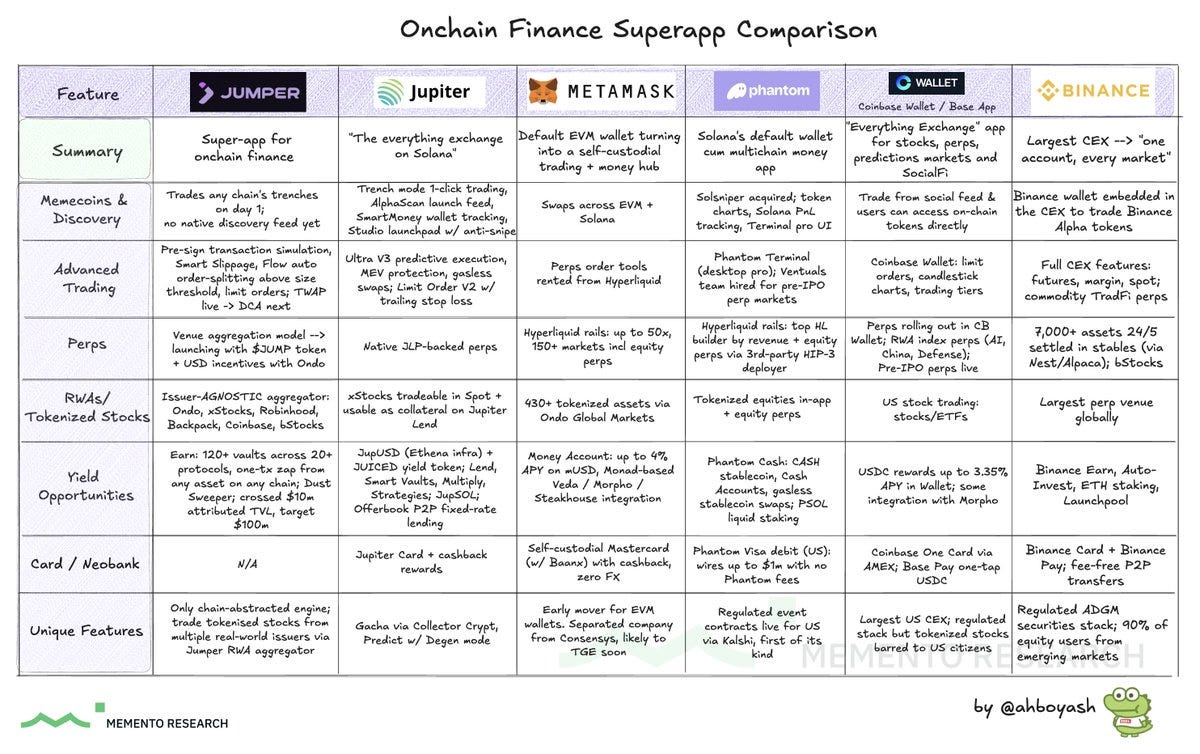
A separate English thread, The battle for the onchain finance super app: the boundaries between wallets, DEXs and CEXs are disappearing, looked at the fight to become the main user entry point for onchain finance.
Author Ash wrote that every onchain finance app is chasing the same goal: to become the app users no longer need to leave. In the past, the division of labor was clear. Wallets stored assets, DEXs handled trading and bridges moved assets from one chain to another. That separation is now breaking down. Products across categories are competing for the same territory and trying to become the single app users open every day to do everything.
According to the article, Binance, Coinbase and Jupiter are pushing in from the CEX and DEX side, while MetaMask and Phantom are moving in from the wallet side. Each platform is layering in features that once belonged to separate product categories, including perpetuals, RWA, yield products, bank cards and social feeds. The market is shifting from competition among single-function products to competition around a unified user entry point.
In RWA aggregation, Jupiter, MetaMask and Phantom each mainly connect to one tokenized stock provider, most often Ondo Global Markets. Jumper, by contrast, aggregates six issuers at once: Ondo, xStocks, Robinhood, Backpack, Coinbase and bStocks. The article said Jumper’s approach is to remain issuer-neutral rather than depend on a single RWA provider, echoing its earlier strategy in bridge aggregation.
On yield products, Jumper supports one-click bundled transactions across more than 120 vaults and more than 20 protocols, and it offers a Dust Sweeper feature to clean up small leftover wallet balances. On advanced trading tools, it already includes pre-signature trade simulation, smart slippage and automatic order splitting once an order exceeds a certain size.
The article said Jumper first built its name as a bridge aggregator. By cross-chain trading volume, it once ranked first with about 15% market share. It now has roughly 100,000 monthly active users and ranks among the top 10 aggregators by swap volume.
Ash argued that the sector is consolidating quickly, but the eventual winner may not be the app with the longest feature list. There is no clear winner yet, only leaders in specific functions. Teams that can keep complexity hidden behind the product, lower the barrier for ordinary users and still give advanced users the tools they actually need are likely to widen their lead.
For Jumper specifically, the article said the current core bet is to get chain abstraction and asset coverage right first, then fill in the rest over time. But in distribution and consumer-facing products such as bank cards, mini apps and asset discovery, wallets and CEXs already have a head start. Jumper still lacks a native meme-token discovery feed, has not launched perpetual aggregation, and does not offer a bank card or neobank product. At least for now, the article said, there are still very few competitors that both avoid dependence on a single issuer in RWA and keep expanding toward the super-app model.
BlockBeats details a meme scam factory on Robinhood Chain
The fifth section, attributed to BlockBeats, examined a meme-token scam pipeline on Robinhood Chain tied to Pons V2 and argued that older safety checks are no longer enough.
The report said that late at night on Sept. 21, 2026, a token called DEED opened trading on Robinhood Chain. Its bonding curve was bought out within a few blocks, the token “graduated” early and moved into a Uniswap v4 pool connected to Pons V2. Under the rules, the pool’s LP was permanently locked. Security plugins then showed a series of green checks: sellable, not a honeypot, liquidity locked. In the first few minutes, it looked like a normal hot meme launch.
DEED was framed as a “real estate vault on Robinhood Chain”: rent would flow into a vault, and DEED holders would share rental income. It had an X account, @DeedEstate, a website and language such as “The Roll to be announced on the 1st,” which made it look like an RWA-style project. But one thing was off. In the first second after launch, 86% of the supply had already been distributed across 98 addresses. Those 98 addresses were funded at nearly the same time, bought at nearly the same time and then began selling at nearly the same time.
Twelve hours later, DEED’s market capitalization had fallen from a peak of roughly $3 million to $4.3 million back to nearly zero, a 99% drawdown. About 229 ETH, or around $630,000, had been extracted, and the launch also generated $180,000 in creator revenue for Pons. The capital used to start that launch, the report said, had arrived 16 seconds earlier from another token that had just finished distributing out.
An onchain analyst named Wazz documented that 16-second handoff. On Sept. 27, he posted a fund-flow chart covering 53 tokens and 53 launches from July 10, 2026 through Sept. 21, with a combined total of about $18.43 million, or roughly 7,447 ETH. The report said that was only the portion that could be identified.
According to BlockBeats, Pons V2 works in a way that closely resembles pump.fun: a fixed supply of 1 billion tokens, a bonding curve, automatic migration to Uniswap v4 after the curve fills at roughly 4.2 ETH, and permanently locked LP. In the first few seconds after launch, there is also an anti-sniping tax that starts at about 99% and decays to zero within seconds. The original purpose was to stop bots from sweeping the cheapest supply in the first second. But the rules left a back door: the creator can whitelist up to about 32 addresses at launch and exempt them from the tax.
The report said that loophole is what these groups exploited. Older rug pulls blocked the exit by removing liquidity, blacklisting wallets or imposing a 99% sell tax. Pons works differently. The path is open, the pool is permanently locked and the token can be sold at any time. The problem is that the cheapest supply in the first second has already been taken by insiders.
DEED was not even among the top 10 cases in Wazz’s list. The three largest extractions were CRUMBS at about $3.12 million with 92 wallets involved in the initial buy, LEGS at about $2.9 million with 77 wallets, and PINK at about $1.44 million with 125 wallets. The operating pattern was the same each time: use 70 to 200 wallets as camouflage and capture more than 70% of the supply. One reconstruction found that tax-exempt wallets plus the creator could end up with 82% to 86% of supply after launch.
BlockBeats listed six structural features. First, the pool is locked, but the token is still sellable. After Pons V2 graduation, LP goes into Uniswap v4 and stays locked permanently. Second, 70% to 86% of supply is taken internally in the first few seconds. Third, the creator exempts 15 to 32 addresses from the anti-sniping tax, then uses one transaction within one to three blocks to help those addresses buy together. Outsiders who try to buy in the first second face a tax near 99%, while insiders do not. Fourth, positions are split across dozens or hundreds of fresh wallets. It is not one obvious operator wallet holding 80%; it is 70 to 200 addresses that look like ordinary users but collectively hold 80%, making the holder distribution appear dispersed by design. Fifth, the new wallets share a very uniform pattern. Many EOAs have only four to 11 transactions, following the same path: receive a small amount of ETH, buy or receive tokens, approve, sell in batches, then send ETH to the same collection address. Sixth, the money moves like an assembly line rather than a one-off trade. ETH from the previous launch is sent to the next funding key within seconds to tens of minutes. Each launch can look independent on its own, but the fund-flow chart links them into a single chain.
The report added that the packaging is more convincing than in older meme scams: fake websites, fake product narratives and fake launch sequences. A contract address may be hyped first to trigger FOMO, followed by the announcement of a “formal contract.” Posts from KOLs are often deleted soon after the rug.
At the top of the same ChainFeeds briefing, the outlet also listed several daily headlines: Xie Jiayin said the restoration of withdrawals would not give priority to institutions, VIPs or employees; unnamed sources said Blockchain.com is seeking a $500 million IPO at a valuation that could reach $6 billion; the U.S. Securities and Exchange Commission updated its crypto FAQ and said token buybacks without a central actor usually do not constitute investment contracts; ZachXBT said a group suspected of laundering Bitget stolen funds for North Korean hackers had publicly asked for help; and Polygon Chain staking rewards are expected to rise to 7.7% on Oct. 1.