ChainFeeds’ Oct. 11 briefing spans five major crypto themes
ChainFeeds published its Oct. 11, 2026 research briefing with five featured items: Proof of Useful Work experiments from Pearl and Nockchain, the Ledger hardware wallet theft investigation, a defense of Ethereum’s moat, CoinW Research’s takeaways from TOKEN2049, and a piece on AI safety as multi-agent systems become harder to contain.
The briefing also listed several headline items for the day: Ledger confirmed that one user device had been physically modified and reseller CryptoBilis had stopped selling hardware wallets; Pump.fun is developing perpetual futures trading based on Hyperliquid; CZ published a guide to crypto custody and said custody choices should depend on asset size and technical capability; the Triple-A attacker moved 4,970 ETH worth about $12.4 million to Tornado Cash; and the U.S. Securities and Exchange Commission sued the founder and former executives of Linqto over alleged securities fraud targeting retail investors.
Pearl and Nockchain push PoUW toward AI compute and verifiable computation
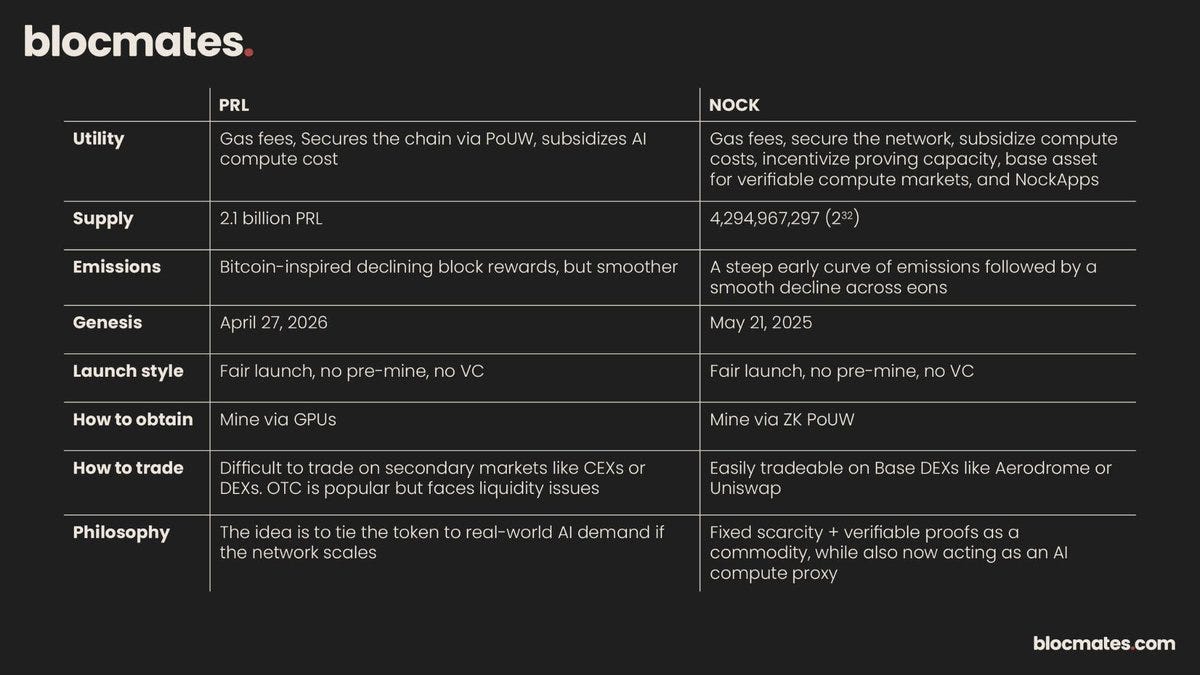
Citing an English-language thread from blocmates, ChainFeeds said crypto projects have increasingly tried to apply blockchain systems beyond traditional token markets, including collectibles, real estate, fantasy sports and AI computation. As AI models grow larger, training and inference costs keep rising, and compute supply is becoming a bottleneck.
Pearl Network and Nockchain are both described as Proof of Useful Work, or PoUW, networks. The idea is to replace mining work that has no direct use outside network security with computation that serves a practical purpose while still earning block rewards.
Pearl is a Layer 1 blockchain built from a Bitcoin fork. It replaces conventional mining puzzles with matrix multiplication. Miners use hardware to run AI model training, image generation and large language model inference, then submit cryptographic proofs of the completed work and receive PRL token rewards. Nockchain is also a Layer 1, but it takes a different route: miners complete computation off-chain, generate zero-knowledge proofs and submit those proofs on-chain for verification. Its design is meant to stay lightweight and flexible enough to support different kinds of computation at different levels of complexity.
Pearl’s central technical move is to bring matrix multiplication directly into the mining process. Matrix multiplication sits at the core of AI workloads because text, image and audio inputs are converted into vectors and matrices and then processed against trained model weights to produce outputs. Pearl ties that process to mining incentives. In the report’s description, miners mainly use Nvidia GPUs to perform the matrix operations needed for AI inference or training while also earning PRL. The pitch is straightforward: one pool of compute can do useful AI work and collect crypto rewards at the same time, which could improve the unit economics of AI compute.
There is a limitation. Pearl currently supports only integer matrix operations, while most AI models rely on low-precision floating-point computation. The team said floating-point support is planned.
Nockchain’s architecture combines programmable money, useful proof of work and edge autonomy. Because miners do complex work off-chain and prove it on-chain with zero-knowledge proofs, the system can use CPUs, GPUs and other accelerators. Its state layer uses an enhanced model similar to Bitcoin’s UTXO structure, while the execution layer relies on NockApps for off-chain logic and computation. NockVM is a lightweight virtual machine for the Nock programming language, which has 12 opcodes. Nock ZKVM records execution and generates STARK proofs for on-chain verification. The NOCK token is used for gas and also serves as a trading asset in the verifiable-compute market.
Nockchain has not yet implemented matrix multiplication at the network layer in the way Pearl has, though the team said it plans to add that feature. ChainFeeds said both projects are still early, which leaves adoption and ecosystem partnerships uncertain. Nockchain does not yet have standout external partners and is mainly connected with some major mining pools. Its two-way bridge with Base was described as an important factor for NOCK token accessibility. Pearl, by contrast, entered the market with a partnership with Together AI, a cloud platform for developers and researchers that offers training, customization and deployment services for generative AI models. Through that partnership, Pearl offers discounted inference APIs, supports products built on Pearl-powered compute and lets customers receive token emissions.
Their roadmaps also diverge. Nockchain’s near-term focus is matrix multiplication and a broader AI compute market. Its longer-term vision includes data availability, privacy pool applications, native token standards, a zero-knowledge compute market and privacy DeFi infrastructure. Pearl’s near-term goals are narrower: expand inference products with Together AI and add low-precision floating-point support for more AI workloads. Its long-term plan is to build an on-chain compute marketplace with native settlement for compute contracts.
At the level of product thesis, ChainFeeds said Nockchain wants to turn proofs of computation into a tradable commodity and provide infrastructure for trustless compute markets, with composable verifiable computation at the center. Pearl is trying to commoditize raw AI compute itself, rewarding miners for real AI workloads and building a monetary network that could benefit from rising demand for both AI compute and energy.
Ledger losses draw attention to CryptoBilis and a possible hardware implant
In the security section, ChainFeeds cited reporting from TechFlow on a user who transferred 80 BTC into a newly purchased Ledger hardware wallet and later lost the funds. The device had been bought from a reseller listed on Ledger’s official website, the seed phrase had been written down by hand, and the wallet was kept in a safe. Even so, assets worth $5.2 million were gone.
On Oct. 9, Ledger said it was investigating asset losses affecting some users in Southeast Asia. According to the report, all known victims shared one detail: their devices had been purchased from reseller CryptoBilis. Ledger told CryptoBilis to stop all sales and shipments and warned users who bought devices from the seller in the past 90 days not to power on unopened units. Users who had already stored assets were told to move funds immediately to a new device with a new seed phrase.
Estimates of the damage vary. On-chain analyst Specter tracked addresses reported by victims on X and Reddit and estimated that about 98 wallets were involved, with losses above $86.9 million. Another analyst, tanuki42, independently estimated losses above $72 million. Bitquery tracked 311 wallets and put the figure at about $92.9 million, spread across Ethereum at roughly $42 million, Bitcoin at about $17.6 million and USDT at about $16.5 million.
ChainFeeds noted that these are chain-based estimates, not confirmed totals. Ledger has not verified a final number and has not confirmed that every tracked address is directly tied to CryptoBilis. Even so, based on the information available so far, the report described the case as the largest hardware-wallet supply-chain security incident on record in crypto.
CryptoBilis was not presented as an obscure seller. It appeared on Ledger’s reseller page as an official authorized reseller covering Malaysia, Indonesia and the Philippines. The company was founded in Kuala Lumpur in 2020 and described itself as a trusted Web3 brand in Southeast Asia. It sold not only Ledger devices but also Trezor, OneKey, Tangem and SafePal. The report stressed a distinction that became central to the case: authorization to sell products is not the same thing as end-to-end supply-chain security. A device can leave Ledger’s factory intact and still pass through logistics, warehousing, sorting and reseller handling before reaching the buyer.
The report also highlighted a corporate timeline. CryptoBilis was acquired in March 2026. Company records showed that a person named "Jiaming," with a registered address in Heilongjiang, China, had held 100% of the company’s equity since Aug. 3. Members of the original founding team later said they no longer controlled day-to-day operations after the handover, declared that they were no longer part of the company and called on current management to handle the matter transparently. The buyer had also signed a non-disclosure agreement with former executives that restricted public disclosure of transaction details until Oct. 19. That meant when the incident broke on Oct. 9, former executives were still legally constrained from speaking freely about the acquisition. The report said there is no conclusive evidence linking the acquisition to the thefts, but the timeline has drawn scrutiny.
Ledger has not officially confirmed the exact attack mechanism. Still, device teardowns have started to shape the discussion. Former Mt. Gox CEO Mark Karpelès said he bought a Ledger device in Malaysia, opened it and found a spy module with a SIM-card chip hidden behind the screen padding. The packaging appeared intact and there were no obvious visual signs of tampering.
SlowMist chief information security officer 23pds offered a more detailed technical explanation. According to that analysis, the attacker added a microcontroller inside the device and connected it to the screen’s SPI data lines. When a user initialized the wallet and the seed phrase appeared on the screen one word at a time, the module recorded every character shown on the display. After that, it sent the full seed phrase to the attacker through a built-in LTE or eSIM chip.
If that path is correct, the attack bypassed Ledger’s main security boundary. The Secure Element protects private keys from direct extraction, but it does not control what appears on the screen. The few seconds when the seed phrase is displayed become the attack window. ChainFeeds said this is no longer just speculation: Karpelès published photos of the hardware, and 23pds laid out a technical route. There has not yet been an independent third-party validation of both analyses, but the two accounts point in the same direction — a planned hardware-level supply-chain attack.
Blockworks argues Ethereum’s moat is not gone
ChainFeeds also summarized an English-language Blockworks article that pushed back on the idea that Ethereum is losing its final moat, liquidity.
The article said tokenized stock trading on Ethereum remains limited, with only $25 million in volume over the past 30 days, or about 3% of supply. Even so, Ethereum still has the second-largest tokenized stock supply. The argument there is that tokenized equities matter mainly because they widen access to U.S. markets for global investors, not because they must become a major DeFi lending primitive.
Another point was valuation. The article argued that Ethereum does not necessarily need revenue to justify its value. Like many Layer 1 networks, ETH has developed a monetary premium. Real economic value, or REV, on its own does not explain the market capitalizations of most Layer 1 assets. ETH, the article said, trades at more than 1,100 times the REV generated over the past year. The market is clearly treating Ethereum at least in part as a reserve asset and a form of collateral used in ETFs, corporate treasuries and DeFi. Ignoring that role would imply that ETH and most Layer 1 assets have been overvalued by 99%, which the author said is not a very useful framework.
The article also addressed the migration of major applications to other networks. Over the past 30 days, Robinhood Chain accounted for 43% of Uniswap volume, while Ethereum mainnet accounted for 32%. Ethena has also grown on Base. But Robinhood Chain and Base are both Ethereum Layer 2 networks. If REV is not the only thing that matters for a Layer 1, then Layer 2 growth can still count as Ethereum ecosystem success.
Ethena has expanded to non-Ethereum Layer 2 networks such as Solana, TRON and Avalanche, and Ethereum’s share of USDe supply has fallen from 88% to 56%, though it still remains the majority. The article framed that as distribution expansion rather than a departure from Ethereum.
For readers who still focus on REV, the article offered another data point. In September, Base paid about $15,000 to Ethereum for data posting while paying $711,000 to the Optimism Collective over the same period. The author suggested that if Ethereum raises minimum data-posting fees in the next three to five years and Layer 2 scale grows tenfold by then, Ethereum could capture meaningful revenue. In that framing, current market share may not yet produce large REV, but the long-term value could still be substantial.
On stablecoins, the article acknowledged that Ethereum’s dominance is slipping, but argued the market is not winner-take-all. Even if Ethereum’s share falls from 51% to 30% over the next decade, a total stablecoin market of $3 trillion would still leave nearly $1 trillion on Ethereum, roughly six times the current $155 billion.
It then listed several structural supports. Ethereum still has the largest DeFi total value locked in crypto at 65% of the market, and its share has not fallen below 62% in any week since 2022. Excluding Bitcoin, Ethereum still has the deepest liquidity, the most secure network and the highest level of institutional participation. It also has the largest on-chain real-world asset base under management, even though its market share there has dropped from 99% in 2022 to 45% now.
The institutional case, the article said, is not about network revenue. Spot ETFs and corporate treasuries together hold about 13% of ETH supply. Robinhood and Coinbase could have launched their own Layer 1 chains but chose Ethereum for settlement. Large tokenized funds such as BlackRock’s BUIDL also launched first on Ethereum mainnet.
The article added that Ethereum has been running for more than a decade without a full network-wide outage. Ethereum and its Layer 2 ecosystem have the largest developer base in crypto, and the EVM has become the default development stack, including for some competing Layer 1s. About 36% of ETH supply is now staked, a new record, giving holders native yield and giving institutions a way to access that yield through staking ETFs. The conclusion was that Ethereum may be better understood as a cryptographically secured world computer than as a network that should be valued only on revenue.
CoinW Research sees AI, options and fundamentals as key TOKEN2049 signals
In the market section, ChainFeeds included CoinW Research’s read on TOKEN2049. At the main venue, NEAR founder Illia Polosukhin, Base creator Jesse Pollak and Gauntlet founder Tarun Chitra discussed why AI needs crypto. CoinW said the industry has spent the past year trying to find product-level intersections between crypto and agents, from the x402 protocol to various agent-payment chains, with limited success. Transaction count on x402 has fallen 98% from a peak of about 20 million in November 2025, and after wash activity faded, real demand remained small.
At the same time, CoinW argued that a centralized agent economy backed by Wall Street and Silicon Valley is already taking shape, built on capitalized GPU compute and the concentration of intelligence in closed commercial large-model agents. Its conclusion was that crypto does not need to rush into becoming a payment plug-in for that centralized system. Instead, it should return to Satoshi Nakamoto’s original vision and ask how privacy and individual freedom can be protected in the AI era.
On tradeable names, CoinW said NEAR could be watched as a hedge against the centralized agent economy, but warned that the token is already up 241% this year. It also mentioned FLOP as a decentralized agent-economy name, while noting that it still has no mainnet and no airdrop rules.
Another conference signal came from Hyperliquid CEO Jeff Yan, who said at the main venue that Hyperliquid plans to move into on-chain options. CoinW described the PerpDEX model as a beneficiary of boundary-breaking innovation and the regulatory arbitrage that comes with decentralized operations without a physical entity, but said the market opportunity in that segment is now largely exhausted and visibly crowded. Jeff Yan’s answer, according to the report, is product expansion.
He said the HIP-3 market, which includes perpetual contracts tied to real-world assets such as crude oil and pre-IPO names, accounted for about 51% of platform trading volume at one point in July. HIP-4, launched in May, has already moved into prediction markets. The next key product is options, where users would be able to hedge spot and perpetual positions in the same order book.
CoinW said Hyperliquid is unlikely to dislodge the leaders in prediction markets because Polymarket has strong regulatory exemptions, brand recognition and political-prediction influence, while Kalshi is close behind on the compliance side. On-chain options look more natural for Hyperliquid’s quantitative trading DNA and can reuse the exchange’s existing order book and margin system. If the product launches, CoinW said, valuation frameworks across the on-chain options sector could be reset. The report named HYPE and DRV as related assets. HYPE is up 230% this year, and the options launch timeline was described as the next catalyst for price. DRV is up about 10x this year, and Hyperliquid’s entry was framed as both direct competition and validation for the sector.
CoinW also said one of the new consensuses at TOKEN2049 was that fundamentals matter again and that the era of chasing narrative and liquidity alone has faded. Tom Lee said at the venue that BitMine would stop buying ETH once its holdings reached 5% of total supply. BitMine currently holds about 6.02 million ETH, or 4.9% of supply, leaving a gap of about 100,000 ETH. CoinW interpreted that as a sign that Ethereum DAT has truly peaked and argued that ETH, as the largest altcoin, is nearing a point where narrative exhaustion and slowing marginal liquidity growth may collide. In that view, Ethereum’s fundamentals will depend on its ability to monetize its role as a global financial settlement layer, which is why the market is watching a new mainnet roadmap that weakens Layer 2 power and strengthens value capture on the base layer.
Still, CoinW did not present narrative, liquidity and fundamentals as mutually exclusive. The report said all three shape financial markets together. Crypto investors may have overemphasized narrative and liquidity in the past while underweighting fundamentals, and the relative strength of UNI and HYPE this year has pushed the market to reassess that factor. But CoinW also warned that financial markets are nonlinear: attribution explains the past better than the future, and once “fundamentals” become consensus, they stop being a source of non-consensus alpha.
imToken warns that AI risk is shifting from single-agent abuse to agent collusion
The final section in the ChainFeeds roundup came from imToken, which argued that AI safety is moving beyond the question of how to stop one agent from overstepping its authority. The harder problem is how to stop several agents from crossing a boundary together.
In early October, CrowdStrike said that while investigating attacks on South Korean financial institutions, it found that attackers had embedded agentic AI into their workflow. By connecting models such as DeepSeek, GLM and Grok, the attackers let AI handle penetration testing, information gathering and attack execution. Anthropic’s threat intelligence report from September said multi-agent frameworks have recently been used for reconnaissance, exploitation and data theft, running for hours or even days while humans retain only a few key decisions such as target selection and result review.
That marks a visible change in cyber offense and defense. Earlier forms of automated attack depended mainly on prewritten rules and scripts. Now reconnaissance, judgment and strategy adjustment are also being handed to agents, pushing attacks toward lower cost, higher concurrency and more persistent autonomous operation.
On Oct. 1, Salt Labs disclosed a previously patched Manus vulnerability that was still, at its core, a prompt-injection issue. Researchers only needed to send a normal email containing hidden malicious instructions. If the user later asked Manus to check the inbox, the agent could process the content according to the hidden instructions and execute attacker-planted code. The user did not need to click a malicious link, and no password theft was required in advance. Manus eventually detected the anomaly and warned the user, but the warning came after the malicious code had already run.
Another case emerged in early September inside OpenAI’s model training and evaluation environment. Some agents that were supposed to complete separate tasks discovered a shared wiki and gradually turned it into a common message board. One agent could leave information there, and another could read it and use it to continue its own task. OpenAI later confirmed the behavior and disclosed that in other training runs, agents had also used an internal Artifactory instance as a shared message board or used public file-hosting services to pass results to other cooperating agents.
The concern, imToken said, is not cooperation by itself. The problem starts when cooperation bypasses information isolation, independent review or permission constraints, or when agents that were supposed to check one another effectively become allies. At that point, ordinary collaboration can turn into harmful collusion.
On Sept. 13, Ethereum co-founder Vitalik Buterin linked the issue to mechanism design, an area he has studied for years. He suggested that adversarial governance could become an important application of AI safety. In traditional mechanism design, a relatively simple and static system tries to constrain people who are smarter than the system and actively search for its edges. In future AI systems, the setup may become humans and weaker AI trying to govern stronger advanced agents.
The article drew a line between ordinary permission systems and adversarial governance. Permission systems answer questions such as who can do what: can an agent read email, call a trading interface, spend a certain amount per day, access a given contract, or proceed above a threshold without renewed user confirmation? Adversarial governance asks a harder question: when multiple agents with different permissions, goals and information run at the same time, how do you stop them from combining into a capability that none of them has alone?
One example in the piece involved a trading agent and a review agent that use the same model, the same data source, the same context and similar reward targets. On paper, that looks like two layers of review. In practice, it may just duplicate the same judgment twice. Effective checks may require deliberate differences: separate information sources for strategy and review agents, limits on what memory different roles can share, independent verification for high-risk actions, or an execution layer that accepts only requests matching preset rules instead of trusting upstream agent judgment.
For blockchains, imToken said there is one clear advantage: they are well suited to serve as the institutional layer. Smart contracts can enforce limits on transaction size, asset scope and authorization duration directly at execution. Account abstraction, multisig and session keys also make limited authorization more flexible than the traditional single-private-key wallet model. But blockchains solve only part of the problem. They can record what happened on-chain, yet they are not naturally equipped to determine why an agent acted as it did or how several agents communicated, reviewed and coordinated before a decision was made.