
ChainFeeds on Oct. 10 published a research roundup spanning AI-related cryptography risk, Ethereum’s Glamsterdam upgrade path, shifts in the 2026 third-quarter crypto funding market, the financialization of compute, and Starknet’s proposal to reposition itself as an independent Layer 1.
AI math advances and the case for a blockchain recovery switch
In a piece titled “Why blockchain governance must enter wartime mode as AI accelerates mathematical breakthroughs,” Haseeb Qureshi argued that the industry should start planning for a failure of core cryptographic assumptions rather than treating it as a distant edge case. The article said OpenAI released 722 mathematics papers two days earlier, a moment some described as the most important in the history of mathematics, and claimed that some century-old foundational problems were being solved with roughly three hours of compute per problem on average.
The essay cited Scott Aaronson as saying OpenAI is shifting research attention toward breaking cryptography. Qureshi’s argument was that the more immediate concern is not AI speeding up quantum computing, which still depends on large-scale physical engineering, but an unexpected mathematical breakthrough that overturns the assumptions behind classical cryptography and allows ordinary computers to solve discrete logarithms. That would break modern public-key cryptography without waiting for practical quantum hardware.
The article framed the issue in risk terms. Even if the probability of such a failure were only 5%, it would still be unacceptable for systems that secure user funds, especially when cryptographers usually think in terms closer to 2^-128. It also argued that banks, TLS providers, and certificate authorities could re-authenticate users or migrate to new standards, while blockchains would be far harder to restore if anyone could derive anyone else’s private key and move funds at will.
Qureshi proposed that major blockchains should build a “Cryptographic Recovery Mode” into protocol upgrades now. Under that model, chains would add a very simple hash-based public-key system as a backup. Users would create a secondary set of hash-based signing keys and map them to their existing addresses. The setup could begin as voluntary and later become mandatory, with exchanges, wallets, and hardware providers pushing users to complete the configuration.
Normal operation would continue on ECDSA until a real break appeared. If AI discovered a practical attack on ECDSA, validators could vote to trigger a pre-deployed emergency switch, moving the network into recovery mode without another protocol upgrade. All addresses would stop relying on ECDSA and fall back to the hash-based signature system. The article acknowledged that this would sharply reduce performance and make DeFi barely usable, but said it could keep the chain alive long enough for developers to assess damage and design a longer-term migration.
Glamsterdam reaches Sepolia as Ethereum targets larger L1 capacity
Bankless, in its article on Ethereum’s next scaling phase, said Glamsterdam combines Gloas on the consensus side and Amsterdam on the execution side. The upgrade was activated on the Sepolia testnet on Oct. 6, and blocks finalized smoothly during the process with no major faults.
Ethlabs researcher Barnabé Monnot said the upgrade could lift Ethereum Layer 1 scaling capacity by more than 3x, raise the smart contract size limit by about 2.5x, and add a range of practical features. Ethereum Foundation researcher Toni Wahrstätter described Glamsterdam as the biggest throughput increase since Ethereum launched.
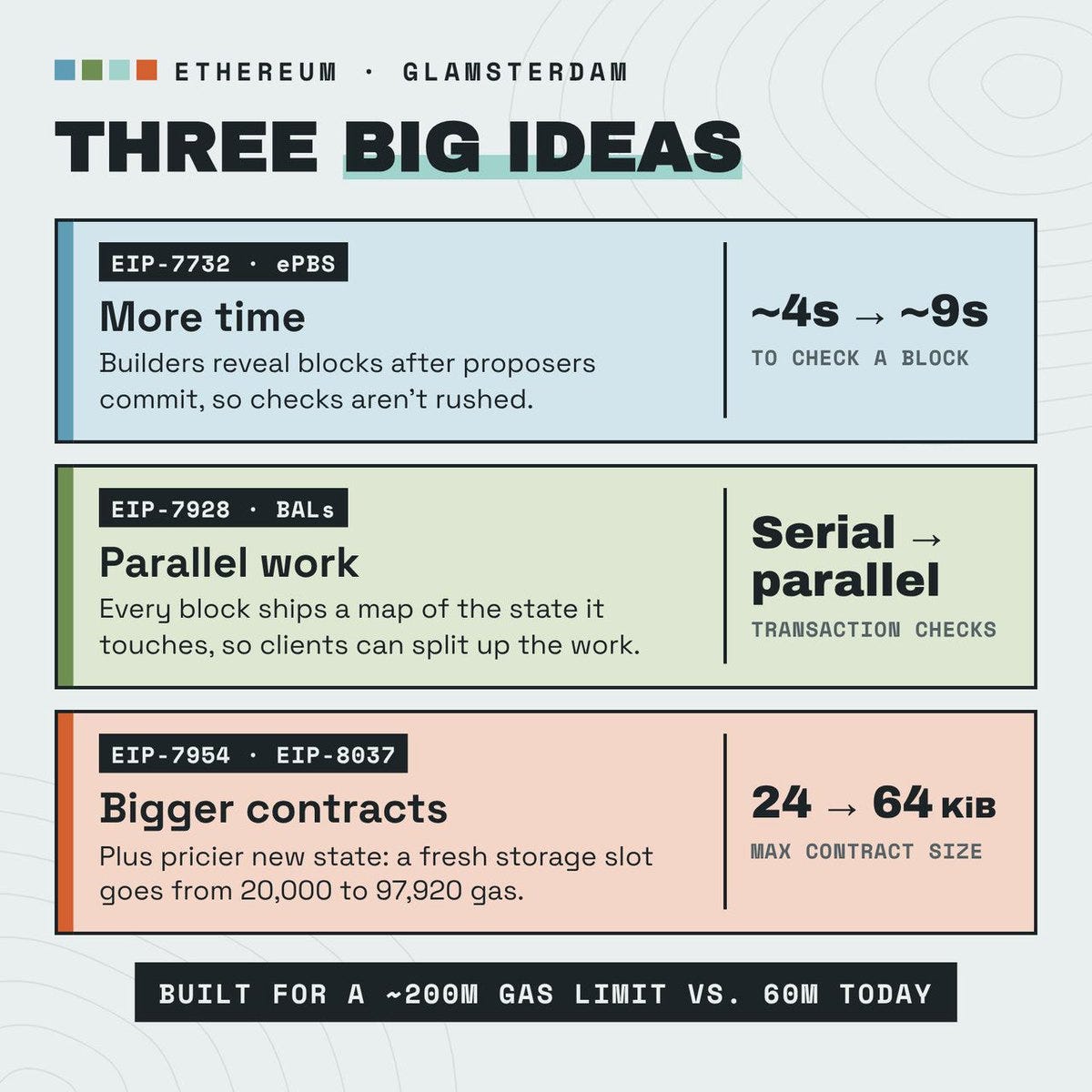
The design target is a block gas ceiling of about 200 million, up from the current 60 million, or roughly 3.3x higher. The article stressed that the hard fork does not instantly triple network capacity. Its main job is to change how blocks are produced and verified so the network can safely handle larger blocks, after which validators can decide whether to raise the gas limit.
The upgrade package includes 18 EIPs, with three carrying most of the technical weight. The first is enshrined proposer-builder separation, or ePBS. Today, most Ethereum blocks are built by specialized builders and passed to validators through trusted relays. EIP-7732 changes that flow by having proposers first confirm a builder-signed bid and only then receive the full block. That means validators no longer need to compress transaction checks into a roughly four-second proof window. Most validators would get about nine seconds to process blocks.
The second major change is block-level access lists, or BALs. Under EIP-7928, each block would include a mapping of the state it touches and the updated values, allowing clients to preload data and verify transactions in parallel. The article compared BALs to running multiple production lines at once, while ePBS gives the quality-control stage more time.
EIP-7954 would raise the smart contract size cap from 24 KiB to 64 KiB, easing the need for large applications to split code across multiple contracts. Gas pricing would also change. EIP-8037 raises the cost of creating a new storage slot from 20,000 gas to 97,920 gas, while EIP-2780 keeps a standard ETH transfer to an existing account at 21,000 gas.
After Sepolia completed the Glamsterdam upgrade on Oct. 6, the first block still carried a 60 million gas limit, matching Ethereum mainnet. About 11 hours later, Sepolia’s gas ceiling had gradually climbed to 200 million and remained there. The article said proposers can only adjust the gas limit by about 0.1% each time, so if every proposer kept raising it, the target could theoretically be reached in around four hours. The longer actual timeline may have been partly due to Prysm and Teku, two major consensus clients, keeping validator gas targets at 60 million by default unless users manually opted into 200 million.
Wahrstätter shared early data suggesting faster processing per unit of gas across clients after the upgrade. In one example, Geth’s time to execute a 40 million gas block fell from about 115 milliseconds to about 30 milliseconds. The article also cautioned that the data came from less than a day of post-upgrade observation and only one node per client.
Next, Glamsterdam is scheduled for the Hoodi testnet, with a tentative activation date of Oct. 27 that has not been finalized. Mainnet remains targeted for the fourth quarter of 2026, though the exact timing may still move. As block capacity expands, wallets, indexers, and gas estimation tools will need to adapt. Activities that create many accounts or storage slots, such as airdrops and mints, may face higher costs, while ordinary ETH transfers would not become more expensive.
Q3 2026: prices rebounded, business funding did not
Tiger Research wrote that crypto sentiment moved from fear to greed in the third quarter of 2026. Bitcoin rose 43% after falling for two straight quarters in the first half, marking its strongest third quarter since 2017. U.S. spot Bitcoin ETFs recorded $6.34 billion in net inflows. The crypto fear and greed index, which had stayed in extreme fear for an extended period, entered greed on Aug. 20 and remained there for most of September.
That rebound in prices did not translate into a comparable recovery in company funding. The report said capital returning with the market rally flowed mainly into crypto assets themselves, while long-duration business investment did not follow short-term sentiment.
M&A showed a structural shift. Deal counts were 39 in the first quarter, 36 in the second, and 37 in the third, so activity was broadly stable by number, but deal size shrank sharply. Citing Architect Partners, the report said third-quarter crypto M&A volume fell 7% quarter over quarter while transaction value dropped 83%.
In the first half, large acquisitions were used to buy whole companies and expand into new lines of business, including Mastercard’s $1.8 billion acquisition of BVNK. In the third quarter, deals were more often used to fill capability gaps inside existing businesses. Examples included Circle agreeing to acquire Singapore-based cross-border payments company Tazapay, MoonPay agreeing to acquire North Capital, which holds U.S. securities licenses, and BitGo acquiring NYDIG’s institutional trading business.
The report said buying capabilities can be faster than applying for licenses and building operations from scratch, so the focus of M&A has shifted from broad expansion to integrating specific capabilities in licensing, payments, and institutional trading.
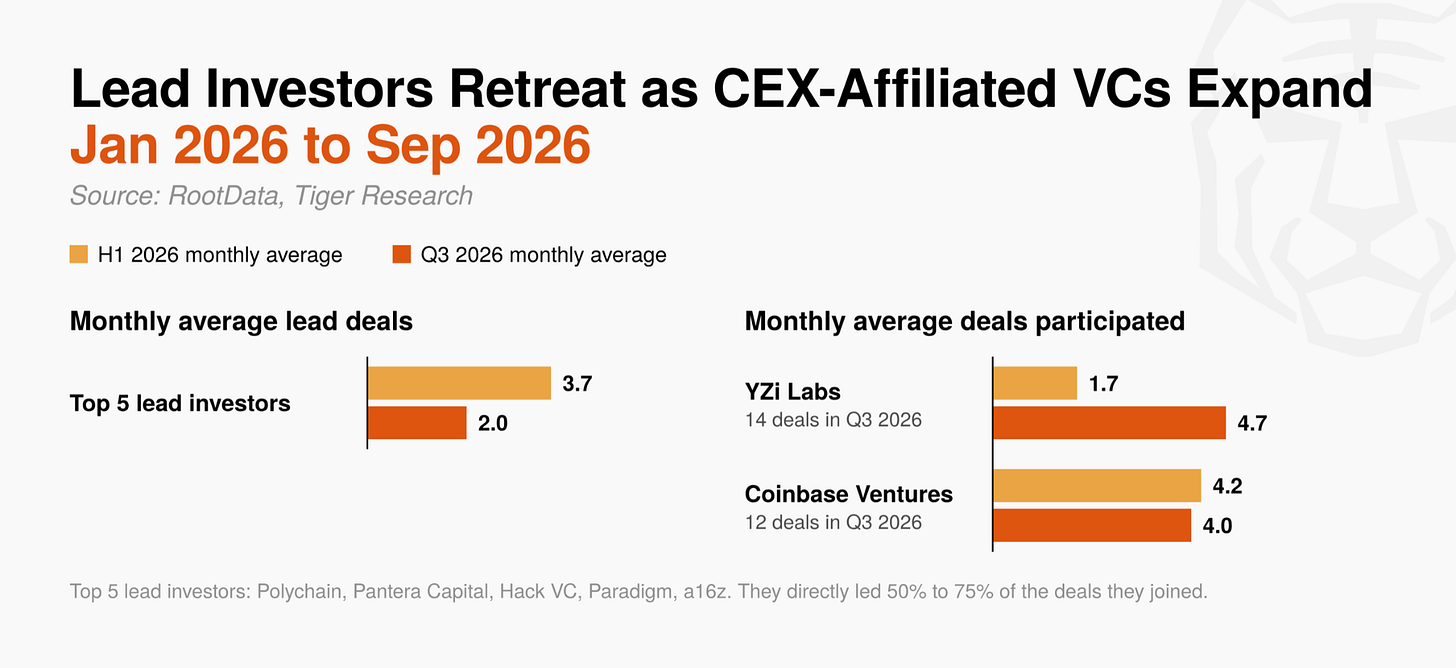
The balance of power in venture also changed. The five most active lead investors since 2024 — Polychain, Pantera Capital, Hack VC, Paradigm, and a16z — averaged 2.0 lead deals per month in the third quarter, down from 3.7 in the first half. These firms had previously led 50% to 75% of the deals they joined and played a large role in setting valuations. Their influence over financing terms is now weakening, according to the report.
By contrast, YZi Labs took part in 14 investments in the third quarter, nearly tripling its monthly pace from the first half, while Coinbase Ventures participated in 12. The report argued that exchange-linked venture arms operate under a different incentive structure from traditional financial investors. Conventional VCs rely mainly on equity or asset appreciation, while exchange-affiliated investors can also benefit from higher trading volume and user growth if portfolio companies expand on their exchange or within ecosystems such as BNB Chain and Base. That gives them reason to keep investing even when prices and valuations are uncertain.
Investors also became more selective about unproven early-stage projects. Seed deals accounted for just 15.0% of all transactions in the third quarter, the lowest quarterly share since 2024. Average monthly seed deal count fell 28%, a steeper drop than the 13% decline in overall deal count. By comparison, disclosed funding for Series A through C rounds rose 29% on a monthly average basis, and third-quarter Series C funding exceeded the total for the entire first half.
The report said capital is concentrating in companies that have already demonstrated their business models through revenue, licenses, or both. Market evaluation standards are also shifting away from token issuance plans and toward operating performance.
Funding structures broadened as well. Of the 13 deals worth at least $100 million in the third quarter, four involved public listings or debt financing. Securitize went public on the New York Stock Exchange through a SPAC merger, while Ripple Prime issued $275 million in unsecured senior notes. On a monthly average basis, venture and strategic equity funding fell 24%, debt financing rose from $70 million to $190 million, and proceeds from public listings increased from $80 million to $150 million.
In the first half, debt financing was driven mainly by treasury companies such as Metaplanet borrowing to buy Bitcoin. In the third quarter, businesses with operating cash flow — including prime brokerage, remittance, and stablecoin lending firms — began borrowing to expand operations, shifting repayment support away from Bitcoin prices and toward company cash flow.
Sector allocation moved closer to traditional finance-linked infrastructure. Infrastructure’s share of disclosed investment rose from 8.1% in the first half to 18.2% in the third quarter, driven mainly by AI data centers and AI training infrastructure rather than new blockchain mainnets. Within the “other” category, about half of the capital went to tokenized securities infrastructure such as Securitize and Alpaca. DeFi investment fell 71% and made up only 3.0% of total funding. In prediction markets, about 91% of investment was concentrated in a single roughly $300 million Polymarket deal.
Compute as a financial asset class
In a separate English thread, Shayon Sengupta argued that compute has become one of the fastest-growing asset classes in the world. The piece said the market has already spent years discussing data center construction, the capital expenditure needed to finance AI compute infrastructure at different scales, and the procurement agreements AI labs and hyperscalers use to secure supply. The first conclusion was straightforward: demand for compute should keep rising, while supply of chips, memory, power, and data center infrastructure remains constrained.
The more important point was that compute is turning into a productive financial asset market. Hundreds of billions of dollars worth of GPUs are already deployed in data centers, generating cash flow through contracts of different durations and serving workloads with different performance requirements. Yet most compute transactions still happen through customized bilateral agreements between large buyers and sellers, plus fragmented broker networks and trading venues.
Sengupta argued that this leaves room to build trading infrastructure designed for compute itself, with financial tools layered on top so producers and consumers can manage risk around price, availability, and hardware class. He said crypto infrastructure is especially well suited to support that process.
The article pointed to three shifts. First, rising inference demand and better service efficiency are changing the residual and resale value of older GPUs. CoreWeave disclosed a customer contract for A100 compute running through 2029. Nvidia launched the A100 in 2020, meaning customers are still willing to use the chip close to a decade after release. CoreWeave also secured a five-year, $2.6 billion credit facility backed by customer contracts with an average term of three years.
Second, demand is becoming more distributed as open-weight models spread and more companies deploy models on their own infrastructure, choosing providers based on cost, latency, geography, and performance. Third, model routing is creating an early auction market for inference order flow. OpenRouter was cited as an example, with large price differences for the same model across providers. For Llama 3.3 70B, input pricing ranged from $0.10 to more than $1 per million tokens.
The proposed market structure starts with a principal dealer connecting buyers and sellers, designing contracts, managing physical delivery of compute, and gradually standardizing common configurations. By participating in real transactions, that dealer could gather data on hardware pricing, counterparty quality, utilization, delivery failure rates, and spreads between compute products, then use that information to create transferable claims on physical compute.
One example in the article described a seller committing to provide a node with eight H100 SXM GPUs in the U.S. East region for 30 days and receiving a standardized certificate representing that compute. The certificate could be transferred before the reservation period begins, posted as collateral, or used for forward settlement. Over time, the market could add transferable forwards, compute options, portfolio margining, public quotes and order books, and financing tools backed by verified compute inventory.
The role of crypto infrastructure, the article said, is to turn rights to physical assets or future services into trusted digital claims. Tokenization would make the underlying assets and cash flows easier to transfer, pledge, and re-pledge. On-chain systems could let lenders see whether a compute certificate has already been pledged, what priority a debt claim has, and what haircut and maturity apply to the collateral. Smart contracts could release payment based on actual compute delivery, return collateral once service standards are met, or enforce penalties if delivery fails. Stablecoins would provide a 24/7 global funding and settlement rail for the market.
Starknet’s independent L1 idea lifts STRK
Deep Tide TechFlow wrote that Ethereum’s Layer 2 sector showed two very different pictures in the first week of October. Blast exited, and Abstract, the consumer chain built by Pudgy Penguins, announced a shutdown and asked users to bridge assets out before year-end. At the same time, Starknet drew market attention after a new strategic idea surfaced, with STRK rising nearly 26% at one point over 24 hours.
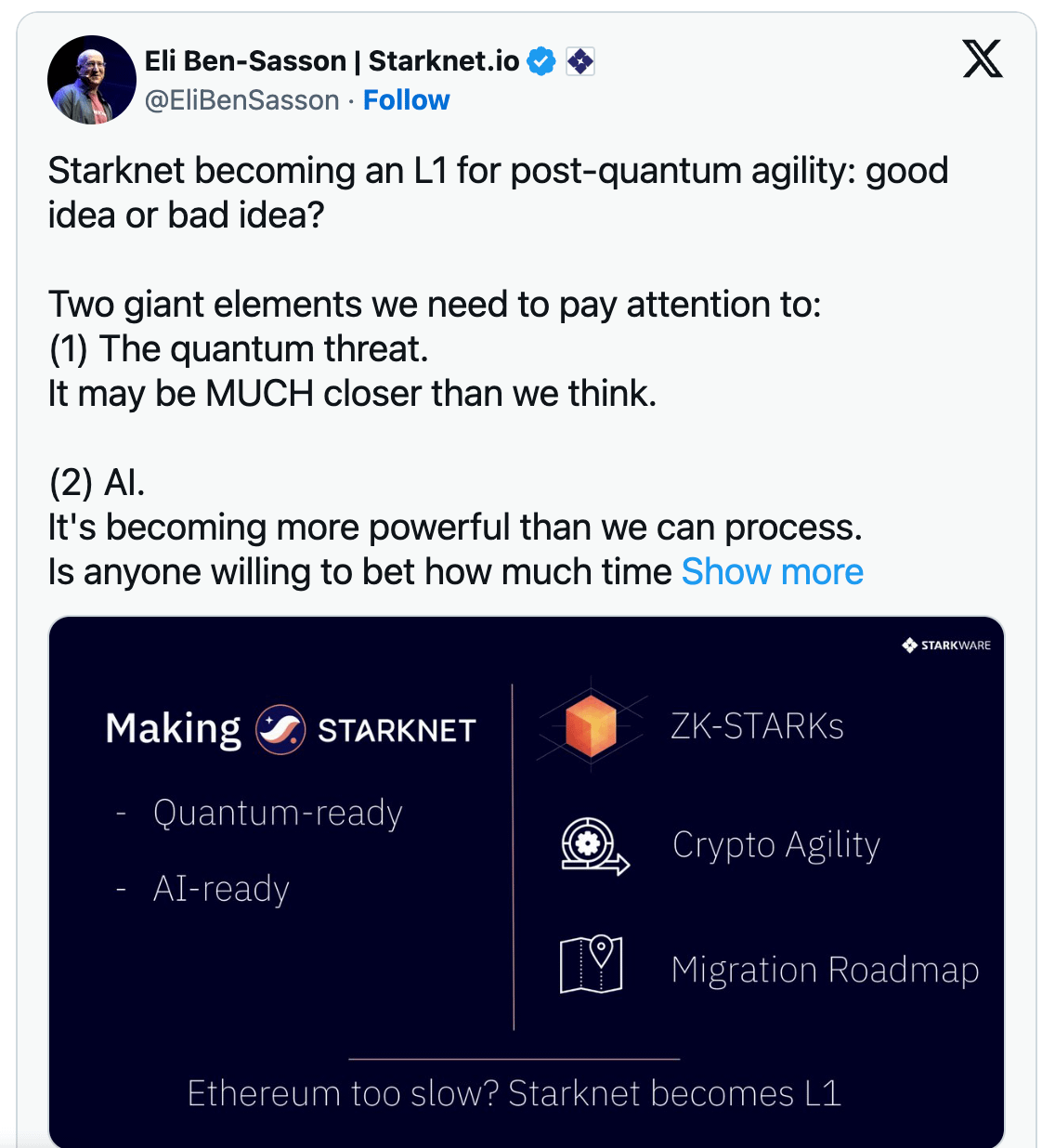
The move was not tied to application growth or airdrop expectations. Instead, it followed comments from StarkWare founder Eli Ben-Sasson, who said Starknet is actively considering leaving Ethereum and becoming a fully independent Layer 1 in 2027, positioned as resistant to both quantum attacks and AI-assisted cryptographic breaks.
The article placed that idea in the context of rising concern over cryptographic security. Ethereum core researcher Justin Drake recently urged large holders to prepare for “Bunker Mode” by moving assets to fresh addresses that have never sent a transaction. The concern stems from rapid progress in AI mathematical reasoning and the possibility that traditional cryptography could face new forms of attack. ECDSA, which secures Bitcoin and Ethereum, has rich algebraic structure, and the market is worried AI could discover unknown mathematical shortcuts that weaken it.
Ben-Sasson compared post-quantum upgrade timelines across chains. According to the article, Ethereum mainnet may not complete a post-quantum cryptography overhaul until the end of 2029, while Bitcoin still lacks a clear upgrade plan. If Starknet leaves Ethereum’s settlement layer and becomes an independent L1, it could control its own cryptographic migration schedule and try to complete the transition in 2027.
The report said Starknet has some technical advantages. Most major blockchains rely on elliptic-curve cryptography, while Starknet’s STARK proof system mainly relies on hash functions, whose mathematical structure differs significantly from elliptic curves. Because hash functions have simpler algebraic structure, finding shortcuts that materially weaken their security is generally harder. Starknet also natively supports account abstraction and has already implemented transaction verification using post-quantum signatures on mainnet.
Still, the article noted that no formal on-chain governance proposal has been released, and the independent L1 plan remains at the stage of public discussion by the founder. Trading data also suggested the rally was heavily driven by leverage. Citing data referenced by CoinMarketCap, the report said STRK open interest jumped more than 53% during the price move, while futures volume reached about five times spot volume.
It also laid out the challenges of moving from L2 to L1. Starknet currently benefits from Ethereum’s economic security. If it leaves, it would need to build an independent consensus network, recruit validators, and defend against attacks through staking and related mechanisms. That would add network security and data availability costs and require proof that its economic model can sustain long-term operation. Running independently would also remove its direct trust link to Ethereum’s settlement layer and could weaken its connection to Ethereum DeFi liquidity.
Other headlines in the same briefing
ChainFeeds also listed several news items in the same daily briefing: CryptoBilis suspended hardware wallet sales for all brands across three countries while cooperating with Ledger in an investigation; SlowMist’s CISO speculated that Ledger devices may have been attacked through side-channel screen recording of seed phrases followed by exfiltration; Malaysian hardware wallet reseller CryptoBilis changed its ownership structure in March and a former co-founder has exited operations; the 79th Vault attacker returned 15,000 BNB to an address designated by the team; and Blockchain.com plans to offer prediction markets and crypto derivatives in the U.S. after applying to the CFTC for DCM and FCM licenses.
The briefing’s five main research sections were compute, AI, Ethereum, markets, and project progress. The project progress section was titled “After the liquid staking war, Lido’s next target is lending.”