ChainFeeds publishes its Sept. 5 research roundup
ChainFeeds published its Sept. 5, 2026 research brief, combining the day’s headline items with a set of longer reads circulated through its Web3 research product. The hot-news list included OpenAI’s release of GPT-6 Astra, activation of the first feature gate under Solana proposal SIMD-0437 on the Beta mainnet, a reply from the Robinhood CEO to criticism from the AMC CEO saying tokenized U.S. equities are not being sold to U.S. citizens, Garrett Jin’s unrealized loss of more than $18.5 million on a ZEC short, and South Korea’s plan to fully launch a tokenized securities market in February 2027.
The brief then pointed readers to five deeper pieces: a September look at OpenRouter and fast-rising AI agents, a breakdown of Bonk Guy’s PONS trade, a note from IOSG Ventures on why the best crypto investments are often made in bear markets, an English essay on Ethereum and institutional under-allocation, and an analysis of Fomo’s growth model. ChainFeeds said the daily package was compiled by its team together with AI, and said the information-flow tools used internally had been opened to readers and Web3 professionals.
OpenRouter data points to continued growth in AI agents and coding agents
The first long read, introduced through blocmates, argued that AI hype often creates the false impression that a product has died or been replaced when actual use has merely moved off the social-media front page. OpenClaw was used as the example. It is no longer at the top of its category and has largely disappeared from broader public conversation, but the piece said that is very different from saying the product is dead.
OpenRouter was presented as one way to look past narrative and into usage. As one of the main large-language-model aggregation platforms, OpenRouter offers developers access to hundreds of AI models through a single API and tracks token usage for applications that opt into public monitoring. Developers can test different models, choose models based on task, and manage APIs and billing in one place. For users who do not want to pick models by hand, AutoRouter can route requests dynamically based on request type, network-wide usage, and the user’s own cost and quality preferences.
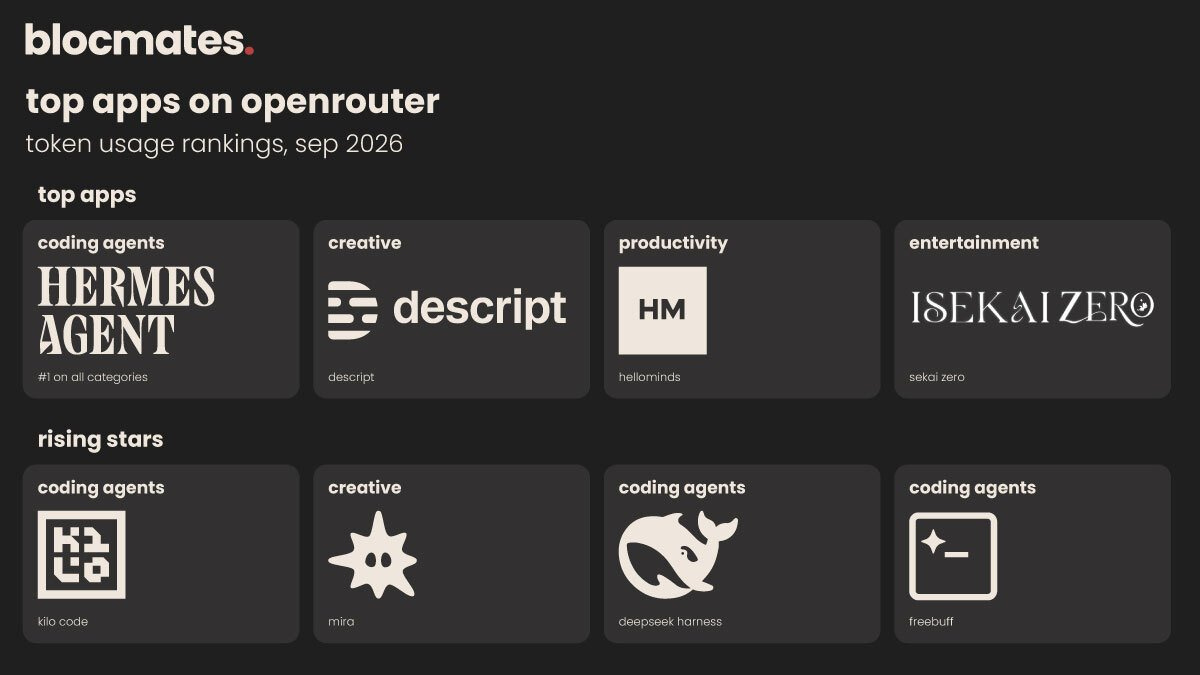
That ranking data, according to the brief, shows that AI agents and coding agents are still climbing quickly in real usage. Hermes has become the top application across all OpenRouter categories by cumulative token usage, with nearly 50 trillion tokens. The brief said most of that usage was generated in the latest month alone. The top 10 models contributed about 40 trillion tokens over that period, and if the additional 443 models used during the same stretch are counted, roughly 85% to 90% of Hermes’ lifetime token usage may have been generated in the last 30 days.
A separate example was Kilo Code, an open-source AI coding agent that runs in VS Code, JetBrains, and the CLI. Unlike products such as Cursor and Claude Code, Kilo Code lets developers control their own data, model choices, and costs. The OpenRouter data cited in the brief showed that its users most often chose Poolside Laguna S 2.1, Tencent Hy3, and NVIDIA Nemotron 3 Ultra rather than the market’s best-known models, because those coding models were described as strong performers while also being free and open weight.
The brief also said AI apps are moving away from a pure chase for the top headline model and toward model-agnostic, multi-model architectures. Mira was given as an example. It wraps a complex agent harness into a Telegram-based personal assistant so users can create skills, schedule tasks, and share capabilities with teammates using natural language rather than code, a CLI, or cron expressions. Under the hood, it routes across different models through OpenRouter, with MiniMax M3 described as the clear usage leader.
The article still warned against treating OpenRouter as a complete mirror of mainstream demand. Its rankings show one slice of internet users, and that slice includes people such as YouTubers, tech influencers, and professional developers who have more time, skills, and context to test tools than ordinary users do. Even so, the OpenClaw example was used to make a narrower point: social-media heat and real product use can diverge in meaningful ways.
Bonk Guy’s PONS trade puts him back near the top of the profit leaderboard
The second feature, sourced to Foresight News, revisited a recent trade by theunipcs, the trader better known as Bonk Guy.
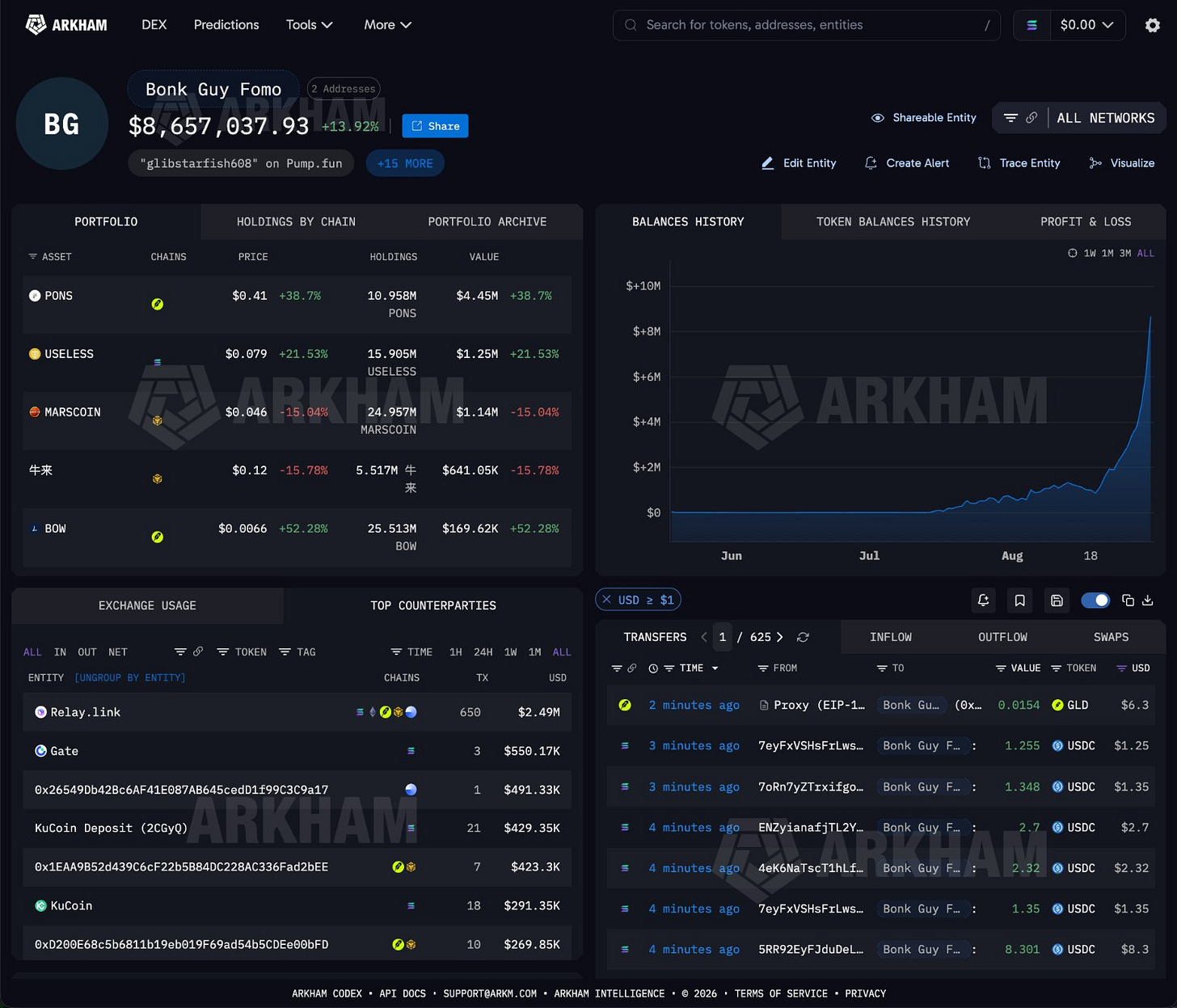
On Aug. 31, on-chain intelligence platform Arkham posted a screenshot showing that an address labeled “Bonk Guy Fomo” was up about $5 million over one week, with roughly $4.4 million of that tied to PONS. According to the recap, he accumulated about 1% of the token’s supply when the market cap was around $6 million and then barely moved the position. The next day, @theunipcs replied, “I’m a fan of Arkham, but it’s going to be $6.5 million soon.” The implication in the ChainFeeds summary was that he accepted the address identification while saying Arkham’s profit estimate was conservative.
PONS is the platform token of Pons Labs on Robinhood Chain and is not an official Robinhood product. Robinhood Chain launched its mainnet in July this year, and Pons quickly became the most concentrated non-custodial launchpad on that L2 in both issuance activity and trading. The brief said about 80% of the protocol’s fee share from trading is used for buybacks and burns. On Sept. 3, Pons Labs said total trading volume over the previous 24 hours reached $400 million. GMGN market data, as cited in the article, showed its market capitalization briefly moved above $500 million.
Using those figures, the piece framed the trade as an 83x return. If theunipcs bought around a $6 million market cap and the token later traded around a $500 million market cap, the gain on paper would be in that range. That headline number anchored the entire recap.
The article then stepped back into his history. theunipcs has said his handle was formed from Uniswap and PancakeSwap, the two decentralized exchanges where he focused on meme-token trading early on. In a January 2025 long-form interview with Bybit, he said he first encountered Bitcoin more than a decade ago through reporting tied to Silk Road, lost an initial five-figure stake, then started over with an amount somewhere in the upper end of four figures. From there, most of his trading capital was built through meme positions. He said the 2021 GameStop and Dogecoin wave convinced him that memes were his core arena.
The nickname Bonk Guy comes from the BONK trade that made him famous in October 2023. He used about $16,000 in capital with 6x leverage on Bybit to go long BONK when the token’s market cap was around $20 million, and at peak his unrealized profit topped $20 million. In November 2024 he shared two more figures publicly: he had held the position for 13 months and had paid roughly $1.879 million in funding. Even after a 70% to 80% pullback from the unrealized peak, he still did not close.
He later reviewed several other trades in public. WIF turned $6,000 into a peak unrealized profit of about $1.4 million. Fartcoin at one point showed more than $8 million in unrealized gains. He also traded POPCAT, PNUT, and FLOKI, and the recap said those trades were also materially profitable.
That run did not protect him from the October 2025 liquidation shock. The broader market saw about $20 billion in liquidations that day. In a long post published the next day, he said all of his perpetual futures positions had been wiped out, including BONK, FARTCOIN, POPCAT, PNUT, CAT, and APEX. He wrote that his book had once shown more than $30 million in unrealized profit and still showed more than $15 million right before the blowup. In DeFi, the ASTER he had posted as collateral lost about 80%. Most of his USELESS spot position remained. He summed up the aftermath with a short line: “I’ll make it back.”
By May 2026, he had shifted to the social-trading platform FOMO. In late August he said his FOMO portfolio had reached an all-time high of about $6 million and that he had made about $3 million over the previous 30 days, with 14 of 17 trades still profitable at that time. On Sept. 2, the platform congratulated him for ranking first on three separate leaderboards. Alongside PONS, he was also pushing MARSCOIN, USELESS, and a broader basket of Robinhood Chain names. The summary said he described his conviction in USELESS as stronger than his conviction in BONK back in 2023. Even with a single trade showing more than $5 million in gains, the brief said he is still some distance from his peak and remains in the middle of a comeback.
IOSG Ventures says bear markets are where quality is most often mispriced
The third piece came from IOSG Ventures and asked why the best crypto investments are often born in a bear market.
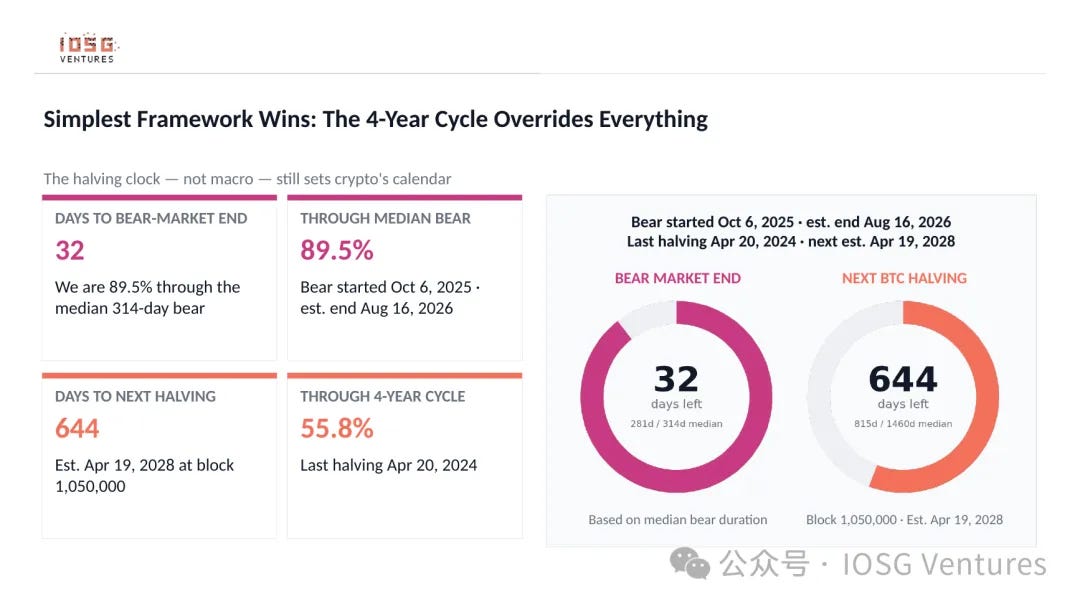
The argument starts with Bitcoin. According to the article, the rebound from the 2022 lows was driven by catalysts specific to Bitcoin itself: the collapse of Silicon Valley Bank in 2022, spot ETF speculation pushing the price to $60,000, and Donald Trump’s election pushing it further to roughly $120,000. By late 2025, most of those catalysts had already been priced in. From that point, the setup changed. The piece said that after 2025 the AI cycle began in earnest, AI-linked assets, gold, and NVIDIA all strengthened, and by ordinary logic those conditions should have helped Bitcoin. Instead, Bitcoin stopped responding and fell 29% year to date.
IOSG borrowed a phrase from the Benmo community, “Bitcoin divine power,” to argue that the four-year Bitcoin cycle once again overrode more complex narratives. In this framing, the cycle model had already pointed to an October 2025 top, and that is what happened, with the bear market starting from October 2025. The article then addressed a common objection, namely that the four-year cycle may be coincidence. Its answer was that many crypto veterans reinforce the pattern themselves. If enough investors expect the market to peak at a certain stage of the cycle, they reduce risk around the same time, and that collective action helps create the very cycle they expected.
On that basis, the piece said the important question over the next few months is no longer why Bitcoin has lagged, but whether the next accumulation phase has already started.
IOSG laid out three reasons bear markets can produce the best trades and investment opportunities.
- First, valuation dislocation. When sentiment is at its worst, projects with real value can trade below intrinsic value, and the best entry prices tend to appear only when others are leaving.
- Second, real revenue survives. The firm said it prefers businesses with cash flow that can be verified, not just narrative. If a project can survive a bear market with clear customers and a clear product, that resilience can compound in a bull market.
- Third, the business has to stand up to scrutiny. IOSG said it only backs projects whose model can be explained from start to finish: who pays, why they pay, and how much they pay. Revenue that can be verified from the outside is the revenue that matters.
The article said that this cycle has already produced genuinely profitable crypto projects ranging in size from several hundred million dollars to roughly $5.8 billion, spread across DeFi and different infrastructure segments. It also argued that crypto is evolving from a trading market into internet-native financial infrastructure. Stablecoins provide better money and settlement rails. Real-world assets and tokenization give on-chain dollars genuine yield and collateral. The application layer keeps expanding. As the financial stack becomes native to the internet, the eventual users will not be only humans, because AI agents also need wallets, payments, identity, and programmable ownership.
The AI section narrowed the discussion to three questions: where compute comes from, where data comes from, and how money moves for AI. On compute, the article said crypto has already demonstrated that open networks can coordinate hardware resources globally. During Ethereum’s proof-of-work era, the network’s aggregated GPU power was on the scale of a frontier training cluster. That does not mean those miner GPUs can simply be repurposed to train frontier models, because the categories are not identical. The point is that token incentives can aggregate idle hardware scattered across the world, and that mechanism could become a real opportunity if applied correctly to AI compute markets.
On data and money movement, the article pointed to Grass. Grass has about 8.5 million users who share unused bandwidth through a browser extension and app in exchange for points. Its network layer distributes scraping tasks from AI labs to those nodes and then cleans and structures web data into enterprise-grade datasets. The brief said Grass now has more than 250 PB of data, generated about $17 million in revenue in 2025, and is expected to exceed $70 million in 2026. The conclusion was straightforward: tokenized crypto projects can already be very real businesses, with revenue, cash flow, and paying customers.
Ethereum’s biggest potential short may be institutional portfolios with zero ETH
The fourth item was an English essay by Fernando Pertini on Ethereum and institutional allocation.
His central claim was that something changed around Ethereum in the summer of 2026, and it was not just a return of excitement on Crypto Twitter. Traditional financial institutions were actually building on the network. Robinhood launched an Ethereum L2 and saw total value locked rise above $1 billion within six weeks. Revolut, which has more than 80 million customers, issued a euro stablecoin on Ethereum. Two tokenized money market funds managed by J.P. Morgan Asset Management reached a combined size of more than $800 million on Ethereum mainnet. Credit Agricole launched a euro stablecoin and used it to settle subscriptions into Amundi’s tokenized money market fund. Japan’s first trust-based yen stablecoin came to Ethereum. Neuberger Berman launched its first tokenized fixed-income fund there as well.
BlackRock then entered not with comments about blockchain being interesting, but with products. The firm launched additional Ethereum-based tokenized funds and announced a partnership with J.P. Morgan’s Kinexys to tokenize part of the share classes of its European Institutional Cash Series, which had $311 billion in assets as of June 30. Morgan Stanley rolled out an Ethereum product with staking, and Fidelity applied to add staking to its ETH ETF.
Pertini argued that once that many institutions appear on the same chain at the same time, the pattern is difficult to dismiss as coincidence. It looks more like financial infrastructure taking shape. Vlad Tenev called it a “global tokenization supercycle,” and Tom Lee went further, saying even that phrase may understate what is coming next. In the essay’s telling, tokenization may only be the first visible layer, behind which sit stablecoins, programmable collateral, 24/7 markets, instant settlement, and AI agents that can eventually trade, negotiate, and pay other agents on their own.
He framed the next stage of AI in financial terms as well. The first AI trade was about compute. The next one may require money that is native to software itself. Bitcoin helped Wall Street understand digital scarcity. Ethereum, in his view, may help Wall Street understand programmable capital.
ETH moved from about $1,560 on July 1 to about $2,450 by late August. That is already a large price move. Even so, the article said institutional product development around Ethereum has kept expanding, products have become more mature, and use cases have moved beyond theory, while actual ETH allocations inside traditional portfolios remain very low.
Pertini said that for years, holding zero ETH may have been the safest career choice in traditional finance. Nobody gets fired for missing Ethereum, and few people need to walk into an investment committee and explain why their portfolio has no ETH. But when BlackRock, J.P. Morgan, Robinhood, Revolut, Fidelity, Morgan Stanley, Credit Agricole, and Neuberger Berman keep showing up on the same chain, the question may start to change from “Why should we own Ethereum?” to “Wait, tell me again why we own none at all?”
His closing point was that the short squeeze worth watching is not about public short interest, perpetual futures, or traders running 50x leverage in the middle of the night. Ethereum’s biggest latent short, he wrote, may be the trillions of dollars in traditional portfolios that still hold zero ETH. If you are explicitly short ETH, you know what you are doing. If you run a traditional portfolio that still holds zero exposure while more and more of the financial system is built on Ethereum, zero itself may turn out to be a position.
Fomo’s growth model links discovery, trading, and creator payouts
The final feature came from Conflux and focused on Fomo, a social-trading platform whose growth has accelerated even while its own team admits the product still has rough edges.
Co-founder Se Yong Park said in an interview that Fomo’s web app is “kind of bad” and remains close to the state it was in at launch, with the team lacking bandwidth to polish it. Even so, web traffic already accounts for about 25% of total platform traffic. In other words, a channel the company itself sees as unfinished has still become a meaningful source of usage.
The growth metrics cited in the article were strong. Dune Analytics data showed Fomo’s trading bot volume and market share ranked first in the meme-trading segment. Se Yong Park said the platform had reached 1.3 million users and was adding 30,000 net new users per day. DeFiLlama data, as cited in the piece, showed Fomo set a weekly protocol revenue record of $2.64 million on Aug. 8, reset its own weekly revenue record three times within a month, and at one point reached an annualized revenue run rate of $29.22 million. On Aug. 16, its daily protocol revenue briefly moved above that of the established derivatives platform Hyperliquid. On Aug. 21, it broke into the top three in the U.S. finance app ranking, ahead of Cash App and prediction market Kalshi, and it later stabilized within the top 15.
The company also raised a $75 million Series B led by Index Ventures, with Union Square Ventures participating. That round valued the company at $550 million and brought disclosed equity financing to about $94 million in total. Fomo was founded by three former employees of decentralized derivatives platform dYdX.
Conflux argued that what could unsettle Binance and OKX is not simply user scale. It is the product chain Fomo has built: information feed to trade execution to creator revenue share. A user can buy a token on Fomo and attach a short thesis explaining the trade. If another user sees that position record and copies the trade, execution fees generated by the follow-on trade can be shared with the original poster through Creator Revenue.
Se Yong Park said Trader Rewards alone distributed nearly $2 million over one week in late August. That means even a small account with only a few hundred followers could potentially earn from copied positions if those positions generate follow-on trading activity. The article contrasted that with older creator paths that required accumulating tens of thousands of followers first and only then monetizing through advertising or referral commissions.
Conflux reduced the competitive split to a conflict between two kinds of power. Binance and OKX are protected by issuance power: the power to decide which asset gets seen first. Fomo is trying to capture information power: the power to sit closest to the instant a trading decision is made. For most of the past decade, exchanges could absorb the bulk of volume through the first advantage alone because on-chain information was scattered across Telegram groups and X influencers and did not need to be integrated by the exchange itself. Fomo packages those fragmented signals, real positions, and revenue-sharing incentives into a single product, effectively bypassing issuance and building a new gateway at the point where attention turns into trades.
The article also stressed that tying calls to trading-driven payouts is not a new invention. eToro’s Popular Investor program used similar economics years ago, with monthly earnings tied to assets under copy, or AUC, and higher tiers earning larger percentages. That model succeeded in producing a set of star trading personalities, but it also attracted years of debate. If income is tied directly to how many people copy a trade, does the commentator gain an incentive to magnify risk or package a more dramatic narrative to attract more followers? Conflux said that same question has followed eToro for more than a decade.
In its view, Fomo’s Trader Rewards and Creator Revenue bring the same incentive structure on-chain and place it inside meme coins, a category that is already highly volatile. Public rankings and feed entries make positions and profit-and-loss records verifiable, which can be harder to fake than wash-prone DEX leaderboards. But the same mechanism can also distort the act of sharing trade logic into the act of manufacturing trade signals for revenue.
The piece ended by noting that Fomo has not confirmed whether it plans to issue a token. For a platform that has just raised $75 million, is aggressively subsidizing traders and creators, is facing poaching from Pump.fun, and is also being studied and potentially copied by OKX, the next step is still open. The article did not offer a conclusion on whether Fomo will refine the system into a more transparent pricing mechanism for information or whether growth pressure will push “trade calls as income” closer to “trade calls as manipulation.”