ChainFeeds publishes a five-part research briefing
ChainFeeds Research used its Sept. 16 daily briefing to bundle together five Web3 subjects: a Solana launchpad design built on arbitrary asset pairings, a note on Ethereum’s second quarter, an explainer on The Standard Reserve, a fight between 0x and Uniswap over v4 hooks, and a16z’s case for the CLARITY Act.
The newsletter was dated Sept. 16, 2026. It also ran through a handful of the day’s headline items: X added a trading option for Cashtags and first connected platforms including Coinbase; Coinbase’s CEO said the failure to move the CLARITY Act forward was disappointing and that focus would now turn to SEC and CFTC cooperation on rulemaking; Senator Kennedy said he was not surprised the bill failed and hoped it could come back in a lame-duck session; two Robinhood engineers were accused of profiting from nonpublic listing information; and stablecoin infrastructure startup Fin.com raised a $20 million seed round led by Expa and Coinbase Ventures.
StonkFun pitches arbitrary pairings as a launchpad alternative
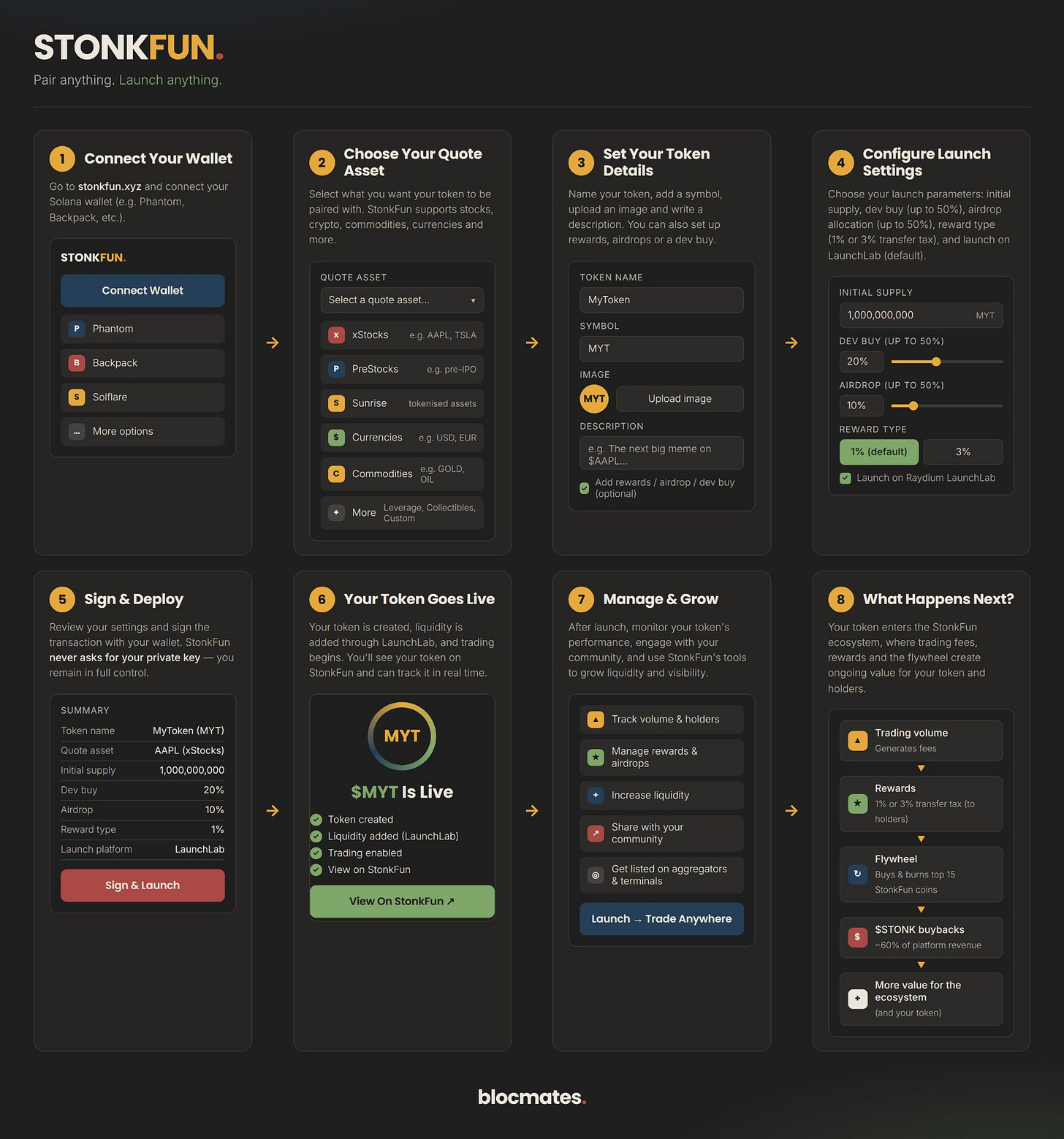
In the first section, drawing from an English thread by blocmates, the briefing said StonkFun is trying to crack open a new market by allowing any asset to trade against any other asset. Traditional launchpads usually quote everything against SOL. That setup piles liquidity and attention into one quote asset. If SOL has a bad run, related tokens can get dragged down too. Projects also wind up fighting a crowd of tokens sitting on the same quote side.
StonkFun’s answer, as the briefing described it, is arbitrary pairings. The pitch is simple: create new markets around assets that already exist, build fresh economic links between different instruments, and cut down the price correlation that comes from using the same quote asset everywhere. And in this framing, every new quote asset can become its own center of gravity for liquidity and attention, which means less dependence on SOL.
The piece also pointed to a reward-token mechanism. Projects can hand out quote assets as rewards to specific token holders. Using CATDOG/ZEC as the example, the note said users could get exposure to CATDOG upside while also collecting passive ZEC income. Put differently, meme tokens stop being just a trade and start acting as a distribution rail for other assets.
The model can stretch into pairings with clearer utility. The briefing floated the idea of combining yield-bearing DeFi tokens with tokenized equities, so users would hold stock-linked income, DeFi yield, and token upside in a single structure. It also described airdrops as a way to borrow an existing community. If a project wants access to holders of token XYZ, it can airdrop part of its supply to that group and use that to seed an initial user base.
StonkFun’s bigger aim, according to the article, is a permissionless market where assets can be linked in arbitrary ways. That includes relative-performance markets such as DEGEN/NVDA or DEGEN/MU, where traders watch how a token performs against semiconductor stocks instead of pricing everything in SOL. A different angle.
The setup also has a fee flywheel. Every V3 liquidity pool and every token launched through LaunchLab sends over part of its trading fees, and those fees are used to buy back and burn the top 15 ecosystem tokens by market capitalization. The article used CAT as the example: CAT launches, grabs attention, generates volume, breaks into the top 15 by market cap, and then starts getting buyback-and-burn support from the fee system, adding demand and visibility to the loop.
For users, the briefing said the process starts by connecting a Solana wallet. Then the user picks a quote asset from options including SOL, BTC, ZEC, NVDAx, SILVER or other meme coins, and sets a token name, ticker and logo. The issuer can choose either Standard or Reward mode and tweak settings such as fee tiers, airdrops and developer buys.
Ethereum note says RWA was the only growth segment in the second quarter
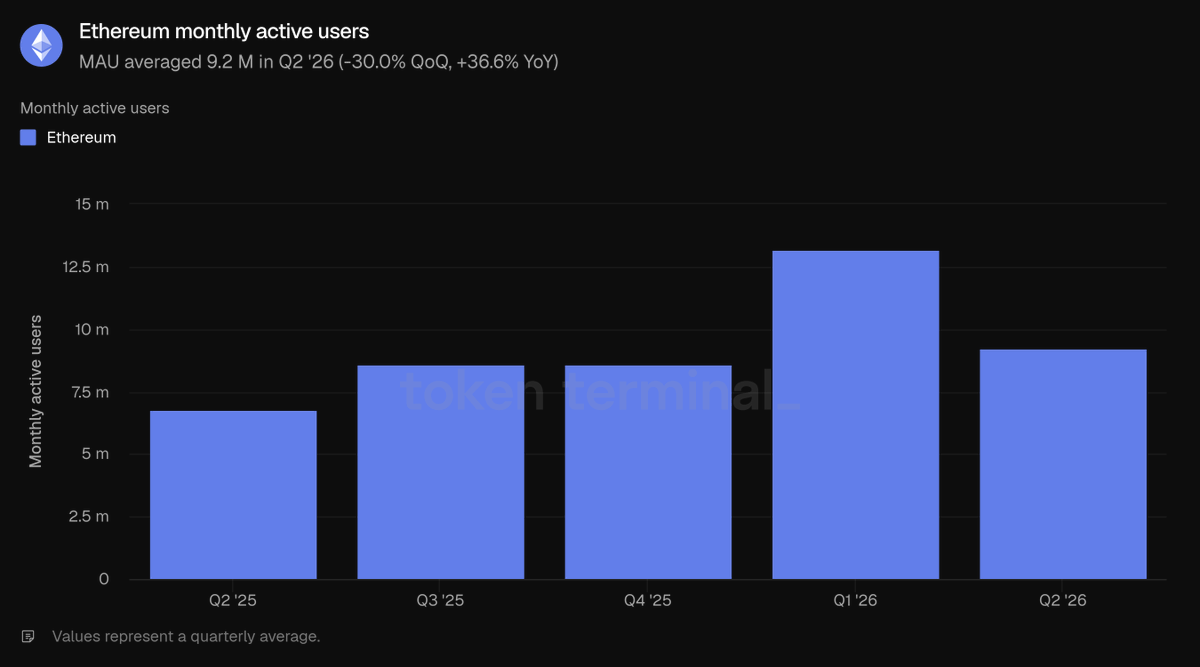
The second item was presented as an English long-form article on Ethereum’s second quarter. Its lead said Ethereum remained the biggest blockchain for tokenized assets and kept the leading share across stablecoins, tokenized funds and tokenized commodities. It also said tokenized U.S. Treasury funds on Ethereum hit a record in the second quarter, and J.P. Morgan Asset Management launched a second tokenized money market fund on the network.
But the input provided for this section does not include the body text that would normally back up the headline claims on transaction count, staking rate and RWA metrics. Instead, the visible body repeats the StonkFun text. So, based on the material actually shown, the report’s attributable points are limited to the lead statements: Ethereum remained the largest chain for tokenized assets, tokenized U.S. Treasury funds on Ethereum reached a record in the quarter, J.P. Morgan Asset Management launched a second tokenized money market fund there, and RWA was described as the ecosystem’s only growth segment.
The Standard Reserve ties realized rewards to giving up future issuance
The third piece, from Foresight News, looked at The Standard Reserve under a headline asking how much yield the project can really deliver after racing to a $50 million market cap and an NFT floor price of 30,000. It opened in the first person: "I opened a 'bank' on-chain."
In that example, the "bank" had no branch office, no employees, and no depositors. It had a Genesis Charter NFT and one Branch. The interface showed that the Branch had generated 147 STANDARD. At a quoted token price of $0.48, that came to roughly $70.
But those STANDARD were only internal, unclaimed balances inside the protocol. They had not been minted into the wallet yet. To convert them into transferable tokens, the holder would have to close the Branch, pay an exit fee, and permanently surrender that Branch’s future issuance share. If the user had only one Branch, closing it would also destroy the associated Genesis Charter and shut down the "bank" entirely.
The article’s main point was blunt: The Standard Reserve does not just send tokens to NFT holders. It ties the realization of accrued rewards to the permanent loss of future issuance rights. That design, the article said, is one reason the protocol has drawn "Ponzi" questions. People can watch an internal balance climb, but whether that balance turns into real profit still depends on later market demand, token price, exit costs and protocol liquidity. The article did not make a final call on sustainability, saying the answer still depends on live operating data.
It then went through the mint numbers. As of the morning of Sept. 15, all 1,000 Genesis Charters had been minted. Total revenue recorded on-chain was 583.594968887 ETH, worth about $1.47 million based on ETH prices around the close of the sale. Of the total, 601 went to whitelist users at 0.15 ETH each, raising 90.15 ETH. The remaining 399 went into a public Dutch auction and brought in about 493.445 ETH. Most of those public auction clears happened between 1.23 ETH and 1.25 ETH. The average public auction price was about 8.24 times the whitelist price.
The project had previously said 100% of Genesis Charter mint proceeds would go to initial liquidity and the protocol treasury, with no team cut from the genesis sale itself. But that promise did not cover later revenue. Based on the white paper and the currently deployed contract parameters, 70% of ongoing ETH revenue from trading taxes and future Charter auctions goes to the active treasury for the current epoch, and then into either the expansion or contraction treasury depending on net fund flow during that epoch. Another 15% goes to protocol-owned liquidity, with half of that swapped into STANDARD for pairing. The last 15% goes to the team.
STANDARD has a hard cap of 1 billion tokens. Of that amount, 100 million were pre-minted during the genesis phase and placed into protocol-owned liquidity. The remaining 900 million make up the future issuance budget. The system uses an account-first, mint-later design: issuance is first recorded as internal balances for each bank, and STANDARD is only minted into a wallet when a banker closes a Branch and claims the reward.
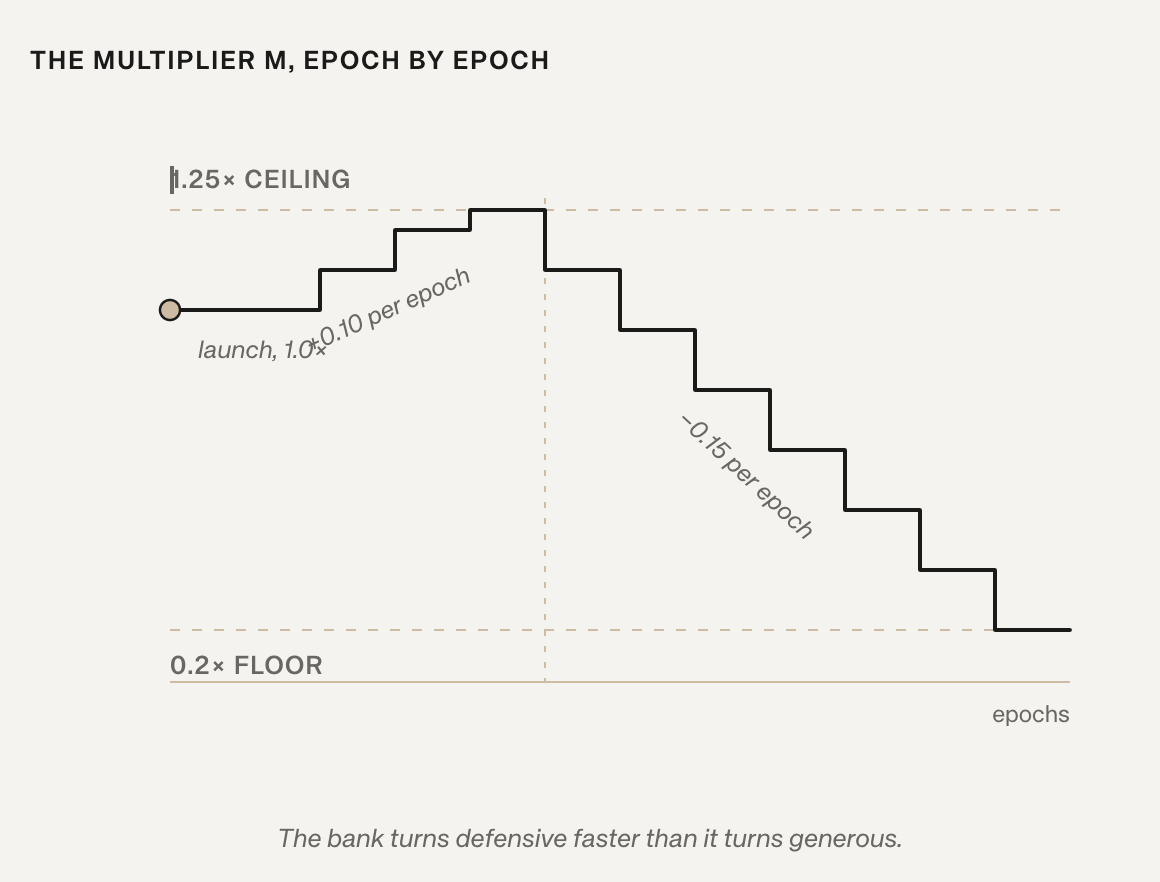
The current base issuance rate is 700,000 STANDARD per day. The policy multiplier starts at 1, with a dynamic range from 0.2 to 1.25, and each epoch lasts three days. As of Sept. 15, the network had 1,100 Branches. On a one-Branch basis, and with the policy multiplier at 1, the theoretical daily output comes to about 636.36 STANDARD. The piece also said that opening more Branches dilutes existing issuance shares, while weaker net ETH inflows could push the policy multiplier lower.
To realize rewards, a banker has to permanently close the Branch tied to that balance and pay a dynamic exit fee of 2% to 60%. If the closed Branch is the last one, the corresponding Genesis Charter is destroyed too.
0x and Uniswap clash over malicious v4 hooks
The fourth piece, from TechFlow, centered on 0x’s claim that more than half of Uniswap v4 hooks are malicious. The attack pattern 0x described was pretty specific. At the quoting stage, a malicious hook shows a very competitive price so the routing engine sends the trade into its pool. But at execution, the hook changes pricing parameters or slips in punitive fees, leaving the user with far less than the quote implied. 0x called that pattern "quote spoofing."
The reported technical methods included detecting EVM execution context so the hook can distinguish a simulation from a live trade and attack only real transactions, switching parameters randomly so detectors cannot reproduce behavior consistently, and charging hidden fees as high as 18% on active pairs. In the most extreme example cited in the piece, the user got 50% less than the quoted amount. 0x said those hooks had pulled hundreds of thousands of dollars from users with looser slippage settings.
0x also gave operating figures. Since the start of 2026, it said its platform had routed 81.92 million trades worth $42.67 billion, and about 70% of that flow involved Uniswap liquidity. As one of the biggest outside distribution channels for Uniswap liquidity, 0x said malicious hooks hurt not just users but also its own execution quality, brand reputation and trading volume.
Hayden Adams answered on three fronts. First, anyone can deploy malicious contracts on Ethereum, and that is not something unique to Uniswap v4. Malicious ERC-20 tokens, honeypots and rug-pull pools existed during the v2 and v3 eras as well. In that reading, hooks are just a new technical wrapper for a familiar type of abuse built on default trust in on-chain assets.
Second, Uniswap’s official frontend and API include only reviewed hooks. Niko, a member of the Uniswap product team, said users trading through the official API are only exposed to hooks that have been vetted. The protocol stays open; the application layer does the filtering.
Third, aggregators are responsible for their own routing decisions. If 0x routes through large numbers of unreviewed hooks, then risk control sits with the aggregator too. The article also said the 84,163 hooks cited by 0x refer to the full set it analyzed, not a set that necessarily interacted with real users. Many may have been deployed without ever seeing actual trades.
The dispute lands on a long-running DeFi question: a permissionless system is, by design, open to bad actors. Uniswap v4 lets developers define custom pool logic and run code around trades. That has produced new structures such as StablePair Hook, DualPool Hook and Permissioned Pools, but it has also opened the door to abuse. Uniswap’s position, as the piece summed it up, is that the value created by openness outweighs the harm from malicious behavior, and that filtering should happen at the frontend, API and aggregator layers. 0x’s position is that if more than half of hooks are being flagged as malicious, the burden on applications is already too heavy and the protocol layer should at least offer better tools to identify and isolate bad hooks. For ordinary users, the article said the risk is lower on Uniswap’s official frontend, more tied to a platform’s hook-screening ability when using third-party aggregators, and higher when dealing directly with contracts.
a16z says the CLARITY Act addresses gaps exposed by FTX
The fifth item was an English piece from a16z arguing that the CLARITY Act would fill regulatory gaps exposed during the FTX period. Its lead said the Senate was set to vote on Sept. 15 on whether to begin formal debate on the bill.
a16z said nearly four years had passed since FTX filed for bankruptcy. In that span, Congress held multiple hearings, the Department of Justice secured convictions tied to misuse of customer funds, and creditors recovered nearly $10 billion. Even so, Congress still had not put in place a framework that could have prevented similar fraud earlier or at least limited it.
The piece said the U.S. House had twice passed digital asset market structure legislation. The latest vote came in July 2025, when it passed 294 to 134 with bipartisan support. After that, the Senate Banking Committee and the Senate Agriculture Committee each approved their own versions of the Digital Asset Market Clarity Act.
According to a16z, FTX’s collapse was not the product of some especially complicated financial scheme. The issue was that the exchange could misuse customer assets without independent custody, segregation of customer property, disclosure rules or effective oversight, leaving an approximately $8 billion shortfall exposed once customers rushed to withdraw. Comparable rules on segregation, custody, capital, disclosure and review have existed in traditional finance for years, but they have not fully covered digital asset spot markets.
The CLARITY Act, as the article described it, would bring digital commodity brokers, dealers and trading platforms into a federal regulatory framework. It would also import familiar market safeguards such as customer asset segregation, qualified custody, limits on affiliate conflicts, mandatory disclosures, listing standards, restrictions on insider sales and a designated compliance officer responsible for firmwide obligations.
The bill also tries to tackle the SEC-CFTC jurisdiction split in digital assets. It would replace the vague question of whether a project is "sufficiently decentralized" with a statutory test based on control. Token issuers would also face disclosure obligations, along with lockups and insider-trading restrictions.
a16z said debate around the bill breaks into three broad buckets. One is whether it would, in practice, loosen oversight of the crypto industry. Another is whether government officials who hold crypto assets could benefit from the legislation. The third is whether stablecoin rewards might pull deposits out of the banking system. Those are legitimate questions to argue over, the firm said, but not a reason to keep the current status quo.
On stablecoin rewards in particular, the article said banks argue that offering a return similar to interest on stablecoin balances could create unregulated savings products and pull money out of traditional banks, affecting household and small business lending. After months of negotiation, the current text bans passive returns that would be treated as deposit interest or as economically equivalent to deposit interest, while allowing rewards tied to genuine user activity. The latest CLARITY Act text also allows the U.S. Treasury to impose more restrictions later if evidence of deposit flight appears.
The article closed by saying agency rulemaking alone cannot offer durable certainty for the industry because commission rules can be reversed by later administrations or tied up in court for years. At the same time, on-chain finance has grown materially: U.S. dollar stablecoin supply has surpassed $300 billion, tokenized assets are worth more than $30 billion, DTCC processed its first production transactions involving tokenized assets in July and plans a full tokenization service, and traditional finance firms including BlackRock, Fidelity, Franklin Templeton and Goldman Sachs have already entered digital assets.
Taken together, the briefing sketched the current arguments across token launch design, tokenized asset growth, on-chain issuance economics, DeFi safety limits and U.S. market-structure legislation.