ChainFeeds on Oct. 21 published a new edition of its Daily research briefing, bringing together five separate reports on meme token market structure, perpetual DEX airdrop opportunities, Aero’s economic redesign, Papertrade’s payout mechanics and Uniswap’s next growth path.

Bitquery data points to bundled launches and early exits in meme tokens
In a piece titled “Behind 8.2 million tokens: the meme coin market is turning into a liquidity extraction game,” StarPlatinum argued that the rules of the meme token market have changed since 2024. Traders once had a chance to gain an edge by spotting a token before broader attention arrived. Now, even when a token appears to have hundreds of holders and meaningful volume, much of the supply may already be controlled by one coordinated group before retail traders even see it.
The report tied that shift to bundled trading. Using infrastructure such as Jito, token creators can package multiple transactions into the same Solana block and coordinate several wallets to buy at launch, securing a large share of supply at the earliest price. A token may appear to have 10 separate early buyers, for example, while those wallets are actually controlled by one entity.
Bitquery analyzed 8.2 million Pumpfun tokens launched between October 2025 and October 2026 and found that 21% of launch activity involved developer-linked wallets participating in bundled trades. Those wallets held a median 10% of token supply. Across the period studied, developers and their related bundled wallets made a combined $579 million in profit.
The same research found that 65% of developers began selling within the first minute after launch. The article’s point was blunt: in many cases, developers were already exiting before most retail buyers had time to understand what they were buying.
Bitquery also cited a June 2026 case in which a developer launched a token with a very small initial buy. Four wallets in the same Jito bundle then acquired 79% of total supply for $6,000. The token graduated almost immediately, and 1,138 wallets entered within the next 18 minutes. By then, the five early wallets had already sold out, turning an initial $11,000 into $121,000, or roughly 11x in 18 minutes.
Volume, the article said, can be just as misleading. In another Bitquery investigation, Solana DEX liquidity pools recorded $201.4 billion in total volume over a 30-day period, but $117.7 billion of that, or 58%, was classified as non-genuine trading. A meaningful share came from simple coordinated buy-and-sell activity in the same token within the same transaction. Developers can also distribute small amounts of tokens across dozens of wallets to create repeated trading activity, then amplify the appearance of demand through Telegram discussions, X posts and KOL promotion.
The report did not say every bundled launch is malicious. Some teams use coordinated launch mechanics to defend against sniping, and independent bots may buy in the first block without any link to the developer. The distinction, it said, comes down to what those wallets do next.
To investigate, the article pointed to tools including Bubblemaps, Trench Radar and Solscan. Traders were urged to check whether wallets that bought heavily in the launch block are still holding, whether major wallets were funded from the same SOL source, whether sudden volume in a thin token reflects independent trading, and whether promoters are accumulating or selling.
Even then, the report warned, manipulators keep adapting. They can vary funding sources, spread buys across multiple blocks, recycle wallets and make coordinated activity look organic. Solidus Labs estimated that 98.6% of Pumpfun tokens in its study showed signs of pump-and-dump behavior. The article closed on a harsher conclusion: part of the industry’s business model now revolves around extracting liquidity before a narrative has time to form.
PANews reviews nine perp DEX airdrop candidates after StandX’s exit
PANews, in a report on potential “airdrop farming” opportunities across the perpetual DEX sector, reviewed nine major protocols through the lens of fundamentals, points systems and risk.
Variational, founded by former Genesis Global Trading engineering and quantitative research executives, has raised more than $61.8 million from backers including Bain Capital Crypto, Dragonfly Capital and Coinbase Ventures. Its retail app Omni runs on Arbitrum and uses an RFQ model for perpetual trading. PANews said Variational has already built a lead among perp DEX projects that have not yet held a token generation event, with about $291 million in TVL, $81.465 billion in 30-day volume and $997 million in open interest. The protocol has committed 32% of its genesis airdrop to points holders and pairs its Omni Points system with zero trading fees and “Loss Refunds,” which return 1% to 15% of eligible losing trades in real time. PANews also noted that the points campaign is already in its late stage, with early users holding a large advantage.
Extended was built by a former crypto team from European digital bank Revolut and completed a $12.5 million strategic round led by eToro in the middle of this year. Maker fees are zero and taker fees are about 0.025%. The protocol currently has about $119 million in TVL, $7.12 billion in 30-day volume and $92.98 million in open interest.
Pacifica is deployed on Solana and was launched by former FTX COO Constance Wang together with technical staff from Jane Street, Binance, OpenAI and DeepMind. PANews said one of its defining features is that it runs on self-generated business revenue rather than outside venture funding. Pacifica’s TVL stands at about $24.19 million, with $10.751 billion in 30-day volume and $60.31 million in open interest. It distributes 10 million points every Thursday, stresses real trading activity and applies retroactive penalties for wash trading, fake orders and Sybil behavior. Community expectations for an early airdrop ratio are close to 30%, though the report said the points algorithm is a dynamic black box, making returns hard to model.
Nado is built on Ink, the chain in Kraken’s ecosystem, with former Vertex team members involved in development. PANews said Kraken and Ink could provide user, capital and trading synergies, while Vertex’s technical background may strengthen the product. Nado currently has about $50.79 million in TVL, $10.34 billion in 30-day volume and $41.04 million in open interest. Its appeal is tied to INK token eligibility: Ink has already listed trading records and liquidity provision on Nado as important criteria for the INK airdrop. Early high-activity traders can also receive the “Templars of the Storm” NFT, which carries points boosts. The protocol is now in season two of its campaign, distributing 950,000 points each week.
TxFlow is a dedicated L1 built around trade execution and a perp DEX model. It claims support for as much as 250,000 TPS and single-block finality for high-frequency trading. Like Pacifica, it follows a “zero investor token allocation” approach and has no private sale rounds. PANews listed its current TVL at about $30.09 million, 30-day volume at $3.773 billion and open interest at $30.35 million. TxFlow launched season one of its points campaign on Oct. 12, distributing 1.25 million points per week to traders, with extra rewards for referrals. PANews described it as one of the least crowded targets in the market right now, while also flagging the friction of bridging assets to a standalone chain and the need to prove actual throughput and stability.
Arcus, incubated by dYdX Labs and built with Robinhood Crypto, focuses on self-custodied tokenized stock perpetuals. PANews said it combines dYdX’s architecture experience and fundraising base with access to the Robinhood Chain ecosystem. Arcus has about $58.73 million in TVL, $9.276 billion in 30-day volume and $99.21 million in open interest. It launched season one of its points program on Oct. 1, distributing 250,000 points weekly, while spot trading carries zero fees. The founder of dYdX has also said future Arcus token allocations will tilt toward the dYdX community.
The report’s introduction said it covered nine protocols in total, while the summary text highlighted Variational, Extended, Pacifica, Nado, TxFlow and Arcus.
Aero replaces ve voting with sAERO and a predictive allocation model
Foresight News reported that Aero has moved away from the ve (3,3) model after two delays, replacing weekly voting with a staking-based structure tied more directly to protocol revenue.
Under the old Aerodrome and Velodrome system, ve holders voted once a week to decide where the next week’s token emissions would go based on the previous week’s fee performance. Dromos, the development team, had said at last year’s presentation that it would keep the ve (3,3) model. The new launch instead converts veAERO and veVELO into sAERO. Remaining lock periods are preserved and rounded up to full weeks, while permanent locks become the maximum staking term and cannot be unstaked before expiry. Unlike the old structure, sAERO no longer rebases and can be transferred.
Weekly voting is being replaced by Predictive Allocation, under which rewards continue flowing into pools. sAERO holders no longer need to wait for a weekly vote and can adjust allocations multiple times during the week. At launch, each position must wait 47 hours between adjustments. Holders also receive revenue from the pools they allocate toward. Token issuers can pay allocators through Liquidity Payments and Launch Payments.
Because sAERO is deployed on Base, holders can make one transaction on Base and direct rewards to pools on any of seven chains without operating chain by chain. Aero said on X that allocators are no longer betting on token price moves but on whether a market will generate trading activity. The logic shifts from rewarding last week’s results to placing capital ahead of expected demand.
An economic model post published by Aero on Oct. 19 said veAERO holders received $14.9 million in revenue over the four weeks of September 2026, including $6.1 million in trading fees and $8.9 million from Liquidity and Launch Payments. Over the same period, LPs received AERO emissions worth $10.5 million under the fixed schedule. The issue, Foresight wrote, was that emissions had been released on a fixed timetable without a direct link to protocol revenue. Last year’s presentation said emissions would be adjusted by revenue, but this time Aero provided actual parameters.
Gauge Caps tie each pool’s reward ceiling to expected revenue, with a long-term target of average rewards across the exchange at about 1.2x expected revenue. AERO above that cap will not be minted. Rewards are minted only when claimed, and LPs who exit before the minimum staking period lose their rewards, which also will not be minted. Aero estimates AERO’s current annual issuance rate at about 11% of supply. Using the 1.2x cap and current revenue, that would be about 8%, while the annual inflation ceiling is 20%.
The Momentum Fund, which folded in the previous buyback program, has bought back or locked about 110 million AERO.
On the revenue side, Slipstream concentrated liquidity pools now use dynamic fees, rising in volatile periods and falling in calmer ones. Aero backtested nine data sets across three pools in August and September 2026 and said dynamic fees produced more revenue than fixed fees when average fee levels were held constant.
According to Aero’s Dune page, the two protocols had generated about $580 million in cumulative revenue by mid-October 2026. Aerodrome, which runs only on Base, accounted for about $510 million. Velodrome, deployed across OP Mainnet and other chains, contributed about $69.8 million, with OP Mainnet alone making up $64.8 million.
Base has also picked up a new source of trading activity. Tokenized stocks issued by Coinbase went live on Aerodrome on Aug. 24, and Aero said its share of EVM tokenized stock trading volume rose from 2% on Sept. 6 to 34% on Oct. 4. Even though revenue is still concentrated on one chain, Aero is trying to widen its addressable market through seven chain entry points. The project said the chains hosting its two original protocols account for about 17% of EVM spot volume, and that figure could expand to roughly three times as much once all seven chains are live.
To attract liquidity on new chains, Aero set platform take rates for unstaked LPs at 0% on Ethereum mainnet, Arbitrum and Robinhood Chain, while the other four chains carry a 5% rate. It also launched Metaswaps, a cross-chain swap feature that lets users trade across supported chains in one application.
Older supported chains are not being shut down entirely. Pools on Celo, Fraxtal, Soneium and Unichain remain tradable on Velodrome but no longer receive AERO incentives, while deposits on Lisk must be withdrawn by Oct. 31.
IOSG says Papertrade’s payout model leaves tail risk with winners
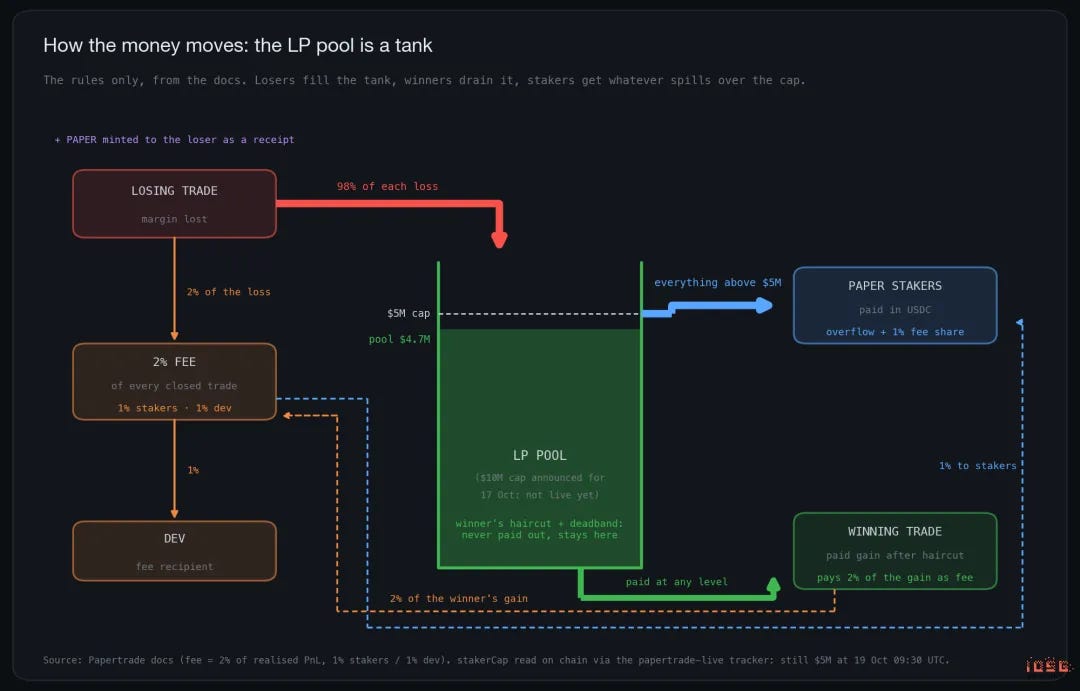
IOSG Ventures used its weekly report to break down Papertrade’s rebate structure and the risks embedded in its pool design. The figures it listed were striking: $136.10 billion in headline trading volume; $529 million in open positions backed by $10.7 million in margin, implying average leverage of about 50x and roughly 160x on day one; $335 million in actual deposits from about 23,000 addresses, with $271 million withdrawn; and a peak locked margin balance of $58 million on the first day.
IOSG then focused on the cash flow that actually changed hands. It put losing liquidations at $249 million, trader net losses at $63.2 million and team fee income at about $4.5 million. Net losses represented about 0.46 basis points of headline volume and, in IOSG’s framing, were the only layer that could truly be distributed to stakers.
The $249 million from losing positions was gross inflow into the pool, including the losing leg of wash trades, and PAPER mining was based on that number. IOSG split the outflows into four buckets: $185 million, or 75%, went to winning positions, much of it to the opposite leg of the same wash trades; $54.1 million, or 22%, went to stakers; $4.7 million remained in the pool, close to the cap; and about $4.5 million, or 2%, went to developers. After subtracting winners, traders were left with $63.2 million in net losses, 86% of which went to stakers.
The central issue, IOSG wrote, is that Papertrade does not guarantee winners will be paid. On a conventional exchange, winning traders are backed by market makers, insurance funds or the venue’s own balance sheet. Papertrade has none of those. The pool contains only money left behind by losers, and the cap is intentional. Once excess funds are distributed to stakers, they cannot be pulled back. If winners are owed more than the pool holds, they are effectively waiting for people who have not yet lost money to arrive, and the contract has no mechanism to force that to happen.
IOSG said that, strictly speaking, this is not a Ponzi because no yield is promised and the house edge is real. But from the perspective of winners waiting in line for payment, it behaves in a similar way: new money has to keep coming in.
The real danger sits in tail winners. A single position is unlikely to break the pool. With a notional cap of $10 million per position, even a 1,000x long would need a move of about 57% to create a $5 million liability. The problem is that there is no rule stopping one wallet from opening dozens of positions. IOSG cited address 0x2025, which at one point held about 30 ETH short positions of $9.9 million each, or $297 million in total. At that size, a 2% move against the position would create liabilities larger than all the money in the pool.
IOSG also described a first-day episode in which 0x2025 pushed the Hyperliquid mid-price. Over 35 minutes, winners withdrew $2.4 million from the pool. The balance stood at $4.91 million at 21:45 UTC and had fallen to $2.48 million by 22:20 UTC. Nothing similar happened again afterward.
On para:PAPER, IOSG said PAPER is a perpetual contract listed by Paragon, a HIP-3 deployer on Hyperliquid whose DEX name is para. The market was not launched by Papertrade and not by Hyperliquid itself. Paragon spent 570.98 HYPE, about $45,000, in the HIP-3 auction to secure the PAPER code.
This is a pre-market product with up to 3x leverage and isolated margin only, later intended to convert into a standard perpetual. Its oracle uses an 8-hour EMA of its own marked price, with an initial value set by Paragon at the listing reference price of $0.012. IOSG stressed that it has no connection to Papertrade. PAPER cannot be transferred, nobody can deliver it and there is no spot market for arbitrage.
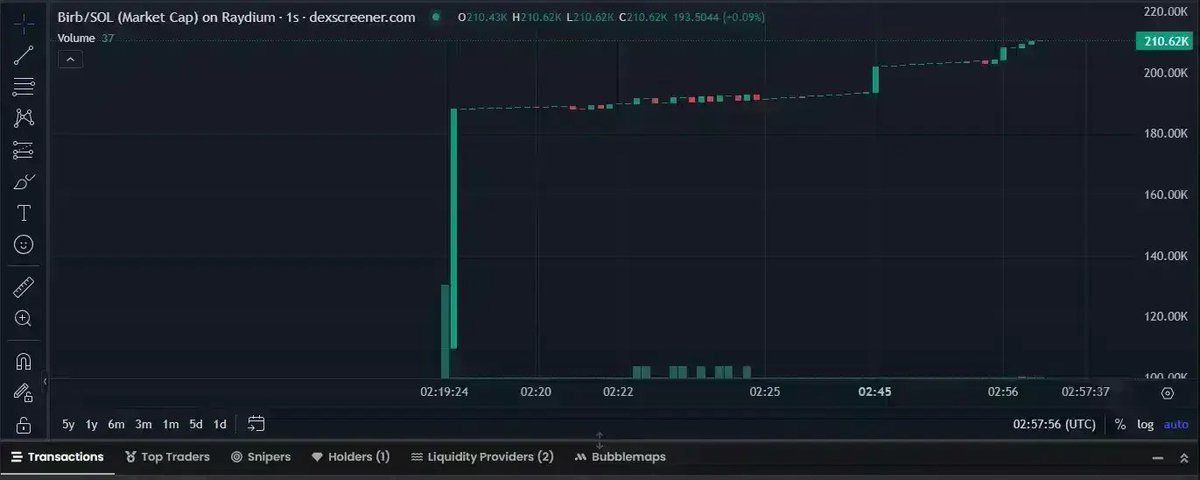
The market opened at 11:00 UTC on Oct. 18 with about $30,000 in open interest. It stayed at the $0.012 reference price for the first hour, close to the wash-trading mining cost of $0.0125, then moved sharply higher: $0.023 by 13:00, an hourly high of $0.0352 during the 13:00 hour, a low of $0.0198 at 19:00, and then around $0.0243 afterward. Twenty-four-hour volume reached $13.9 million, or 70% of all Paragon volume. Open interest stood at 203.5 million tokens, about $5 million. Funding was close to zero. At $0.0243, 8.69 billion tokens implied a market cap of $211 million, while the 12.7 billion cap implied $308 million.
Blockworks sees Uniswap growth in tokenized assets and Robinhood activity
In a separate English-language piece, Blockworks argued that Uniswap’s next growth phase could come from two directions: institutional adoption of tokenized assets over the long run, and a possible revival of retail speculation in the Robinhood ecosystem over the shorter run.
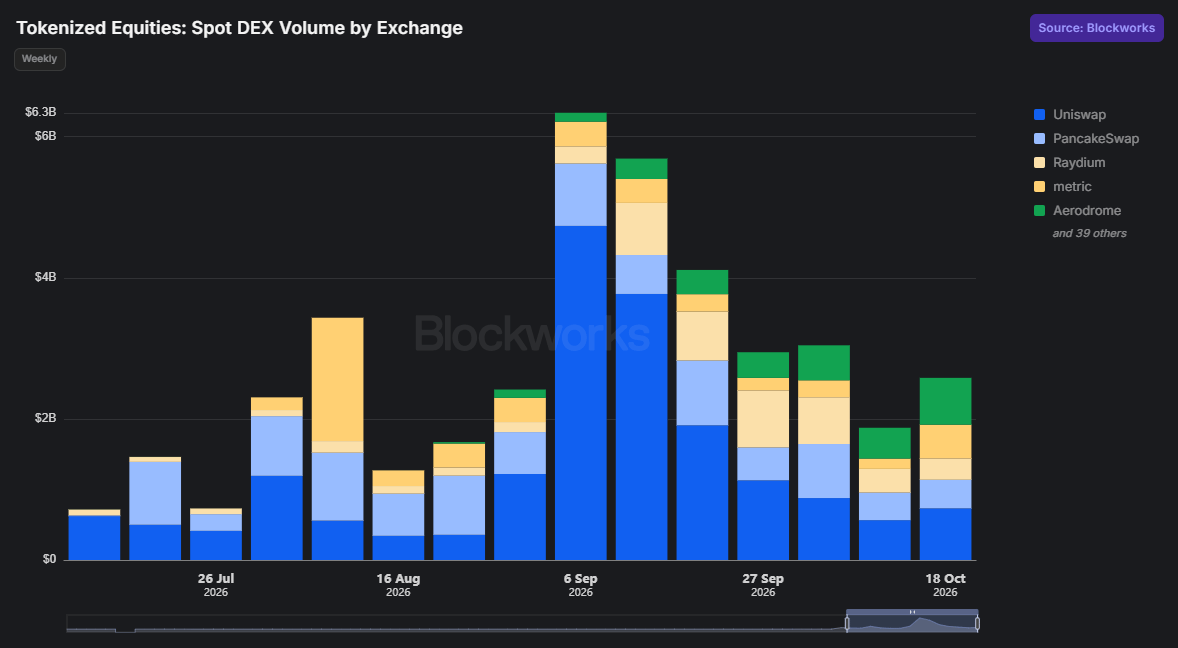
The article said the U.S. Securities and Exchange Commission’s Innovation Exemption, introduced a month earlier, was a major positive for tokenized assets because it opened a path for tokenized U.S. equities to trade through AMMs and liquidity pools. Issuers such as Backpack and Securitize stand to benefit from bringing stocks on-chain, but Blockworks argued that a meaningful share of value will ultimately be captured by the trading layer where those assets change hands. In that segment, it said, Uniswap remains dominant and is still the platform of choice for tokenized stock trading, even as Aerodrome closes the gap.
Blockworks said Uniswap processed $730 million in volume last week, while the on-chain tokenized stock market is still in its early stages and could grow far beyond current levels. One competitive edge for Uniswap is the ability to offer customized features for institutions through v4 Hooks. In July, Uniswap launched Permissioned Pools with partners including Superstate and Securitize. In early October, Sumitomo Mitsui Banking Corporation and Nethermind said they would build an on-chain trading platform for Japanese investors on top of Uniswap v4, designed around Japanese regulatory requirements and targeted for launch in mid-2027.
On the retail side, Blockworks focused on speculative trading and meme tokens. It said activity across the Robinhood ecosystem has cooled sharply from its peak, with tokens such as PONS and AI down more than 50%. Sentiment is now near a low, in the author’s view, but that could change quickly. Market rumors suggest Robinhood may launch a nine-figure funding program and a Builder Program. If that happens, the article said, Uniswap is still likely to benefit because many applications and token launch platforms in the Robinhood ecosystem are already built on top of Uniswap.
Taken together, the five reports in this ChainFeeds edition map out a market where token launches, derivatives incentives, DEX economics and on-chain trading infrastructure are all being reshaped at the same time.