
ChainFeeds publishes its Aug. 26 daily research brief
ChainFeeds released a new edition of its Daily research brief on Aug. 26, centering on Bitcoin institutionalization, the latest crypto rebound, the HyperEVM ecosystem, U.S. Treasury yields, and the on-chain meme trade. The package was titled around three headline themes: Michael Saylor’s comments on a possible “Bitcoin reform,” the question of which assets rebounded the hardest in crypto’s latest upswing, and how to read current on-chain action after CZ turned attention toward Robinhood CEO Vlad and CASHCAT hit a fresh high.
In the headline roundup, the brief listed several items: unnamed sources said potential buyers of crypto custody firm Copper had offered well below the previously cited $500 million mark; RockawayX was said to be raising $150 million for a crypto hedge fund focused on undervalued tokens and crypto equities; Kalshi had raised about $1.12 billion through equity financing, with total issuance nearing $1.5 billion; Arthur Hayes said he would publish a FLOP tokenomics infographic this week and host an AMA next week; and Caixin reported that Zhou Guren, described there as the largest backer of the Trump family crypto project WLFI, had been listed as a dishonest debtor in six cases involving debts of tens of millions of yuan.
The rest of the brief was built around five longer items.
Michael Saylor says institutionalization does not conflict with Bitcoin’s principles
The first section focused on Michael Saylor’s discussion of what he called “Bitcoin reform.” As presented in the brief, Saylor argued that reform does not mean weakening the protocol, expanding supply, or abandoning verification. Instead, he drew a line between Bitcoin’s non-negotiable core rules and the preferences formed by a particular subculture under specific historical conditions.
His position was that the base layer should remain secure, scarce, and resistant to arbitrary change. At the same time, the economic system built around Bitcoin can keep evolving in response to real-world demand, becoming richer, more layered, and more innovative. He said studying Satoshi Nakamoto matters, but “what Satoshi said” should not stand in for evidence, engineering judgment, or consensus, because Bitcoin was designed to continue operating without its creator. In that framing, the white paper explained a breakthrough in decentralized settlement, but did not pre-answer every question in finance, law, governance, security, or economics.
On custody, Saylor argued that self-custody should be treated as a right, not as a ritual. Users’ ability to hold Bitcoin directly should be protected, but people who choose collaborative custody or institutional custody based on their own capabilities and risk tolerance should also be respected. The piece added that labels such as “Bitcoin only,” “open source,” “institutional grade,” “regulated,” and “decentralized” are descriptions, not guarantees of safety. A system, in his view, should be judged on evidence, control mechanisms, incentive design, and failure modes.
He also rejected blanket opposition to counterparties. The better approach, as summarized in the brief, is to identify what can go wrong, how losses would be allocated, what collateral exists, which controls have been validated, and how quickly participants can exit. Bad counterparties should be rejected; cooperation itself should not.
The article grouped stocks, bonds, preferred shares, deposits, derivatives, trust interests, and Bitcoin UTXOs as different kinds of claims that need precise description rather than labels such as “paper Bitcoin.” It also said the Bitcoin network is not determined by any one constituency alone, but by voluntary adoption and coordination among users, miners, nodes, developers, markets, and institutions.
On Bitcoin and fiat, the argument was coexistence rather than replacement. Sovereign currencies are better suited to state obligations, wages, credit, and day-to-day commerce, while Bitcoin is better suited to scarce, portable, non-sovereign capital.
Saylor’s bigger claim was that Bitcoin’s next phase extends far beyond a new payments use case and into the digitization of capital. The brief cited several large capital pools: global equities at roughly $157.8 trillion in market value in 2025, global fixed-income securities outstanding at about $160.7 trillion, and the investable gold market at about $15 trillion. Real estate, private businesses, sovereign reserves, collectibles, and other stores of wealth would expand that figure further. Bitcoin, the piece said, would not need to replace all of those assets to produce a major shift.
As adoption broadens, Saylor sees Bitcoin supporting a layered financial architecture: Bitcoin itself as “digital capital” used as a reserve asset and long-term store of value; “digital equity” built around organizing capital, operations, and financing on top of Bitcoin; “digital credit” and “digital debt” designed from Bitcoin-based balance sheets; tokenized sovereign currencies for transactions; and digital financial instruments, digital derivatives, and “machine capital” controlled by software, devices, robots, and autonomous intelligent agents.
Foresight News says the rebound again showed the weight of policy and ETFs
The second item examined the latest market rebound. Foresight News argued that every extreme move acts as a stress test for market structure, and that this rebound once again confirmed several clear patterns.
The first was that short-term directional turns in crypto have become highly dependent on swings in the U.S. policy cycle. Looking back across the last four years, major turning points — including spot Bitcoin ETF approval, shifts between Federal Reserve tightening and easing cycles, and this round of Treasury buybacks — have moved in step with U.S. fiscal and regulatory policy. In that reading, price-setting power is gradually shifting away from crypto-native leverage cycles on-chain and toward macro liquidity and regulatory expectations.
Foresight News reduced the latest rally to two key drivers. One was a reversal in macro liquidity expectations after a long-duration Treasury buyback decision. On Aug. 19, Treasury Secretary Bessent announced that the single-operation buyback size for 10-year to 30-year Treasuries would rise from $2 billion to at least $4 billion, a response to surging long-end yields and heavy selling in long-dated government bonds. The market read that as the U.S. government using looser operations to ease its own borrowing costs, weakening the dollar and sending capital toward alternative stores of value such as gold and Bitcoin. Because Bitcoin also behaves like a high-beta risk asset, its gains stood out.
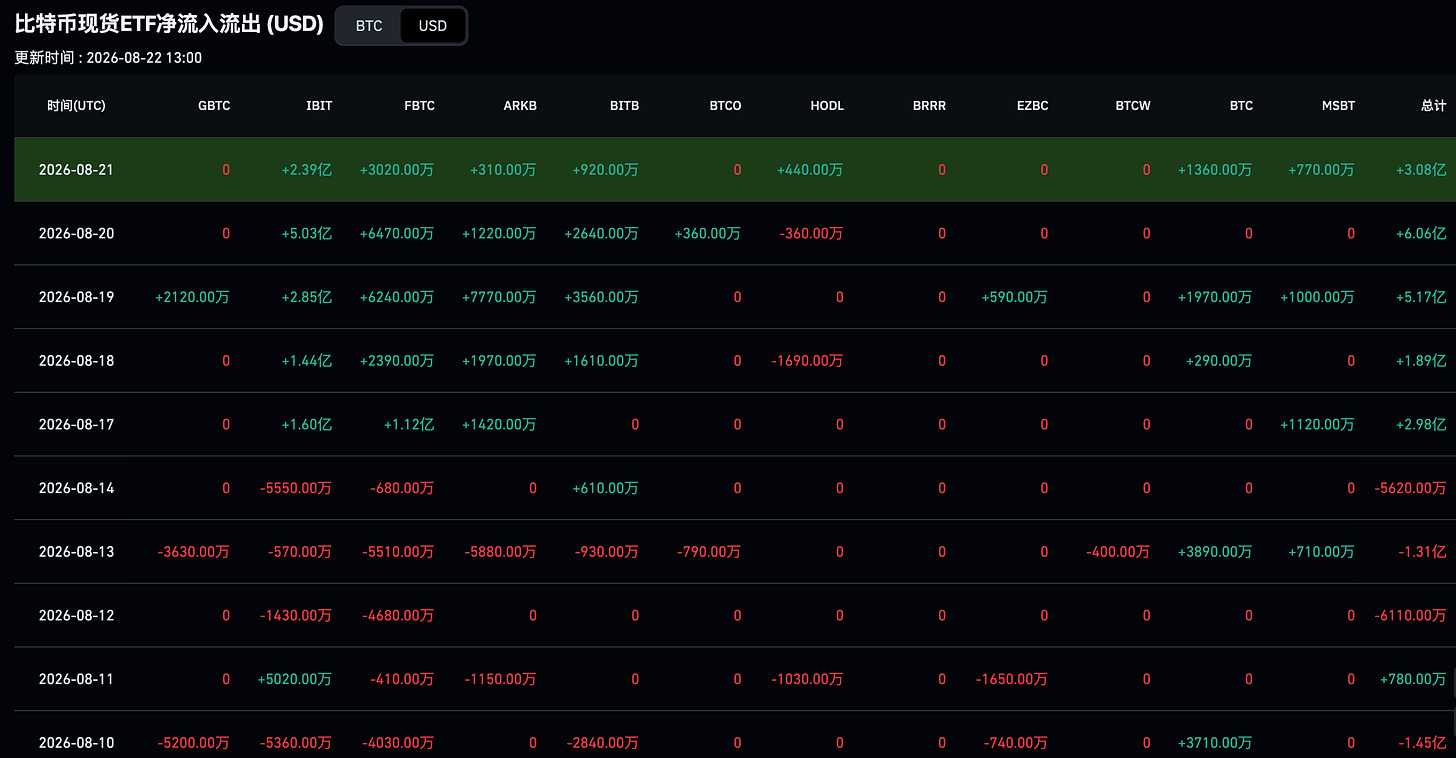
The second driver was the return of spot ETF leadership. The brief described the pattern of spot Bitcoin ETFs moving before the rest of the market as one of the clearest structural features in crypto over the last two years. In this rebound, the broad market breakout began on Aug. 19, but spot Bitcoin ETFs had already shown steady net buying in the days before that point.
For the week ended Aug. 21, U.S. spot Bitcoin and spot Ethereum ETFs posted combined net inflows of $2.6 billion, the highest weekly level since October 2025. Spot Bitcoin ETFs accounted for about $1.9 billion of that. Weekly trading volume jumped from $6.9 billion in the prior week to $22.1 billion, a 219% increase, while total net assets rose from $76.6 billion to $96.1 billion. Spot Ethereum ETFs also had a strong week, bringing in $697.2 million, the largest weekly inflow since the week ended Oct. 3, 2025. Their weekly trading volume climbed from $1.9 billion to $6.9 billion, up 259.4%. Both ETF groups recorded their biggest weekly net inflows of 2026. The contrast with the previous week was sharp: together they had seen net outflows of $392 million.
Bitcoin lit the spark in this round, but the bigger elasticity showed up when large-cap altcoins and smaller tokens followed. Ethereum started the week near $1,900 and reached as high as $2,546, for a weekly gain of 29.8%, beating Bitcoin’s 22.9%. The ETH/BTC ratio recovered to around 0.031, and Ethereum’s market capitalization moved back above $280 billion.
Foresight News said Ethereum’s stronger rebound reflected more than the shared forces of macro liquidity and short covering. It pointed to three Ethereum-specific factors. First, spot Ethereum ETFs drew in roughly $697 million last week, their strongest week since October 2025. Second, exchange supply kept tightening. Exchange-held ETH fell from about 7.7 million in early June to about 6.54 million by mid-August, a drop of roughly 15%. At the same time, more than 42 million ETH had been staked, which kept tradeable circulating supply shrinking. Third, regulation turned more supportive. On Aug. 18, the U.S. Securities and Exchange Commission proposed a new draft framework for public crypto token sales, which the market viewed as a positive sign that issuance rules were becoming clearer. That, in turn, lifted risk appetite across the Ethereum ecosystem.
Biteye maps HyperEVM’s meme surge and its core infrastructure names
The third section turned to HyperEVM. Biteye reviewed a group of active memes and utility projects in the ecosystem and described the current move as a re-rating driven by HYPE reaching new highs.
EGG, the piece said, came from an old Jeff Yan post: “Just buy eggs with your shitcoins.” The community turned that line into a native HyperEVM meme and built a small game and interactive website around it. During its breakout stage, EGG posted a 24-hour gain of more than 14,000%, and its market capitalization briefly reached about $8 million to $9 million before pulling back sharply.
CHAMELEON was tied more directly to Jeff’s actual startup history. Before Hyperliquid, according to the brief, Jeff ran Chameleon Trading, and his X handle remains @chameleon_jeff. CHAMELEON’s market capitalization once rose to about $4 million, and it has since retraced roughly 65% to 70%.
In the launchpad category, Motion.meme was described as a HyperEVM version of Pump.fun. It uses a bonding curve for price discovery before assets move into trading on a HyperSwap V3 pool. The fee structure listed in the brief was 0.05 HYPE to launch a token, about 0.5% platform fees during the bonding phase, and around 0.01% pool fees on HyperSwap.
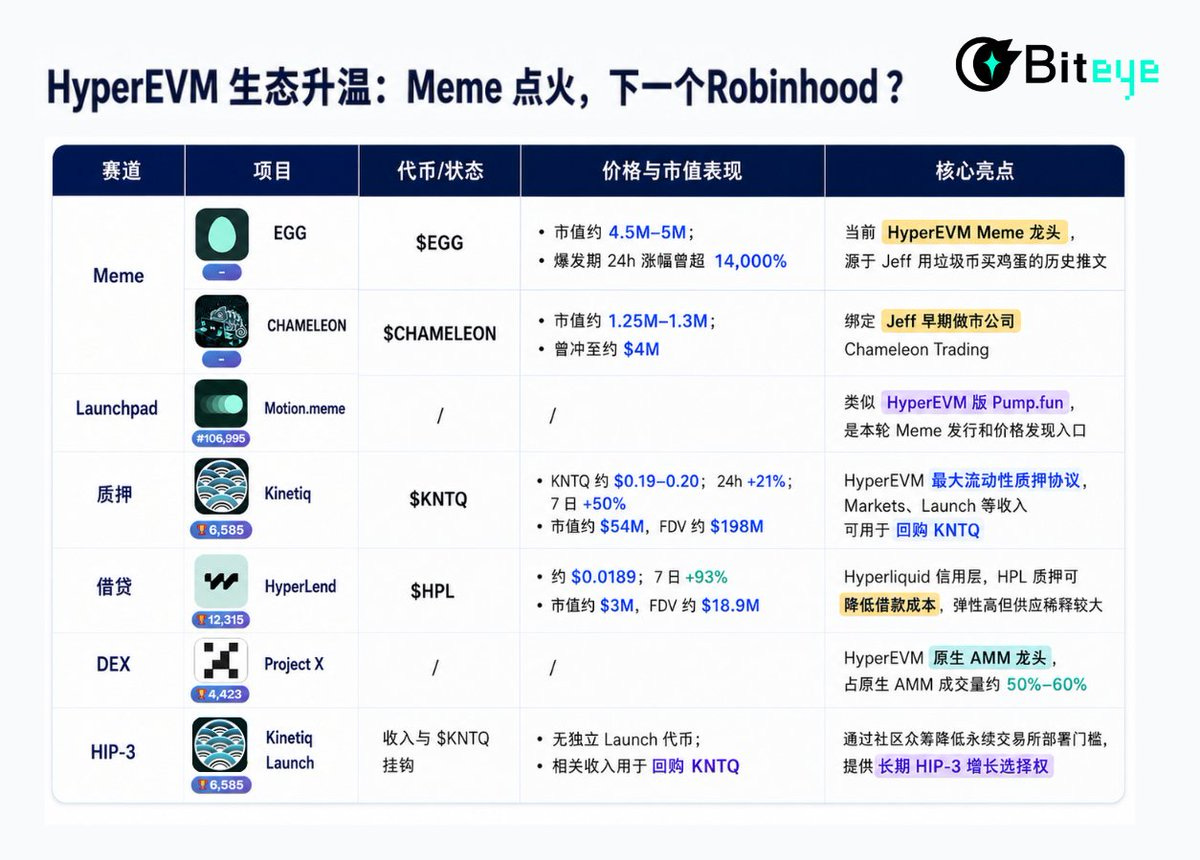
Kinetiq was identified as the largest liquid staking protocol on HyperEVM. Users stake HYPE and receive kHYPE, which allows them to earn staking yield while also using kHYPE in lending markets and liquidity provision. Biteye argued that KNTQ has relatively clear value capture: revenue from Markets, Launch, and part of validator income is used to buy back KNTQ and distribute value to sKNTQ stakers.
Kinetiq Launch is aimed at HIP-3 perpetual exchanges. Deploying one such exchange requires staking more than 500,000 HYPE, which the article said was close to $40 million at current prices. Kinetiq Launch allows communities to crowdsource that capital and isolate exchange-specific risk through separate exLST structures. Launch revenue earned by Kinetiq is used for KNTQ buybacks, adding a new “HIP-3 exchange incubator” angle to the token. Overall, Biteye described Kinetiq as one of the most complete utility projects on HyperEVM in this cycle.
HyperLend was presented as the main lending market on HyperEVM and a credit layer for Hyperliquid, supporting collateral such as HYPE and kHYPE. It had about $570 million in TVL and roughly $308 million in outstanding borrows. HPL can be staked into sHPL to reduce borrowing costs, with rebates of up to 80%. The market case for HyperLend, the piece said, is the combination of low market capitalization and high TVL.
Project X was described as the leading concentrated-liquidity AMM by volume in HyperEVM, with TVL of about $45.8 million and 24-hour trading volume of roughly $152 million. Among native HyperEVM AMMs, it accounted for around 50% to 60% of volume share.
Still, Biteye stopped short of calling this a full “HyperEVM Season.” Whether the move can evolve into that, it said, depends on how many users remain after meme speculation cools and whether utility projects can turn that activity into real users and actual revenue. Gas costs were flagged as a recurring constraint. Every time HyperEVM heats up and on-chain activity rises, gas fees jump sharply; at peak periods, a single transaction can cost $10 to $20. That supports HYPE demand and token burn through gas usage, but it also limits the upper bound for meme trading and the ecosystem’s longer-term expansion.
Arthur Hayes links the 5% Treasury threshold to renewed Bitcoin bullishness
The fourth section, citing Deep Tide TechFlow’s summary of Arthur Hayes, focused on U.S. bond yields. The key argument was simple: regardless of politics, both Janet Yellen and Bessent fear a 10-year Treasury yield that nears 5%, and when that level comes into view, policymakers revert to monetary expansion.
The piece called the 10-year yield the most important price in the U.S.-led financial system. Thirty-year fixed mortgage rates, corporate bond yields, and a wide range of consumer borrowing costs are all priced from it. Once yields move above 5%, financing costs for households and businesses become too expensive and economic activity slows.
It then distinguished short-dated Treasury bills from longer bonds. Bills maturing in less than a year have duration much closer to cash, which makes them more liquid and more attractive to many investors, especially money market funds. Those funds want the highest return possible while taking as little interest-rate risk and counterparty risk as they can. In that framework, the safest place to park cash is the Federal Reserve, through its reverse repo facility, where eligible counterparties can earn a return close to the effective federal funds rate.
The article noted that lending to the U.S. government in dollars is often treated as risk-free in theory because the government can print money, but actual debt settlement still depends on congressional approval. That is why debt ceiling fights matter to market participants. If lawmakers refuse to approve spending, bondholders may not get paid. As a result, if money market funds are going to hold Treasury bills, those bills need to yield slightly more than reverse repo to compensate for that risk.
According to the brief, about $2.5 trillion was sitting in the reverse repo facility. The problem for Yellen was that the money multiplier on those balances was zero because the funds were stuck on the Fed’s balance sheet and could not be rehypothecated. If money market funds shifted those balances into higher-yielding Treasury bills, banks could rehypothecate them. The article said that process would channel liquidity into bonds, push yields lower, and lift equity prices. For crypto traders, it argued, Bitcoin also bottomed after the FTX collapse under that broader liquidity backdrop.
The piece added that increasing bill issuance pushes down Treasury bill prices and raises their yields well above reverse repo rates, forcing profit-maximizing money market funds to switch between the two instruments. By the time Bessent took office on Jan. 20, 2025, reverse repo balances had dropped from $2.5 trillion to $100 billion. The resulting $2.4 trillion liquidity injection was described directly in the article as money printing because the original source was pandemic-stimulus deposits. It said that liquidity flowed into financial markets, helping lift the Nasdaq 100 and Bitcoin, while the 10-year yield fell away from the critical 5% level and the federal funds rate stayed around 5.3%.
BlockBeats says on-chain trading still trails the broader rally
The fifth and final section came from BlockBeats and dealt with how to interpret current on-chain conditions after CZ commented on the Robinhood CEO discussion and CASHCAT reached a new high.
The opening view was that if the broader market stays stable or extends its strength, the on-chain cycle still may not even have properly started. In the article’s words, Bitcoin at $80,000 is not especially high and still needs to be tested over a longer time frame. Opportunities on-chain have clearly increased, but most of the gains are concentrated in older tokens that already had community backing and capital support. New launches have not produced the kind of explosive, rapid rotations often seen in stronger on-chain phases. That suggests on-chain activity is still lagging behind the broader market because the speed and scale of the BTC and ETH move exceeded most expectations, and sentiment and capital have not fully flowed down into new token issuance.
Older names with long-established communities and funding bases have therefore moved first, with capital using them to test market sentiment. The article said this incomplete consensus is not limited to meme coins; the same pattern is visible across other altcoins as well.
It also argued that meme coins have now been repositioned. During the DOGE and SHIB era, meme tokens were still a relatively novel crypto-native narrative. By the Pump.fun period, the issuance and trading model had changed sharply, allowing traders to speculate directly on attention. Now exchanges and public blockchains increasingly recognize meme coins as one of the asset classes most capable of attracting new users. Solana CPO Vibhu was cited as saying meme coins are among the most effective crypto application categories for attracting mainstream users and have generated significant returns in the market.
Traditional finance moving on-chain may be the bigger business, the article said, but user traffic comes first. Because meme coins have already become a stable business model, they are no longer something exchanges and chains can afford to ignore.
The piece stressed that meme coins have rarely received this kind of positive endorsement, especially after “meme stock” style mechanisms began to appear in tokenized U.S. equities. Robinhood CEO Vlad said in a recent podcast that users holding a meme coin could receive an airdrop of tokenized U.S. stocks. In the article’s framing, that links meme coins with U.S. equities and creates a type of asset category that had not previously existed.
Vlad also said that before Robinhood, roughly 50% of U.S. households owned stocks, and Robinhood helped lift that figure to 65%. Tokenization, he said, could be the key to pushing stock ownership further toward 95% while making high-quality U.S. equities and other RWA assets easier to distribute globally.
When asked about U.S. stock memes, CZ also responded positively, calling the approach novel and interesting, while adding that issuers would need to make sure they can actually fulfill their obligations. The article ended by noting that despite positive comments from both Vlad and CZ, the sector still has not produced a representative token with a market capitalization above $100 million, leaving substantial room in the narrative.
Source details
The brief was published by ChainFeeds Newsletter on Aug. 26, 2026. The source page collected a headline roundup and five research summaries, drawing from Michael Saylor, Foresight News, Biteye, Deep Tide TechFlow, and BlockBeats.