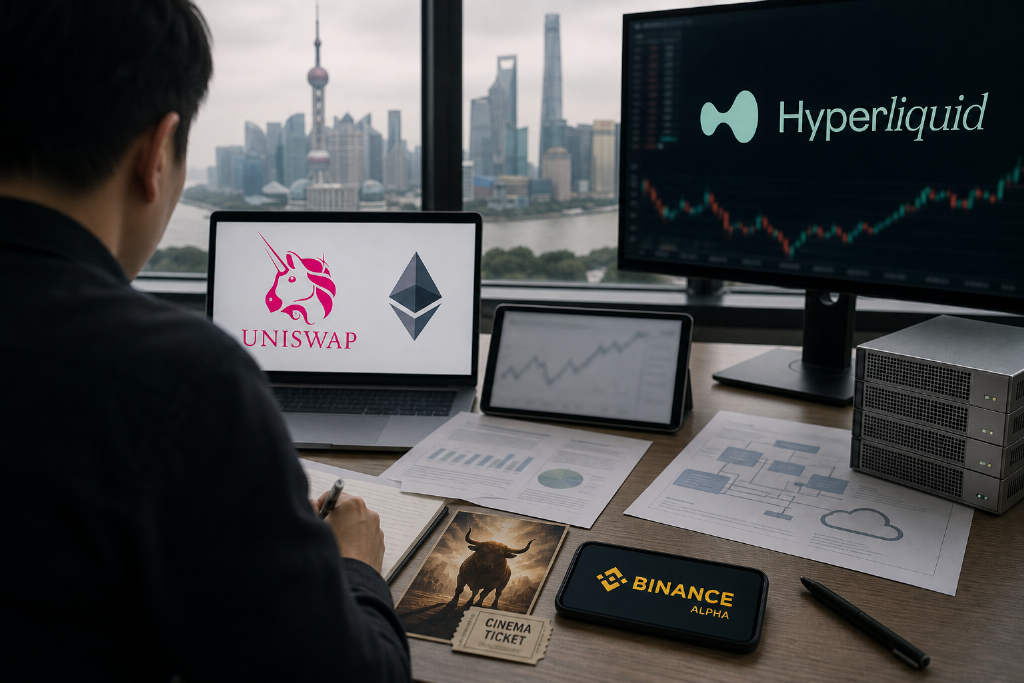
ChainFeeds published its latest research digest on Aug. 19, grouping five pieces released in its Aug. 18 briefing across crypto markets, AI infrastructure, social protocols, meme speculation and onchain trading platforms.

Headline items in the daily digest
The roundup’s headline news list included Ripple Prime completing a private placement of $275 million in senior unsecured notes, Arthur Hayes becoming CEO of Flop Labs, Visa seeking new stablecoin settlement partners, Binance Alpha listing 「牛来」, and an Ethereum community EIP proposal to shorten the consensus-layer block retention window to about 36 days.
Uniswap founder says AMMs may win through correlated pairs
In a featured post titled “How AMMs can win global markets through correlated pairs,” hayden.eth argued that automated market makers remain in a very early phase even after Uniswap has processed about $4.6 trillion in cumulative volume.
The piece says tokenization is changing who gets to make markets. In traditional finance, professional market makers bundled capital, strategy, execution, settlement and distribution into a single business stack because assets sat in fragmented systems and settlement was slow. Blockchains start to break that structure apart: execution can be handled in code, custody and settlement become shared services, and work once dependent on proprietary infrastructure is increasingly handled by open-source software.
That shift lowers the barrier to market making even more. Under an AMM model, anyone can deposit two assets into a pool and earn trading fees. In that setup, capital becomes the scarce input, and the edge goes to whoever can hold inventory at lower cost. Professional firms still need to pay for staff, technology and infrastructure, and often hedge price risk with instruments such as options. Long-term holders of those same assets can absorb that risk more naturally. Asset issuers may face an even lower capital cost because, in the old model, they were already paying outside firms to make markets in newly issued assets.
The article says this has produced an organic onchain liquidity structure in which correlated assets cluster together. Assets in the Ethereum ecosystem often trade against ETH. Solana ecosystem assets often trade against SOL. Stablecoins pair with each other. Those clusters are then linked by a smaller number of highly liquid bridge pairs. The reason is simple: when the two assets held by LPs move more closely together, inventory risk falls, so the willingness to provide liquidity rises.
Hayden.eth extends that idea to tokenized real-world assets. The article argues that the world’s largest financial markets could eventually reorganize in a similar way. In traditional finance, many assets trade against the U.S. dollar not because the dollar is always the best natural quote asset, but because different asset systems need the dollar and legacy payment rails to connect them. If assets share a common blockchain settlement layer, any asset could, in theory, trade directly against another. The examples given include NVDA/SPY instead of NVDA/USD with SPY/USD acting as the bridge to dollars, oil company equities trading against an oil ETF or tokenized oil, and private credit paired with tokenized U.S. Treasury funds.
Under that framework, if more stocks trade directly against correlated instruments such as SPY, flows that ultimately need to enter or exit dollars can be concentrated into a small set of bridge pairs like SPY/USD. Those bridge markets would still need more specialized market making, but there would be far fewer of them, and their volume concentration could still attract professional firms. The post points to ETH/USDC as evidence that this kind of structure already emerges naturally in DeFi because many different liquidity clusters route through it.
The conclusion in the piece is that highly correlated pairs could be served mainly by passive LPs, while professional active LPs compete in a limited number of key bridge markets. End users would still be able to buy and sell assets using dollars because routing across pools can happen automatically, but liquidity would no longer be forced into dollar-denominated pairs by legacy market structure. Hayden.eth says the pattern is already visible in tokenized equities: Uniswap now has 10 tokenized stocks paired directly with SPY, and some trades can already move from one stock into another without touching dollars at all.
IOSG questions whether Model Fusion really pays off
In a separate weekly note, IOSG Ventures argued that enterprises do not buy leaderboard rankings. They buy acceptable task outcomes while also weighing price, latency, privacy and reliability. If a cheaper model already clears the business acceptance bar, paying more for something smarter may not make economic sense. Cost efficiency, the note says, is the real center of competition.
IOSG breaks today’s quality-improvement methods into four buckets. One is to upgrade directly to a stronger single model. Another is to spend more test-time compute on the same model through longer reasoning, self-consistency or repeated sampling. A third is routing, cascading and task delegation, where cheaper models handle verifiable or mechanical steps and harder cases get escalated. Only the fourth is Model Fusion in the narrow sense: multiple models answer the same question and a judge or synthesizer produces the final output.
All four approaches amount to spending more compute to buy more quality, but they spend it differently. Single-model scaling buys deeper reasoning. Routing buys better allocation. Fusion buys more candidate answers. IOSG’s point is that the first three methods focus budget on the part most likely to change the result, while Fusion first pays for overlapping opinions and then hopes a judge can identify useful differences. Fusion only has a clear case if candidate models contribute independent information and the judge can recognize it.
The note cites DRACO comparisons run through OpenRouter, where multiple panel models are called in parallel and then reviewed and synthesized. All three tested setups improved scores: Fable 5 + GPT-5.5 rose from 65.3 to 69.0; Opus 4.8 self-fusion increased from 58.8 to 65.5; and a low-cost three-model panel moved from 60.3 to 64.7. IOSG says the stronger gain in Opus self-fusion suggests the improvement may come from added search and sampling rather than cross-model knowledge complementarity. On that basis, it argues that the fair comparison should be against self-consistency, longer reasoning and a stronger single model under the same token budget.
The article also points to prior research showing that multi-agent systems improved by at most 7.1 percentage points at around 20x compute, while debate and Mixture-of-Agents outperformed self-consistency by only 1.3 and 2.7 points at equal budget. Another study using equal reasoning-token budgets found a single agent could match or beat the multi-agent setup. IOSG’s reading is that a meaningful share of the apparent collaboration gain disappears once the compute bill is normalized.
Cost and latency remain central to the critique. OpenRouter’s default three-model panel costs about 4x to 5x as much as a standard generation and runs 2x to 3x slower, according to the piece. Yet the full token, cost and latency breakdown for the DRACO configurations was not disclosed, making it impossible to judge whether a 3.7-point improvement is worth it. In IOSG’s framing, the work shows Fusion can raise scores, but not that it improves production ROI.
The note goes further and says Fusion carries more than API expense. It also adds wait time and new system risk. Its value depends on candidate models contributing truly independent information, but many models share training corpora, web sources and faulty premises. That creates what the piece calls “citation laundering” in research tasks, where multiple answers trace back to the same source but appear as separate pieces of evidence. Without claim-level provenance and search-path retention, API cost can rise almost linearly with the number of models while evidence diversity does not.
IOSG cites a 2026 paper, “When Does Combining Language Models Help?”, by KAIKAKU.AI co-founder and CEO Josef Chen. The study covered 67 models from 21 providers. In open-ended math tasks, the predicted probability that all models would fail together was 2.3%, but the observed rate was 5.2%, about 2.3x the prediction. Joint failure rates climbed to 7.9% in execution-scored coding tasks and 12.7% in the free-response version of GPQA-Diamond. On a 100-question GPQA-Diamond set, that implies roughly 13 questions where every candidate model would miss the answer, leaving voting, judging and synthesis with nothing correct to choose from.
The takeaway in the article is narrow rather than sweeping. Model disagreement on easier tasks can increase combination value, but the hardest tail-risk cases are exactly where models may fail together. IOSG says Fusion may make sense only when the cost of error is high, candidate models contribute complementary search paths, no cheaper external verifier exists, and the business can absorb extra latency and vendor risk. Even then, final outputs should still be checked by humans or outside evidence.
Farcaster heads toward a second sale in one year
Another piece in the digest, from TechFlow, tracks the unraveling of Farcaster. On Aug. 17, Neynar co-founder rish said the company was looking for a new team to take over the Farcaster protocol, the official app and token-launch platform Clanker. Neynar plans to return remaining funds and then dissolve the team. The announcement came only seven months after Neynar took over the project from its original creators, making this the second sale process for Farcaster within a year.

The article revisits the earlier transfer. On Jan. 21, Merkle Manufactory, the original Farcaster team, handed over the protocol contracts, codebase, official app and Clanker to Neynar, then returned the full $180 million it had raised to investors. Founders Dan Romero and Varun Srinivasan moved on to Tempo, a payments chain incubated by Stripe and Paradigm. That left a project once backed by Paradigm and a16z and once valued at $1 billion searching for another owner again just months later.
Neynar, described as a middleware company building Farcaster developer tools, had raised $11 million in a 2024 Series A. According to the article, it inherited two things: a developer-first social network and what looked like a money-printing token-issuance machine. Seven months later, that thesis had changed.
The most valuable asset in the package was Clanker, an AI token-launch bot. During the peak of the AI token-issuance wave earlier this year, it served as Farcaster’s cash cow and generated $35 million in onchain token issuance service fees in a single quarter. Citing DefiLlama, the article says Farcaster ecosystem protocol fees were $35.43 million in the first quarter of 2026, fell to $4.67 million in the second quarter, then dropped to $377,000 from July 1 to Aug. 17. In the latest 24-hour window, protocol fees were just $4,001. The piece describes that move from $35.43 million in one quarter to roughly $4,000 in one day as a 99% drop. Since launch, cumulative fees reached $94.1 million. Meanwhile, buybacks for the CLANKER token, which were funded by those fees, have stopped.
Costs were disclosed as well. Rish said the full-stack social network costs $100,000 per month to run, with peak monthly burn reaching $500,000. Over the last 30 days, the ecosystem generated $120,000 in revenue, roughly enough to cover current monthly spending. He added that operating cost was not the reason behind the decision and said the company’s balance sheet could absorb the current cost indefinitely, but the numbers could matter to whoever takes over next.
The article argues the harder question is product direction and demand: why should users leave X and come here? Alliance co-founder Imran is quoted saying Farcaster was a useful infrastructure experiment, but that a decentralized social graph on its own is not enough to pull users away from X and Instagram. In his view, the version that could work is social trading, where token discovery, speculation and PnL reputation are tied into one native product loop, something incumbent social platforms would struggle to copy.
It also suggests Farcaster’s best period was the moment it looked least like a social product. When Clanker was booming, users came to issue and trade tokens rather than to socialize. Once the speculation wave faded, revenue disappeared, the social narrative returned, and the project ended up back on the market. Still, the article notes that Megapot, an onchain lottery project on Base, has publicly expressed interest in taking over Farcaster in replies to rish’s announcement.
How “Niulai” turned from a box office joke into a $46.79 million meme coin
Baihua Blockchain’s contribution to the digest traces the 72-hour arc of “Niulai,” a little-known animated movie that became a viral meme and then an onchain asset. The film opened with 245 screenings and just 3,420 yuan in box office revenue. By day 10, only four screenings remained nationwide. Its producer was formerly a renovation company in Dalian, and the core creative team had just two people: a mother-son pair who handled directing, screenwriting, modeling, dubbing, production and even the ending song over five years without outside investment.
On Aug. 14, the phrase “Niulai box office 7,352 yuan, not ten thousand” hit the trending list. Crude visuals from the movie spread rapidly across short-video platforms, and a film that had drawn almost no attention became a collective internet joke. The next day, daily box office jumped to 484,000 yuan, up more than 6,000%, while screenings surged from 21 to 359. People drove long distances to buy tickets. Others used seat maps on ticketing apps to show support. Cinemas filled with live reactions, filming and meme-making. A movie that had nearly been pushed out of theaters by weak sales was sent back by internet attention, with cumulative box office quickly crossing 10 million yuan, peak daily revenue exceeding 4.85 million yuan, and a place in the annual top 10 for domestic animated films.
The article says the name itself made the story different. “Niulai” sounds like “the bull market is coming.” For A-share investors and crypto traders waiting for a market turn, the phrase quickly detached from the film and became a shorthand for bullish sentiment. Stock traders started posting movie tickets with captions like “Niulai, explosive rally,” turning a small ticket purchase into a ritualized gesture toward market hopes. The mood then spilled into capital markets. On Aug. 17, Luoniushan, a hog-breeding company with no business link to the movie, hit its daily upper limit. Jinniu Chemical at one point rose more than 6%.
The direct conversion of that mood into a financial asset happened onchain. According to the piece, a same-name contract had already been deployed on BNB Smart Chain on Aug. 13, before the movie reached the trending charts. After the meme wave took hold, the token rose more than 150x in 24 hours and its market capitalization topped $15 million. It then swung sharply, dropping from $29 million to $10 million before rebounding. Peak 24-hour trading volume reached $37.6 million. By Aug. 17, as related A-share concept trading heated up, more capital entered and market cap hit a high of $46.79 million.
The article frames the contrast bluntly: a mother and son spent five years making a film that generated box office on the scale of 10 million yuan, while an anonymous deployer needed only a smart contract to mobilize tens of millions of dollars in market value around the same cultural event. In the meme market, the speed of asset propagation is determined less by copyright, business or cash flow than by the strength of the story. “Niulai” combined a trending topic, a bullish homophone, market sentiment and amplification from the A-share market, allowing a social meme to become an onchain asset in a very short time.
Hyperliquid expands beyond perps into a broader market stack
The final long-form item in the digest, by JamesX, argues that Hyperliquid is no longer well described as just an onchain perpetual futures exchange. In his framing, it is a trading and liquidity stack built around the high-performance onchain order book HyperCore, the composable financial layer HyperEVM, and HYPE as the asset for security, governance and value recapture. Through HIP-3, builder code, native spot products and stablecoin mechanisms, external developers, frontend distributors, market makers and asset issuers are all connected to the same account and margin system.
The article says this design creates a visible flywheel. Trading depth attracts traders. Traders draw in frontends and developers. Frontends bring more order flow. More order flow improves market-making efficiency and fee generation. Those fees then flow back into HYPE through mechanisms including the assistance fund. The broader point is that Hyperliquid did not follow the usual Layer 1 path of launching a token first and trying to fill in applications later. It built a high-frequency, high-revenue core product first and then began pushing outward into an application layer.
Using an official Info API snapshot, the piece says Hyperliquid has handled about $5.31 trillion in cumulative volume and reached about 2.405 million cumulative users. Current platform-wide perpetual open interest is around $12.06 billion. On the snapshot day, total platform volume was about $6.68 billion, of which perpetuals accounted for about $6.59 billion.
HIP-3 is presented as the platform’s second growth engine. In the cited snapshot, native perpetual markets contributed about $2.85 billion in daily volume and $7.65 billion in open interest. Ten HIP-3 deployers together contributed roughly $3.74 billion in daily volume and $4.41 billion in open interest. That implies HIP-3 represented around 56.8% of platform-wide perpetual daily volume and 36.5% of open interest. But concentration remains extreme: trade[XYZ] alone accounted for more than 99% of HIP-3 volume and open interest.
JamesX explains that HIP-3 lets outside teams deploy their own perpetual DEXs, manage market parameters, oracles, margin and settlement settings, and share in fees. Each deployer must stake 500,000 HYPE, and misconduct can result in slashing. Users, however, continue to trade in USDC through a unified account rather than splitting funds across isolated venues. In his telling, that turns the exchange’s heaviest functions — matching, risk control, liquidation and the liquidity network — into common infrastructure, leaving deployers to focus on asset discovery, oracle design and distribution. trade[XYZ], he writes, has already shown demand using U.S. equities, indexes, commodities and other markets, but one successful deployer is not the same thing as broad decentralization at scale.
The article’s deeper claim is that Hyperliquid’s moat is not just TPS. High throughput, low fees and fast matching can be copied. What is much harder to copy is a composable liquidity network that already has capital, distribution and developer participation attached to it. Hyperliquid, the piece says, has open interest at a roughly $12 billion scale, stablecoin balances at a roughly $6 billion scale and mature market-making inventory. Official frontends, wallets, bots and pro terminals can share liquidity through builder code. HIP-3 deployers and HyperEVM applications can access the same accounts and financial state. Once a new frontend can tap into existing depth immediately, a new market can access existing USDC directly, and a new application can use HYPE and LSTs as collateral, the exchange starts to look more like a platform.
JamesX adds that Hyperliquid’s current strength lies especially in open interest and the unified capital layer. Its share of the OI market is meaningfully higher than its share of trading volume, which in his reading signals an advantage in capital retention and risk-position carrying capacity. But that also changes the benchmark. Over time, he says, Hyperliquid will be measured less against other onchain DEXs and more against Binance, OKX, Bybit and even traditional brokers on liquidity, fiat on-ramps and compliance coverage.