
ChainFeeds published its latest Daily research briefing on Nov. 4, pulling together five themes: Bitcoin’s historical behavior around U.S. midterm elections, the latest stablecoin yield campaigns from centralized exchanges, Zcash’s privacy and quantum-resilience design, Robinhood Chain’s public-chain strategy, and what a stronger Democratic showing could mean for crypto legislation.
Headline items in the newsletter
The newsletter’s headline list said prediction-market data showed Democrats at a 99% probability of controlling the Senate and a 100% probability of controlling the House. SlowMist researcher Cos described the Binance theft as an advanced persistent threat attack and said both individuals and companies should check for poisoning risks. Binance said hackers compromised an engineer’s computer through a fake recruiting interview and then used AI tools to gain signing control. Block reported third-quarter gross profit growth of 22% and plans to pay $964 million to settle an anti-money-laundering probe. The newsletter also noted that lawyers for Justin Sun had filed a sanctions application against WLFI, arguing that it disclosed a shareholder’s UAE citizenship only months after litigation had begun.
Bitcoin and the midterm-election pattern
In a section based on IOSG Ventures research, the briefing revisited how U.S. midterm elections have historically lined up with risk-asset performance. From 1950 to 2022, the U.S. held 19 midterm elections. In the 12 months after each one, the S&P 500 posted gains every time, with an average return of 15.1%, a median return of 14.5%, and even the weakest case still up 1.1%.
By contrast, in non-midterm years, using early November as the same starting point, the average one-year return was 7.2%, and roughly 70% of the samples were positive. Most drawdowns came before the election. The median maximum drawdown in the year before a midterm election was 16%. In a six-month observation window around voting day, 17 of the 19 elections saw the market bottom before election day. BlackRock’s analysis, as cited in the piece, showed that U.S. equities have often started rising about a month before the midterm election as the result becomes clearer.
In late October this year, prediction markets put the probability of Democrats controlling the House at about 93% and the Senate at about 68%. The report said that a split government had already been widely priced in, which means election day itself may not deliver a major surprise.
Bitcoin offers a much shorter history and a rougher holding experience. Across the three full midterm-election cycles in 2014, 2018 and 2022, BTC fell in the weeks after voting day each time, but its price one year later was higher than on election day in all three cases. In 2022, the decline was shorter, and BTC had already turned positive by three months after the election.
Binance Research estimated that Bitcoin’s average gain in the year after a midterm election was about 54%, broadly in line with the 53.8% average in the sample. The path mattered, though. The median return three months after the election was about -31%, while the median return after 12 months was about +45%. The report’s point was simple: even if investors are right about the recovery over a one-year horizon, they may still have to absorb meaningful losses first.
The sample does not isolate the election effect on its own. Each midterm election also happened roughly two to two and a half years after a Bitcoin halving and during a bear-market phase. The November 2026 election is also about two and a half years after the April 2024 halving. With only three observations and overlapping cycles, the report said there is no clean way to determine whether the election itself materially changed the pattern.
For the crypto industry, the more direct election impact lies in policy. The CLARITY Act was used as an example of that uncertainty. On Sept. 15, the Senate failed 49-50 on a procedural motion to end debate and move the bill forward. A motion to reconsider was later introduced, so the bill is stalled rather than definitively dead. Before the election recess, the Senate did not hold a second vote, leaving the lame-duck session between the election and the seating of the next Congress as the only remaining window for this Congress.
The next Congress will decide committee leadership, legislative priorities and the terms of any renewed negotiations. If Republicans keep the Senate, that may be more favorable for industry-backed policy proposals, but it still does not guarantee passage. If Democrats control Congress, bipartisan legislation is not automatically off the table either. Regulators, the report added, can still act within existing authority. Rulemaking and staff guidance may solve some specific issues, though their scope and durability may not match formal legislation.
CEX yield campaigns push stablecoin rates above 10%
A separate long thread from Biteye compared recent stablecoin savings campaigns across major exchanges. The piece said Binance, Bitget, Gate and OKX have all rolled out promotional products, with some flexible stablecoin yields now above 10% on an annualized basis.
Binance was listed as offering 11.85% annualized yield on the first 1,000 USDT in its flexible product. BFUSD and RWUSD were shown at about 10.16% and 10%, respectively. Bitget was described as offering 12% APR on flexible USDC balances up to 300,000 U. OKX launched a 1 million USDT prize pool to attract BTC and ETH holders, though the threshold was higher because the campaign was limited to eligible VIP users.
For balances below 10,000 U, the report said users could prioritize high-yield flexible products. Bitget’s 12% USDC product and Binance’s 11.85% rate on the first 1,000 USDT were both presented as options. For users holding only USDT, the article suggested combining Binance BFUSD with Bitget flexible products. Under the allocation shown in the piece, a 5,000 U portfolio would generate an annualized yield of about 10.72%.
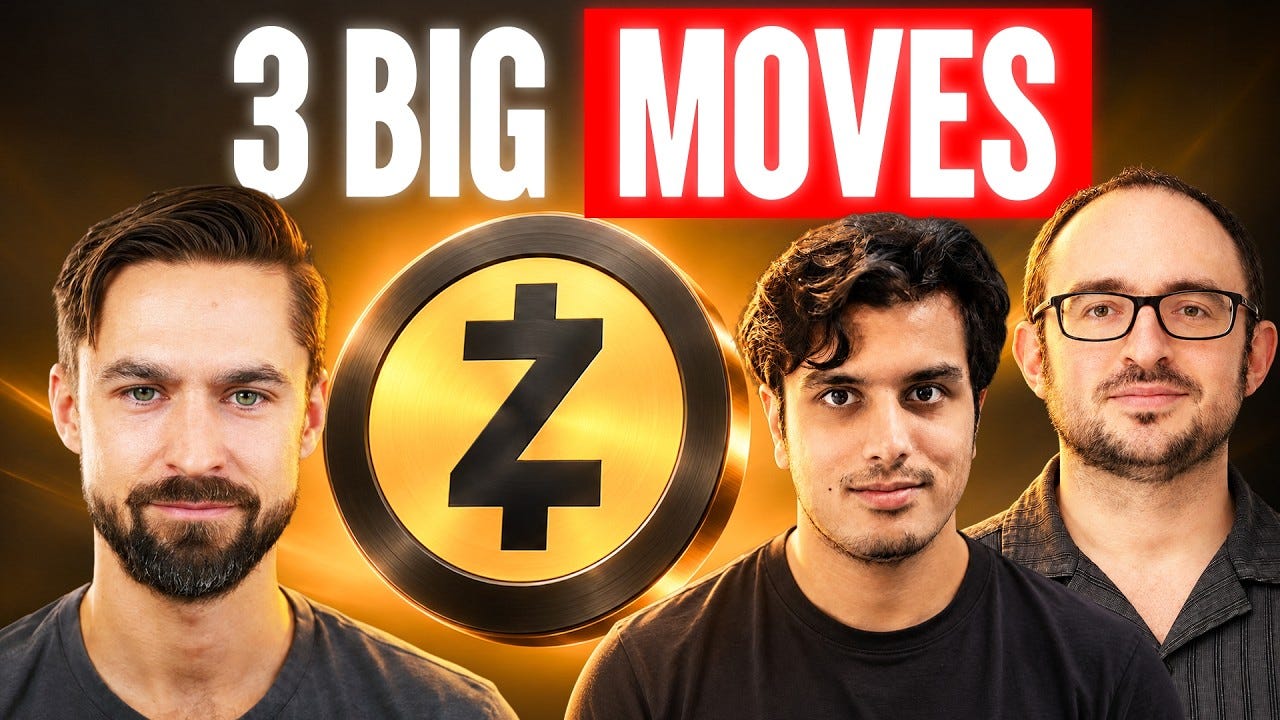
For balances between 10,000 U and 100,000 U, the report pointed to Binance BFUSD and RWUSD, with annualized yields of about 10.16% and 10%, alongside smaller high-yield flexible products on the two platforms. Under that sample allocation, a 20,000 U portfolio would produce an annualized yield of about 10.30%. Users holding USDC could also consider Bitget’s 12% flexible product.
For balances above 100,000 U, Bitget’s USDC product still offered 12% annualized yield within the 300,000 U cap. Users looking to spread platform risk could also combine it with Binance BFUSD and RWUSD. Based on the sample allocation in the article, a 100,000 USDT portfolio would deliver a blended annualized yield of about 10.11%.
The report also stressed that all of these figures were reference rates tied to campaigns or product terms. Actual returns may vary depending on campaign duration, quota, eligibility and product rules, and users were told to rely on real-time figures shown in exchange apps before allocating funds.
Zcash on hard privacy, quantum recovery and AI-era security
The podcast-notes section centered on comments from Zcash core contributor Sean Bowe. He argued that privacy systems cannot afford partial failure, saying that in privacy engineering, 99.9% privacy is no different from 0% if the remaining 0.1% of metadata leakage becomes the first domino that breaks the whole system.
Bowe said Zcash has been built around the purest form of zero-knowledge proofs from day one. Inside the shielded pool, transaction amounts, senders and recipients are encrypted, leaving only a mathematical proof on-chain that cannot be forged or reversed. He also said that once developers leave a backdoor at the protocol layer, that backdoor will eventually be exploited by hackers, authoritarian governments or institutions that abuse power. In his framing, hard privacy is a non-negotiable line.
On quantum computing, the report separated confidentiality from signature risk. Under the current Zcash design, the confidentiality of private transactions relies on Pedersen commitments. From an information-theoretic perspective, Bowe said, even a quantum computer with effectively unlimited power would not be able to reverse-decrypt the contents of past shielded transactions. The more exposed area is the discrete-log assumption used in digital signatures and proof systems.
The article said Zcash’s quantum-recovery design pre-positions post-quantum hash locks and multiple identity credentials in the protocol. In a worst-case scenario where some underlying discrete-log signature system is suddenly broken by undisclosed quantum capability, an attacker still would not be able to directly steal user assets. Users could rely on retained post-quantum credentials to migrate funds safely into a new defensive pool at the protocol level.
Bowe also described a shift in how vulnerabilities may be found. In the past, discovering a subtle cryptographic circuit flaw could require months or years of manual work by top mathematicians. Now, he said, advanced code-focused large models and symbolic reasoning engines are already showing strong automated vulnerability-scanning ability. Attackers may not need to understand the whole system if AI can identify under-constrained circuit defects for them.
That is where formal verification comes in. The report described it as using computer programs to prove rigorously that a circuit behaves exactly according to mathematical specifications under every possible input combination, with no undefined edge states. Bowe’s conclusion was that mathematical tools are the only reliable answer to automated AI probing in this kind of high-dimensional security contest.
The section headline also referred to a path toward 50,000 TPS and a long-term case for ZEC, though the body of the summary focused mainly on privacy principles, quantum recovery and formal verification.
Robinhood Chain and the push toward programmable stock tokens
In an English-language thread summarized by ChainFeeds, c4lvin argued that Robinhood management is not trying to build the business around high fees from on-chain activity. Instead, stock-token TVL is being treated as the core measure of Robinhood Chain’s long-term sustainability.
CEO Vlad said Robinhood Chain’s real advantage lies in real-world assets. CFO Shiv Verma said third-quarter on-chain fee revenue was about $50 million and net revenue was about $25 million, but the chain team’s target is not fee revenue. It is growth in TVL, developer count and stock-token adoption.
Daily network fees on Robinhood Chain peaked at about $8.27 million on Sept. 4, then fell by more than 99% to roughly $30,000 to $40,000 a day by mid-October, while spot trading volume still held above $600 million to $700 million a day. Because Robinhood Chain is built on Arbitrum, block-space congestion directly affects fees. As meme-token issuance congestion faded and Robinhood raised the gas limit to increase throughput, fees dropped as well.
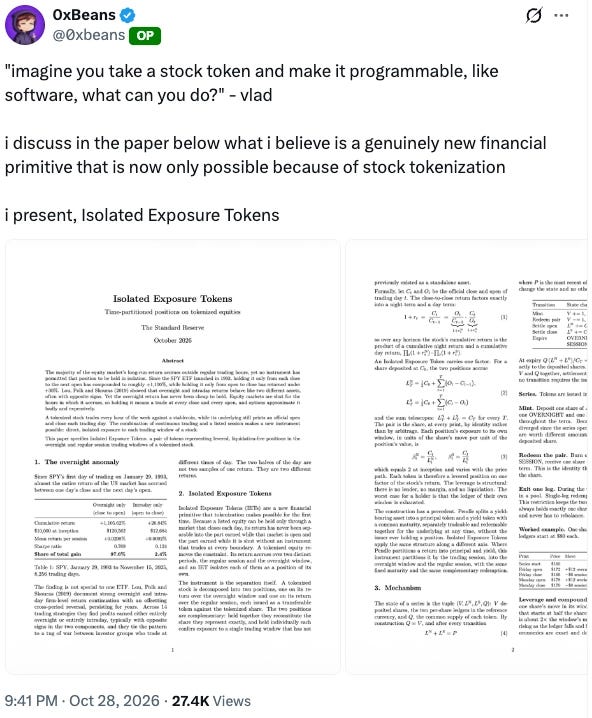
The interpretation in the piece was that Robinhood is more likely to see meme-driven fee spikes as a user-experience cost than as a revenue stream it wants to preserve. Vlad described current applications on the chain as relatively simple products such as launchpads and liquidity pools. The next phase, he said, is to make stock tokens programmable like software so that products that do not yet exist today, such as tokenized options contracts, can be built on top.
Robinhood’s roadmap was described as moving as many assets as possible from the U.S. Robinhood platform onto the chain for international users, then turning those assets into composable building blocks for developers. DeFi perpetuals were highlighted as a major area, with daily trading volume already above $1 billion. Most of that activity currently comes from Lighter and Arcus, and both protocols have received strategic investment from Robinhood.
The thread argued that Vlad’s promise of more builder support is less about simply expanding the existing launchpad ecosystem and more about encouraging more complex financial applications built around stock tokens. The biggest current limitation is that stock tokens are still unavailable to Robinhood’s core U.S. users. Robinhood app users account for only about 1% to 2% of on-chain trading volume.
Vlad was described as positive on the U.S. Securities and Exchange Commission’s recent innovation exemption proposal and said the company would soon announce more U.S. tokenization plans. If Robinhood continues to support meme-token activity, the article said, the goal may be to expand issuance and circulation of stock tokens rather than to maximize on-chain fees. Meme tokens remain an important source of stock-token demand for now, but because Robinhood has made healthy stock-token TVL growth its key metric, the longer-term direction appears to be broader utility and less dependence on meme trading.
That logic could shape which ecosystem projects receive stronger support. The article cited Lighter, which has strategic backing from Robinhood and is integrated with Robinhood Wallet. Since July, it has allowed users to post Robinhood Chain stock tokens as collateral for perpetual contracts. Priors was cited as another example, using stock tokens as collateral to raise AI Agent borrowing capacity for USDG and receiving public support from Robinhood Crypto on the day of the earnings call. By contrast, launchpads such as Pons, whose value proposition relies more heavily on speculative token issuance fees, buybacks and burns, were described as less aligned with management’s stated growth metrics.
If Democrats sweep, what changes for crypto legislation?
The final section, based on BitpushNews, examined whether a Democratic sweep in the 2026 U.S. midterms would amount to the worst-case legislative outcome for crypto. On Kalshi and Polymarket, Democrats were priced at roughly 72% to 75% to win the Senate. TD Cowen described that scenario as the least favorable legislative setup for the industry because Elizabeth Warren, viewed as strongly anti-crypto, could take over the Senate Banking Committee, while the odds of reviving the CLARITY Act before 2027 would become slim.
Public Citizen said crypto-related groups spent more than $200 million in the 2026 cycle, more than online gambling and data-center development groups, making them the largest single-issue super PAC bloc in U.S. history. The Fairshake network accounted for much of that spending. Coinbase and Ripple each contributed $25 million, and a16z was another major backer. Fairshake and affiliated PACs supported 33 House candidates, including 19 Republicans and 14 Democrats, and spent at least $1 million each on six sitting lawmakers.
Even so, the industry’s preferred bill, the CLARITY Act, failed on Sept. 15 in a Senate procedural vote by 49 to 50, still 11 votes short of the 60 needed to end debate. Republicans held 53 Senate seats at the time, yet the bill still did not clear the chamber even under what was seen as a more crypto-friendly majority. TD Cowen analysts said campaign money has been effective at buying allies, but much less effective at buying the laws the industry wants, and the process is slow even when it works.
TD Cowen added that if Democrats sweep, Warren could become chair of the Senate Banking Committee, a position that controls whether crypto bills reach the agenda. Because Warren has consistently opposed the CLARITY Act, the bill would have little chance of returning for a Senate vote before 2027 if she takes the chair. At the same time, she would not be able to stop regulators from issuing industry-friendly rules within their existing authority, so a blocked legislative path would not mean the regulatory path is fully closed.
On the market side, the report said crypto had not seen obvious panic selling tied directly to the midterms. The bigger shock to capital flows was Binance’s large-scale hack last week. SoSoValue data showed spot Bitcoin ETFs recorded net outflows of $643.3 million on Friday, the largest single-day outflow since June 25, and cumulative weekly net outflows of $202.6 million for the week ending Oct. 30. Spot Ether ETFs saw net outflows of $155.9 million on Friday, the largest since Oct. 7, and cumulative weekly net outflows of $431.5 million.
Rick Maeda, head of markets at Laevitas, said the $643 million outflow was still less than 1% of the ETFs’ $98.14 billion in total net assets, making it look more like a de-risking move than a loss of institutional conviction. Bitunix said the average on-chain holding cost had risen to $74,800. If BTC falls below $77,000, market attention could shift back to that cost area. In its view, the real decision zone for capital sits between $74,800 and $80,000, regardless of the election result.