In its newest VC roundup, ChainFeeds pulled together fresh talking points, recent research, and primary-market fundraising moves from across crypto investing. This issue zeroed in on PHP security flaws, a16z crypto’s shift to the a16z Frontier name, and IOSG Ventures’ read on Papertrade’s high-leverage setup.
Topics crypto VCs are discussing
Based on the ChainFeeds table of contents, the discussion section in this edition revolved around two things: PHP vulnerabilities and the a16z crypto name change.
On PHP, the setup was blunt: flaws in PHP and similar software put a huge number of websites at risk, and 20 years of accumulated technical debt may get repriced in the AI era.
USV says AI has lowered the barrier to exploiting complex bugs
Jay Yu of Union Square Ventures pointed to what he called the single most important line from Wiz’s blog post about the PHP intrusion incident: "As artificial intelligence lowers the barrier to developing and adapting complex exploits, vulnerabilities once seen as difficult to weaponize have now become practical attack targets."
Yu said software development has always produced what he called "sloppy" code, or just "garbage code." Before AI, he said, the sheer effort involved in brute-forcing or tracing bugs one by one made exploitation hard. And he said it was striking how many internet systems still depend on "security through obscurity," which, in his view, is not security at all.
His take? AI has driven the cost of brute-force attacks down to zero. He said the industry has hit a breaking point where stacked vulnerabilities built up over the past two decades could start erupting all at once. And patching bugs, he argued, is not a lasting fix, because AI-generated bad code may create even more holes. The longer-term answer, he said, has to be structural. He pointed to heavier use of formal verification and newer programming languages like Rust and TypeScript, which are built to remove certain classes of programming mistakes.
Dragonfly says onchain hacks are a warning sign for broader cybersecurity
Haseeb Qureshi of Dragonfly said cybersecurity is moving through a wave sweeping the internet, with a pattern he compared to the COVID pandemic. He said it was surprising that this had taken so long to arrive. But now, he said, it is plainly here.
Qureshi said crypto had already lived through this dynamic. He described onchain hacks as an early warning for where the wider cybersecurity field may be heading, since blockchain systems are among the first places where attacks can be monetized fast and directly.
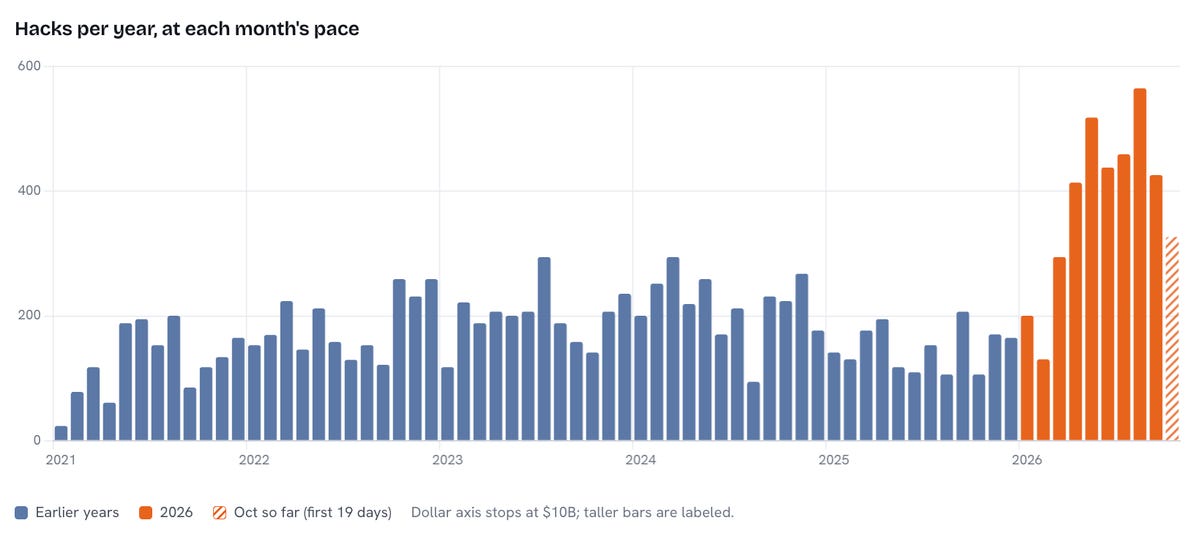
He said crypto protocols have already tightened defenses against these threats. Smaller protocols, in his telling, still often get compromised, while larger ones have begun using AI tools to protect themselves. The outcome, he said, is that the number of attacks has jumped sharply while the total amount stolen has remained roughly in line with 2025 levels. So the average value per incident has dropped even as attack frequency has climbed. He characterized that as mass looting of small, badly maintained protocols. And he said he expects the same pattern to be spreading across the broader internet.
a16z crypto becomes a16z Frontier
On the second topic, ChainFeeds said Andreessen Horowitz’s crypto investing arm, a16z crypto, has been renamed a16z Frontier. From the background included in the piece, the new fund’s investment scope has widened from crypto startups to a broader group of frontier startups.
The table of contents named Variant, 1kx, 1confirmation, and Dragonfly as firms connected to that discussion.
Recent research output
In its section on recent research from crypto VCs, ChainFeeds listed three items:
- IOSG Ventures: Papertrade’s daily revenue trails only Tether, and the platform is described as a casino that gives 90% of its rake back to losing users;
- Tiger Research: the value of prediction markets may not be in trading itself;
- Delphi Digital: why speculation may become the investment theme of the next decade.
From the contents shown in the article, this section focused on high-leverage trading structures, what prediction markets are actually worth, and how speculation fits into long-term investment themes.
Primary-market funding snapshot
ChainFeeds also ran a funding roundup covering Oct. 12 to Oct. 18. It said nine financing events were publicly disclosed during the week, with total funding topping $50 million.
The projects listed in the contents were DATA Network, Fission, Multiliquid, Spout Finance, AIsa, Farcaster, EFY Finance, Bluvo, and EFFORCE.
The article was published on Oct. 25, 2026, and credited to chunzhen.