ChainFeeds published its latest research digest on Sept. 15, pulling together five in-depth crypto reads spanning venture capital, trading infrastructure, Ethereum roadmap work, stablecoin settlement design, and HIP-3 market structure.
Crypto VC is being forced to abandon the old token playbook
In a piece titled Is the era of story-first crypto VC and waiting for TGE over?, Paul Klay argued that the traditional SAFT-based logic in crypto relied on a structural loophole created by token issuance. In Web2, venture investors and founders usually need an acquisition or an IPO to exit, outcomes that are both rare and hard to reach. In crypto, by contrast, even a company that never truly works as a business can still issue a token. Once retail demand appears and liquidity forms, early backers can still realize returns.
That structure, he wrote, comes with a basic problem: money does not appear out of nowhere. IPOs run through a more defined process, with business operations scrutinized, financials verified, and valuations tied more closely to real earnings power and expectations for future profit. Crypto worked differently for a long time. Even when projects aimed for first-tier exchange listings, the amount of verification required could be surprisingly limited, with trading volume often enough to get attention.
Klay said token market caps often had little connection to a company’s real economics. Investors held token exposure, while the company still kept the operating revenue, creating two separate sets of economic interests. What should have functioned as an easier path to liquidity than an IPO instead turned into what he described as a casino game.
He also focused on the lack of transparency. The people controlling the process were often the only ones who knew what was really happening. Outside investors had little ability to verify whether KOLs were paid, why market makers behaved in a certain way, why large token supply appeared one minute after listing, where marketing budgets actually went, or how much of a project’s explanation was true. Unless an investor was directly involved in operations, the market was left trusting what it was told.
According to the article, many crypto VCs ignored those issues for years. They did not spend enough time checking what happened, why it happened, or where the money went. The goal was to get the token out first. More participants then ended up going bankrupt. At the same time, the game itself grew extremely complex, with returns shaped by marketing, KOL relationships, exchanges, market makers, launchpads, liquidity, listings, and token allocation. One choice could mean a 500% return. Another could reduce returns to zero. Telling the difference often required years of experience and repeated exposure to full token issuance cycles.
Klay’s point was that this differs sharply from the IPO process because the market was often not trying to determine what something was actually worth. It was trying to sell it at a price far above that value. He said the industry is now waking up to the fact that the old crypto VC model no longer works. SAFE plus SAFT structures are becoming close to indispensable. Investors are paying more attention to real revenue and business models they can understand, while diligence is moving closer to Web2 standards. More capital is flowing to categories that already proved product-market fit in crypto, including gambling and prediction markets, meme coin launchpads, payments, new forms of banking, fiat on- and off-ramps, AI, and to some extent DePIN and RWA.
His conclusion was blunt. Web3 fundraising used to look like the Wild West. Now, if a team wants to raise in Web3, it may first need to show it could also raise in Web2. The sector will keep maturing. The VCs that once sprayed money around without discipline have mostly disappeared or paid heavily for doing so. The firms still standing are building more serious investment processes. Retail investors are changing too. In his framing, the market is being split into two games: one where participants know it is pure speculation and move in and out quickly, and one where an asset has a real product, real users, and real revenue, giving holders a reason to stay for longer. The middle is fading.
Mojo AI founder Forest says Hyperliquid is close to an endgame
Another featured item centered on comments from Mojo AI founder Forest, who said Hyperliquid is close to an endgame and that the next wave of crypto growth is more likely to come from AI trading agents.
Forest compared Hyperliquid with Uniswap, saying both faced multiple challengers over time. He named PancakeSwap, SushiSwap, and CowSwap, then argued that the simplest products are often the hardest to displace because meaningful differentiation becomes difficult once the incumbent already works well. He added that Hyperliquid began exploring the RWA market early and opened a franchise-like model. In his view, HIP-3 and HIP-4 are especially strong designs because Hyperliquid focuses on the protocol layer instead of competing on operations or business development, then lets others handle promotion and liquidity. He also pointed to the design of HLP as a strength.
Forest listed three reasons for Hyperliquid’s success. First, he said it built a perp DEX with genuinely strong performance, well beyond earlier offerings such as dYdX. Second, its tokenomics and token community growth have been healthy. Third, the HIP-3 “storefront” or franchise approach worked well. He said it is hard to imagine a product that is 10 times better than Hyperliquid, in much the same way that Bitcoin remains dominant and ETH is still widely used for smart contracts, while other chains mostly find room in memecoin activity.
He also said that, in his view, the best assets over the next decade could even be science and technology stocks in mainland China because founders there are undervalued and valuations are too low. He suggested that an “ABC friend” could build a mainland stock version of HIP-3, while adding that such a model would still need a hedging channel in order to anchor prices.
Forest then walked through his own choices after leaving Bitget and Foresight. He said he had three paths in mind. One was building a perp DEX, which made sense for a team with exchange experience, especially in a market that still believed perp businesses could make money. Another was going deeper into compliance, noting that “we also acquired OSL.” He said he did not want either path, or did not have the ability to pursue them, especially the compliance route. As for perp DEXs, he said there was no longer much point in trying to out-compete the field. New entrants lacked real differentiation and mostly saw a burst of volume only when they launched a token or an airdrop. He cited Lighter as an example, adding that it was already highly professional. That led him to AI, which he sees as a different layer entirely, one that can change or disrupt the way trading is experienced and executed.
On Robinhood Chain, Forest said its strength comes from having a group of highly professional users and a built-in Robinhood channel that can move them quickly from Robinhood into Robinhood Chain. Those users, he said, are traditional U.S. stock traders who tend to be more professional and operate with larger pools of capital.
He was more skeptical about meme-driven token formats and DAT structures. Meme token runs, he said, may be fueled by speculation in the short term, but over a longer period prices still return to value. He said he invested in none of the DAT names because he felt the structure was “ridiculous” and not meaningfully different from a memecoin. He gave three reasons: it does not create new value, it only tries to create a new funding channel; the issuance threshold is very low and can be cleared with legal fees of a few hundred thousand dollars; and it is entirely different from MicroStrategy, which raises capital to buy Bitcoin, whereas many DAT structures involve assets transferred over the counter, borrowed, or entrusted, with some not even qualifying as OTC deals.
Ethlabs outlines faster Ethereum, shorter slots, and account abstraction work
ChainFeeds also highlighted the latest Ethlabs weekly note, where Barnabé Monnot said the team began a focused round of interoperability research two weeks earlier in an effort to clarify where work should be concentrated next. Ethlabs is currently pushing what it calls a “faster Ethereum,” including a Fast Confirmation Rule, shorter slots, and faster finality. The goal is simple: reduce the time users spend waiting for Ethereum confirmations and improve interoperability across the network.
Two areas now stand out. The first is cutting latency from L2 back to L1. Conversations with L2 teams, Monnot said, made clear that users care about the fluid movement of assets and operations across chains. Faster confirmations, shorter slots, and faster finality can reduce delays from L1 to L2, but the return path from L2 to L1 faces a different set of constraints, including data submission, proof construction and verification, and the challenge period used by Optimistic Rollups. Ethlabs is studying which changes matter most and where it can contribute something unique.
The second area is account interoperability. Accounts, in Ethlabs’ framing, should help users coordinate activity across chains. That includes managing linked cross-chain accounts, batching multiple actions, sponsoring gas on a chain where the user does not yet hold funds, and setting preconditions for later actions. This ties directly into the broader account abstraction effort, with the aim of making native account abstraction feel more consistent across chains so that accounts can effectively be carried and used across different environments.
On the Hegotá upgrade, Ethlabs said it revisited more than 60 previously proposed EIPs and updated its priorities. The main directions remain stronger censorship resistance, a faster Ethereum, ongoing performance engineering, and native account abstraction. Performance work, the note argued, can create more room for Ethereum. That extra room can be used to expand capacity, shorten slot times, lower node requirements, or pursue several of those goals at once. Ethlabs’ position is that Hegotá should keep creating that performance headroom while also delivering improvements users can directly feel.
For L1 slot timing, the team still sees Hegotá as the right window for a first reduction and argues that the current 12-second slot should first be cut to 10 seconds. RPC providers, meanwhile, are becoming a key part of whether the Fast Confirmation Rule can be adopted at scale. Ethlabs said FCR could cut deposit confirmation times from L1 to L2s, centralized exchanges, and other bridges from minutes to tens of seconds, helping liquidity move faster. Because many applications and L2s obtain Ethereum state through RPC endpoints, their ability to use a faster confirmation model will depend heavily on the information RPC providers can serve. Ethlabs said it is working with RPC and bridge teams to design a clear migration path for existing applications.
The note also covered formal verification work around fast finality using decoupled consensus. That design separates finality voting from block production, allowing the two timelines to be optimized independently: one for faster finality, another for shorter slots. The latest progress is centered on recovery behavior, meaning how the confirmation mechanism regains safety after the network returns to sync from a desynchronized state, and how finalization and stabilization once again align with the canonical chain when model assumptions hold.
Ethlabs is still integrating two native account abstraction proposals, EIP-8141 (Frames) and EIP-8130 (Keystore). EIP-8141 is already planned for L1, while EIP-8130 is being driven by the Base protocol team. The group also plans to prepare a unified wallet support framework for Ethereum’s new account model. In the next stage, Ethlabs intends to publish a shorter-slot survey for application developers and further clarify its targets for finality and blobs, including when those goals should be reached and how.
Why Circle is building Arc as its own settlement chain
In a separate breakdown of Circle Arc ahead of mainnet, SoSo Value argued that Circle has run into three structural limits as the issuer of USDC on Ethereum, Solana, and major L2s while remaining a user, not an operator, of those networks.
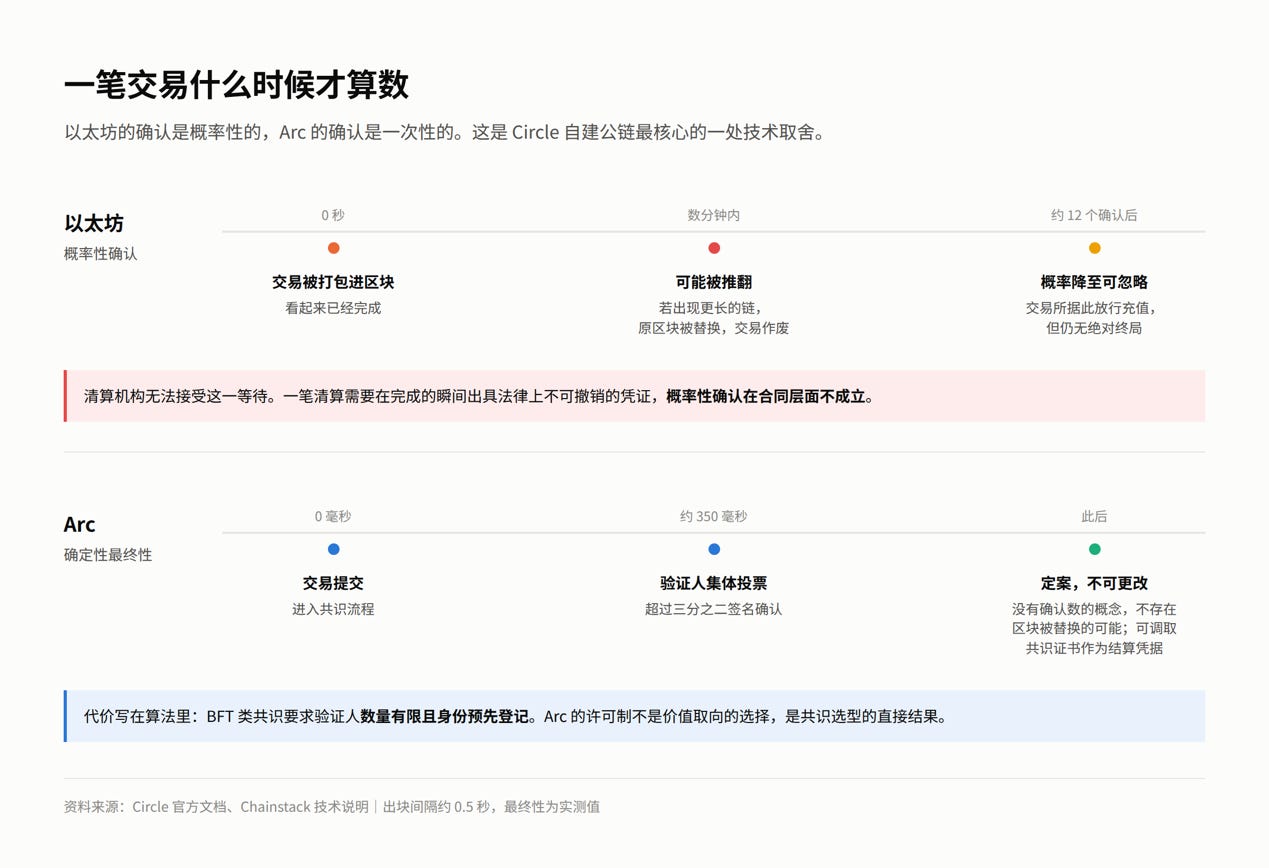
The first is financial friction created by a two-asset model. When enterprises handle cross-border settlement or large-value transfers, they need to buy and hold ETH or SOL separately to pay fees. That adds exposure, foreign-exchange conversion, and tax treatment issues to the balance sheet. The second is that transaction confirmation can still be reversed. On Ethereum-like networks, inclusion in a block is not the same as final settlement. If a longer chain appears, the original block can be replaced and the transaction invalidated through a reorganization. Crypto users may be used to waiting for a number of confirmations so that this probability becomes negligible, but clearing institutions cannot work that way. The article said clearing requires a legally meaningful and irreversible record at the instant a trade is completed. Probabilistic finality does not satisfy that standard at the contract level. The third issue is loss of protocol control. Hard forks, MEV-related congestion, gas volatility, and sequencer failures lie outside Circle’s own risk controls.
Against that backdrop, Arc is not being positioned as a general-purpose chain trying to win DeFi liquidity. It is being framed as a settlement network for stablecoins, tokenized real-world assets, and foreign exchange.
SoSo Value said Arc uses Malachite as its consensus engine, developed by Informal Systems, a team known for formal verification work around Tendermint that was brought into Circle in 2025. The execution layer uses Reth and is fully compatible with the Solidity tooling stack. Block intervals are about 0.5 seconds, and the mainnet chain ID is 5042. The system offers deterministic finality: once a transaction is submitted, validators vote collectively, and it becomes final after signatures from more than two-thirds of the validator set. The measured time is about 350 milliseconds. There is no concept of waiting for additional confirmations, and no path for a block replacement, so the reorg risk is removed at the mechanism level.
That comes with an explicit tradeoff. BFT-style consensus relies on validator voting, which requires a limited set of participants whose identities are registered in advance. Arc’s permissioned structure, the piece said, is therefore not a matter of preference but a direct consequence of the consensus model.
Its validator set is currently fully closed. Circle disclosed 11 founding validators, and together with Circle itself that makes 12 nodes: DTCC, ICE, Visa, Mastercard, MoneyGram, Global Payments, BlackRock, Standard Chartered, SBI Group, Sumitomo Corporation, Galaxy, and Circle.
The article compared Arc with Robinhood Chain, which launched on July 1, 2026. Robinhood Chain was positioned as a regulated venue where tokenized real-world assets could connect to DeFi, with stock tokens such as on-chain versions of NVIDIA and Apple shares acting as anchor products. The design was widely viewed as a model for traditional brokerages moving on-chain. What followed, however, diverged from that goal.
After launch, meme activity dominated the chain. A cat-themed token called CASHCAT rose 2158% in one week and reached a market capitalization of $156 million. At that time, the total size of tokenized real-world assets across the chain was $12.81 million, of which stocks accounted for $10.68 million. By share of activity, RWAs represented 4.1%, while asset management and lending together made up 78.8%. The report said CEO Tenev initially called tokenized RWAs a “durable direction” for crypto, but later remarked that “doing meme is not bad either” as CASHCAT surged. Within two months, the network’s DEX volume exceeded $34.6 billion and stablecoin supply rose above $1 billion. Over the same period, actual trading volume in RWA tokens stayed below $30 million, less than 0.1% of total DEX volume on the chain.
IOSG says HIP-3 is an expensive ticket, not a moat you can buy
The fifth item, from IOSG Ventures, examined HIP-3 through the trading patterns of Trade[XYZ] and argued that the decline in activity cannot be reduced to a simple competitive loss.
Its figures showed Trade[XYZ] logging $64.60 billion in 30-day volume, down 44.2% from the prior month. The seven-day average fell from $5.36 billion per day in early August to $2.01 billion per day, while the depth or size of its own order book pulled back 62%. Its largest market, SK Hynix, dropped to $8.50 billion. IOSG said both legs of the market-share decline are real, but the data suggests much of the HIP-3 weakness is not actually about direct competition.
The test, it wrote, is straightforward. If competition were the main driver, the underlying names should still be trading normally while Trade[XYZ] merely captures a smaller slice. That is not what happened. The names themselves became quieter, without a broad selloff. Using early August, when volume peaked, as the reference point, every major market in the book is now priced higher. What collapsed is how far those markets move in a day, and venue volume almost fell in sync. On weekdays alone, the correlation between average daily volatility in the storage segment and the venue’s daily turnover was +0.47 across a 45-day sample. Gold served as a natural control because it was the only major market that saw intraday volatility rise during the month, and its volume rose as well. Silver was the exception that did not fit the pattern.
IOSG said real trading in the storage and AI segments did in fact fall 25.7%, so part of the decline is genuine. But XYZ fell 49.7%, almost double that number. The extra 24 percentage points did not come from the industry itself. The largest gaps appeared in its core names: SanDisk at -26.0 percentage points, Micron at -25.4 percentage points, Intel at -21.5 percentage points, and SK Hynix at -17.2 percentage points. On the other hand, it outperformed the real market in NVIDIA at +36.5 percentage points and Nebius at +18.6 percentage points, though both books were smaller to begin with.
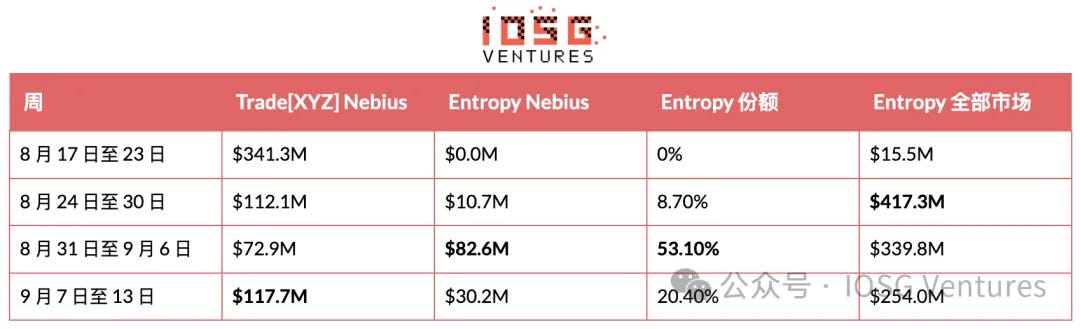
Competition alone also fails to fill the gap. Entropy’s entire 30-day SanDisk volume was $523 million, while XYZ’s own SanDisk book was down $6.14 billion. By that math, the challenger could have absorbed only about 8% of the missing flow. The remainder looked more like rotation. Over the same period, perpetual volume in Hyperliquid’s core crypto markets rose 117% while HIP-3 activity fell, and the combined total across the two still increased 26%. In IOSG’s reading, the capital did not leave Hyperliquid. It moved from equity-style books back into crypto-native books.
During the same 30-day period, the nine underlying names traded $2,004.7 billion on their home exchanges, while XYZ handled $23.5 billion in those same names, equal to 1.2%. Even XYZ’s full 104-market total of $64.60 billion was just 3.2% of the real trading volume in those nine names.
IOSG described Trade[XYZ] as a 24/7 venue for storage and AI capex trades, plus oil, metals, and index products. That includes South Korean and Japanese semiconductors, a synthetic DRAM index, SpaceX, its own XYZ100 basket, and a licensed S&P 500 product. Its territory is a set of assets that crypto-native traders cannot access elsewhere at three in the morning. That, IOSG said, is exactly where Entropy chose to attack, starting with SanDisk and Nebius rather than Apple.
The note also pushed back on the idea that the venue avoids private companies. In IOSG’s view, pre-IPO names are actually one of its stronger businesses. SpaceX alone traded $2.80 billion over 30 days, accounting for 4.3% of the book and ranking ninth. Other names included Unitree at $511 million, CXMT at $317 million, Zhipu at $156 million, MiniMax at $92 million, and SHEIN at $27 million, while YMTC had already been registered and was pending issuance. The common feature across those names is that they all have observable secondary prices and known share counts. SpaceX periodically conducts tender offers that provide explicit per-share pricing. Several of the Chinese names have active pre-IPO gray markets domestically, and share counts can be inferred from corporate records and financing rounds. That, in turn, allows the venue to quote them on a per-share basis in the same way it does for other assets.