
Sohu founder, chairman and CEO Charles Zhang said human viewpoints and original reporting still carry value in an AI-driven media environment, speaking after an offline session marking the 10th anniversary of his livestream program "Charles Zhang’s English Class." The discussion covered the course’s 10-year run, Sohu Video’s feed-based product ecosystem and what Zhang sees as the limits of AI in content creation.
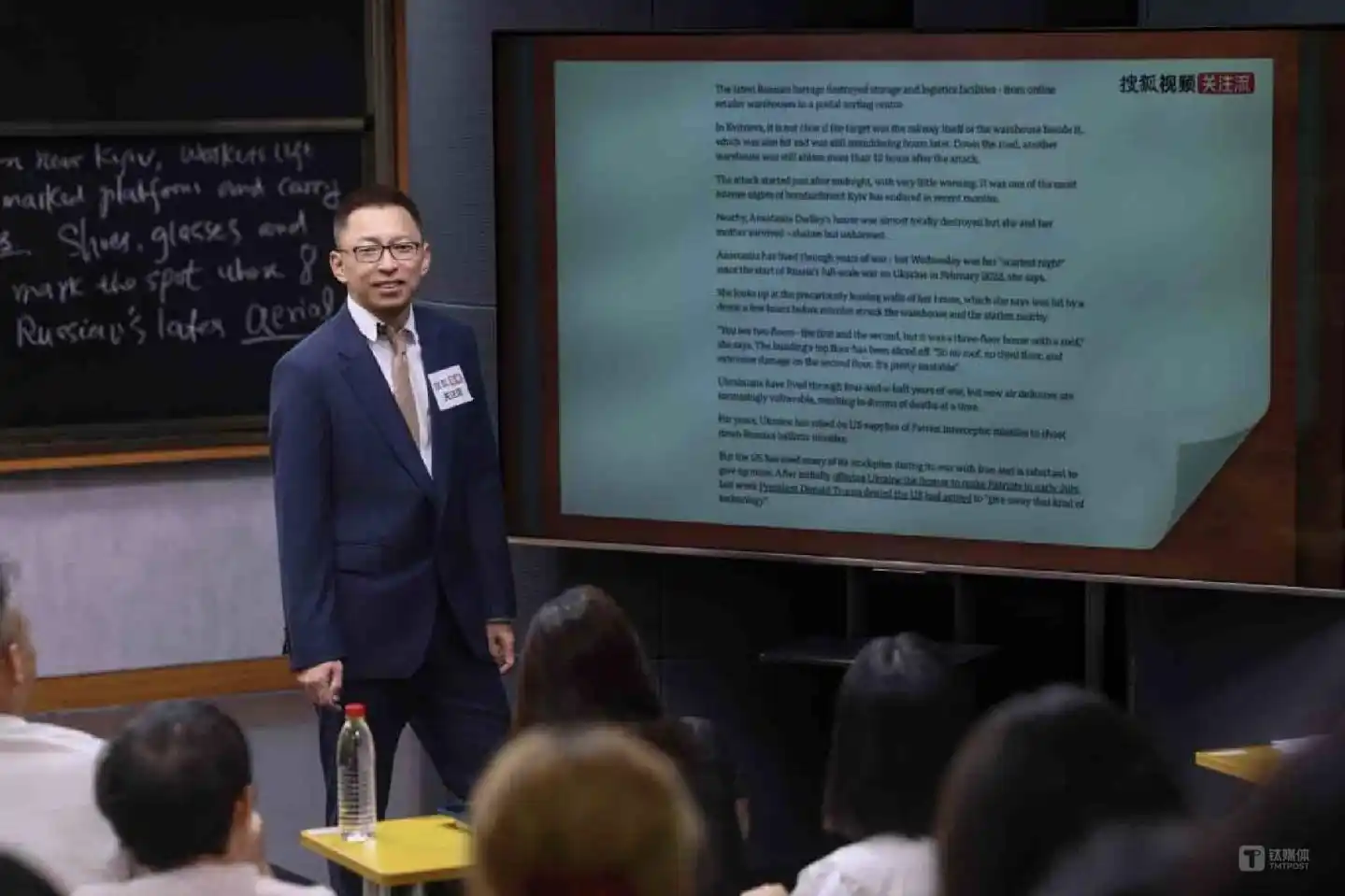
A livestream class that moved into a physical classroom
Zhang has remained one of the more recognizable figures among China’s first generation of internet founders. He keeps a steady public presence, sleeps only four to five hours a day, maintains a 5-kilometer walk-run routine, sometimes runs marathons, and frequently appears at offline technology forums and conversations with Nobel Prize winners.
He said he no longer feels compelled to chase every trend and has shifted his focus from outward business expansion to rebuilding himself internally, arranging both work and life at a pace he accepts. In his words, "People are not afraid of being busy. The busier you are, the better your body gets. If people have nothing to do, all kinds of emotions can emerge, and their physical condition can get worse instead."
The latest offline class became the setting for a longer exchange on his English lessons, content products and AI.
Started in August 2016, now more than 2,000 sessions
Zhang launched the first English lesson livestream on Qianfan Live in August 2016. Before each stream, he said, he spends about 40 minutes preparing: scanning more than a dozen headlines, reading five stories closely and selecting three for the class.
Over the past decade, "Charles Zhang’s English Class" has recorded more than 2,000 livestreams, accumulated over 110,000 minutes in duration and drawn more than 52 million cumulative views.
He said the class initially started because he wanted to speak more as a way to cope with emotional distress. At first, he would talk to the television, repeating lines after news anchors.
At the time, China’s internet industry was in the middle of a live streaming boom, and Zhang had also launched a product called Qianfan Live. His thinking was simple: if he needed to speak, why not do it through a livestream? The format came with listeners and interaction, and that became the starting point for a daily English class.
He added that another part of the motivation was to bring audiences original English-language news material, while the remaining part was tied to promoting Qianfan Live by personally trying the product first.
Zhang recalled, "Adjusting my emotions every day was like a monk reciting scriptures." Each morning at 8 a.m., he would read news and speak English to the camera. What looked like an awkward daily ritual eventually helped him move out of depression. He said he even reached what he described as "the peak state" of his life.
A deliberately manual process in the age of AI summaries
From a product standpoint, Zhang’s path was unconventional. There was no upfront market research and no dedicated growth strategy. The course emerged from a founder’s own need and later overlapped with user demand.
Its production process, though, is highly structured. He still prepares for around 40 minutes before each session, checks more than a dozen headlines, studies five pieces in detail and narrows them down to three.
The material spans geopolitics, national economies, advances in technology, medicine, health and social issues. Over 10 years, he said, that daily reading built a large compounding system of knowledge.
At a time when AI-generated summaries and algorithmic recommendations flood the market, Zhang said he sticks to what he called "clumsy work": reading source texts line by line and making lesson materials by hand. He still prepares his livestreams manually, closely reads articles and writes on the board by hand instead of using one-click AI content generation.
The English course has now become part of his fixed daily rhythm. Preparing his physics class is even more demanding, requiring one full day each week in front of a blackboard to think through problems and derive solutions, with little room for anything else.
Inside the livestream room, Zhang said he sees himself as a "content creator," not as a corporate CEO or a classroom teacher. He treats the physics class as extreme training for the brain, even if 99% of people cannot understand it, and the English class as a sensor for understanding the world.
That, in his view, explains why a top entrepreneur could keep doing something that appears unrelated to business for 10 years. He described it as both an information input system and a way to heal mentally and cognitively after a low period.
AI delivers information, but not the outside viewpoint he values
Zhang described this long-running practice as a form of persistence against pure efficiency. Reading, he said, is not only about collecting fleeting talking points. It is also about finding peers, support and spiritual nourishment.
Applying that idea to the media business, Zhang said people do not read news simply for news itself. Human beings have doubts and confusion in life, and they look for comparison, community, peers and support through what they read. Large models cannot satisfy that need, he said, because "they can only give you information."
At the event, a content creator told Zhang about a growing anxiety: after feeding personal articles into AI tools, the resulting language often sounds more comprehensive and more profound, while many parts of the original writing become AI-like to the point that the final piece feels distant from the author, making the work itself feel less valuable.
Zhang replied with a market analogy: "When you go to a vegetable market, carrots that were not forced out by chemical fertilizer may still have dirt on them and may not look that polished, but they taste good and have real flavor. Tomatoes pushed out by chemical fertilizer have no taste at all."
He said AI is giving a lot of content a "plastic" feel. At the same time, he acknowledged its usefulness in improving information efficiency. In his own work, especially in physics and sociology research, he often asks AI direct questions and gets quick answers from specialized fields.
What matters to him, though, is the difference between information and viewpoint. Large models provide information, he said, while the outside world provides perspectives. He cares deeply about what that external viewpoint is and how another person thinks through an issue.
"Don’t think that just because AI has arrived, the Earth stops turning," Zhang said.
Strong impact on rule-based work, but limits in art and creativity
Zhang said AI is currently replacing work with strong rules and repeatable structure. He pointed to software as one clear example, saying the industry had already seen obvious disruption in the first half of this year, with many programmers laid off because decent code can now be written without years of experience.
He drew a line, however, at areas such as arts, social sciences, emotional expression and creative work, which he said AI still cannot replace.
"Hollywood is still thriving and still making great works. The Oscars will keep handing out awards. The Nobel Prize in Literature will keep being awarded. They are all written by real people, and the works are still thought out by real people," he said.
Even with that caution, Zhang said he is not rejecting technology itself and remains open to AI applications. Sohu has launched AI assistant-related products called "Zongjiexia" and "Xiaohu."
Within Sohu’s AI efforts, Zhang said he sees his own role as a "provider of training corpus for large models." His argument is that model training still depends on original human-created material as a data base, which makes originality irreplaceable.
For creators, authenticity remains the baseline
Zhang also said the self-media era has given individuals a new way to discover their strengths and achieve some degree of growth. His advice to younger people was that everyone should at least think about self-media.
Still, he drew a firm line on authenticity. If AI digital avatars are used, he said, they should be clearly labeled. Failing to disclose that and allowing viewers to assume they are watching a real person wastes the audience’s time, especially when many still prefer content made by real humans.
Behind the rapid advance of AI, Zhang said, there are practical issues that cannot be ignored. As AI produces polished answers quickly, people are becoming more used to accepting summarized results while skipping doubt, reasoning and trial and error. In that process, the ability for deep thinking can quietly weaken.
His answer is the same one reflected in his two livestream classes: read books, speak in front of the camera, sweat on the track and build connections with real people.
By Li Chengcheng, edited by Yang Lin.