
The current fight over ChatGPT in writing looks new on the surface. MarsBit argues that the core issue is much older: if a piece carries one person’s name, but that person did not actually write the words, what exactly makes it authentic?

A campus email disclosed ChatGPT assistance and drew backlash
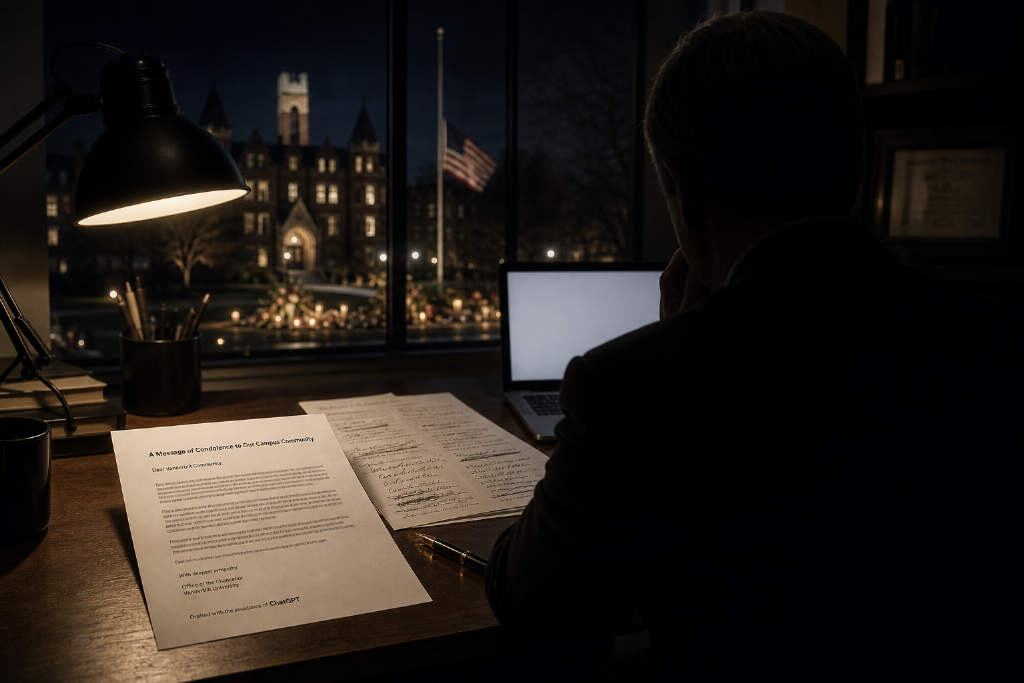
The article points to an incident from February 2023, when Michigan State University suffered a deadly campus shooting, at a time when ChatGPT had been online for a little over a year. Afterward, Vanderbilt University sent a message to students intended to offer comfort.
The email said, “The tragedy in Michigan is a reminder of how important it is to care for one another and stay connected.” But a small line at the bottom noted that the message had been revised with assistance from OpenAI’s ChatGPT.
Students reacted sharply. One senior, as quoted in the piece, said: “It’s so ironic, so outrageous. This was supposed to be about solidarity, empathy, warmth, and mutual support, and the university could not even slow down and write it sincerely on its own. It just handed the job to a machine.”
Vanderbilt later apologized and opened a professional ethics investigation, according to the report. A vice dean said the episode reflected a mistake made while the school was adjusting to new technology.
That case, MarsBit writes, captures the broader uncertainty now facing teachers, students, and creators: when AI helps produce text, does that count as misconduct, or as something ethically questionable?
Ghostwriting has been around for more than a century
The report says none of this began with AI. Disputes over ghostwriting have been going on for well over 100 years.
It defines ghostwriting as paying someone else to produce text that is later published under another person’s name. In today’s context, that often means a professional writer working with celebrities or industry figures who have public standing and access, but lack the time, writing ability, or energy to produce a book themselves.
Once the book is published, the ghostwriter usually does not disappear completely, the article says. In many cases, that person is mentioned briefly in the acknowledgments as a “friend” or “advisor.” In a smaller number of cases, the ghostwriter’s name appears on the cover alongside the credited author. Even so, the final authority over the work and its ownership generally belong to the paying client.
MarsBit also notes that if someone searches Google for material on having another person write under one’s name, the top results do not simply frame the issue as ghostwriting. Terms such as pen name, pseudonym, plagiarism, and defamation appear prominently, reflecting the uneasy way the practice is perceived.
The article cites a 1953 piece in The American Scholar, which said that in the 1950s academia often blurred the line between “forgery” and “ghostwriting,” while forgery itself implied deception.
That helps explain why ghostwriting has remained ethically contested even when both parties enter the arrangement voluntarily and with clear payment terms. Public figures and business leaders often try to hide the fact that they used a ghostwriter, the report says, while readers tend to feel an instinctive discomfort when they encounter a ghostwritten work.
That discomfort runs in both directions. MarsBit says the issue, whether viewed from outside criticism or the inner conflict of the people involved, comes down to the same thing: even if the content is factually true and lawfully commissioned, presenting someone else’s words entirely as one’s own still carries a sense of deception.

The article adds that ghostwriting agencies have long tried to soften that image, telling clients that ghostwriting is an ordinary and legitimate form of collaboration with a long history, rather than laziness, dishonesty, or naked utility.
AI gave ordinary users access to a personal ghostwriter
According to the piece, chatbots changed the structure of the market. AI, it says, gave ordinary people free access to what amounts to a personal ghostwriter.
The report quotes professional ghostwriter Josh Lisec as saying that if traditional human ghostwriters want to avoid being pushed out, they will have to move toward high-end and niche services aimed at wealthy clients.
Where assistance ends and misrepresentation begins
MarsBit argues that neither paid ghostwriting nor free AI help is automatically unethical in every case. Seeking assistance during a creative process, or refining work through collaboration, is not inherently improper.
The article points to familiar examples. Editors are expected to polish and reshape manuscripts. Artists often rely on assistants for basic work. Television scripts are commonly built by a full writing team. Creative work has never been purely solitary.
The same logic appears on campus. The report says most teachers can accept students using ChatGPT to fix grammar, polish prose, or improve structure, but they do not accept students having AI write an entire assignment from start to finish with one prompt.
Many universities now allow AI tools, the article says, but they attach firm requirements. Users must verify whether the AI output is correct, and they must clearly disclose and mark where AI was used. Even when that disclosure is made and the material has been checked, there is still a hard boundary: AI-generated content cannot be submitted as wholly original work.
In other words, text written by another person and text written by AI cannot simply be passed off as one’s own.
Compliance may not settle the reader’s objection
The article says this framework closely resembles the contractual structure of the human ghostwriting business. Ghostwriters typically sign originality guarantees, promise that the work is not plagiarized, and run professional originality checks on the material. If factual errors or plagiarism surface, the ghostwriter is often the one who bears the blame and responsibility.
By that logic, if a human ghostwriter voluntarily accepts liability, and an AI user discloses and describes the tool’s role honestly, the arrangement may appear compliant with formal rules.
But the Vanderbilt case shows that compliance does not erase the objection. Even though the university disclosed that the message had been written with ChatGPT assistance, students and staff still responded with strong discomfort and criticism.
MarsBit’s conclusion is straightforward: school rules and contracts can give this kind of conduct a legal and procedural shell, and they may reduce legal risk. What readers and the public still care about most, though, has not changed. They want to hear what the named author genuinely thinks.