
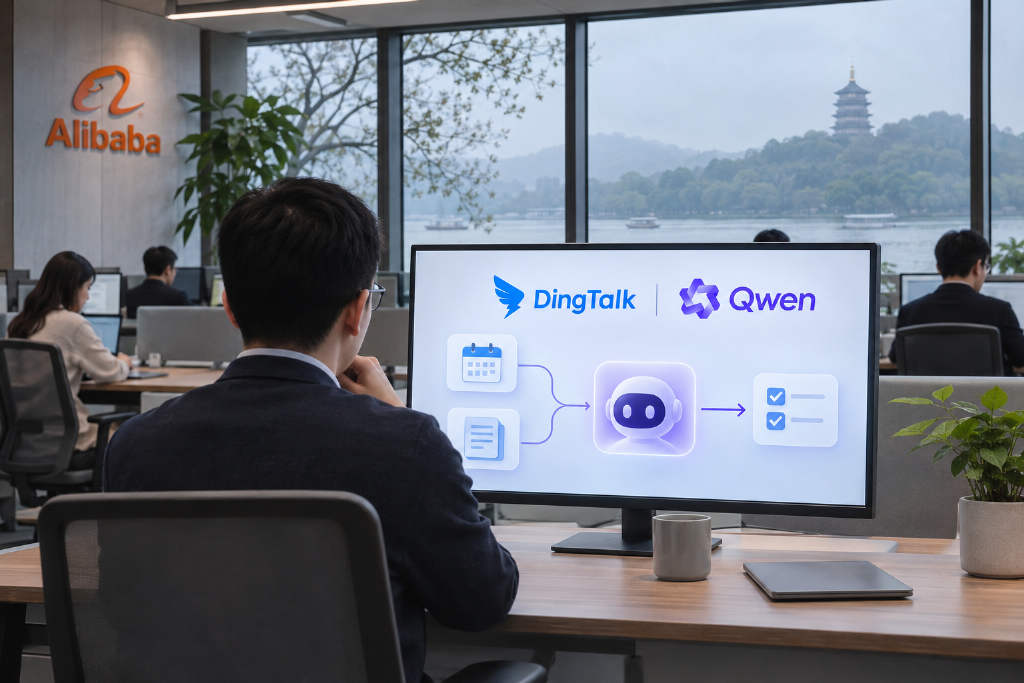
At 34, Chen Yusen has taken over as CEO of both DingTalk and Qwen Office, placing him at the center of Alibaba’s effort to turn AI capabilities into products that enterprises will use inside their daily work.
In June 2026, Jack Ma, Wu Yongming and other Alibaba partners rolled up their trousers and planted rice seedlings in half an acre of paddy fields on the outskirts of Hangzhou. An internal Alibaba article published that day was titled “Only by holding seedlings in your hands can you ensure grain for the future.” Chen, the youngest executive in the group, was also in the field. He had been named DingTalk CEO only days earlier.
From changing DingTalk’s routines to leading Qwen Office
During his first week as DingTalk chief, Chen sent a letter to employees that ended DingTalk’s mandatory 9 p.m. review meetings. He also removed morning check-in requirements and late-night patrols. Alibaba’s traditional management style has placed more emphasis on process control and visible supervision. Chen, who comes from a technical background, is more inclined to use automation to remove repetitive work.
The shift in management style also reflects a larger question for Alibaba. The company has models, computing resources and cloud infrastructure. What it lacks is a way to turn those capabilities into agent products that businesses will actually adopt.
That is the task Chen has taken on: putting agents inside real enterprise workflows. It is not his first encounter with business customers. Twelve years ago, during his first startup, he ran into the same problem from a different angle.
Technical performance did not produce orders by itself
China’s mobile internet industry was expanding rapidly in 2014. The country had 527 million mobile internet users that year, and the share of people accessing the internet by phone exceeded the PC share for the first time. Mobile payments, mobile games and e-commerce were growing quickly, creating opportunities for young technical professionals.
Chen graduated from Zhejiang University that year. Instead of joining a large company such as Alibaba, he moved to Beijing and founded Chaitin Tech with several members of the Blue Lotus security team, entering enterprise cybersecurity.
Technical confidence was not in short supply. During university, Chen placed in several international security competitions. After Chaitin was founded, he visited customers himself and met bank executives with a record that included a world championship in a security competition. He believed superior technical metrics would be enough to convince them. In some meetings, he argued with customers over which technical approach was correct.
The orders kept falling through.
A classmate later told him that customers had no obligation to understand his technology. The reminder changed how Chen approached product development.
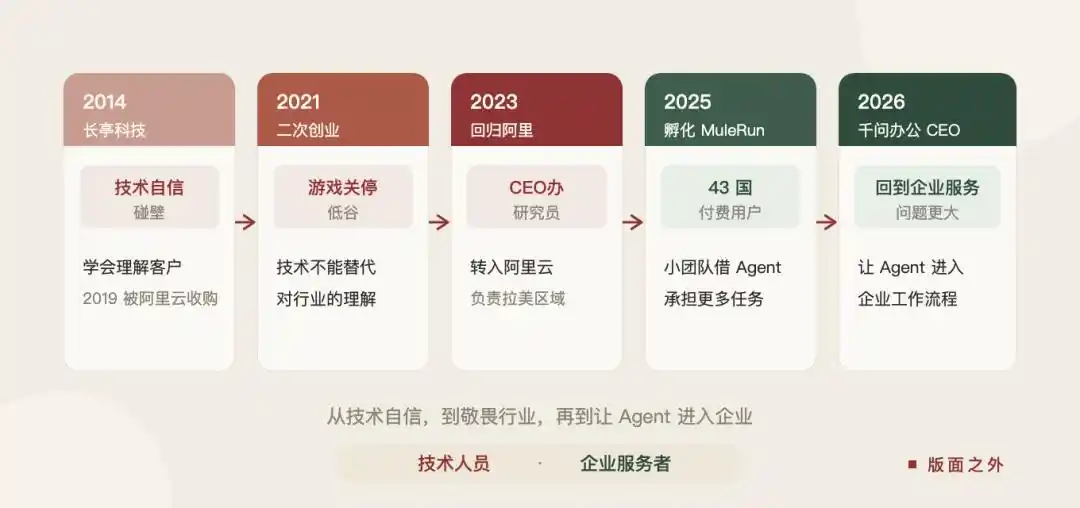
Bank customers were less concerned with how advanced the technology was than with whether it met business rules and compliance requirements and solved a practical problem. Chen shifted his attention from demonstrating technology to understanding customers, and Chaitin’s business gradually opened up.
In 2015, Chaitin secured an angel round from ZhenFund. By 2018, several leading banks in China had become customers.
This was also the direction Alibaba Cloud was seeking at the time. In 2018, Alibaba Cloud was upgraded into the Alibaba Cloud Intelligence business group, extending its focus from basic computing capacity to more complex enterprise services. A year later, Alibaba Cloud acquired Chaitin Tech in full, bringing the 27-year-old Chen into Alibaba.
His first startup transformed him from a technical professional into an entrepreneur serving enterprise customers. It also left him with another assumption: if his technology and learning ability were strong enough, he could quickly make a new industry work. He soon paid for that assumption.
A new industry requires a new education
In August 2021, Chen left Alibaba, giving up options that had not yet vested, and began a second round of entrepreneurship.
He founded two companies at the same time. Sloop Technology continued to work on data security and completed a Series A round worth tens of millions of yuan in 2022, led by Source Code Capital. The other company, known as “Give It to the Cat,” tried to combine AI with computer graphics to develop mid-sized and large-scale games.
The two businesses took different paths. The data-security company progressed smoothly, while the game project failed to gain traction. In 2023, the game company had to shut down because of cash consumption and a departure from its original direction. Chen later said the period in which he prepared to close it was a low point in his life.
In an interview with Yicai, Chen said he had not shown enough respect for an unfamiliar industry. He had tried to use the experience behind his earlier success to build a large game with innovative gameplay and subject matter, while underestimating the industry’s basic knowledge barriers.
Chaitin’s success had convinced him that technical ability could accelerate a move into another industry. The failed game project taught him a different lesson: technology can shorten the time needed for trial and error, but it cannot replace an understanding of the industry.
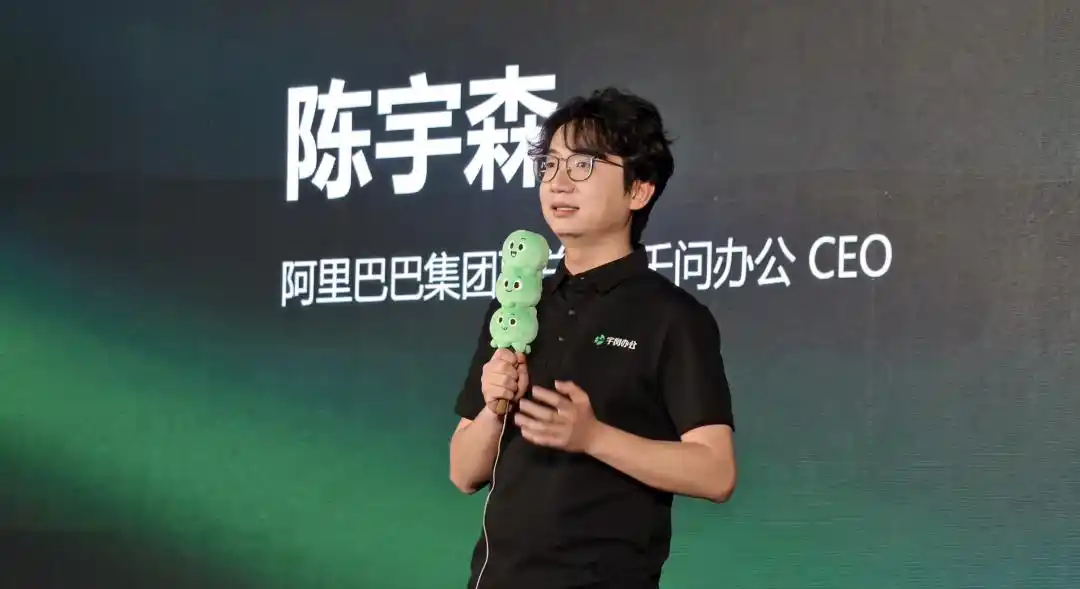
The failure changed his career path. Chen returned to Alibaba at the end of 2023, but did not move directly into a core product line. He first became a researcher in the group CEO’s office. In April 2024, he transferred to Alibaba Cloud, where he took responsibility for global strategic partnerships and also served as general manager of the Latin America region, helping build the South American market from the ground up.
Competition among China’s large language models was already accelerating, but Chen did not rush to follow the application boom. After two startup experiences, the excitement of a technology wave was no longer enough. He needed a more specific answer: what work can stronger models change, and what products will users continue to pay for?
Looking for a signal in the application noise
By the end of 2024, large language models had become one of the most competitive areas in the technology industry, and Alibaba was accelerating development of Tongyi Qianwen. By February 2025, many leading models on the Hugging Face open-source rankings had been trained further on the Qwen series. Qwen had become a significant presence in the open-source ecosystem.
While competition centered on AI assistants, Chen went through several rounds of experiments at the application layer. He tried Watt, a Vibe Coding product, an application marketplace for agents and an internally tested PM Agent. Some were never released; others were rejected during testing.
His explanation was straightforward. Many applications simply put a new interface on top of a model. They could be built quickly, but they struggled to keep users coming back. “It was an environment where the noise was louder than the signal,” Chen later recalled.
When Cognition released Devin in 2024, Chen saw a different direction. AI could operate a computer, write code and execute complex tasks. It was no longer limited to answering questions; it could take over a specific workflow.
In 2025, Chen led an Alibaba Cloud team that incubated MuleRun, an AI agent product. In the small team, he ran an automation experiment: after the team discussed requirements with AI, AI wrote code in the background and ran tests.
MuleRun was not promoted on a large scale. Soon after launch, it had paying users in 43 countries. Among them, 34% of high-value monthly subscribers paid more than $200 in a single month.
The experiment showed Chen that AI’s value may extend beyond improving individual productivity. It may change how work is completed: a small team can use agents to handle tasks that once required more people.
Experiments by individuals or small teams are only a first step. Bringing an agent into a large enterprise means dealing with more complicated data, processes and organizational relationships.
In July 2026, Alibaba began an internal consolidation that brought together three separate agent product lines: Qoder Work, Wukong and MuleRun. Qwen Office entered public beta on Aug. 3, with Chen as its CEO. He had returned to enterprise services, but the problem was larger than the one he faced 12 years earlier.
Back to enterprise customers after 12 years
By taking charge of DingTalk and Qwen Office, Chen was again working with enterprise customers. The challenge this time was structural.
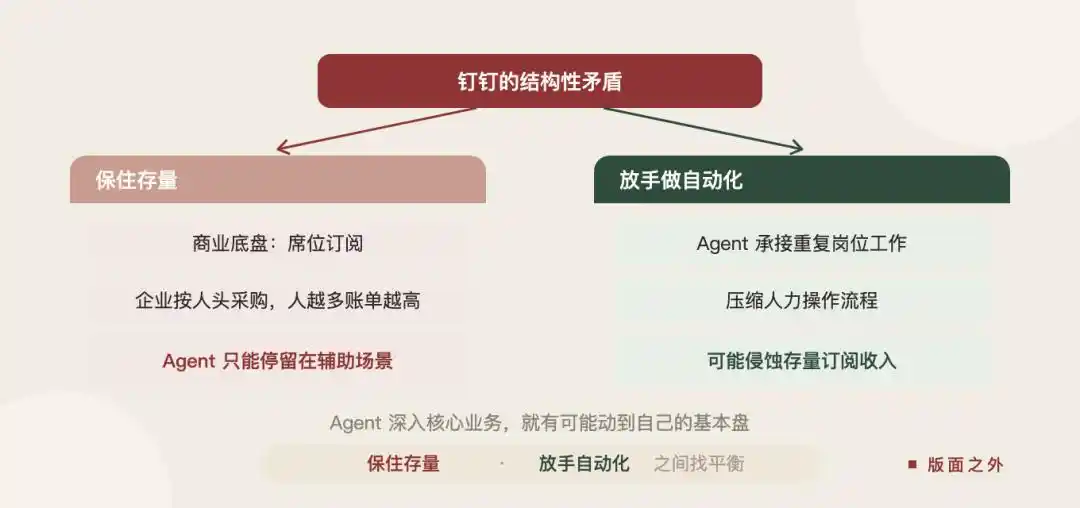
DingTalk’s commercial base over the past decade and more has relied on seat-based subscriptions. Companies buy accounts by headcount, and a larger user base produces a larger bill. The core value of an agent, by contrast, is to take over repetitive, standardized job tasks and compress manual workflows.
If an agent is deeply embedded in core business operations, it could erode existing subscription revenue. If Alibaba wants to protect the stable SaaS base, the agent may be limited to lower-risk assistance such as document polishing and meeting summaries, leaving it far from the center of business operations. Chen has to find a narrow balance between preserving the existing business and pushing hard on AI automation.
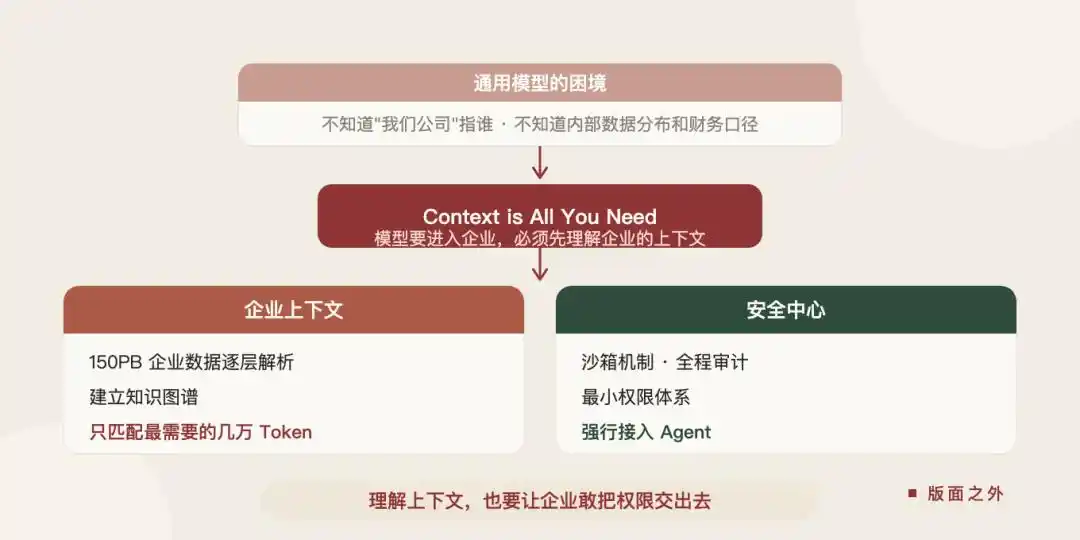
At the Yunqi Conference in Hangzhou in late September, he posed a question: What was our company’s gross margin in East China last quarter?
A general-purpose model does not know who “our company” refers to. It also does not know how data is distributed inside the enterprise or which financial definitions the company uses. A model can explain gross margin without being able to locate the company’s actual operating data.
Chen summarized his view in one sentence: “Context is All You Need.” Before a model can enter an enterprise, it has to understand the enterprise’s context.
This brought him back to the issue he had encountered at Chaitin. No matter how strong the technology, it cannot skip the customer’s own business rules. The difference is that Chaitin had to understand banks’ security needs, while today’s agents have to understand a company’s data, roles and workflows.
Security is another threshold. A company will not hand an agent access to core systems simply because it can complete tasks. Which data it may read, which operations it may execute and whether abnormal activity can be traced must all be addressed at the product-design stage.
Chen started his career in security and is familiar with the issue. To make businesses willing to let AI handle work, he brought that earlier respect for operational rules back into the product.
Qwen Office has introduced an “enterprise context” system that parses 150 petabytes of enterprise data layer by layer and builds a knowledge graph. When an agent performs a task, it matches only the tens of thousands of tokens it needs. Its security center also connects sandboxing, full-process auditing and a least-privilege framework to the agent.
The Qwen Office 2.0 release in November shifted the product’s positioning from a personal AI office assistant to a Team Agent for collaboration between individuals and organizations, with more attention given to organizational coordination.
Chen is no longer only trying to find room for one startup to survive. He is carrying Alibaba Group’s new entry point into the enterprise market in the AI era.
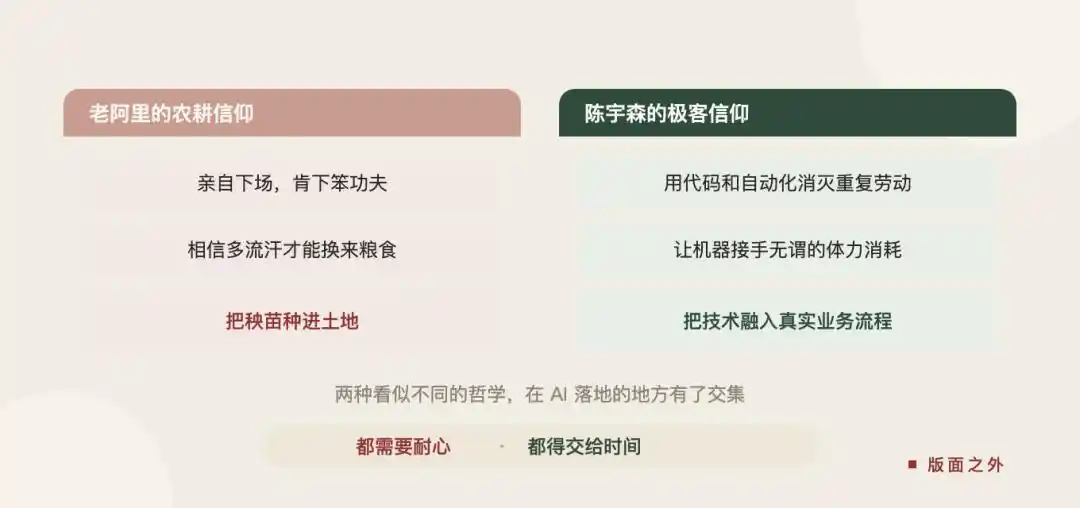
A few months earlier, Ma, Wu and other Alibaba partners had been planting rice in a half-acre field outside Hangzhou. The old Alibaba farming ethos emphasizes personal involvement and a willingness to do difficult, unglamorous work, with the belief that more sweat produces more grain. Chen’s technical ethos is to use code and automation to reduce unnecessary human effort and let AI take over repetitive labor.
The two approaches meet where AI is brought into a business. Planting seedlings requires patience, and so does integrating technology into real workflows.
This article was originally published by the WeChat account “Outside the Layout” and written by Huahua.



