
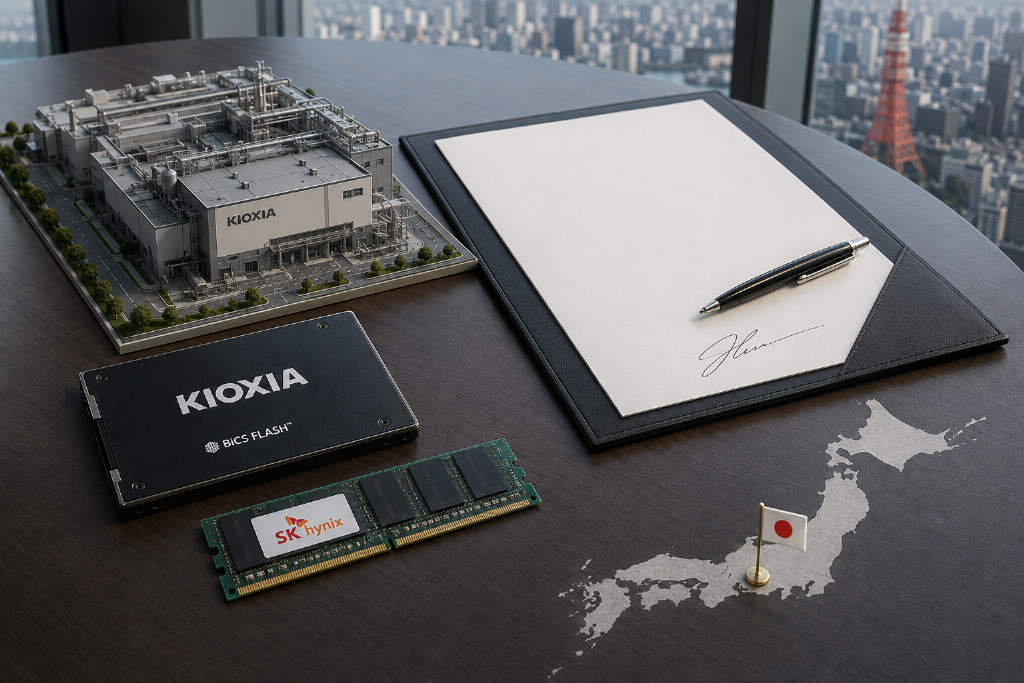
SK Group Chairman Chey Tae-won said in a recent interview with The Asahi Shimbun that SK would walk away from its long-standing investment relationship with Kioxia if the Japanese chipmaker does not bring SK Hynix into its core future strategy.
The message was direct. Chey tied it to a broader plan around NAND flash production, R&D cooperation, and supply chain integration. A few days earlier, at a Korea-Japan chamber leaders meeting held in Sendai on Aug. 31, he had said SK was evaluating the possibility of building a joint memory semiconductor plant in Japan.
Chey laid out three areas for potential cooperation
In the interview, Chey gave the idea more shape and named three possible directions: joint production, R&D cooperation, and shared supply chains.
He pointed to Kioxia’s existing model with U.S. company SanDisk, where the two set up a joint venture and produce major NAND products together. Chey said, 「If SK Hynix can be included in Kioxia’s future strategy, we are ready to become its partner at any time.」 He added that building a factory together remains a possibility.
Chey said SK would end the investment if no cooperation can be formed
Chey also made his position explicit in the interview: 「If we cannot establish any cooperative relationship, we will terminate our investment in Kioxia.」
SK Hynix currently holds Kioxia shares indirectly through a special purpose company managed by Bain Capital. That leaves the two companies in a complicated position in the NAND market, as both competitors and investment counterparts.
The report said that if SK Hynix were to convert convertible bonds issued by the SPC into Kioxia shares, its control and influence over Kioxia would rise sharply. If SK exits instead, Kioxia would lose an important strategic investor, which would make its position in the global NAND market more complicated.
Kioxia confirmed limited existing ties
Kioxia responded cautiously. The company only confirmed that the two sides are currently working together on self-developed MRAM R&D, and said SK Hynix is also one of its DRAM suppliers. Kioxia added that it hopes to maintain a good relationship.
Combined NAND shipment share would reach 36%
If SK Hynix and Kioxia do move toward cooperation, the global NAND flash market could look different. Counterpoint Research data cited in the report showed second-quarter 2026 NAND shipment market share at 25% for Samsung Electronics, 22% for SK Hynix, and 14% for Kioxia.
Based on those figures, SK Hynix and Kioxia together would account for 36%, above Samsung’s 25%.
SK Hynix CEO Kwak Noh-jung has also said recently that the company is evaluating plans to develop the NAND market with customers and partners, a comment the report said aligns with Chey’s position.
Chey said data center memory supply is 20% to 30% short of demand
A key driver behind SK Hynix’s push to expand production overseas is the imbalance created by fast-growing AI demand. In the interview, Chey said supply of memory semiconductors for data centers is running 20% to 30% below actual demand, and that South Korea’s existing large-scale domestic investment plans alone would not be enough to close the gap in time.
Among several candidate locations, Japan stood out. Chey cited two advantages: the country’s concentration of semiconductor materials and equipment suppliers, including SK Hynix partners Namics and Tokyo Electron, and the presence of major customers such as Sony Group and Nintendo. He also pointed to Micron’s plant in Hiroshima as evidence that Japan already has a mature industrial ecosystem.
He said the Japanese government is actively offering large-scale subsidies to overseas chipmakers under a policy approach modeled on support for Taiwan Semiconductor Manufacturing Co. (TSMC)’s Kumamoto plant, which strengthens Japan’s appeal as a production base.
Chey said, 「From both a risk and cultural perspective, Japan is a very attractive candidate location.」 Multiple local governments in Japan are now trying to attract an SK plant, and a specific investment policy could be announced as early as this year, according to the report.
SK Hynix is expanding on both U.S. and Japan tracks
Shortly before the interview, SK Hynix held a groundbreaking ceremony on the 27th for a next-generation HBM advanced packaging plant in West Lafayette, Indiana. The report said Japan could become the company’s second major overseas production base after the United States, helping support supply chains for both HBM and NAND.