
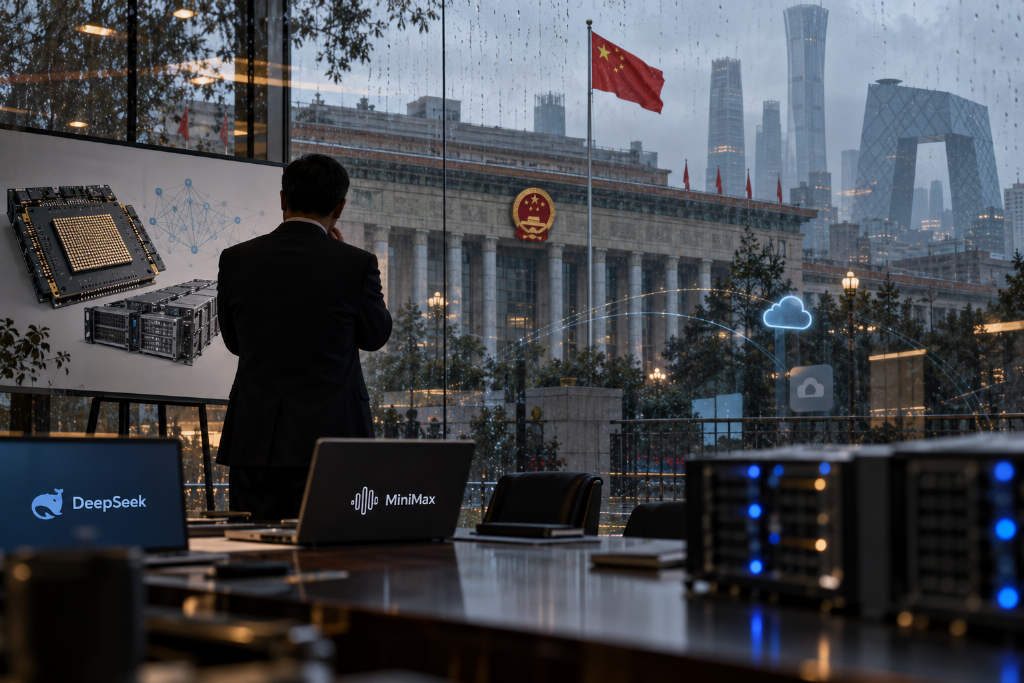
China’s Ministry of Commerce and Ministry of Science and Technology have proposed placing 23 AI technologies under export prohibition or restriction, while requiring pre-export registration before covered transfers leave the country. In a response to reporters, the commerce ministry said services delivered to overseas users through APIs, apps, web pages, or SaaS do not count as technology exports.
That clarification addresses one of the main questions raised after Beijing moved to tighten oversight of AI technology exports: whether the rules would affect overseas access to models from DeepSeek and MiniMax. The formal catalog is still under public consultation, and the final details have not been settled.
State media said DeepSeek and MiniMax had completed registration. The commerce ministry has not published a list, and neither company has issued a public explanation.
Model weight releases continued after the Oct. 16 notice
After China began tightening AI export controls, some users questioned whether overseas use of DeepSeek and MiniMax models would be affected. But both companies continued to release new model weights in the week after the Oct. 16 notice from the two ministries.
DeepSeek published V4.1-Flash-1017 on Hugging Face on Oct. 17. On Oct. 23, MiniMax said on its official X account that it had released the weights for M3.1 Flash. Its partner Modular said the model was the same one previously tested anonymously as Space Bunny.
The public record confirms the sequence of events: both companies released weights after the government notice. What it does not show is whether those two models were included in any registration filing.
What “registration” means and who has to file
On Oct. 16, the two ministries took two steps.
- First, they opened a public consultation on revisions to the Catalog of Technologies Prohibited and Restricted from Export by China. The proposal would add 40 technologies across AI, biomedicine, and photovoltaics, with AI accounting for 23 of them. Comments are being accepted through Nov. 15.
- Second, they imposed temporary “pre-export registration” management for those technologies starting the same day, to remain in place until the revised catalog is formally adopted and implemented.
Registration means filing information through the commerce ministry’s business system platform before a covered technology export takes place. The notice lists three situations:
- transferring ownership of a technology to an overseas party, including intellectual property transfers;
- authorizing overseas use;
- changing the owner or actual controller of the technology to an overseas entity.
The ministry also reserved the option to designate other situations through separate notices. Exports that have already started but are not yet complete are also covered.
The filing must include basic information on the exporter and recipient, the destination country or region, the content and intended use of the technology, and the expected export amount. The obligation falls on technology export operators in China. Overseas developers downloading weights or calling an API are outside the registration scope. The rule is aimed at sellers and licensors, not end users.
How the 23 AI technologies are being divided
The commerce ministry said the 40 technologies across the three sectors are split into 14 proposed export prohibitions and 26 proposed export restrictions. Its response to reporters did not break out how many AI items fall into each bucket.
The examples it did provide were more specific. AI-driven malicious code generation and mutation technology is listed as proposed prohibited export technology. AI-assisted vulnerability discovery technology is listed as proposed restricted export technology.
An article from Yuyuantantian added that large models trained on “core data” and then used to provide services would be proposed for export prohibition, while those trained on “important data” would be proposed for export restriction. Agent technologies that reach a certain performance threshold would normally fall into the restricted category, but if they are specifically or mainly used in highly sensitive scenarios such as national defense, military industry, or core government affairs, they would be upgraded to prohibited status.
On thresholds, Yuyuantantian said the catalog includes quantitative indicators such as more than 10²⁶ floating-point operations, more than 2 trillion parameters, or capabilities ranking in the global top 10. The article did not explain which indicator maps to which specific technology item.
What is not covered
The commerce ministry was more explicit about the areas that are not subject to control.
Technologies that have already entered the public domain through open-source release or publication in academic papers are not included. Open-source technology exports qualify for automatic licensing, and the ministry said the process is basically “report and export immediately.”
Companies using restricted large models to provide API access, app or web interaction, or SaaS applications are also not engaging in technology export, according to the ministry.
The ministry also said that after formal implementation, the vast majority of AI technologies would still be free to export.
The claim that companies have “completed registration” remains unverified in public disclosures
The statement that registration had been completed came from a Yuyuantantian article published on the evening of Oct. 22, which said only that “Tan Zhu learned” this information. The commerce ministry has not released a registration list, and neither company has publicly responded.
A reporter from the STAR Market Daily separately said MiniMax’s filing covered “some recently released and soon-to-be released models,” not all of them.
That leaves a gap in the public record. There is still no disclosed material showing exactly which DeepSeek or MiniMax models were included in any registration.
Key points are still unsettled
The catalog remains in the consultation stage, and neither the final content nor the effective date has been announced. There is also no explanation of who would determine a “global top 10” ranking or how that determination would be made.
Another unresolved point concerns overseas localized deployment. Restricted technologies remain within the control framework if they are deployed abroad locally. Only cases considered more controllable in risk terms, such as deployment on a company’s own overseas cloud, qualify for automatic licensing.
STAR Market Daily quoted a securities analyst as saying that the completion of registration by the two companies had actually made the overseas path for open-source models clearer. That view came from a market participant, not from the regulator.



