

China’s listed AI sector has taken a steep hit from its 2026 highs, and Protos says the numbers now point to a bubble that is deflating. Since its late-June peak, China’s Star 50 AI stock index has fallen 42%. The country’s tech sector, measured through the CSI 300 index, is down 18% over the same period. By comparison, the Nasdaq 100 benchmark has declined just 1.5%.
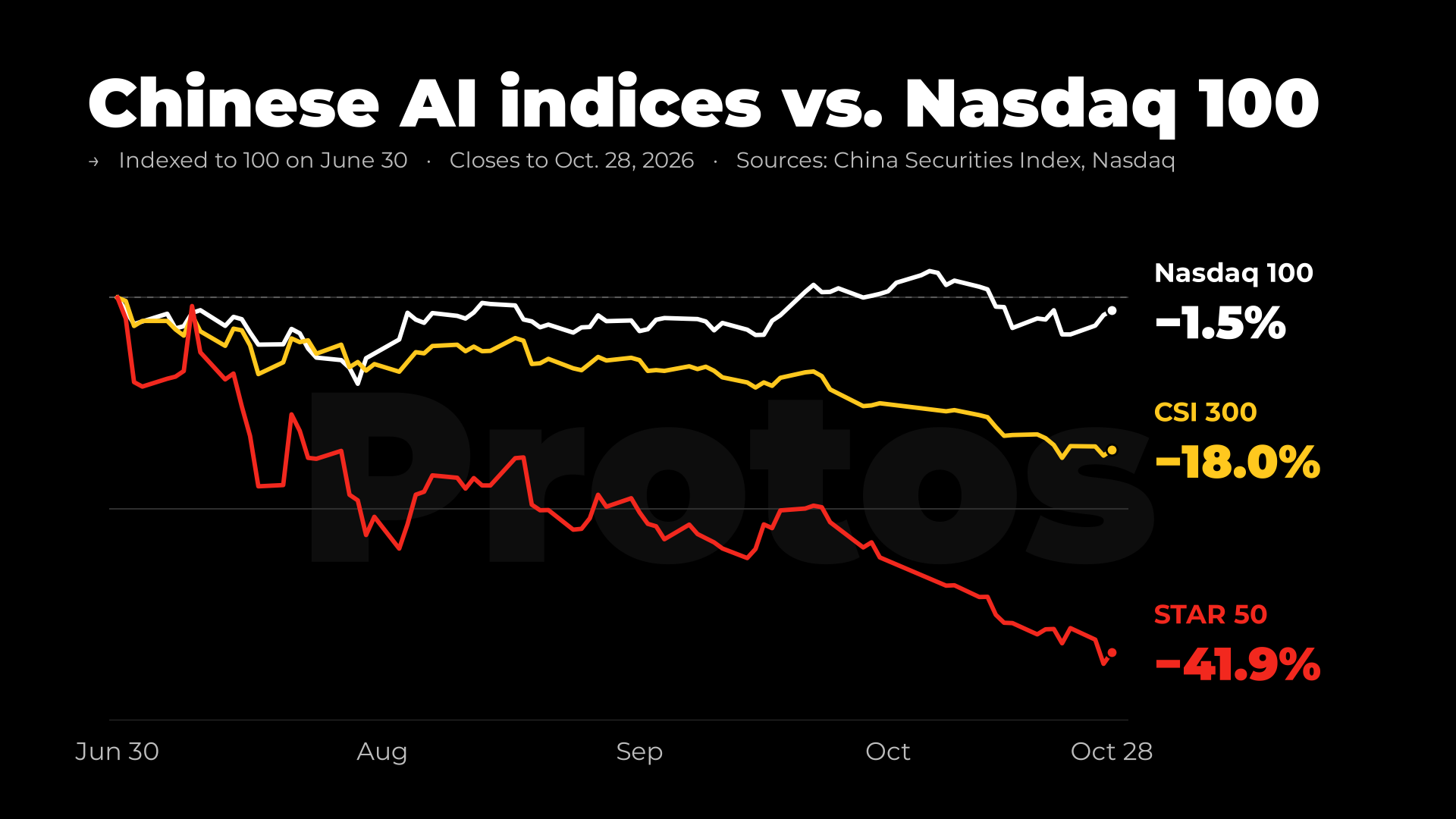
Chinese AI indices trail the Nasdaq 100
According to Protos, both Chinese indices have underperformed the Nasdaq 100 by a wide margin since June 30, 2026. Publicly traded AI companies with mainland China operations, many of them major constituents in those indices, have led the downturn.
The report included a chart comparing the performance of the Nasdaq 100, CSI 300, and Star 50 indices from June 30, 2026 onward.
MiniMax and Unisound show deep drawdowns
One of the sharpest examples cited by Protos is AI model developer MiniMax. Its shares closed trading in Hong Kong on Thursday at 87% below their earlier 2026 high of HK$1,330.
Unisound, a Chinese AI speech technology and language model software company, has seen a similar drawdown from its 2026 peak.
$340 billion erased across 14 Chinese AI stocks
Protos said the combined market capitalization loss across 14 Chinese AI stocks now stands at $340 billion below their 2026 highs. The declines have been broad enough that only three of the 14 companies have managed to keep losses to less than 50%.
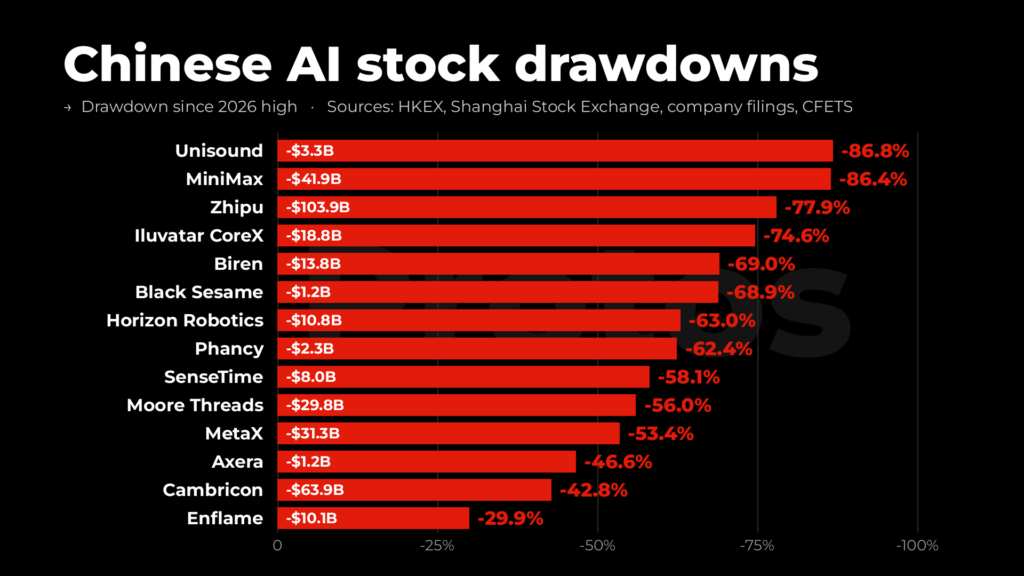
To keep the list tied to China’s publicly traded AI sector, Protos said it only included companies with substantial mainland China operations and financial statements showing that a majority of revenue comes from AI models, AI software, or AI computer chips.
Investors and strategists warn about the fallout
A partner at Shanghai Zhuozhu Investment Management acknowledged the scale of the selloff in Chinese AI stocks, saying, "All bubbles inevitably burst."
Hong Hao of Lotus Asset Management warned that many mainland AI stock listings are being paused. The report also said AI stocks still account for roughly 40% of China’s stock market.
Bank of America’s Alex Liu told Bloomberg, "Right now it’s actually hard to say who’s going to survive."



