
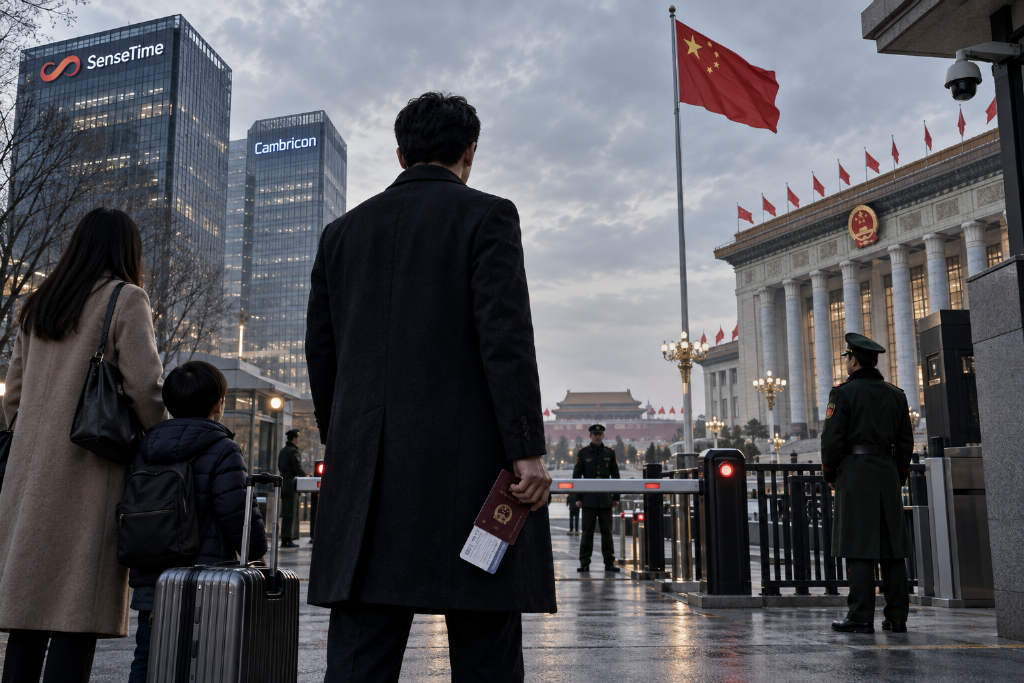
China has started extending some travel restrictions on top artificial intelligence talent to family members, with certain spouses and children of executives at AI and chip companies now required to obtain Beijing’s approval before even short trips abroad, Bloomberg reported, citing people familiar with the matter.
The report said the measure is not a blanket ban on overseas travel. Still, it adds another layer of pressure for a technology sector already operating under unusually tight controls. According to Bloomberg, the people affected include founders of well-known startups and heads of strategically important AI-related companies whose work is considered relevant to national security.
Tighter controls build on earlier restrictions
Bloomberg framed the latest step as an escalation of existing controls rather than a new policy from scratch. In March 2025, The Wall Street Journal reported that Chinese authorities had told leading AI entrepreneurs and researchers to avoid traveling to the United States. Those who did travel abroad were required to report their plans in advance and, after returning, explain what they had done and whom they had met.
The report also pointed to DeepSeek founder Liang Wenfeng, who declined an invitation to the Paris AI Summit in February 2025. Authorities were said to be concerned about both the leakage of sensitive information and the possibility that executives could be detained overseas and used as leverage in US-China negotiations, a line of thinking Bloomberg compared with the earlier detention of a Huawei executive in Canada.
The Manus case remains a key reference point
Bloomberg also revisited the Manus case. In March 2026, the Financial Times reported that Manus CEO Xiao Hong and chief scientist Ji Yichao were summoned to Beijing for a meeting with the National Development and Reform Commission. After the meeting, they were told not to leave China during a review period, though they could still move freely within the country. At the time, Meta was pursuing an acquisition of Manus valued at about $2 billion.
In April, the NDRC halted the deal and ordered the completed acquisition to be unwound. On June 11, the two sides completed an operational separation. In August, Manus said it had resumed independent operations after a Tencent-led consortium bought it back at roughly the original price.
Bloomberg said the Manus episode sharpened concerns among Chinese officials over the outflow of critical technology and talent, and that Beijing later moved to restrict US capital from investing in sensitive technology companies. At the same time, Bloomberg said the plan to limit the movement of AI talent may not be directly tied to the Manus case, because preventing technology leakage has long been a standing policy objective.
Earlier Bloomberg reporting had already described AI travel approvals
On May 26, Bloomberg reported that some top AI personnel at private-sector companies including Alibaba and DeepSeek had to obtain official approval before traveling abroad. In some cases, passports were also required to be handed over to their companies for centralized custody.
The Sept. 28 report pushes that same framework one step further by extending it to family members. Bloomberg said Beijing has for years imposed travel restrictions on selected groups, including researchers at prominent universities, nuclear scientists, and executives at state-owned enterprises, with family members also affected. What is different now, the report said, is that the focus has been clearly directed at the private sector, where top AI and technology engineers are viewed as strategic assets for the world’s second-largest economy.
Public rules do not mention family approval
Bloomberg noted that a separate set of new exit restrictions took effect on Sept. 15 and applies to cases ranging from criminal investigations to potential violations involving industrial and technology security. The timing and scope align with the State Council’s rules on exit-entry administration, which were reviewed at the 90th executive meeting of the State Council on June 29 and published on July 31. The document contains 19 articles.
A comparison with the published text shows no explicit reference to family members. Article 4, paragraph 3, says Chinese citizens who violate export control rules or technology import and export management rules, and in doing so may endanger national industrial or technological security, can be barred from leaving the country by competent authorities including commerce regulators. Article 6 says the authority making such a decision should notify the person in writing of the facts, reasons, legal basis, and available remedies, although notification may be withheld in matters involving national security or criminal investigations.
Across all 19 articles, there is no clause requiring spouses or children to obtain approval before leaving the country, and no article specifically names the AI or semiconductor sectors.
No public confirmation so far
Bloomberg drew a distinction between the logic of the published rules and the newly reported family restrictions. The public rules target alleged violators, meaning restrictions are tied to what a person is accused of doing. The family-approval arrangement described by Bloomberg is based instead on strategic value: the more important a person is deemed to national security, the more likely family members are to face restrictions as well, regardless of whether any violation has occurred. The first framework has public legal text and formal remedies. The second, at least for now, does not have a publicly disclosed legal basis.
Bloomberg said the family-related restrictions have so far been disclosed only through anonymous sources and have not been publicly confirmed by Chinese authorities. The Ministry of Industry and Information Technology did not respond to a faxed request for comment, according to the report. The people familiar with the matter also said it remains unclear whether all family members of those already under travel controls will be subject to the new requirement.
The list may keep growing
Bloomberg reported that two people familiar with the matter said officials had already informed several individuals that family travel would require prior procedures, and that Beijing’s plan is to add more people over time. That suggests an expanding list rather than a one-time rule applied all at once.
For top engineers, Bloomberg said, the policy could alter career calculations. It may force globally minded talent to choose between staying in China and moving abroad earlier in their careers. Once family members are included, the cost is no longer limited to personal mobility. It also reaches children’s education, spousal visits, and broader family arrangements.