
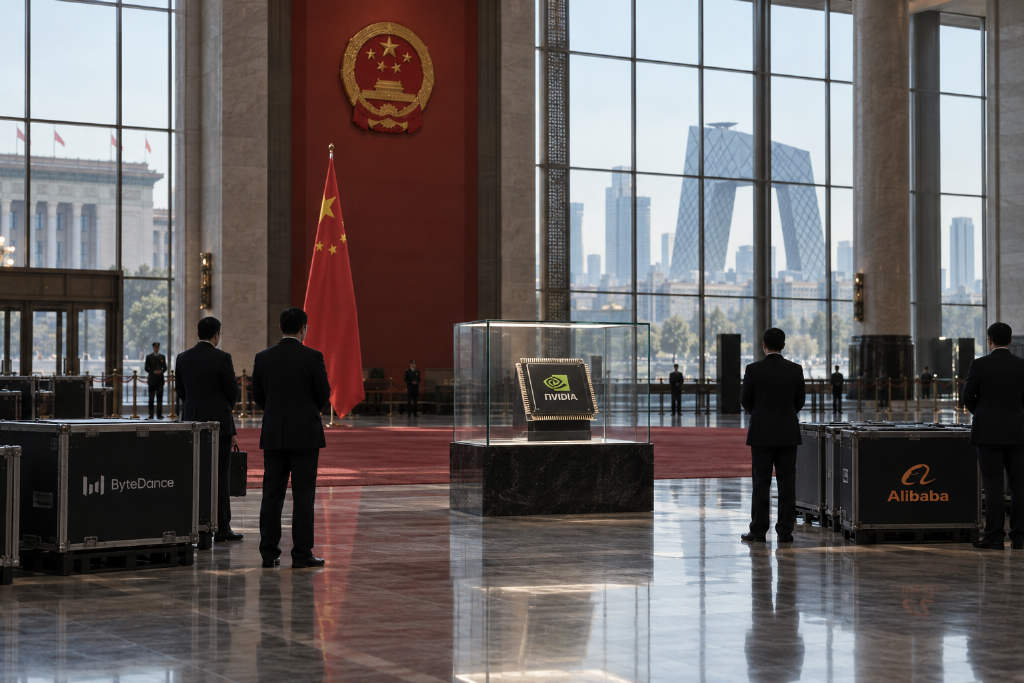
China has signaled that it may allow ByteDance, Alibaba and other domestic companies to buy a newly launched Nvidia chip built for high-end professional computers, according to a Sunday report by The Information cited by Reuters.
MIIT reportedly told some companies approvals are planned
The report cited two people familiar with the matter as saying that China’s Ministry of Industry and Information Technology has told some companies that the government intends to approve those purchases. Reuters said it could not immediately verify the report on its own.
In Reuters’ retelling, the product being discussed is a newly introduced Nvidia chip aimed at high-end professional computers, not the data center GPU line that has drawn wider market attention. No exact model number was given, and the report did not specify the size of any potential orders.
No public response yet from Chinese authorities or Nvidia
For now, the report describes an intention to approve purchases rather than a formal approval. Chinese authorities and Nvidia had not publicly commented at the time.
If confirmed, the development would point to a softer stance from Beijing on Nvidia chips. Over a period of time, Beijing had encouraged large technology companies to reduce purchases of Nvidia products as part of its push to support domestic chipmakers, while also tightening scrutiny of foreign chips.
The article also noted that Chinese companies have used different channels to secure computing capacity. ABMedia had previously reported that a ByteDance subsidiary obtained Nvidia B200 GPUs through UK-based AI cloud provider Nscale.
Report surfaced after the Trump-Xi meeting
The timing of the report drew attention because it came after the Trump-Xi meeting, where the U.S. and China announced a dialogue mechanism on what the source described as “super intelligence” and reached an agreement to cut tariffs on $30 billion of goods.
At the same time, the White House summary of the summit did not mention chips or export controls. That leaves open whether the latest signal reflects a domestic policy adjustment by Beijing or an extension of warmer ties after the summit. The report said there is not enough information yet to determine that.
Separately, Bloomberg cited comments the same day from Chinese state media outlet Yuyuantantian, saying that China and the U.S. have both the ability and the responsibility to jointly manage and develop artificial intelligence. The comment suggested that Beijing’s public messaging on AI is also leaning toward cooperation.
Taiwan supply chain implications hinge on follow-up details
For Taiwan, whether major Chinese technology companies can buy Nvidia’s new chip has direct implications for Taiwan Semiconductor Manufacturing Co. foundry orders and demand across the AI server supply chain. The report described ByteDance and Alibaba as among the world’s biggest AI capital spenders. If Beijing allows the purchases, expectations for Nvidia’s China revenue, as well as shipments of related servers and components from Taiwanese suppliers, could shift.
Still, until MIIT makes a formal statement and Nvidia confirms anything, the situation remains at the stage of possible approval. The next points to watch are the approved chip models and volumes, whether any conditions are attached, and whether U.S. export controls move in step.