
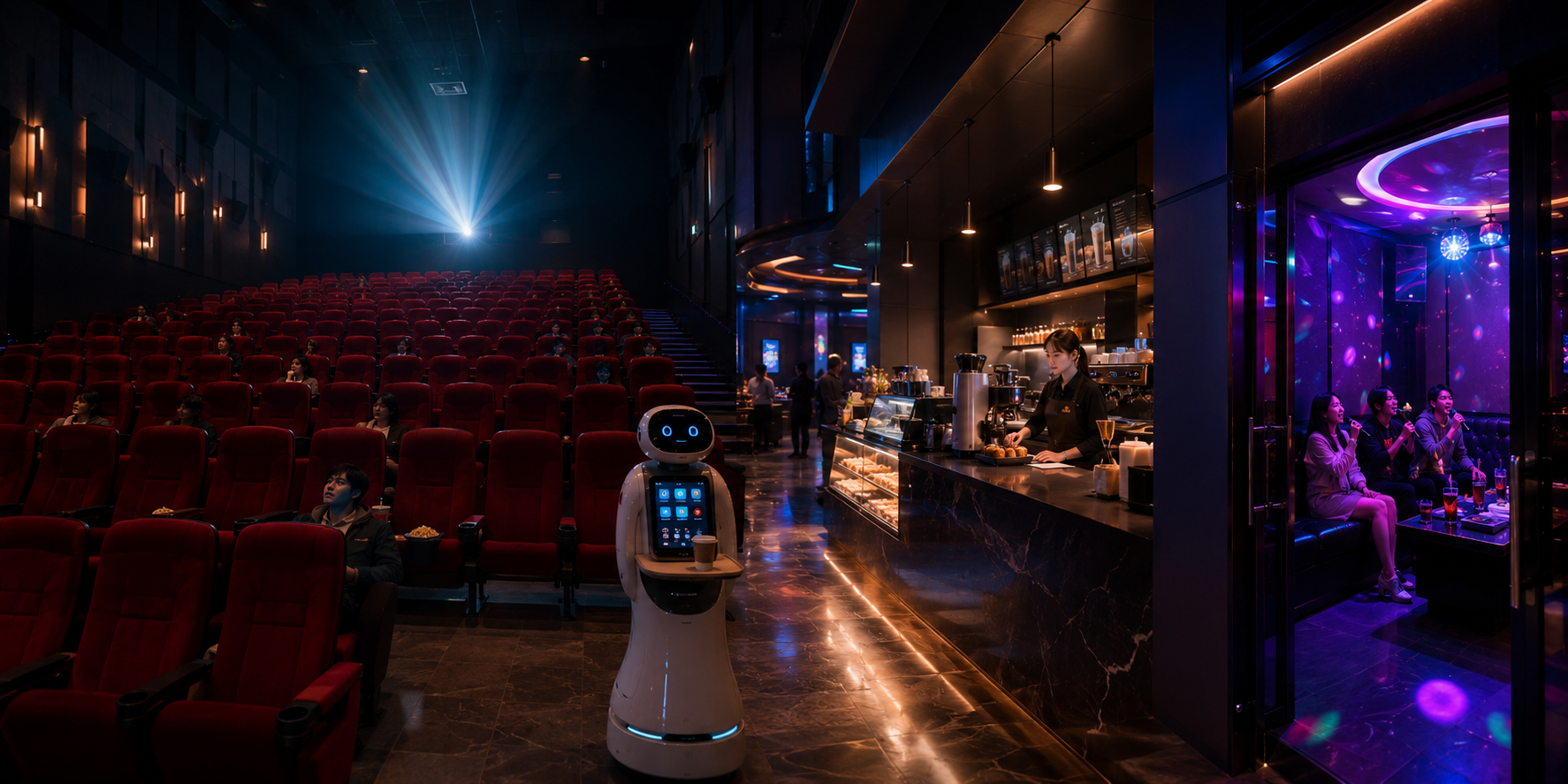
China's movie screens remain lit, but seats are increasingly empty. In early July, the China Film Administration and the State Administration for Market Regulation jointly issued a notice to encourage cinemas to diversify — no more ticket subsidies, just survival.
Key measures include AI agents for lobby interaction and guidance, video games and KTV lounges, cultural-educational activities, premium coffee shops and bakeries, as well as movie merchandise and pop-up art exhibitions. The vision: a single cinema visit becomes a full consumption loop, not just a two-hour dark screening.
The notice uses advisory language like "encourage" and "support." Implementation depends on local cinema chains.
Box Office Slump and 4.8% Occupancy
In the first half of 2026, total box office revenue hit only 17.3 billion yuan, down over 40% year-over-year. Movie admissions stood at 421 million, with average ticket price at 41.1 yuan. Even the usually reliable Spring Festival holiday earned only 5.752 billion yuan and 120 million admissions — a 39.5% drop and an 8-year low.
The critical metric: average seat occupancy nationwide was 4.8%, the lowest in 12 years. For every 10 seats, fewer than one was filled.
Fighting for Attention: Short Video and Streaming Squeeze
More viewers prefer a 10-minute short video to a two-hour cinema trip. Streaming platforms release new titles faster, eroding the "must-go-to-theater" incentive. Short videos have no showtime restrictions, no commute, and no trailers. Cinemas must reclaim not only wallets but dwindling attention spans.
Bringing AI agents, coffee shops, and KTV into cinemas is an admission: a single film can no longer lure audiences. Screening halls shift from "sole purpose" to "add-on option." The cinema evolves from content pipeline to hybrid physical space.
Globally, North American chains long relied on popcorn and drinks for margins; Japanese and Korean cinemas gradually merged food and entertainment. If even China's major market needs policy to sustain audience interest, the era of "cinemas selling only tickets" may be ending.