

After June 12, 2026, mainland China users of Futu and Tiger can still see their holdings and assets in their U.S. brokerage accounts. They can sell and move money out. What they cannot do anymore is deposit fresh funds, buy, or add to positions. In the source article, a cross-border financial boundary ultimately comes down to whether a button still works inside a retail account.
The piece places this cleanup of offshore U.S. equity access alongside China’s crypto crackdown from nearly a decade earlier. In both cases, its argument is the same: authorities tightened access to asset channels available to onshore users and moved against financial exposure seen as harmful to domestic liquidity over the long run.
A multi-year tightening of cross-border brokerage access
The article cites the Implementation Plan for the Comprehensive Rectification of Illegal Cross-Border Securities, Futures, and Fund Business Activities, issued jointly by the China Securities Regulatory Commission and seven other agencies. It says the document calls for a full shutdown of illegal cross-border investment activity within two years, with an immediate halt to new account openings and new capital inflows. Existing funds may only be withdrawn over a two-year period. Beyond the financial services themselves, the source says supporting facilities and services tied to cross-border investing, including online information exposure within mainland networks, are also barred.
It adds that Futu and Tiger were fined RMB 1.85 billion and RMB 410 million, roughly $270 million and $60.7 million. Their shares at one point dropped 45% and 30% in premarket trading. The article treats that as the point at which the era of mainland users freely buying U.S. stocks at the regulatory edge came to an end.
The source stresses that this was not a one-off shock. It lays out a timeline:
- November 2021: senior executives at Futu (FUTU) and Tiger (TIGR) were called in by the securities regulator;
- December 2022: both firms were labeled as operating illegally and barred from opening new mainland accounts;
- May 2023: their apps were removed from mainland app stores;
- May 2026: a formal investigation was opened and an eight-agency cleanup campaign was launched.
The article reads those steps as part of a longer-standing capital control framework. Its stated logic is straightforward: preserving renminbi exchange-rate stability and monetary-policy autonomy has long required managing cross-border flows, and investment restrictions are one piece of that system. In this framing, money made inside China is expected to circulate back into the domestic economy rather than leave without limit.

State priorities and household asset allocation do not always line up
For many Chinese households, the source says, offshore investing has not only been about seeking returns. With wage growth slowing and property values falling sharply, exposure to high-quality global companies has looked like one of the few remaining ways to alter a family’s long-term wealth path. That route is now narrowing.
The article then groups several cases under the same policy instinct: the full ban on cryptocurrencies, the intervention around TikTok’s U.S. sale, and the rejection of the Manus acquisition. Its point is not that these events are identical, but that when finance collides with state strategy, the priorities remain financial stability, onshore monetary control, and keeping critical resources inside the country.
Those resources, in the article’s telling, are broader than capital. Technology, talent, data, and supply chains belong in the same discussion. If those elements stay onshore and domestic capital supports local firms, the argument goes, national competitiveness improves from the ground up.
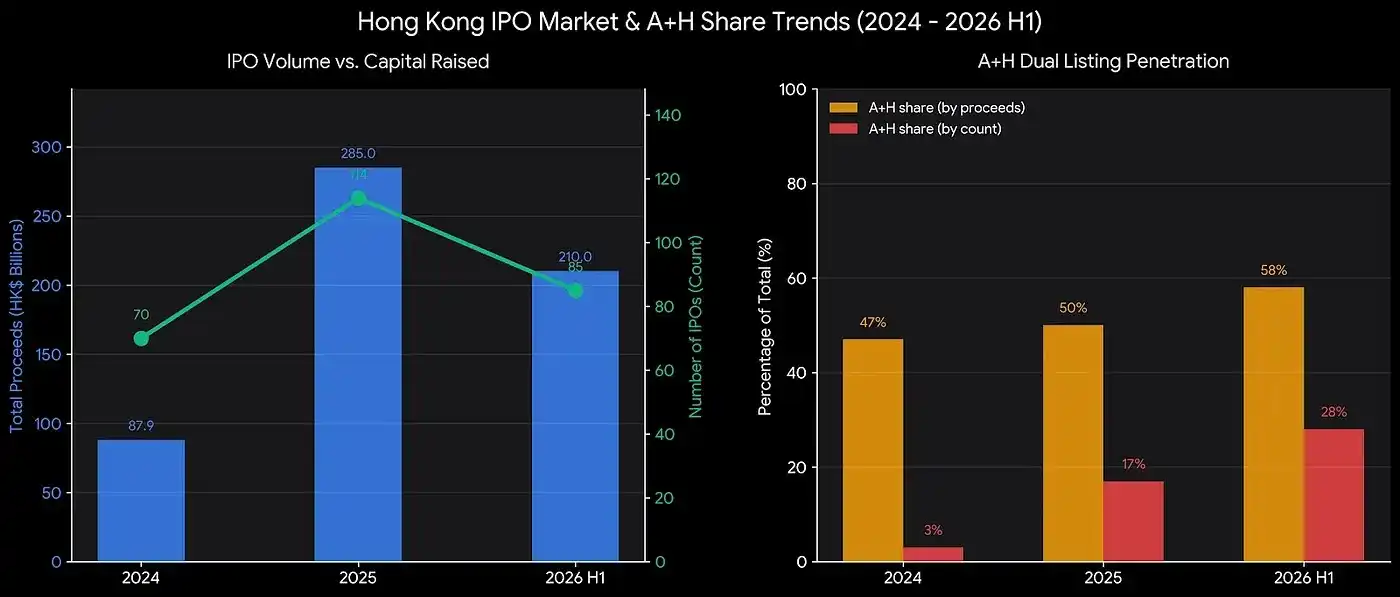
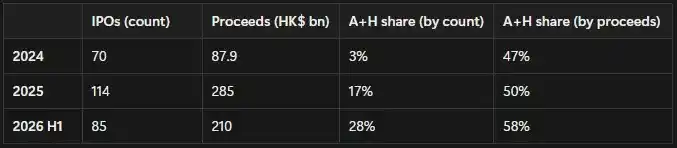
That is also how the source interprets policy support for Hong Kong and mainland science-and-technology listings, and the push for companies with core technologies and data sensitivity to favor A-share or Hong Kong listings over U.S. ADR issuance. It cites 2025 Hong Kong IPO proceeds of about HK$285 billion, or $36 billion, the first time since 2019 that the market topped global rankings again, ahead of Nasdaq at $27.5 billion. It also says the proportion of companies listed in both A-shares and Hong Kong had climbed to nearly 60% by the first half of this year.
From that, the article concludes that Hong Kong is being shaped into a liquidity center for Chinese companies while governance control remains firmly in Chinese hands. In that reading, the removal of easy U.S. brokerage access is not only about stopping domestic money from supporting U.S. equity valuations. With China already having missed the first move in AI, the source argues that the strategic weight of this step may exceed that of earlier capital-control measures.
The concentration of global tech ownership and the anxiety of Chinese retail investors
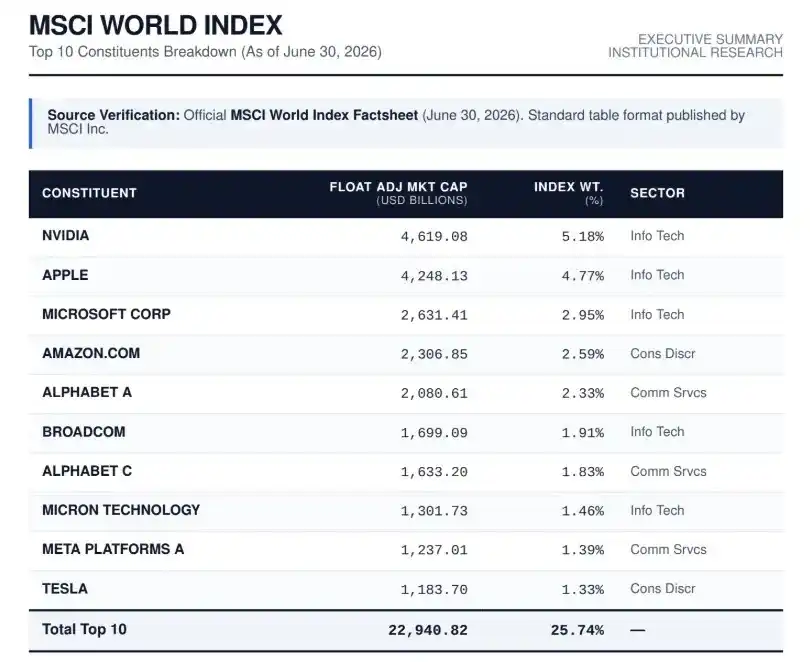
Citing the MSCI World Index factsheet for the end of June 2026, the article says the top 10 constituents accounted for 25.74% of the index, and were almost entirely U.S. technology and AI-related companies. These firms, it argues, control ownership over future cash flows linked to AI compute, cloud platforms, chips, advertising networks, operating systems, consumer access points, electric vehicles, and satellite internet.
That concentration feeds what the source calls a siphon effect for passive money. Because index funds allocate by market capitalization, nearly $26 out of every $100 in new global liquidity flows mechanically into those 10 U.S. tech names. In the article’s view, that dynamic pushes valuation premiums even higher and gives those companies unusually cheap financing power for acquisitions, research, and the locking-in of future digital and physical assets.
When a quarter of global growth is being captured by those firms, the piece argues, ordinary Chinese investors have no simple way to access what looks like the most visible beta trade of the era.
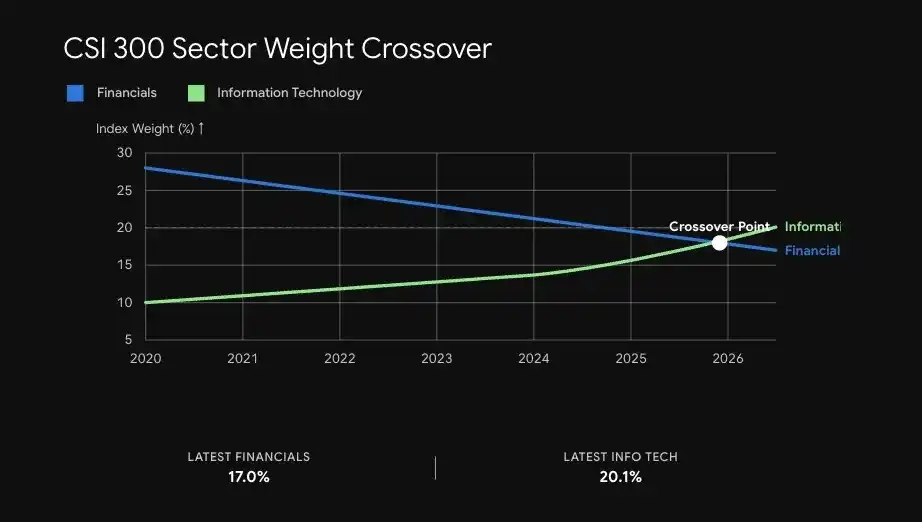
The domestic benchmark looks very different. According to the article, financials historically dominated the CSI 300, usually carrying a 20% to 30% weighting. Only between late 2025 and early 2026 did information technology first overtake financials to become the largest sector in the A-share benchmark.
The source links that shift to three structural changes:
- a turn in the credit cycle, as tighter control over local-government debt and property leverage slowed balance-sheet expansion in the traditional financial sector and pushed valuation centers lower;
- targeted central-bank liquidity, including tools such as relending for technology innovation, directed toward hard tech, domestic semiconductor substitution, and advanced manufacturing;
- a repricing of what it calls “new quality productive forces,” with compute infrastructure, semiconductor equipment, and advanced materials companies receiving higher valuation premiums and stronger capital support.
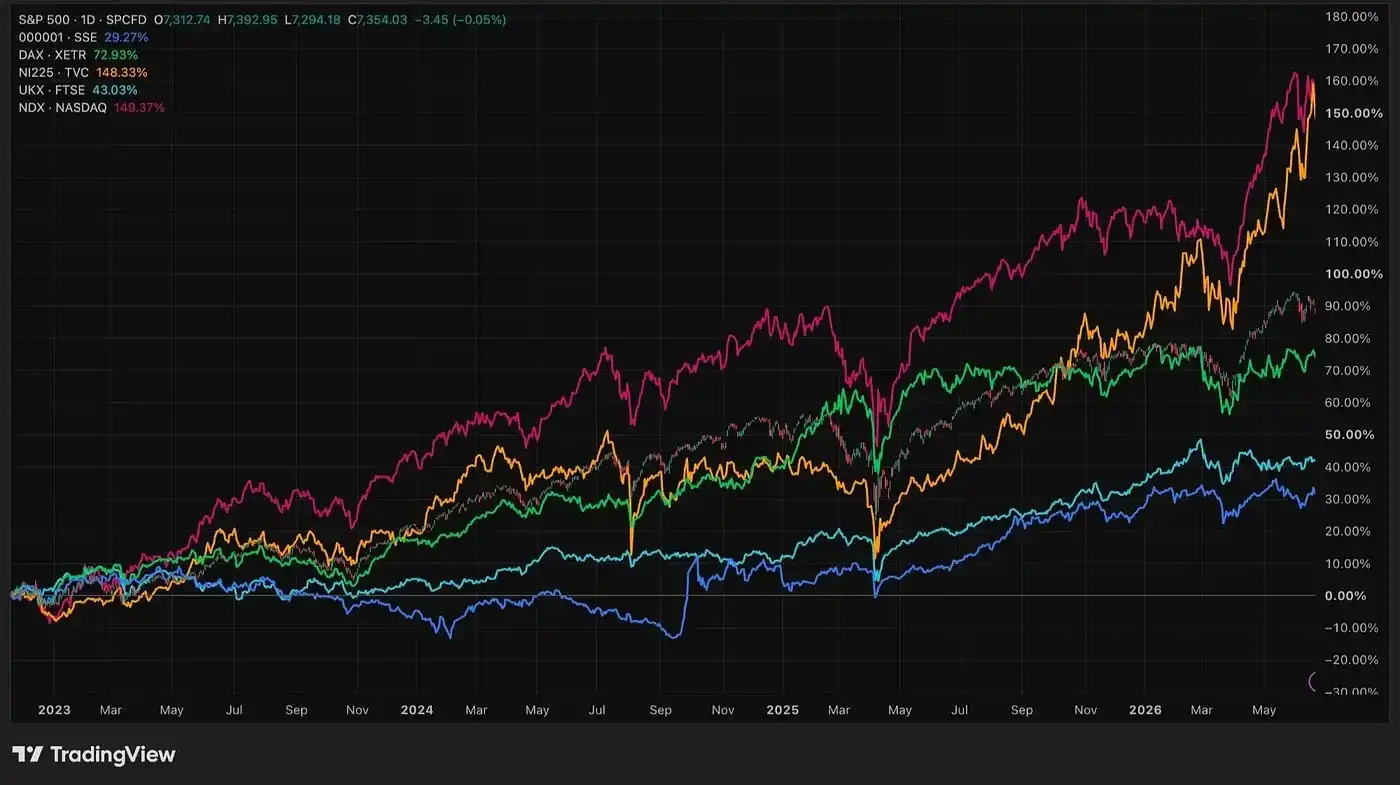
The article says the lag is visible not only in index composition but also in market performance. Since ChatGPT arrived in 2022, it writes, China, despite being the world’s second-largest economy, has posted the weakest stock-market gain among the five largest economies. Retail investors in China are left staring at limited account quotas while being shut out of a new wealth system.
In that context, the source says demand for offshore exposure is not simply a matter of preferring foreign assets. It reflects weak performance from domestic technology companies, the sharp contraction in real-estate values, and a growing sense of relative deprivation. The article notes that ETFs tracking overseas markets even traded at premiums of as much as 10% in China’s A-share market this year.
At the state level, the piece acknowledges the policy rationale for capital controls: keeping domestic liquidity from strengthening foreign companies, limiting external control over AI supply chains, and preserving domestic influence over asset pricing. For individual investors, though, the source says the country of origin matters less than whether they can buy the asset at all.
That gap between state goals and personal portfolio demand is where the article sees a fresh opening for crypto.
Tokenized equities and on-chain RWA as a new access layer
For the past 15 years, the source says, one of crypto’s central narratives has been “banked the unbanked” — bringing people without bank accounts into payments, savings, lending, and a more advanced monetary system. It argues that the next frontier may be moving those users into the distribution layer for global core assets.
The numbers it gives are these: tokenized stock market value increased by more than $1.3 billion over the past year. In June 2026, led by SpaceX, monthly trading volume in tokenized stocks surpassed $3.4 billion. On trade.xyz, daily trading volume in RWA perpetual contracts topped $6 billion.
The article does not claim that on-chain tokenized assets are anywhere near the scale of the traditional U.S. equity market. What it does claim is that liquidity has started to show up in a meaningful way: these instruments can be accessed globally, trade around the clock, and continue price discovery after traditional markets close.
Over time, the source says, those assets may come to look more like native crypto collateral. They could be pledged, borrowed against, and recombined into new structures, building an alternative distribution layer for investors excluded from traditional finance and giving them a new form of brokerage access.
Today, it says, the people locked out are Chinese retail investors. Tomorrow that could mean Latin American users without U.S. brokerage accounts, Asian users without accredited-investor status, Middle Eastern users constrained by domestic capital controls, or younger investors who simply do not want local financial systems deciding their asset boundaries.
On that basis, the article argues that crypto’s next major opportunity may not be another faster wallet or a cheaper exchange. It may be a new front end for assets — a way to repackage, price, and distribute global productive assets.
Capital flows in the AI era are not only about retail investors
The source extends the same “brokered the unbrokered” idea to companies. Its premise is that whoever can secure future capital, scarce physical resources, and investor attention on a global scale first is more likely to build a moat ahead of competitors. U.S. companies, in this framing, have long been first-class citizens in asset issuance.
Large U.S. technology firms, the article says, carry balance sheets and credit ratings stronger than those of many sovereigns. They use that privilege almost like macro hedge funds. When the Bank of Japan or other central banks keep local rates low while dollar funding is more expensive, these firms can run a corporate-level carry trade and lock borrowing costs at 1% or lower, with local pension funds and insurers often providing the money.
The article then points to foreign-currency bond issuance. Since last year, it says, major U.S. cloud firms have issued large amounts of debt outside the dollar market. In 2026 alone, Alphabet sold JPY 576.5 billion in Japan, equal to $3.6 billion, and CHF 3.055 billion in Europe, equal to $3.9 billion. Amazon also completed a CHF 2.82 billion bond deal, roughly $3.6 billion. Over just two years, the source says, the share of foreign debt in these companies’ capital structures rose from zero to 30%.
Still, the article argues that this privileged position in asset issuance may not last forever. AI supply chains are creating new non-dollar assets. It points to the rising importance of South Korean and Taiwanese semiconductor capacity in global supply chains, as well as the recent listing of ChangXin, which it says drew 500 times oversubscription. Those companies, in the article’s view, occupy important positions in the AI supply chain while remaining outside dollar capital markets. It also says ChangXin appeared on Hyperliquid early because it wanted access to global liquidity.
The source also argues that the gap between China and the U.S. in AI may be smaller than many assume. It cites DeepSeek, launched in February last year, and the recently released Kimi K3, and adds that China remains well ahead in the industrialization of humanoid robots. While market attention is fixed on U.S. big tech and on future listings from OpenAI and Anthropic, the article says that if DeepSeek and Moonshot one day reach the A-share market, the investors left regretting the missed trade may not be in China.
When asset allocation becomes a new social divide
The final stretch of the article moves from market structure to social structure. Demand for assets is becoming more global, it says, but ownership rights and issuance rights remain constrained by national borders. That is why the source sees “brokered the unbrokered” as more important over the next 15 years than “banked the unbanked.” The latter is about connecting individuals to a monetary system. The former is about who gets access to low-cost financing in the future, and who gets ownership over advanced productive capacity.
To make that point, the article reaches back to 1914, when Ford introduced the eight-hour day and five-day workweek. Much of modern society over the last century, it says, was organized around the institutionalization of work and work ethics. Who you are was often tied to what you do for a living.
Now, under an AI-driven fourth industrial revolution, the piece argues, the marginal value of cognitive labor is being compressed. For most knowledge workers, wage growth will become increasingly unable to keep pace with asset prices and monetary expansion, especially the assets that capture technology rents, monetary rents, and monopoly rents.
That leads to the article’s closing claim: asset-allocation rights are no longer just a conventional wealth-management issue. They are becoming a new mechanism of social stratification. The source ends on a short line about finance being in the business of hope.