

Access to asset allocation is no longer just a personal finance issue, according to a July 29 article published by TechFlowPost. The piece argues that it is becoming a new form of social sorting.

The article starts with a concrete change in market access. After June 12, 2026, mainland Chinese users logging into their U.S. stock brokerage accounts at Futu and Tiger Brokers could still see their holdings and assets, and they were still able to sell positions and transfer money out. What they could no longer do was top up funds, buy, or add to existing positions. In the article’s framing, when capital begins to show signs of moving beyond state control, regulation often tightens first around the individual investor’s room to choose and allocate assets.
It compares the latest cleanup of cross-border U.S. equity brokerage business in China with the crypto crackdown of nearly a decade ago. In both cases, the author writes, policymakers moved to narrow financial exposures seen as unfavorable to domestic liquidity over the long term, while drawing a harder line around what onshore users are allowed to trade. For many Chinese households, the article says, those channels were not simply about investment returns. With wage growth slowing and property values falling sharply, access to high-quality global companies may have been one of the few remaining paths for improving household wealth over the next 20 years. That path is now narrowing.
The policy structure behind the brokerage cleanup
The article points to the “Implementation Plan for the Comprehensive Cleanup of Illegal Cross-Border Securities, Futures, and Fund Operations,” issued jointly by eight agencies including the China Securities Regulatory Commission. It says the plan makes the direction explicit: all illegal cross-border investment activity is to be fully shut down within two years. Effective immediately, no new accounts may be opened and no new capital may flow in. Existing funds may only be transferred out, and must be fully withdrawn within two years. Beyond core financial services, supporting facilities and services around cross-border investing, including information exposure on domestic internet platforms, are also set to be banned.
The same article says Futu and Tiger were fined RMB 1.85 billion and RMB 410 million, equivalent to about $270 million and $60.7 million. Their shares fell as much as 45% and 30% in premarket trading. In the author’s reading, that marked the end of an era in which mainland users could still trade U.S. stocks through channels operating at the regulatory edge.
The piece stresses that this was not a one-off shock. It places the move inside a longer tightening cycle around outbound renminbi investment channels, beginning with pressure on brokerages. The timeline it lays out is:
- November 2021: the CSRC held talks with senior executives from Futu (FUTU) and Tiger (TIGR).
- December 2022: both firms were classified as illegal operators and barred from opening new mainland accounts.
- May 2023: their apps were removed from mainland app stores.
- May 2026: formal investigations were opened, alongside the joint cleanup campaign by eight agencies.
The article argues that capital controls have long been part of China’s strategic framework for preserving exchange-rate stability and monetary policy autonomy in a dollar-dominated system. Restrictions on cross-border investing are only one part of that setup. In the author’s words, the policy objective is straightforward: money earned inside China should feed back into the domestic economy rather than flow outward without limit.
From the crypto purge to keeping capital onshore
The article extends the argument beyond brokerage accounts. Whenever financial activity runs against national strategy, or even touches the country’s strongest local innovation assets, Beijing’s priority remains financial stability and onshore monetary power, it says. The author cites several examples: the broad ban on crypto, intervention around TikTok’s U.S. sale process, and the blocking of Manus acquisition plans. The common thread, in the article’s view, is not only limiting where capital goes, but also preventing the outflow of technology, talent, data, and supply-chain capacity. Keep those core factors at home, then support local companies with domestic funding. That, the piece argues, is how state competitiveness is reinforced at the base layer.
The author places this logic in the context of AI competition. During the previous phase of globalization, China could still stand out through manufacturing supply chains. In the AI era, the article says, China is up against not just OpenAI and Anthropic, but also Nvidia, Microsoft, Amazon, and Alphabet, companies with more than a decade of technical accumulation and the backing of deep U.S. capital markets. Their ability to finance growth and use financial leverage, the author argues, may exceed that of Chinese companies by more than two orders of magnitude. That is why keeping domestic liquidity and private capital onshore, then concentrating it on local technology champions, is presented as an urgent task.
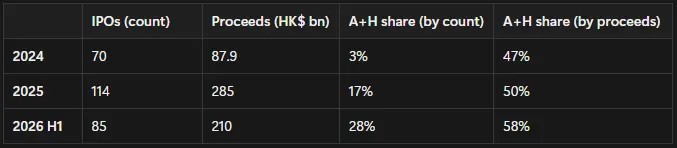
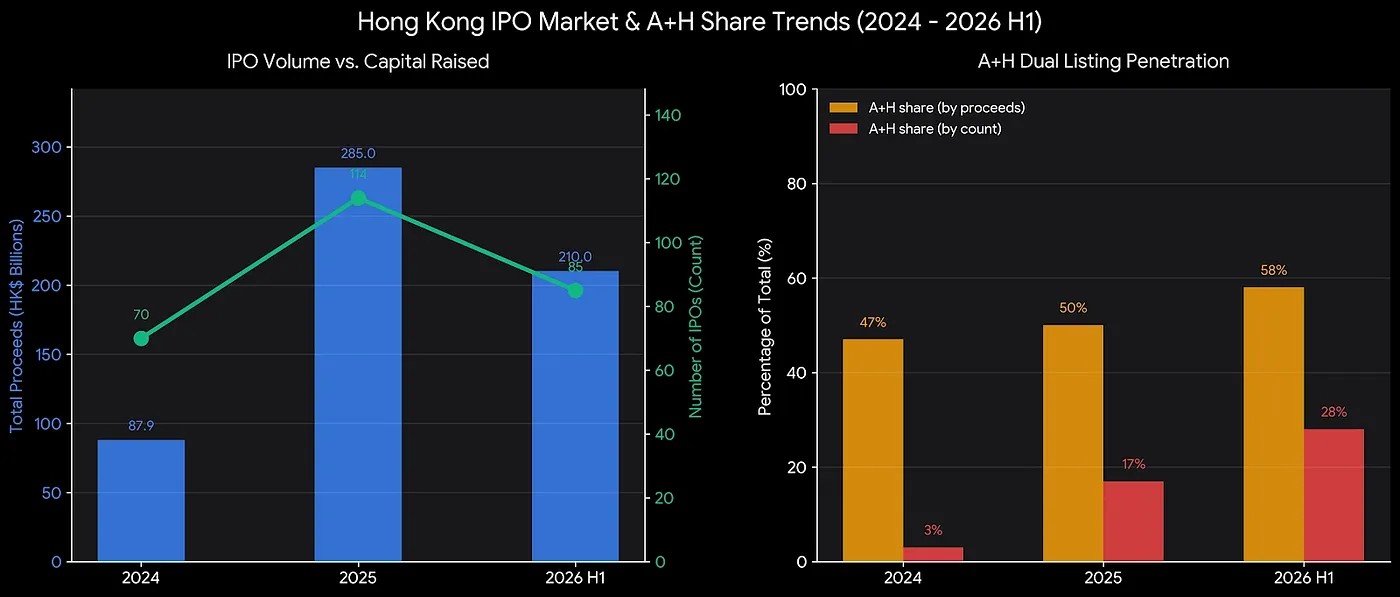
The article ties that tougher financial rectification to support for Hong Kong listings and China’s STAR Market. Strategically, it says, firms with core technologies and sensitive data are being encouraged to list in mainland China or Hong Kong instead of issuing ADRs in the United States. It cites roughly HK$285 billion, or about $36 billion, in Hong Kong IPO proceeds in 2025, putting the market back at the top globally for the first time since 2019, ahead of Nasdaq’s $27.5 billion. The share of companies with dual listings in A-shares and Hong Kong is also said to be climbing, reaching nearly 60% in the first half of this year.
From there, the article argues that Hong Kong is being shaped into a center through which Chinese firms can absorb global liquidity while keeping control of governance inside China. In that frame, the cleanup of U.S. stock brokerage access is not merely about blocking domestic money from continuing to support valuation premiums in U.S. capital markets. The author says that, given China’s lost first-mover position in AI, the strategic meaning of this step may exceed that of earlier capital-control measures.
Why Chinese retail investors are anxious
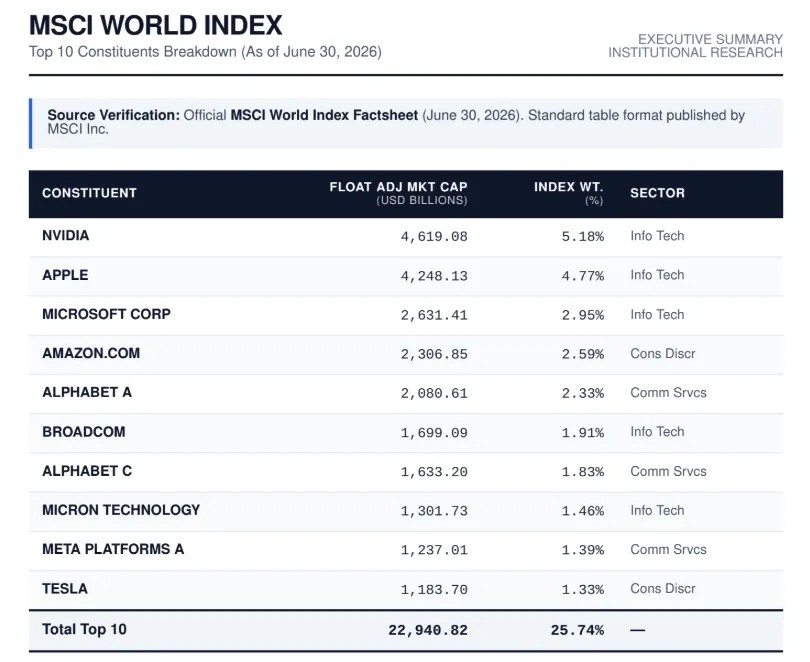
The article then turns to benchmark composition. Based on the MSCI World Index factsheet for the end of June 2026, it says the top 10 constituents account for 25.74% of the index, and that those names are almost all U.S. technology and AI-related companies. These firms control AI compute, cloud platforms, chips, ad networks, operating systems, consumer gateways, electric vehicles, and satellite internet, the piece says. In other words, the ownership of future cash flows tied to productive digital assets is increasingly concentrated.
That concentration creates what the author calls a siphon effect for passive money. Because passive index funds allocate strictly by market capitalization, every new wave of global liquidity, whether from pension contributions or sovereign wealth allocations, mechanically sends almost $26 of every $100 into those 10 U.S. tech companies. The article says that pushes valuations even higher and gives them unusually cheap financing that can be deployed for acquisitions, R&D, and deeper control over future digital and physical assets.
Against that backdrop, the author writes, ordinary people in China have no easy way to capture what looks like the most obvious beta of the era, even as a quarter of global growth is being absorbed by those companies.
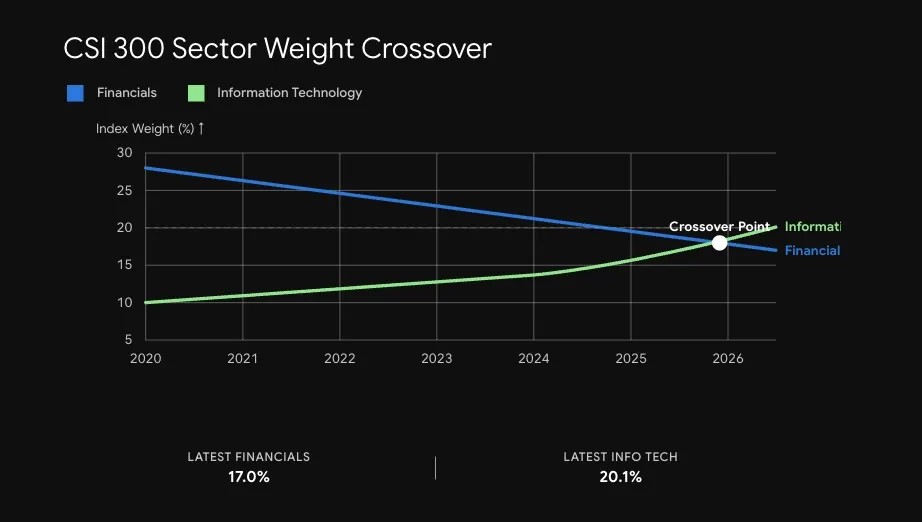
The structure of China’s domestic market looks very different. In the history of the CSI 300, the financials sector long dominated with weights often ranging from 20% to 30%, according to the article. Only from late 2025 to early 2026 did information technology first overtake financials to become the largest sector in the index.
The piece attributes that shift to three forces. First, the credit cycle has turned: tighter controls on local government debt and property leverage have slowed balance-sheet expansion across traditional financial institutions and pushed valuations lower. Second, China’s central bank has used structural liquidity tools more directly, with programs such as relending for technology innovation channeling funds into hard tech, domestic semiconductor substitution, and advanced manufacturing. Third, the market is repricing what the article calls “new productive forces,” placing a premium on self-reliance in computing infrastructure, semiconductor equipment, and advanced materials.
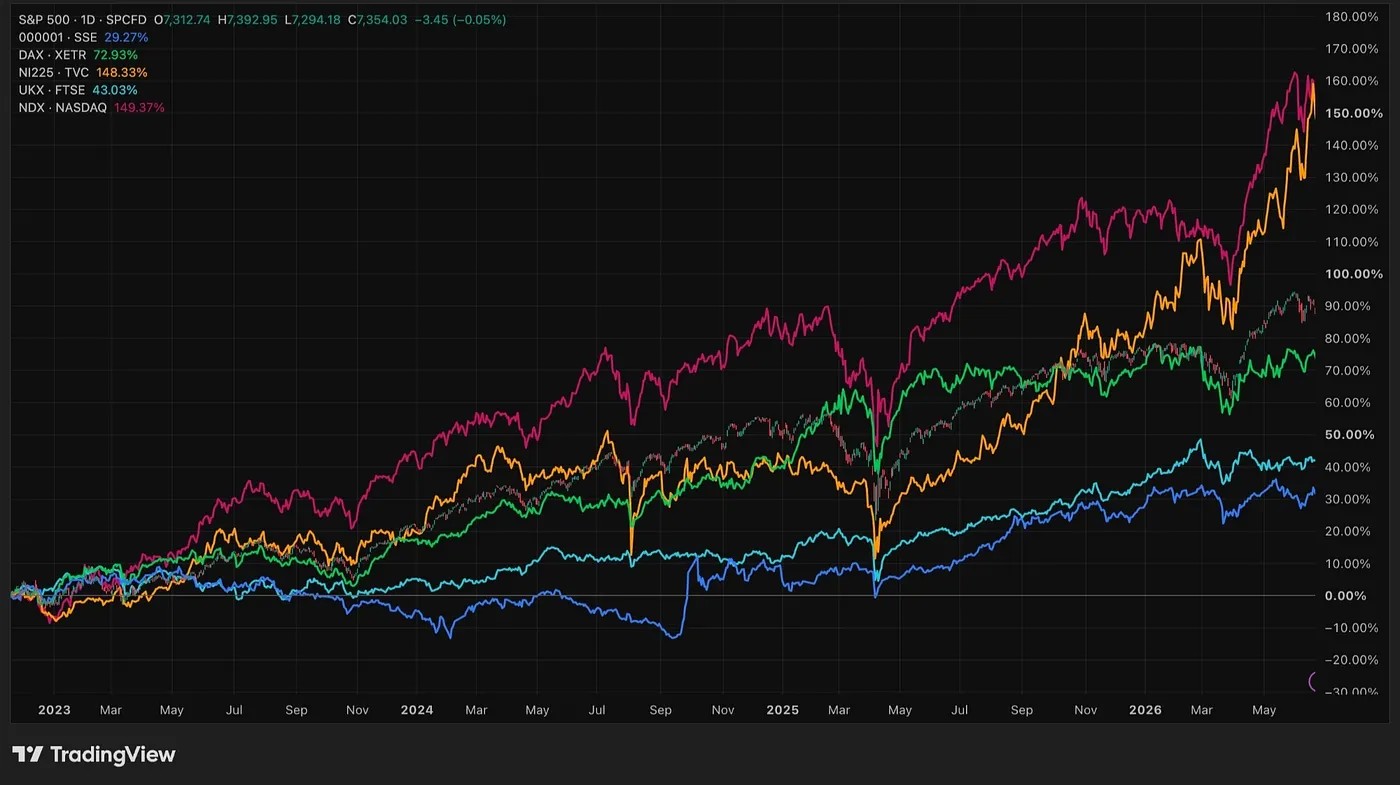
Even so, the author says this adjustment has lagged the global AI rally. Since ChatGPT’s debut in 2022, China, despite being the world’s second-largest economy, has posted the weakest stock-market gains among the five largest economies. Chinese retail investors, the piece says, are left staring at limited quota and account access while feeling shut out of a new wealth system.
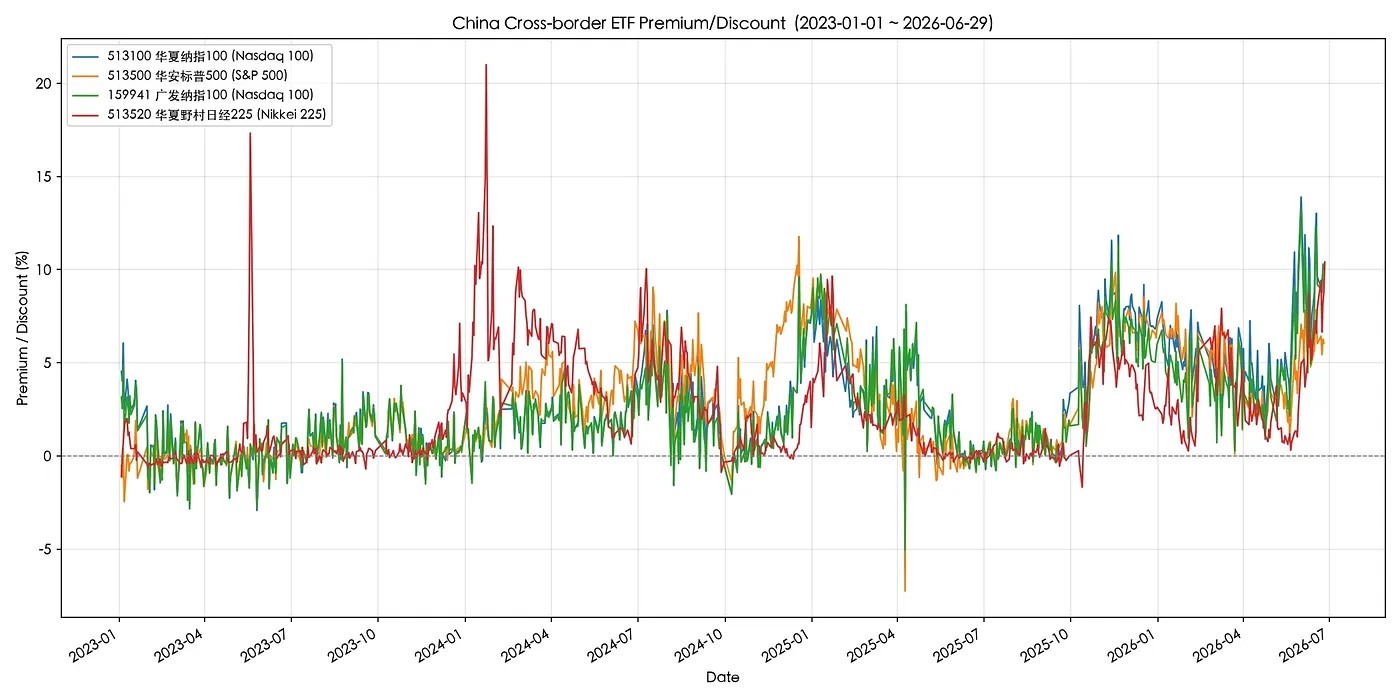
Demand for cross-border investing inside China should not be reduced to a simple preference for foreign assets, the article adds. With local technology companies underperforming and real estate shrinking fast, the sense of relative deprivation has pushed retail anxiety to a peak. ETFs tracking overseas markets have even traded at premiums of as much as 10% in the A-share market this year.
That sets up a split between state objectives and individual investor needs. From the state’s point of view, capital controls can stop domestic liquidity from strengthening foreign companies, redirect that capital toward local firms, reduce the chance of overseas dominance over AI supply chains, and preserve pricing power over assets. For individuals, the country of origin matters less than whether they can access quality productive assets at all. Where those interests diverge, the article argues, crypto finds a new opening.
“Brokering the unbrokered” and tokenized stocks
The author describes that opening with a phrase: “Brokering the unbrokered.” For the last 15 years, the core crypto narrative has been “banked the unbanked,” giving people without bank accounts access to payments, savings, borrowing, and stronger monetary systems. That narrative still matters, the article says, but the next frontier is bringing those same people into the distribution layer for global core assets.
To support that argument, the piece points to several market data points. Over the past year, the market capitalization of tokenized stocks has grown by more than $1.3 billion. In June 2026, SpaceX helped push monthly trading volume in tokenized stocks above $3.4 billion. On trade.xyz, daily trading volume in RWA perpetual contracts exceeded $6 billion.
The article says that while this remains small relative to the traditional U.S. equity market, it is enough to show that on-chain liquidity around tokenized assets is starting to deepen. These instruments can be accessed by global users, traded around the clock, and priced even after traditional markets close. Over time, the author suggests, they may also be used as collateral, borrowed against, and combined into new structures in much the same way as native crypto assets today. If that happens, tokenized securities could become an alternative asset-distribution layer and a new broker system for people excluded from traditional finance.
Today, the investors locked out may be Chinese retail traders. Tomorrow, the article says, it could be Latin American users without U.S. brokerage accounts, Asian investors without accredited status, Middle Eastern users constrained by local capital controls, or simply young people who do not want local financial systems deciding the boundary of what they can own. The next big crypto opportunity may not be a faster wallet or a cheaper exchange. It may be a new asset gateway that repackages, prices, and distributes productive assets globally.
AI-era capital flows and the right to issue assets
The article extends the same idea to companies. In the AI era, “brokered the unbroked,” as written in the original text, works in both directions. It applies not only to individuals but also to corporations. Whoever can lock in future capital, scarce physical resources, and market attention on a global scale before rivals do is more likely to build a moat first. U.S. companies, the author writes, have long enjoyed first-class status as issuers of assets and have financed themselves globally on privileged terms.
Large U.S. technology companies, according to the article, have balance sheets and credit profiles superior to those of many sovereign states. They are using that advantage as “macro hedge funds.” When the Bank of Japan or other central banks maintain relatively loose rate environments while dollar funding remains expensive, these firms can conduct corporate-level carry trades and lock in borrowing costs at 1% or even lower. The lenders are often local pension funds, insurers, and other institutional investors. In that sense, the savings of other countries’ citizens are directly supplying cheap ammunition for the expansion of U.S. tech giants.
Since last year, the article says, major U.S. cloud companies have issued large amounts of foreign-currency debt. In 2026 alone, Alphabet issued JPY 576.5 billion in Japan and CHF 3.055 billion in Europe, equivalent to $3.6 billion and $3.9 billion. Amazon also completed a CHF 2.82 billion bond deal, equal to about $3.6 billion. Over just two years, the article says, the share of foreign debt in these companies’ capital structures climbed from zero to 30%.
Still, the author argues, the privilege U.S. companies enjoy in asset issuance may not last unchanged if the AI supply chain keeps generating important non-dollar assets. The article points to the growing weight of semiconductors in South Korea and Taiwan, and to Chinese memory-chip firm CXMT, which it says recently listed and drew subscriptions 500 times above the amount on offer. These are all part of the AI supply chain, yet many high-quality companies remain outside dollar capital markets. The article says this is why CXMT moved onto Hyperliquid early: to connect with global liquidity.
The same section says the gap between China and the United States in AI may be smaller than many assume. From DeepSeek, launched in February last year, to what the author describes as the recently impressive Kimi K3, China is moving quickly in pursuit of the U.S., the article says. It also points to China’s lead in the industrialization of humanoid robots. For now, global attention remains focused on U.S. big tech and future listings tied to OpenAI and Anthropic. But if DeepSeek and Moonshot one day list in China’s A-share market, the article says, the investors left regretting their exclusion may be Americans instead.
The article’s closing argument
The conclusion returns to ownership. Demand for assets is becoming more global, the article says, while ownership and issuance are still constrained by borders. That is why, in the author’s view, “brokered the unbrokered” will matter more over the next 15 years than “banked the unbanked.” The latter solves how individuals enter a more stable monetary system. The former determines who gets access to future low-cost financing and who gets to own advanced productive capacity.
The article closes with a broader reflection on labor and wealth. In 1914, Ford introduced the eight-hour day and five-day workweek, and much of modern society over the following century was organized around the ethics and institutional structure of work. A hundred years later, the author writes, the AI-driven fourth industrial revolution is compressing the marginal value of cognitive labor. For most knowledge workers, wage growth will increasingly struggle to keep up with asset prices and monetary expansion, especially when those assets carry technology rents, monetary rents, and monopoly rents.
The piece ends with a line that captures its central thesis: access to asset allocation is no longer just a wealth-management issue. It is becoming a new mechanism of social stratification. It follows with one final sentence in English: “finance is in the business of hope.” The article is attributed to Primitive Ventures, with the handle @primitivecrypto.