
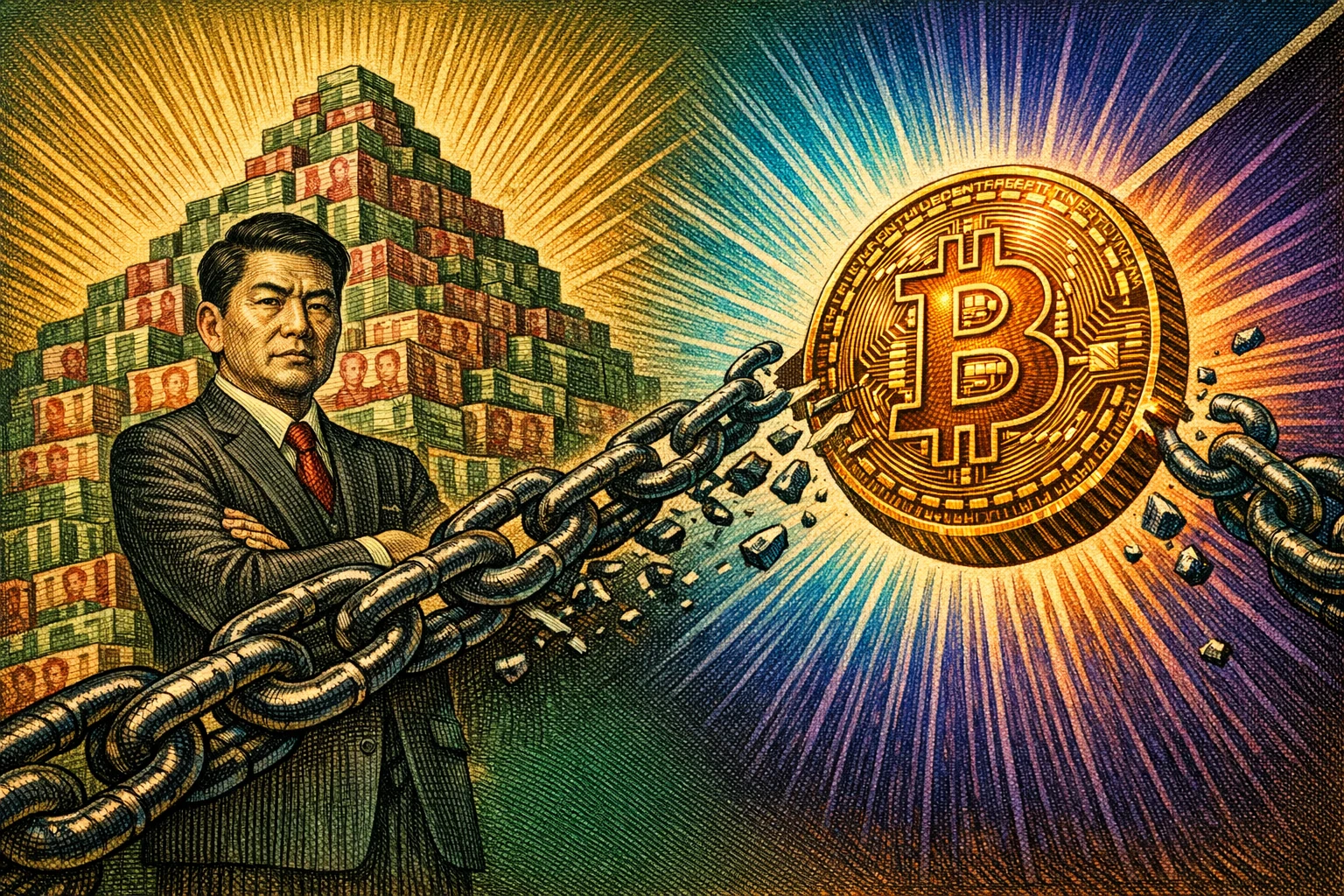
China’s broad money supply, or M2, stood at RMB 340.29 trillion at the end of 2025, according to data from the People’s Bank of China. That was up from RMB 198.65 trillion at the end of 2019, a rise of RMB 141.64 trillion over six years. The average annual increase exceeded RMB 23.6 trillion, with more than RMB 28 trillion added in 2022 alone. In an article examining where that money came from, former Bank of China vice president Wang Yongli also took direct aim at Bitcoin and other crypto assets as candidates for a monetary anchor.
Central bank balance sheet growth accounted for only a small share
Wang wrote that the central bank’s balance sheet expanded from RMB 37.11 trillion to RMB 48.16 trillion over the same period, an increase of RMB 11.05 trillion. That represented only 7.8% of the total M2 increase. His point was simple: the jump in money supply did not mainly come from direct central bank expansion, but from credit creation and balance sheet growth across the broader financial system.
That distinction sits at the center of his analysis. In a modern credit-money system, bank lending remains the main channel through which money is created.
Loans led the expansion, followed by government claims and asset purchases
The largest driver was loan growth. Outstanding RMB loans reached RMB 271.91 trillion by the end of 2025, up from RMB 153.11 trillion at the end of 2019. That is an increase of RMB 118.80 trillion. Wang said commercial banks create deposits through lending, making credit issuance the core mechanism of money creation in the current system.
Government-related claims were another major contributor. Holdings of government claims by deposit-taking institutions and the central bank rose from RMB 30.53 trillion to RMB 74.35 trillion, an increase of RMB 43.82 trillion. At the same time, government deposits at the central bank increased by RMB 1.76 trillion, which partly offset that expansion.
He also pointed to financial asset purchases and foreign-exchange flows. Deposits used by households and institutions to buy stocks, insurance products, and wealth-management products were estimated to account for roughly RMB 26 trillion. From 2020 to 2025, banks’ cumulative net RMB injections through foreign-exchange settlement reached RMB 3.57 trillion, while the central bank’s FX-related positions stayed broadly stable, limiting the impact on base money creation.
Wang rejects Bitcoin as a new anchor for money
In discussing the nature of modern money, Wang explicitly mentioned Bitcoin. He argued that money has already moved away from any metallic standard and is no longer tied to any single tradable asset. In his view, the relevant relationship is the overall linkage between the total money supply and the total value of tradable wealth.
He wrote that returning to a metallic standard, or trying to anchor money again to assets such as Bitcoin and other crypto assets, rare earths, or energy, reflects a misunderstanding of the nature of money and its development path. He called that move regressive rather than progressive and said it is “bound to fail.” He also argued that under a governance structure built on sovereign independence, a supranational world currency is detached from reality and difficult to achieve.
The same M2 figures are also being read through a debasement lens
The data has drawn a different interpretation inside crypto markets. Based on the figures cited in the article, China’s M2 expanded by 71.3% over six years, implying an average annual growth rate of about 9.4%. Those numbers feed into the market narrative around currency debasement, where Bitcoin and gold are often treated as hedges against the erosion of fiat purchasing power.
Wang’s argument defends the logic of the credit-money system and dismisses Bitcoin’s monetary-anchor thesis. In crypto markets, the opposite case remains active: fixed-supply assets outside sovereign credit are still seen by many participants as a store-of-value alternative. The dispute over what qualifies as money, and what can anchor it, remains unresolved.