
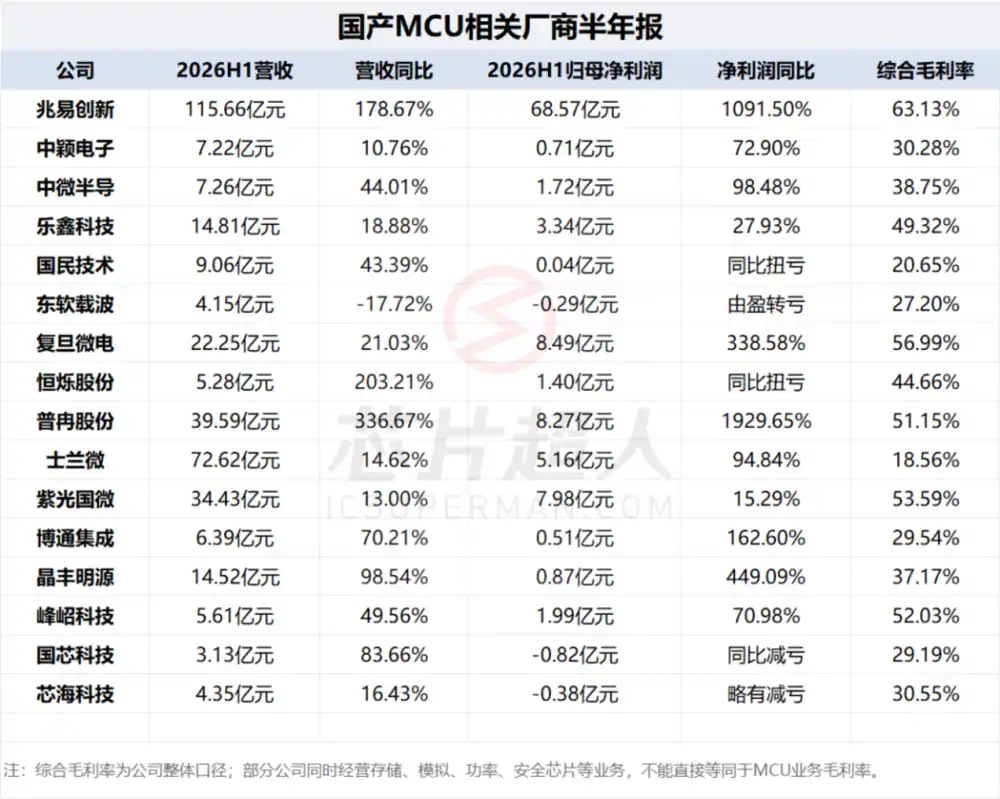
China’s domestic MCU sector showed a clear improvement in the first half of 2026, though the recovery was not evenly shared across the industry. Citing an incomplete tally by Xinshixiang, the report said 15 out of 16 companies with relevant MCU exposure posted year-over-year revenue growth, and nine recorded increases of more than 40%.
The numbers point to a broad rebound, but not a clean return to full health. Some companies are still losing money, margins remain under pressure at part of the group, and the spot market has yet to turn into a uniformly profitable environment.
Revenue growth was widespread, though memory remained a major driver for some companies
Among the 16 companies covered, GigaDevice was still the largest MCU maker by scale. In the first half of 2026, it reported revenue of 11.566 billion yuan, up 178.67% from a year earlier, and net profit attributable to shareholders of 6.857 billion yuan, up 1091.5%. Both figures were the highest in the group.
The report said GigaDevice’s overall surge was driven in large part by an upswing in its memory business. Looking only at MCU operations, the company generated 1.43 billion yuan in MCU revenue in the first half, up 49.07% year over year, still a strong increase.
In its interim report, GigaDevice said several years of destocking and a mild recovery in demand led to moderate price gains for MCU products in the first half of 2026. MCU shipment volume rose at a relatively fast pace from a year earlier, industrial applications became the largest source of MCU revenue, and revenue and shipments into automotive markets also grew well. By the second quarter, the company said, rising wafer and packaging-and-testing costs upstream had started to push MCU prices modestly higher.
The fastest revenue growth among the companies in the tally came from Puya Semiconductor, which reported first-half revenue of 3.959 billion yuan, up 336.67%. Hengshuo followed with 528 million yuan, up 203.21%, and GigaDevice ranked third with 178.67% growth.
Those three companies share a similar profile: each has an MCU business, but memory still makes up a large part of its operations. Puya’s main business includes EEPROM and NOR Flash, while it has also been extending into MCU and other “memory-plus” products. Hengshuo focuses on NOR Flash and MCU. GigaDevice is one of China’s key suppliers in NOR Flash, DRAM and MCU.
As framed in the report, the first driver behind those gains remained the memory cycle rather than a sudden acceleration in MCU demand itself. Still, the article noted that MCU volumes were also rising at Puya and Hengshuo. Puya said its “memory-plus” strategy helped new products including MCU scale up quickly in industrial control and AIoT markets, with market share improving steadily. Hengshuo said MCU-related shipments kept growing quickly as it expanded in motor control, AI voice modules and ultra-low-power internet-of-things niches.
Outside the memory-heavy names, MCU makers also posted solid first-half results
Several companies with less memory exposure also reported notable gains.
China Resources Micro? No such company was named here; the report specifically highlighted Zhongwei Bando. Zhongwei Bando posted first-half revenue of 726 million yuan, up 44.01%, and net profit attributable to shareholders of 172 million yuan, up 98.48%.
In a July earnings preview, the company said traditional MCU demand in consumer electronics, smart home appliances, industrial control and automotive electronics was recovering steadily. At the same time, demand from AI and computing workloads continued to crowd out wafer and testing capacity, tightening MCU supply. The company said growth in MCU market demand was running ahead of the growth in its own MCU production capacity. In that setting, MCU shipment volume increased and product prices also rose.
Fortior Tech was described as one of the companies with a more solid growth profile in this cycle. In the first half, it posted revenue of 561 million yuan, up 49.56%, and net profit attributable to shareholders of 199 million yuan, up 70.98%. Its gross margin reached 52.03%.
The report pointed to one number in particular: motor-control MCU revenue reached 391 million yuan in the first half, or about 70% of total company revenue. Those MCU products are concentrated in BLDC motor control. Their application base has moved beyond small household appliances, white goods and power tools into automotive, industrial, server cooling and robotics. In the article’s reading, Fortior’s growth this year is tied to new demand from automotive, industrial and robotics markets for motor-control MCU products.
Other fast-growing companies were also linked to stronger structural demand in specific niches.
- Nationz-like automotive expansion was represented here by Guoxin Technology. The company’s automotive-grade MCU business entered a volume ramp. First-half revenue reached 313 million yuan, up 83.66%. Of that, automotive electronics chip revenue was 102 million yuan, up 108.47%, with shipments above 8 million units. Shipments of automotive-grade security MCU products exceeded 1.9 million units, up about 80%.
- Beken benefited from edge AI demand in wireless MCU products. It reported first-half revenue of 639 million yuan, up 70.21%, while net profit rose 162.60% from a year earlier. Its Wi‑Fi 6 MCU and Edge AI chips had entered large-scale volume shipments, with applications extending from smart homes into AI toys, smart glasses and industrial intelligence.
- BPS reported first-half revenue of 1.452 billion yuan, up 98.54%, and net profit attributable to shareholders of 87 million yuan, up 449.09%. Revenue from motor-control driver chips came to about 302 million yuan, up 57.28%, while shipment volume rose 48.79%. The article said the company’s motor-control chips are mainly MCU products.
Growth did not erase pressure on profits, margins and cash flow
Despite the broad revenue recovery, the report stressed that not every company had moved beyond a difficult patch.
Eastsoft Carrier was the clearest example of pressure and the only company in the 16-name group to report a year-over-year revenue decline. First-half revenue was 415 million yuan, down 17.72%, and the company swung from profit to a net loss of 29 million yuan attributable to shareholders, mainly because of weakness in its carrier communication business. Even so, the company said AI-computing demand was crowding out wafer and test capacity, tightening supply for traditional MCU products, while demand from domestic substitution in industrial control was being released.
Chipsea Technologies reported first-half revenue of 435 million yuan, up 16.43%, but still posted a net loss attributable to shareholders of 38 million yuan. The report listed three reasons: rising manufacturing costs in the upstream supply chain, delayed price adjustments because of competition downstream, and new products still being in the ramp-up phase without enough scale effect.
Nations Technologies posted first-half revenue of 906 million yuan, up 43.39%, and net profit of about 4 million yuan, returning to profit. The company’s business mix also includes security chips and anode materials, not only MCU products. Its view, according to the report, is that MCU supply is now tightening and lead times for high-performance products used in automotive, industrial and edge AI scenarios are getting longer, pointing to an improving industry environment.
The article argued that pressure at individual companies should not be read as a sign of weakening demand across the whole MCU sector. Instead, the pace of recovery is varying by product line, customer group and end market.
That divergence showed up even more clearly in gross margin data. Although MCU prices have started to recover, not every company had escaped margin pressure by the end of the first half. GigaDevice and Puya benefited from stronger pricing and volume in memory, lifting gross margin to 63.13% and 51.15%, respectively. Zhongwei Bando and Espressif saw gross margin improve to 38.75% and 49.32%, up 5.49 percentage points and 4.12 percentage points from a year earlier. By contrast, companies such as Sinowealth and Chipsea were still dealing with higher wafer, packaging and testing costs, and their gross margins continued to decline year over year.
Cash flow and inventory data told a similar story. GigaDevice remained well ahead in operating cash flow, with net cash generated from operating activities reaching 6.048 billion yuan in the first half. Puya, Unigroup Guoxin and Fudan Microelectronics reported 945 million yuan, 827 million yuan and 770 million yuan, respectively. Most companies still posted positive operating cash flow, but Nations Technologies, Beken and Chipsea remained negative.
Nations Technologies said procurement spending increased significantly because it stepped up wafer stocking to meet market demand and its operating plans. Beken said inventories rose 46.94% from the beginning of the year after it increased stock in line with sales conditions. Fortior also said that with wafer and packaging capacity tight, it used moderate prepayments to lock in supplier capacity.
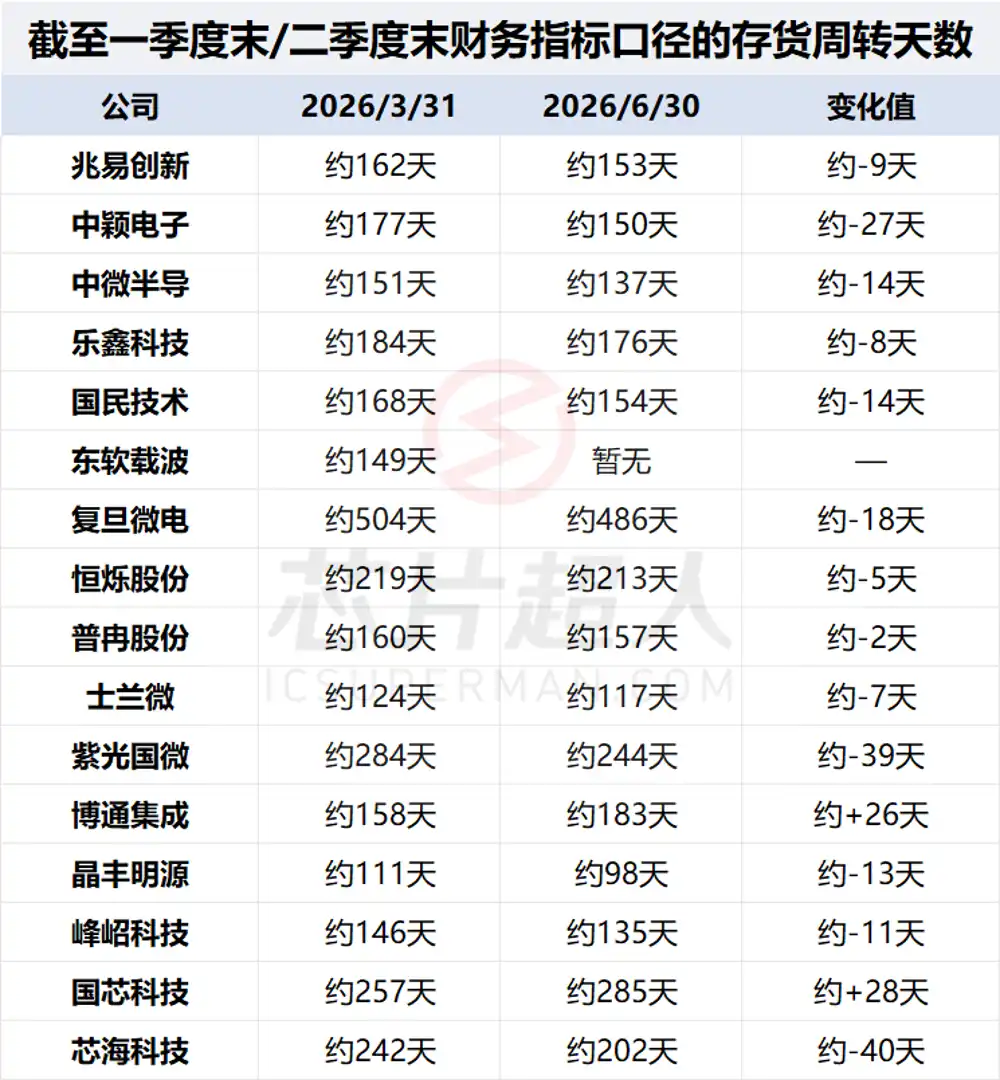
On inventory turnover days, most of the 16 companies improved, with only Beken and Guoxin Technology showing an increase. The report said that should not be read as evidence of unsold inventory. Beken’s interim report said the company increased stock based on market sales conditions. Since Wi‑Fi 6 MCU and Edge AI chips have entered volume shipments, the article said the rise looked more like active inventory building. Guoxin Technology gave a similar explanation, saying ending inventory increased because orders in hand were growing and safety stock needs had risen, while overall inventory remained at a reasonable and controllable level.
Based on those purchasing and stocking moves, the report said some companies have shifted from earlier destocking to active inventory building aimed at supporting demand growth and securing supply.
This recovery is being driven by industrial, automotive, motor control and edge AI demand
The article’s main conclusion was that China’s MCU market is recovering, but the growth engine has changed. Traditional consumer electronics are no longer the main source of momentum. Industrial control, automotive, motor-control applications and edge AI are taking a larger role.
GigaDevice’s MCU revenue rose 49.07% year over year in the first half, and industrial applications became its largest source of MCU revenue. Fudan Microelectronics reported that sales of white-goods main-control chips and automotive-grade MCU products rose by more than 100% from a year earlier. Guoxin Technology’s shipments of automotive-grade security MCU products increased 80%. BPS and Fortior continued to add exposure to automotive electronics.
Motor control and edge AI were highlighted as new structural growth sources. Fortior and BPS stood out in motor-control MCU products. Sinowealth started building out robot-joint and servo MCU products. Beken’s Wi‑Fi 6 MCU and Edge AI chips have entered large-scale shipments, while Espressif and Chipsea are also expanding into AIoT, edge AI and computing-peripheral scenarios.
In the report’s framing, the growth model for domestic MCU suppliers is shifting from a single consumer-led recovery to a wider pull from multiple application markets.
The spot market remains mixed, and price hikes have not translated into uniformly strong profits
During the first half of the year, stronger demand, tighter supply and rising upstream costs led MCU vendors from overseas, mainland China and Taiwan to issue a growing number of price-increase notices. Even so, participants cited in the report said the business has not become uniformly easier for domestic MCU suppliers.
One distributor serving end customers said the company mainly handles a domestic motor-drive MCU product. Customers have indeed pushed harder on domestic substitution this year to reduce costs, the person said, but price competition in the white-goods market remains intense. 「Resistors and capacitors, boards and active components are all getting more expensive, but customers won’t accept higher prices. MCU pricing is very unfriendly to suppliers, and margins are very low.」
Another industry participant said the MCU market now offers almost no profit room, with market prices broadly in line with platforms such as Yunhan and Lichuang, so the firm is taking fewer of those orders.
Another distributor said pricing in the MCU market is still disorderly. Upstream costs are rising across the board, but customers downstream differ in what they can accept. Some will take new prices, while others still compare against last year’s levels, which means price transmission is not smooth.
For consumer MCU products, one distributor said occasional shortages at some domestic suppliers do not necessarily mean end demand has expanded sharply. In many cases, customers are simply looking for parts because their previous supply source can no longer fully meet existing demand. That is different from a sudden demand surge, and domestic MCU prices are still being competed down. On industrial MCU products, the same person said, 「business is okay, and prices have also moved up.」
Market action in ST products showed the same back-and-forth pattern. In March, some STM32 models jumped quickly as lead times extended, then fell back just as fast. From late June into early July, another round of price increase notices, longer lead times and tighter channel controls pushed market attention up again. After late July, some models started to cool.
The article’s closing assessment was that the latest price increases in domestic MCU products reflect costs and supply more than a broad transition into a high-profit spot market. China’s MCU market is no longer in the simple destocking phase seen over the previous two years, but it is still far from a stage of across-the-board shortages and across-the-board price increases.
This article was originally published by the WeChat account Xinshixiang and written by Silvia.