
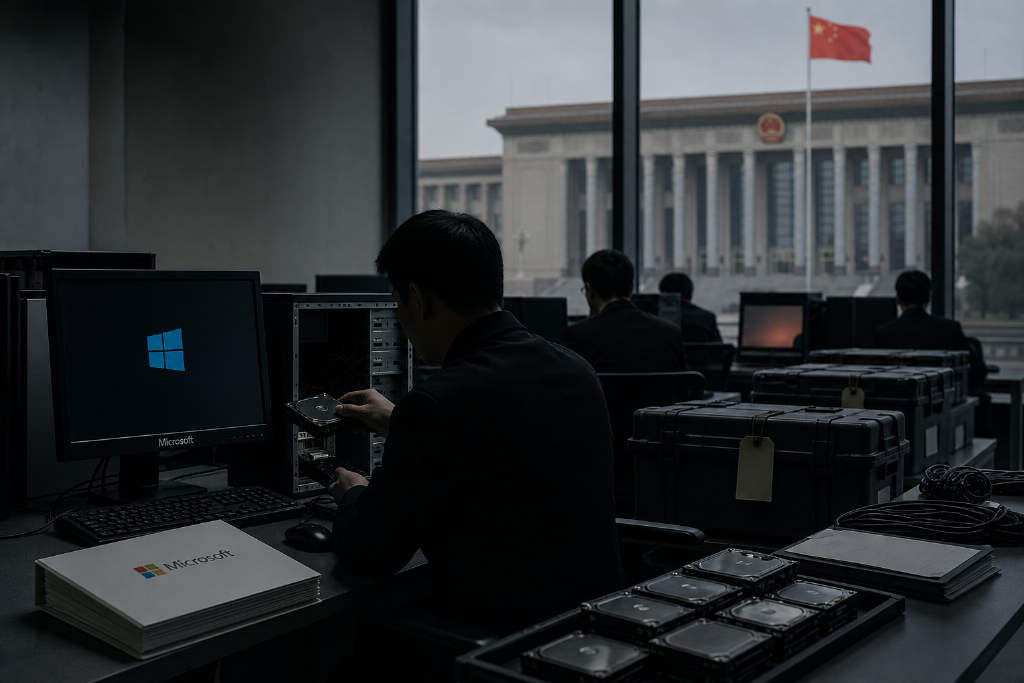
China’s Ministry of State Security has ordered some government-linked institutions to remove Microsoft’s customized government version of Windows 10 ahead of schedule, Bloomberg reported, moving up a transition that had originally been set for February 2027.
The report said the affected product is formally known as Windows 10 CMIT Government Edition. After the news surfaced, shares tied to domestic operating systems rallied sharply: Kylinsec and Archermind Technology both closed at their 20% daily limit, and China National Software rose 10%.
The Windows edition named in the report
According to Bloomberg, citing unnamed people familiar with the matter, the software was developed by China Standard Software Technology Co., Ltd. under the CMIT framework, a joint venture established in 2016 by Microsoft and China Electronics Technology Group (CETC). Its purpose was to remake Windows 10 into a version that met Beijing’s cybersecurity requirements for government use.
Bloomberg said some native functions were disabled in that edition, while China-developed security modules were added so government offices could keep using a Microsoft operating system while still meeting internal review and data-control requirements.
Timeline brought forward
The system had originally been due to leave service in February 2027, in line with Beijing’s longer-running push for information technology application innovation, or Xinchuang, and the gradual replacement of foreign technology. People familiar with the matter told Bloomberg that the accelerated schedule caught many civil servants off guard. The report said Beijing’s concern centered on data security risks, though officials did not specify the potential vulnerabilities involved.
Bloomberg framed the move as another tightening step in China’s tolerance for core U.S. technology in official settings, this time involving desktop systems used every day inside government agencies.
Stock market response
Investors moved quickly after the policy signal emerged. Kylinsec and Archermind Technology each hit the 20% daily limit, while China National Software gained 10%. The report said the move reflected bets that domestic substitution policies could keep expanding and may spread more quickly into procurement across other public-sector systems.
Part of a wider substitution drive
Bloomberg linked the development to Beijing’s broader effort in recent years to phase out foreign technology. The report said central government agencies had already been asked to replace foreign-branded computers step by step with domestic devices, and that Apple iPhones had been barred from some sensitive official units.
It also said Chinese operating system vendors including Kylin Software and UnionTech are moving to fill the gap left by Windows. In semiconductors, with restrictions on Nvidia’s high-end AI chips, companies such as Huawei and Cambricon are taking on a larger role in China’s AI computing stack.
Taken together, the report described a pattern in which U.S. software and hardware are being added one by one to replacement lists across government and defense-related systems that handle sensitive data, with the pace now increasing.