
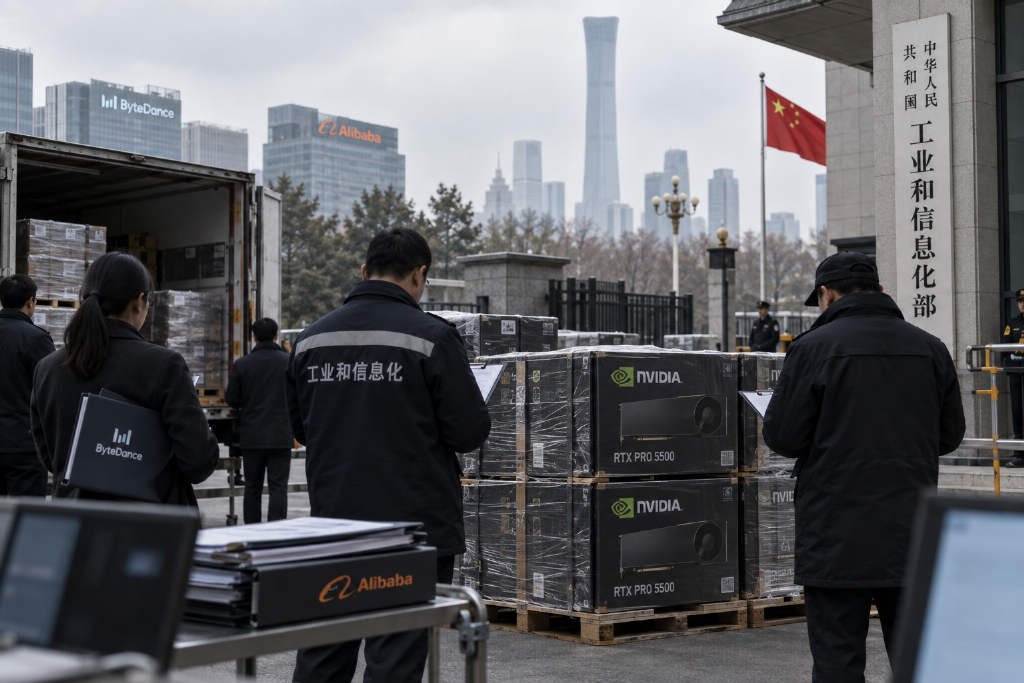
China’s Ministry of Industry and Information Technology has reportedly asked companies to file procurement plans for Nvidia’s RTX Pro 5500 and told some firms it intends to allow purchases of the card, according to The Information. The report also said ByteDance is considering an order of about 1 million units.
At 85,000 to 90,000 yuan per card, that potential order would be worth about 85 billion to 90 billion yuan, or roughly $12.6 billion to $13.4 billion.
So far, however, there has been no public confirmation from the ministry, Nvidia, ByteDance, or Alibaba. The timing, approval terms, and any ceiling on volumes are still unclear. The US side has also not said whether the card would be cleared for export to China.
Procurement filings return to the process
The Information said the ministry recently asked some companies to report intended purchase volumes and use cases, then told several of them that it planned to approve those purchases.
The procedure is not new. In July, China informed Alibaba, ByteDance, and DeepSeek that they could buy limited quantities of H200 chips, again subject to prior filing requirements.
That H200 path was uneven. Reuters reported in May that the US had approved purchases by about 10 Chinese companies, with a 25% tariff and an annual cap of 75,000 units per company. Trump later said China had “chosen not to buy.” In the same month, Jensen Huang said Nvidia’s share of China’s AI accelerator market had fallen from about 95% to zero.
How the RTX Pro 5500 is being viewed
The Information said some industry executives expect the RTX Pro 5500 to avoid US export restrictions because, while it is a new product, it is not a top-tier AI chip.
The report also said Nvidia told customers they must place orders by Sept. 30 to secure supply. The company is said to be planning shipments to China of about 500,000 units per quarter starting in late December. On that basis, ByteDance’s potential order alone would be close to two quarters of planned supply.
What the card is designed to do
Nvidia’s product page dated Sept. 9 describes the RTX Pro 5500 as a Blackwell-generation professional workstation GPU with 84GB of GDDR7 memory and power consumption of up to 600 watts. It uses the same GB202 processor as the GeForce RTX 5090, while offering 2.6 times the memory capacity of that card’s 32GB.
GDDR7 is a standard graphics-memory format with lower cost and easier capacity scaling. HBM, or high-bandwidth memory, stacks memory dies vertically next to the processor, delivering much higher bandwidth but at a higher price and with tighter supply.
Because the RTX Pro 5500 does not use HBM, its ability to train large models is weaker than Nvidia’s B200 and GB200. Bloomberg also said the card uses an older process generation and is mainly aimed at graphics and simulation workloads.
Buyers may be focused on inference instead. Inference is the stage after training, when a model answers user requests in production. The Information said some potential buyers plan to install the cards in servers to help customers run AI models. One buyer plans to use eight cards per server so they can work together on larger models.
The use cases listed in the report include chatbot responses, AI agents, report summarization, video subtitles, translation, video editing and generation, ad production, and content moderation.
Price competition with domestic alternatives
In China, the card is priced at 85,000 to 90,000 yuan, or about $13,000, putting it close to Huawei’s Ascend 950PR launched earlier this year.
In April, Alibaba, ByteDance, and Tencent placed combined orders for hundreds of thousands of Ascend chips from Huawei. At a similar price point, customers may now have a second option.
Domestic chip shares fell first
On Monday, Sept. 28, Moore Threads fell about 6.3%, Cambricon lost about 5.7%, Semiconductor Manufacturing International Corp. dropped about 3.7%, and Hua Hong fell nearly 5%, while broader mainland China and Hong Kong equity benchmarks closed higher the same day.
Bloomberg pointed to Shanghai Biren Technology and Cambricon, saying the market is worried that an influx of foreign chips could erode demand for domestic suppliers.
Charu Chanana, chief investment strategist at Saxo, said Beijing has long pushed chip self-sufficiency, and that allowing Alibaba and ByteDance to buy another Nvidia chip would show a pragmatic stance. She said domestic chips have advanced quickly, but gaps remain in performance, supply, and the AI ecosystem, and Nvidia can fill those gaps.
Huawei constraints remain visible
The shortfall is most visible at Huawei. On Sept. 18, Huawei moved up the launch of the Ascend 960DT to the first quarter of 2027, but the scale of its supernode system was reduced to one-quarter of the original plan. Production capacity and HBM supply remain the biggest limits on domestic compute expansion.
No clear signal yet from Washington or Beijing
An Nvidia spokesperson told Reuters that US companies are still caught between what the company described as outdated US export controls and China’s own import restrictions. The spokesperson added that the US easing seen recently mostly covers older chips, and volumes are not large.
Last week, Xi Jinping and Trump met in Washington, but neither side mentioned chip export controls in their official readouts. US Trade Representative Jamieson Greer also said the issue was not discussed in the negotiations.