
China’s domestic semiconductor equipment sector is moving through a faster capitalization cycle this year.
In January, Hengyunchang listed on the STAR Market as the board’s first listing of the year. In May, wafer transfer equipment maker Guona Semiconductor filed with the Hong Kong Stock Exchange. By late June, the Shanghai Stock Exchange had accepted 18 semiconductor companies in a concentrated batch, including seven equipment and component names: Zhongdao Optoelectronics, Huazhuo Jingke, Dongfang Jingyuan, Shenzhou Co., Shanghai Yinguan, Mifei Technology, and Leuven Instruments. Lieqi Intelligence has received registration approval and is awaiting issuance. Zhongkexin and Sirui Intelligence have completed tutoring acceptance, while Shengjisheng, Tongchao Precision, Weijian Advanced, and Shengdake have each filed for IPO tutoring during the year. Taken together, the article says the number of equipment companies already on an IPO track for 2026 is close to 20.
The filing wave has come alongside a sharp rise in domestic wafer-fab capital spending. Mature-node capacity expansion has continued, advanced-process investment has stayed in place, and memory chip makers have become the largest incremental source of capex. Equipment vendors, as the direct recipients of that spending, have seen order growth and a capital-markets window open at the same time.
From major tool makers to niche champions
The contrast with the previous cycle is clear.
Companies that entered the capital market between 2019 and 2022, including Advanced Micro-Fabrication Equipment Inc. China, Kingsemi, ACM Research Shanghai, Piotech, and Hwatsing, were mainly focused on large equipment categories that account for a high share of fab capex and sit in global markets worth tens of billions of dollars, such as etch, thin-film deposition, cleaning, coat/develop, and CMP. After listing, those leaders followed a recognizable platform-expansion path: they used capital-market funding to pursue acquisitions and broaden product lines, moving from single-tool vendors toward multi-process platforms.
AMEC expanded beyond etch into thin film, metrology and inspection, and CMP. After acquiring Hangzhou Zhonggui, it became a domestic integrated equipment platform with capabilities in four core front-end process areas: etch, thin-film deposition, CMP, and metrology and inspection. Piotech extended from PECVD into ALD, SACVD, and bonding equipment. ACM Research Shanghai moved from wet cleaning into electroplating and wet equipment for advanced packaging. Hwatsing used CMP as its base to enter thinning and bonding equipment. For large equipment makers, listing served as a capital springboard for breaking through the ceiling of a single category.
The current IPO queue looks different. Most of the candidates are rooted in narrower equipment links and target smaller, high-barrier segments. Zhongdao Optoelectronics works on optical metrology and inspection. Dongfang Jingyuan focuses on e-beam metrology and computational lithography, both in lower-localization inspection segments. Hengyunchang and Shenzhou Co. make plasma RF power supplies, key components behind complete tools. Mifei Technology develops automated material handling systems, or AMHS, for wafer fabs, while Shanghai Yinguan makes ultra-precision motion platforms. The article describes these as “equipment for equipment,” a category absent from the previous list.
Other names mentioned include Leipu Technology in laser thermal processing, Leuven Instruments in MRAM magnetic tunnel junction process equipment with a technology route benchmarked against Lam Research, and Sirui Intelligence, which spans both ALD and ion implantation. Also waiting for acceptance are Zhongkexin and Sirui Intelligence, both of which have completed tutoring acceptance, as well as Shengjisheng, Tongchao Precision, Weijian Advanced, and Shengdake, which have each filed for tutoring this year across thin-film deposition and rapid thermal processing, core equipment components, die-bonding equipment for packaging, and test equipment.
That change in lineup reflects a shift in where localization efforts are now concentrated. Domestic penetration in major equipment categories such as etch, thin-film deposition, and cleaning has already moved into double digits, and leading companies in those areas have largely completed their listing plans. The remaining gaps are concentrated in lower-penetration bottlenecks: ion implantation, high-end metrology and inspection, core lithography components, AMHS, and RF power supplies. Once an equipment maker crosses the threshold from first-tool verification at a leading fab to small-batch trial use and then stable repeat orders, IPO materials tend to follow quickly. The article argues that in small markets only the No. 1 player has a valuation anchor, while the No. 2 player struggles to tell an IPO story.
Losses are common among whole-tool makers
Another clear difference from the previous cycle is profitability. A sizable share of the current applicants are still loss-making.
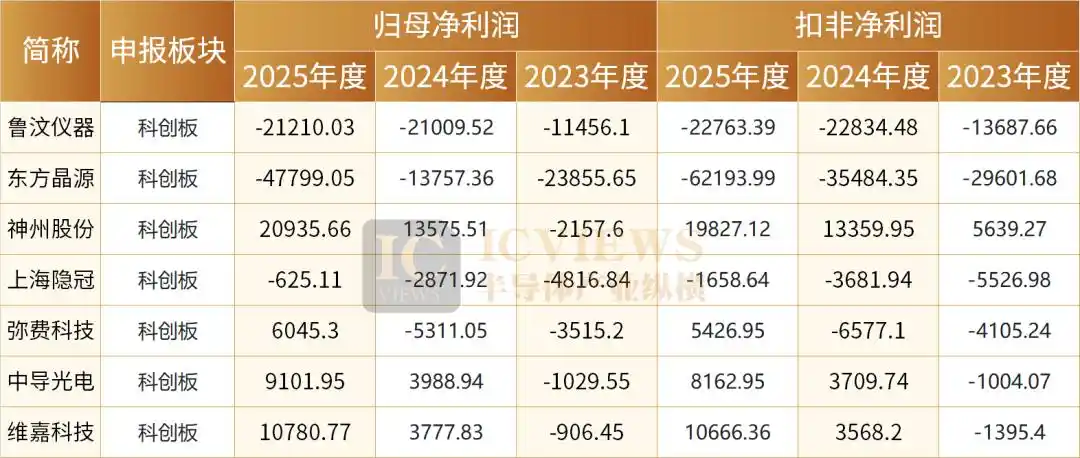
In its first-round inquiry to Huazhuo Jingke, the Shanghai Stock Exchange asked the company to explain whether “not yet profitable” is a common industry phenomenon. A comparison table cited by Huazhuo Jingke sketches the broader picture: Dongfang Jingyuan posted a 2025 loss of 478 million yuan, Leuven Instruments lost 212 million yuan, and Shanghai Yinguan lost 6.25 million yuan. Among other semiconductor special-equipment manufacturers that filed around the same time as Huazhuo Jingke and have already been accepted by the exchange, nearly half were still unprofitable during the reporting period.
Mifei Technology, Zhongdao Optoelectronics, Shenzhou Co., and Weijia Technology were profitable in 2025, but all were loss-making in 2023. The losses are concentrated in whole-tool businesses that carry heavy R&D spending and have not yet reached scale shipments. Transport-system and component suppliers already offer some profitable examples. In Zhongdao Optoelectronics’ case, most of its profit came from flat-panel display inspection, which accounted for nearly 90% of revenue in 2025, while semiconductor wafer inspection contributed just over 10%. The article describes “high-speed revenue growth and continued deep net losses” as a common condition among front-end whole-tool IPO candidates.
Losses no longer automatically block an IPO because the STAR Market allows listing standards based on expected market value and revenue. Huazhuo Jingke, for example, applies the fourth standard in its prospectus: expected market value of no less than 3 billion yuan and revenue of no less than 300 million yuan in the most recent year, with no net-profit threshold. When the company first filed in 2020, it was still profitable and used the first standard, which required earnings.
Short-term losses may be tolerated, but use of proceeds still has to stand up to review. Eight equipment and component companies that have already filed plan to raise about 16 billion yuan in total, and for most of them, working-capital replenishment accounts for only around 10% of proceeds. Dongfang Jingyuan, the deepest loss-maker in the group, plans to allocate 730 million yuan to working capital, close to 30% of its total fundraising, while its net assets at the end of 2025 had fallen to 288 million yuan. Huazhuo Jingke plans to raise 3.5 billion yuan, with 3.2 billion yuan earmarked for R&D and manufacturing of key components, high-end complete tools, and an R&D center, and only 300 million yuan for working capital. Leuven Instruments plans to direct all 2.5 billion yuan to an R&D headquarters in Lingang, Shanghai, and a manufacturing base in Pizhou, with nothing for working capital.
The article says fundraising by loss-making companies is essentially financing for the climb from first-tool verification to volume repeat orders: R&D teams must be maintained and capacity must be prepared in advance while companies wait for orders to pull revenue past break-even. Reviewers are also pressing on where the money will go. Mifei Technology plans to invest 193 million yuan in an overseas business center in Malaysia and still seeks to raise another 100 million yuan for working capital despite holding more than 600 million yuan in cash and wealth-management products on its books. That has already drawn concentrated media questioning over the necessity of the fundraising plan.
Familiar names return as the bar rises
Several companies in the queue are repeat players.
Huazhuo Jingke is making a second IPO attempt. Its first application was accepted in June 2020. In July 2021, review was suspended at the listing committee stage, where regulators focused on the industrialization prospects of a lithography dual-workpiece-stage project and on whether the company’s R&D relied too heavily on Tsinghua University. In September that year, the company substantially cut lithography-related descriptions from its prospectus and then passed the meeting. Passing did not lead to a listing, though. The project stalled for nearly three years, and the company eventually withdrew the application voluntarily in June 2024 before restarting the process this year.
Yitang Co. followed another long route: accepted in June 2021, passed the meeting in August, submitted for registration in September, then remained stuck at the registration stage for three and a half years until registration took effect in March 2025. It finally listed on the STAR Market in July, becoming one of the few equipment companies from the previous cycle to make it through. CMP equipment maker Jingyi Jingwei stopped before registration. It was accepted in June 2023 and passed the meeting in February 2024, but never submitted registration materials and withdrew the filing directly in July that year, with no new progress since.
In the AMHS segment, Mifei Technology filed for the STAR Market in late June. Its direct competitor, Fuchuangde, a unit under Han’s Laser, terminated its ChiNext listing tutoring in December 2025. Test-interface supplier Taosheng Electronics voluntarily ended its IPO before replying to the first round of inquiries. The trigger was a trade-secret infringement lawsuit filed by peer Qiangyi Co., and the defendant was the very entity implementing Taosheng’s fundraising project.
The article notes that a batch of equipment companies accepted in 2020-2022 but stuck for years at the registration stage withdrew en masse during the tighter IPO cycle in 2024. As review activity improved in 2025, some returned with updated order data and more complete industrialization results. This new filing wave is a second assembly after a regulatory interruption, but the listing threshold is now materially higher. Tolerance for unprofitable companies rests on three hard conditions: executable orders, verifiable production-line progress, and clear, independent technology sources.
State-backed and downstream industrial capital move in
Beyond continued investment by the Big Fund in equipment and component targets, the article identifies two new sources of capital entering shareholder lists in a systematic way.
The first is central state-owned capital. Zhongkexin is controlled by a company within the China Electronics Technology Group system. It was formed in 2019 by integrating the ion implantation business of CETC’s 48th Research Institute and received the title of one of the “Top 10 Major Instruments of Central SOEs in 2023.” In Ningbo-based Shengjisheng, the shareholder roster includes SMIC, SMIC Juyuan, and Xinxin Financial Leasing, which has a Big Fund background. Shengjisheng focuses on thin-film deposition and rapid thermal processing equipment and started IPO tutoring in July.
The second is downstream industrial capital. In October 2025, Huazhuo Jingke completed a 260 million yuan financing round. Yangtze Memory Industry Fund subscribed 100 million yuan and Huahong Hongxin Phase II subscribed 50 million yuan, implying a post-money valuation of about 3.2 billion yuan. Shareholders in plasma power supplier Shenzhou Co. include Intel, Yangtze Memory Industry Fund, AMEC, and Piotech. AMEC is both its largest customer and a shareholder.
According to the article, memory makers, foundry leaders, and equipment leaders are investing real money into upstream equipment suppliers to secure supply chains, not just to seek financial returns. The investment logic has moved beyond pure financial payoff.
Capitalization enters a tiered phase
The article concludes that capitalization in China’s domestic equipment industry has entered a tiered phase. Leading companies are responsible for platform expansion and global competition, while specialized suppliers are filling one low-localization gap after another. Listing is no longer simply the endpoint for leading firms. It has become a financing channel for strengthening and extending the entire industrial chain.
In that framing, the real point of interest in the current filing wave is not the list itself but the verification progress behind it. Which company has moved its equipment from first-tool deployment to batch production on a live line will determine who remains on the next list.
This article is sourced from the WeChat public account “半导体产业纵横” (ID: ICViews) and written by Peng Cheng.




