
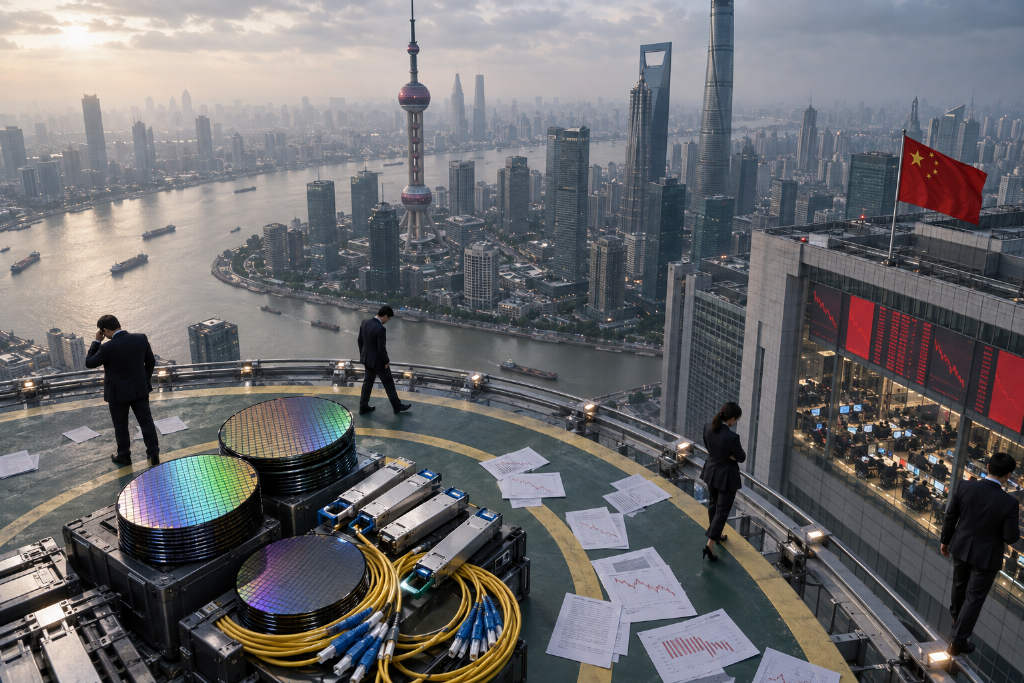
China’s first trading session after the holiday break opened on a weak note, wiping out the warmer mood that had built around the so-called eight-point consensus in China-U.S. talks. The Shenzhen Component Index and the ChiNext Index fell to their lowest levels since July. The communications sector dropped more than 6% intraday, electronic components fell nearly 7%, and CPO and optical communications names sold off in tandem. More than 4,200 stocks across the market declined.
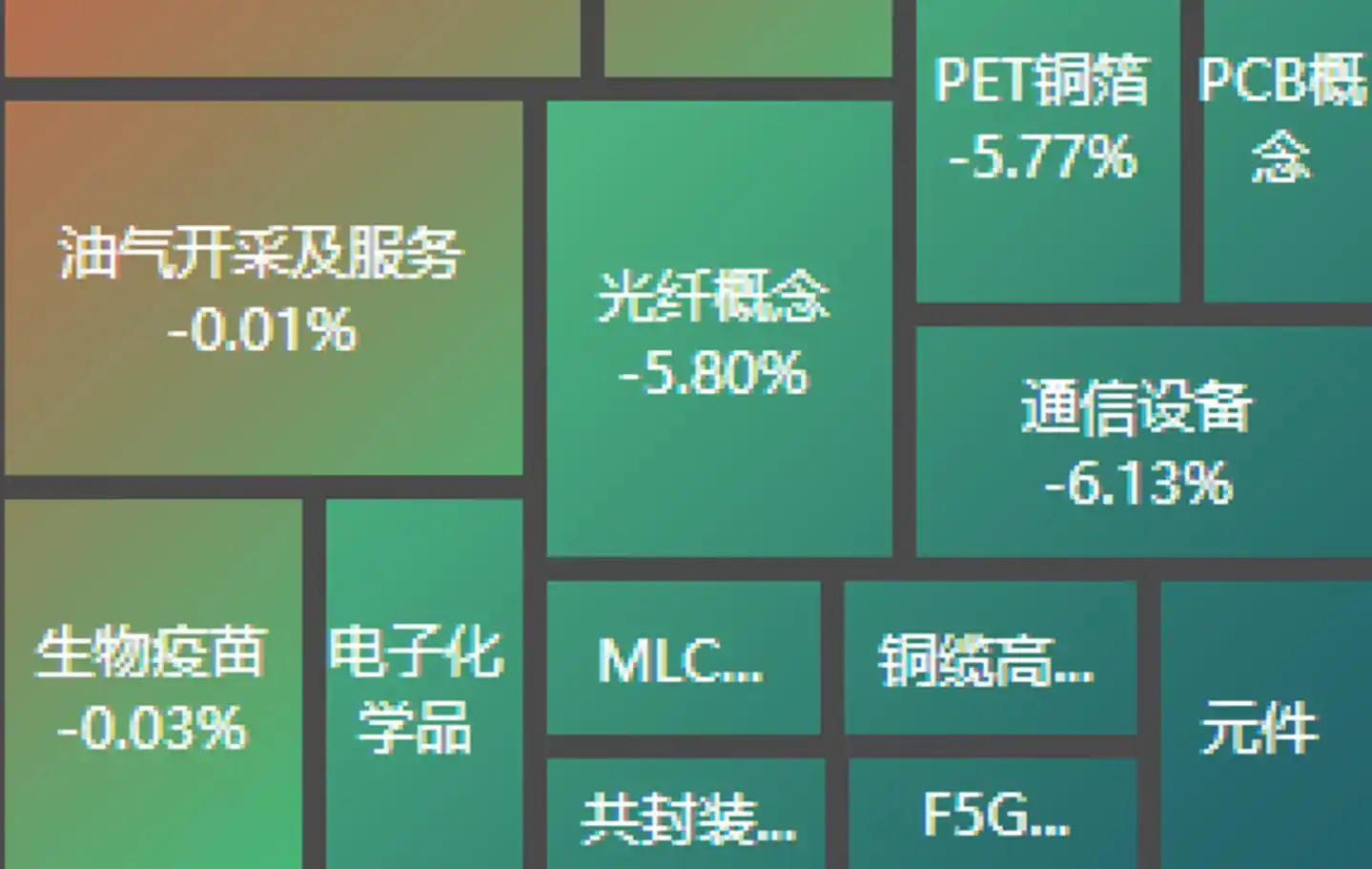
The source article said the slide in the major indexes was only part of the story. What hit sentiment more directly was a concentrated batch of shareholder reduction announcements released before the holiday.
Technology names faced a wave of stake-sale disclosures
Several announcements in semiconductor and computing-related companies became the center of attention.
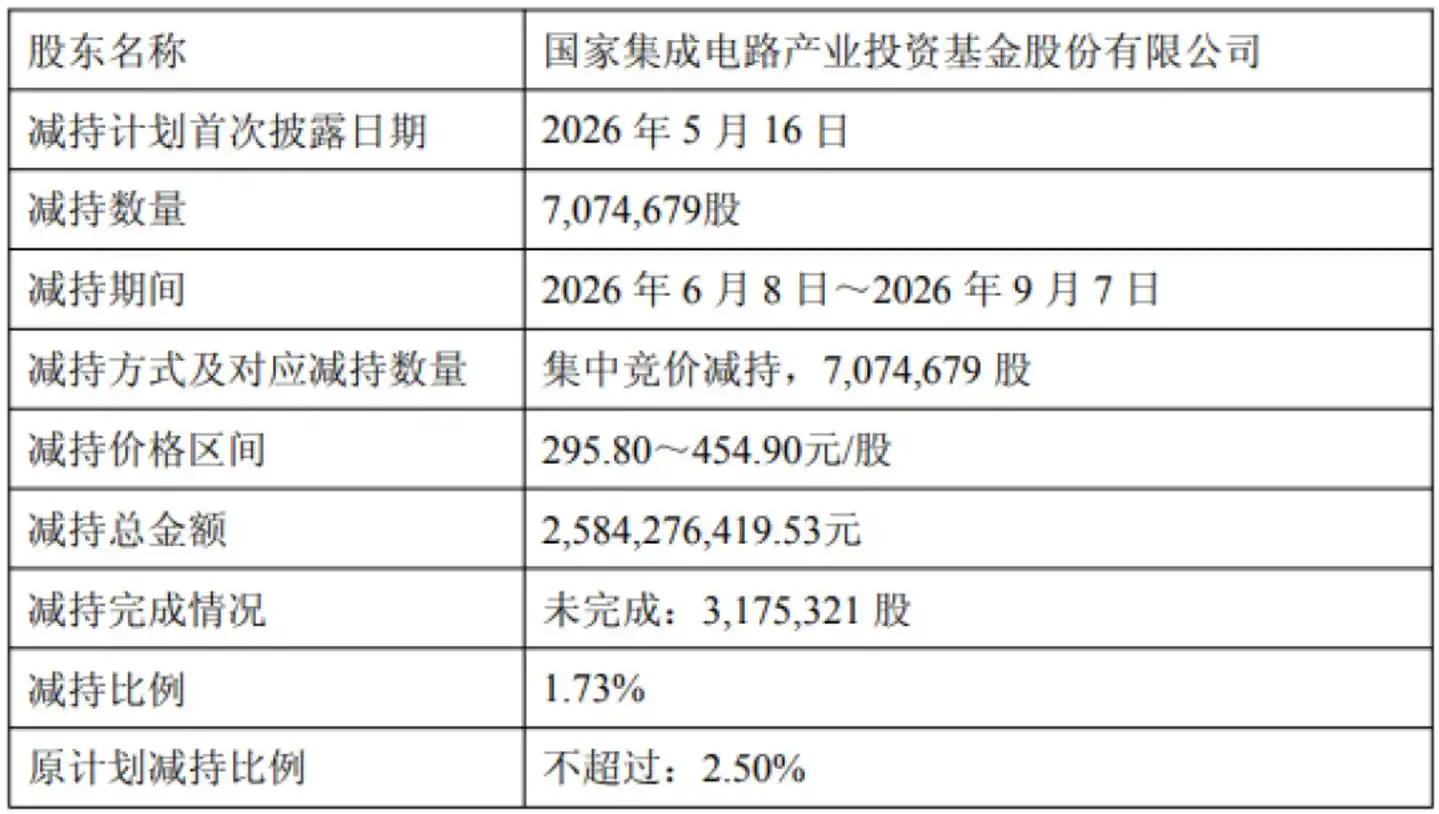
Shengke Communication, described in the article as a leading domestic switch-chip company, saw National Integrated Circuit Industry Investment Fund Phase I reduce 7.0747 million shares from June 8 to Sept. 7 for business and management needs. That represented 1.73% of total share capital. The transaction price ranged from 295.80 yuan to 454.90 yuan, with cash proceeds of about 2.584 billion yuan.
At ASR Microelectronics, a domestic baseband chip maker, Alibaba Network reduced 1.86% of its stake from Aug. 17 to Sept. 10 due to its own arrangements. The sale price ranged from 82.91 yuan to 107.87 yuan, bringing in 703 million yuan. It later announced an early end to the reduction plan.
Xingfu Electronics, linked in the article to the electronic-grade red phosphorus theme, disclosed that Big Fund Phase II completed its reduction on Sept. 10. The average sale price was 117.80 yuan, and the transaction size was about 424 million yuan.
Huafeng Test & Control, described as a domestic leader in analog semiconductor testing, disclosed that controlling shareholder Xinhua Holding reduced 1.10% through an inquiry transfer on Sept. 11 because of its own funding needs. The transfer price was 328.94 yuan per share, involving about 727 million yuan.
Taken together, those four transactions came to nearly 4.5 billion yuan.
The article also listed a longer set of planned reductions that had not yet fully played out. Jinqiu Investment and parties acting in concert at Primarius Technologies planned to cut no more than 2%. WLT at Montage Technology planned to reduce no more than 0.19%. The actual controller of Yuanjie Semiconductor and parties acting in concert planned to reduce no more than 0.2317%.
On the evening of Sept. 27, three companies — Zhongke Feice, Heda Technology, and Hongyu Shares — disclosed reduction plans on the same day. The article noted that Zhongke Feice and Heda Technology had both risen more than 100% this year.
The market focused on where those sales happened
The report argued that each transaction, viewed in isolation, could be framed as small in percentage terms and not disruptive to company operations. But placed side by side, the names involved — Shengke Communication, Montage Technology, Yuanjie Semiconductor, Xingfu Electronics, Primarius Technologies, Huafeng Test & Control, and Zhongke Feice — all sit on the same broad line of science-and-technology chips and AI computing power, one of the market’s strongest themes over the past year.
In the article’s view, stake reductions do not by themselves guarantee a price decline. The signal comes from the price zone where they occur. Shengke Communication’s average reduction price was above 300 yuan, while Huafeng Test & Control’s inquiry transfer was done above 328 yuan. The article said that, in practical terms, industry capital and controlling shareholders with the deepest understanding of these companies chose to cash out at elevated levels.
The Big Fund has long been treated as one of the most recognizable forms of industrial capital in China’s semiconductor sector. Based on incomplete statistics from listed-company filings, the article said that since 2026, Big Fund Phase I and Phase II have issued reduction-related announcements covering at least 18 A-share targets, including Shanghai Silicon Industry, Changchuan Technology, Yak Technology, and Biwin Storage. Those filings included both pre-disclosed plans and completed sales, and the article described selling into strength as a built-in path.
It added that when a financial investor such as Alibaba also monetizes holdings, the market quickly reads that as a signal that profits can be taken. For crowded high-level growth stocks, valuations are already highly sensitive to sentiment. Investors were still debating the durability of the growth cycle, and a queue of shareholders selling stock made capital less willing to keep supporting prices.
External liquidity pressure and pre-holiday caution added to the move
The article also said it would be too one-sided to blame the entire drop on stake reductions. Repeated market chatter about another round of adjustments in overseas demand for optical modules, pressure from external liquidity, pre-holiday risk aversion, and quarter-end institutional repositioning all combined to produce the rare pullback.
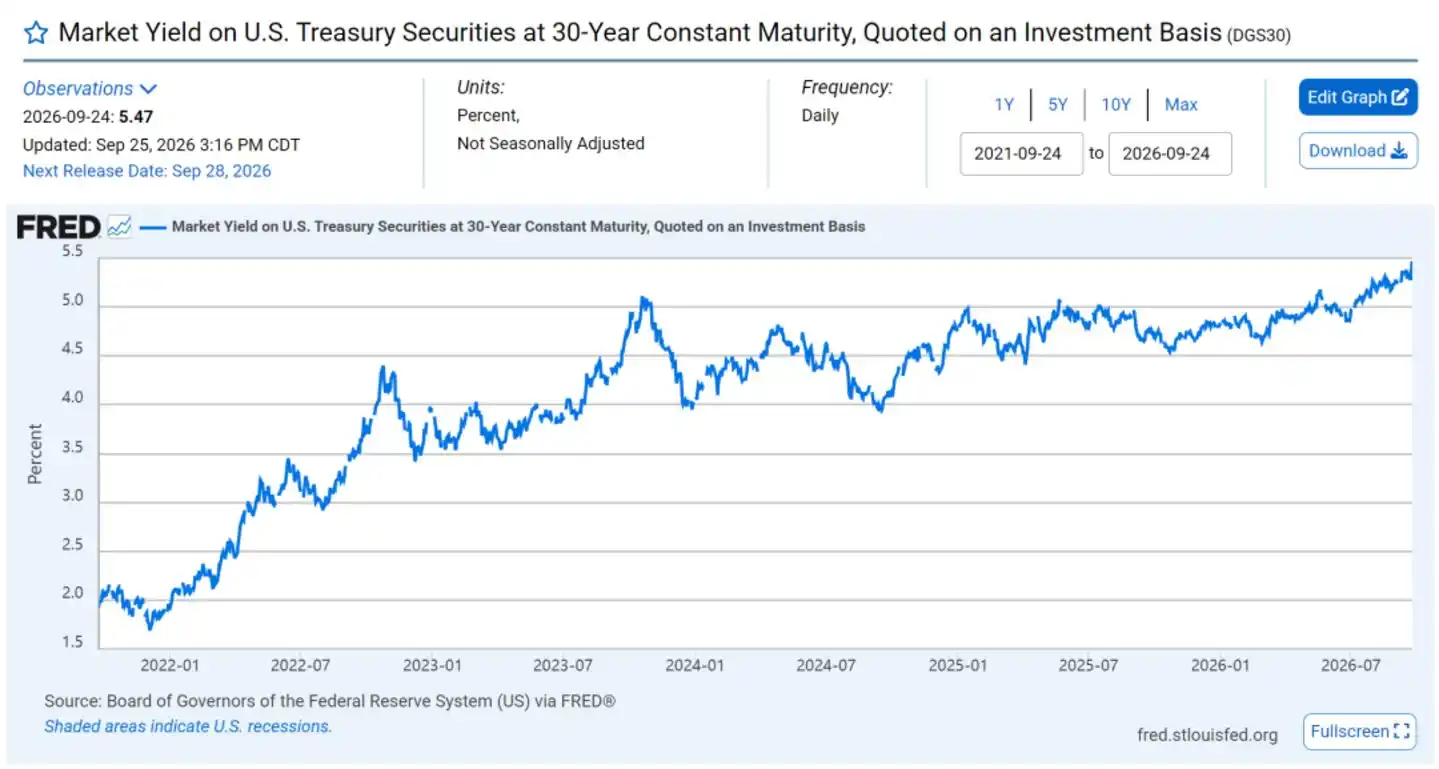
For China’s technology shares, U.S. Treasuries remain a hard constraint on the valuation side. In late September, the 10-year U.S. Treasury yield briefly rose above 5.16%. Last Friday, the 30-year yield moved above 5.5%, the highest level since 2004.
The structure of that move matters as well. From the start of the year to early September, the nominal 10-year yield rose 65 basis points. Of that increase, 53 basis points came from real yields, while inflation compensation contributed only 12 basis points. The article said the market is no longer pricing mainly a short-term inflation scare, but a reassessment of long-term fiscal sustainability.
Technology-stock valuations are built on discounting future cash flows. When the discount rate rises, the distant portion of those cash flows shrinks in present value terms. The day’s biggest laggards — CPO, optical communications, and computing hardware — are exactly the assets with the highest share of far-out cash flows and the strongest dependence on narrative-driven valuation. The article added that the Nasdaq has recently made new highs despite the same Treasury pressure, not because valuation logic stopped mattering, but because valuation premiums and earnings certainty differ.
Quarter-end rebalancing and holiday positioning reinforced the negative feedback loop
The classic pre-holiday effect was another factor. The long break leaves room for uncertainty in overseas markets, geopolitics, and oil prices. For many investors, holding positions through the holiday means taking on several extra days of hard-to-control risk premium. Public funds, private funds, and short-term traders often respond by cutting exposure and holding more cash.
There was also a practical quarter-end constraint. As the third quarter drew to a close, funds needed to review holdings and performance rankings. Some institutions chose to realize floating gains from the third quarter, trim technology names that had already posted large advances, and shift capital toward themes for the fourth quarter. Once prices started falling, trend-following quantitative money added to the move and helped create a negative feedback loop.
The article concluded that the market’s main discomfort came from several pressures landing in the same window: industrial capital cashing out at high levels, overseas rates pushing down valuations, and pre-holiday risk reduction by funds. The positive factors investors had been looking for were described as medium- to long-term variables, not something that could immediately offset short-term shocks.
At the same time, the source article said there was no need for excessive panic. Shareholder reductions are capital actions, not proof that an industry cycle has ended. The long-term growth case for hard-technology sectors such as semiconductors and optical communications has not disappeared. What the market is dealing with now, it said, is a period of valuation digestion. The bigger warning sign, in the article’s framing, is when companies continue telling a growth story while major shareholders keep cashing out in size and earnings fail to keep pace with valuation.