
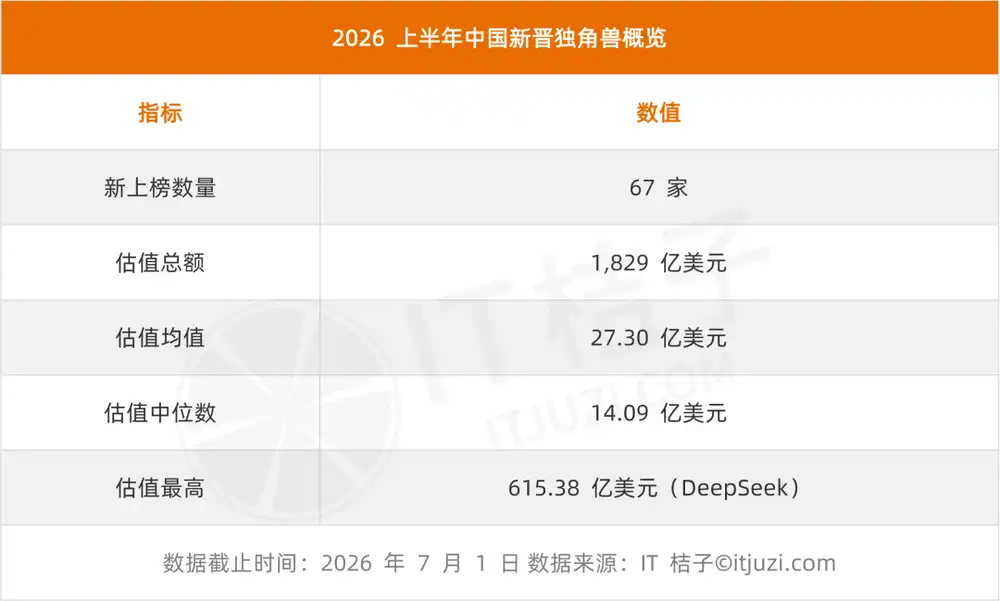
According to IT Juzi’s unicorn database, China had 517 unicorn companies as of July 1, 2026, with a combined valuation of roughly $2.39 trillion. In the first half of 2026, the country added 67 new unicorns with a total valuation of $182.9 billion, marking the highest semiannual tally in nearly five years. Across the full list, the valuation profile remains heavily pyramidal: 57.3% of companies are valued between $1 billion and $2 billion, 30.8% fall in the $2 billion to $5 billion range, and only 62 companies, or 12.0%, are worth more than $5 billion.
At the top end, value remains concentrated in a handful of firms. China has only five “super unicorns” valued above $50 billion: ByteDance, Ant Group, SHEIN, DeepSeek, and Xiaohongshu. Their reported valuations stand at $600 billion, $87.7 billion, $66 billion, $61.5 billion, and $50 billion respectively. Together, these five names account for about 36% of the total valuation of all Chinese unicorns, underscoring how much the overall market is driven by a small number of very large private companies.
A sharp rebound in new unicorn formation
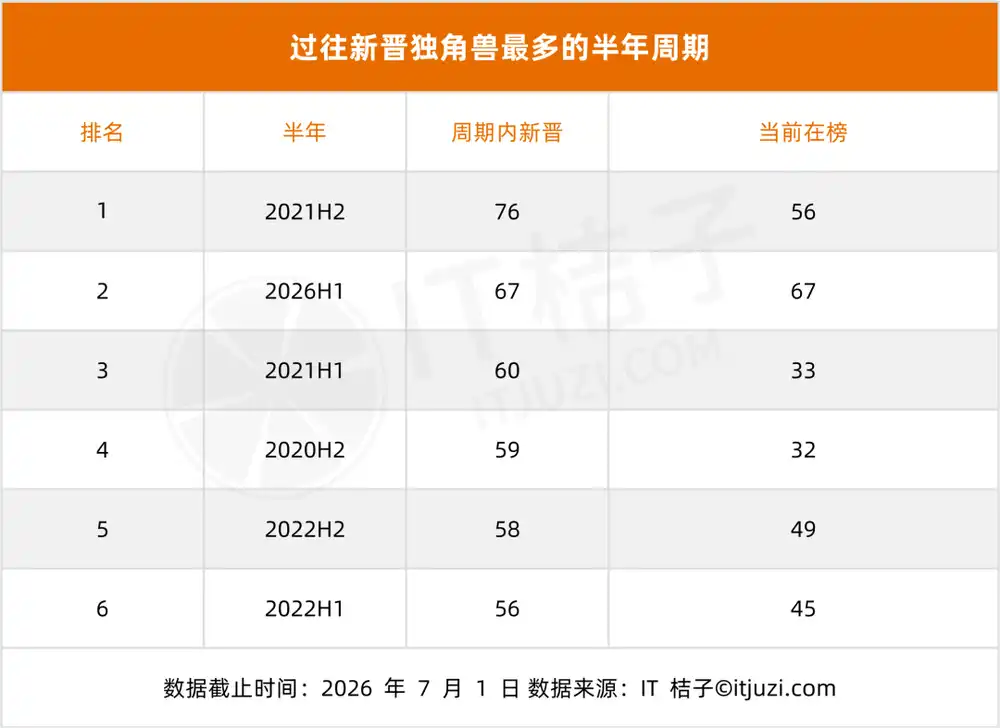
Looking at the historical cycle, China saw a strong wave of unicorn creation in 2021 and 2022. The second half of 2021 set the record with 76 newly added unicorns, while the first and second halves of 2022 added 56 and 58, respectively. That pace then cooled visibly through 2023 and 2024. Against that backdrop, the addition of 67 new unicorns in H1 2026 stands out as a significant rebound, equivalent to nearly one new unicorn every three days.
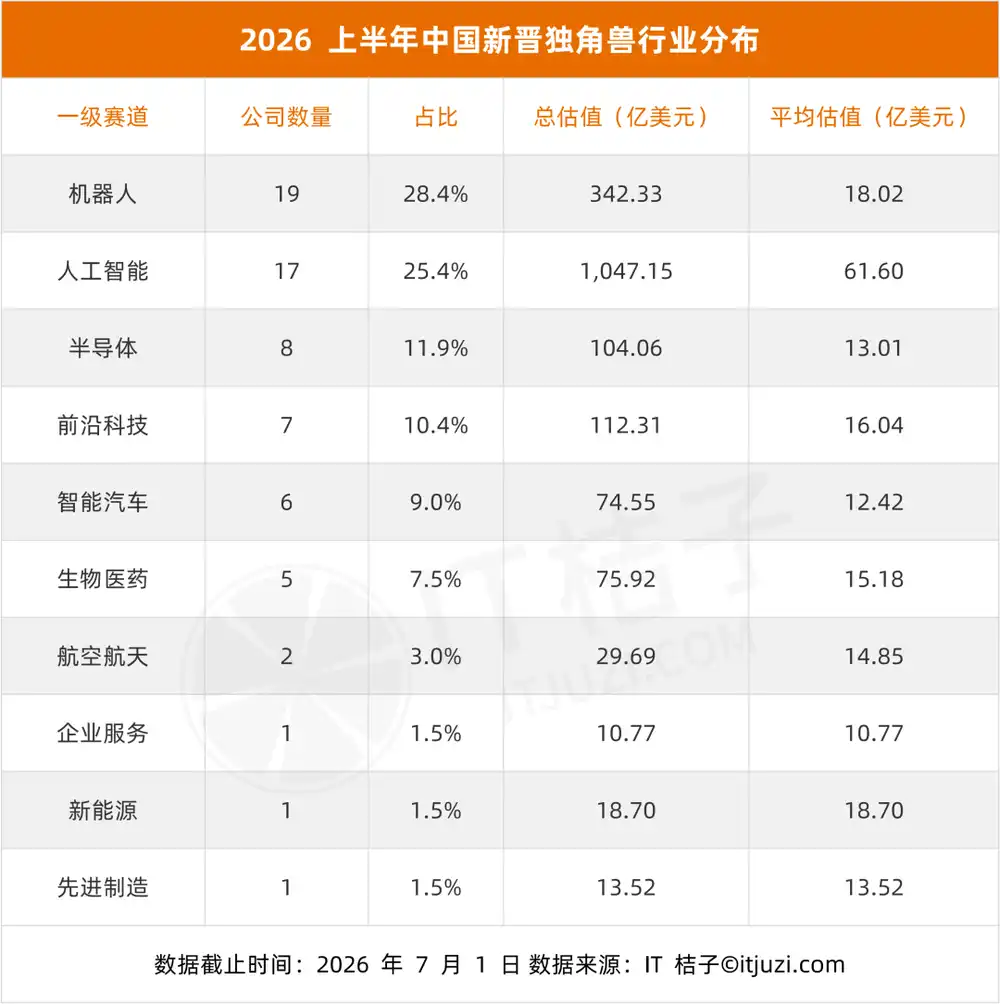
The latest surge is materially different from the previous one. The 2021–2022 cycle was supported by a broader mix of sectors, including new energy, biopharma, and consumer internet. By contrast, the 2026 H1 cohort is highly concentrated in two areas: 19 robotics companies and 17 AI companies, or 36 out of 67 in total. That means more than 53% of all new unicorns came from those two categories alone. The report argues that this reflects a new technology-led cycle driven by foundation models and embodied intelligence rather than the earlier mobile internet and EV supply-chain story.
Sector mix shifts further toward hard tech
Across all 517 unicorns currently on the list, advanced manufacturing ranks first with 151 companies, or 29.2% of the total. Artificial intelligence comes next with 71 companies, followed by healthcare with 53. Robotics has grown to 44 companies, overtaking e-commerce and retail, which now counts 34. The composition suggests that China’s highest-growth private companies are increasingly moving away from pure internet consumption models and toward hard-tech industries.
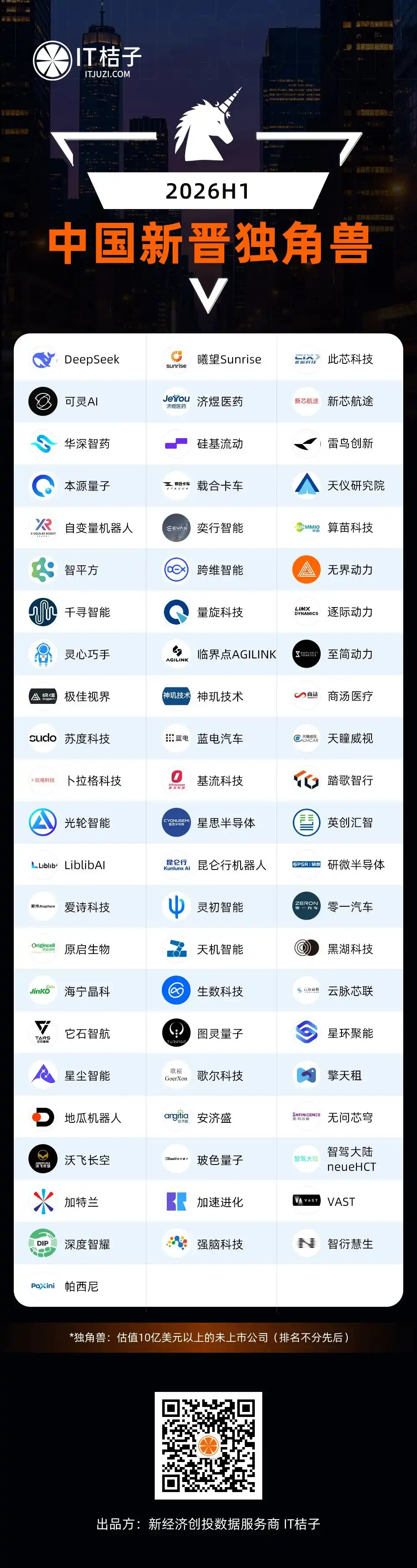
Within the 67 newly added unicorns, robotics ranked first with 19 companies. The segment spans humanoid robot makers, dexterous hands and other key components, embodied intelligence software platforms, and robot leasing services. Eight of the new robotics unicorns are focused on humanoid robots, including Zibianliang Robot, Zhifang, and Qianxun Intelligence, all with valuations above $1.2 billion. The report also highlights the rise of spin-off companies. AGILINK emerged from Zhiyuan Robot’s dexterous-hand division, while Digua Robot came from Horizon’s AIoT team, signaling growing technology spillover from major platform companies.
AI accounted for 17 new unicorns, but valuations in this group were far more uneven. DeepSeek alone, at roughly $61.538 billion, represented about 59% of the sector’s total valuation. Excluding DeepSeek, the remaining 16 AI unicorns were worth a combined $43.2 billion, or roughly $2.7 billion on average. The category includes large models, multimodal video generation, AI chips and compute infrastructure, and AI drug discovery. Keling AI, valued at around $18 billion, ranked second only to DeepSeek inside the AI cohort. Four names in the list focused specifically on AI chips and computing capacity: Sunrise, Yixing Intelligence, Jiliu Technology, and Wuwen Xinqiong, showing that capital continues to flow into AI infrastructure.
Other hard-tech categories also made gains. The semiconductor segment added eight unicorns across automotive chips, communications chips, AI chips, autonomous driving chips, advanced packaging, and semiconductor equipment. Frontier technology contributed seven new unicorns, including four in quantum computing: Origin Quantum, SpinQ, Turing Quantum, and Bose Quantum. That concentration suggests quantum computing in China is entering a faster commercialization stage, at least by private-market valuation standards.
Beijing, Shanghai, Shenzhen, and Hangzhou dominate
Geographically, China’s unicorn landscape remains highly concentrated. Among all 517 unicorns, Beijing hosts 142, Shanghai 98, and Shenzhen 61, with those three cities accounting for 58.2% of the national total. Hangzhou ranks fourth with 28 unicorns, but its valuation contribution is disproportionately high at $239.4 billion, helped by heavyweight names such as ByteDance and DeepSeek.
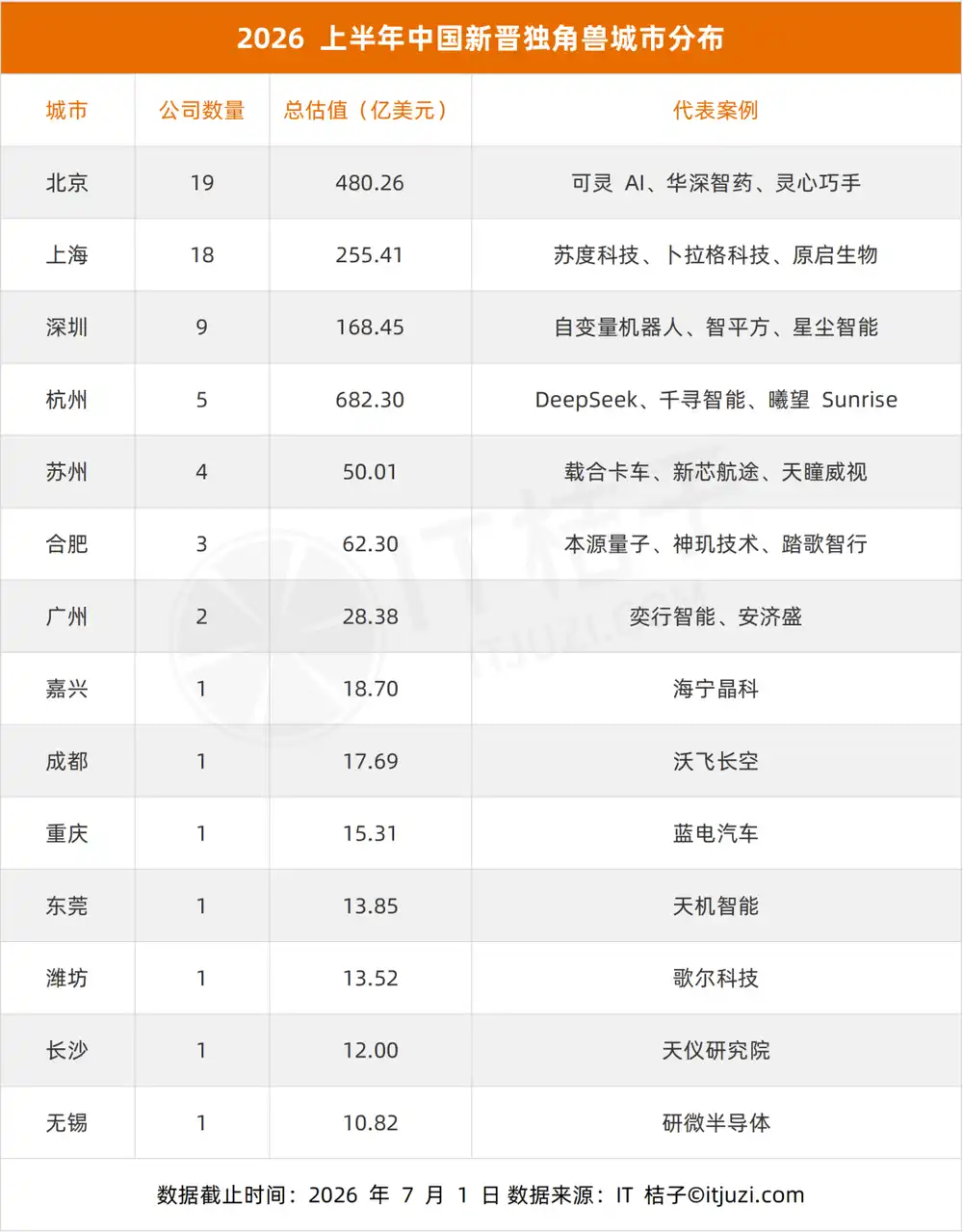
The concentration becomes even more pronounced in the 2026 H1 intake. The 67 newly added unicorns are spread across 14 cities, but Beijing has 19, Shanghai 18, Shenzhen 9, and Hangzhou 5. Together, those four cities account for 51 companies, or 76.1% of the total. Beijing leads by number, only one ahead of Shanghai, yet its new-unicorn valuation of roughly $48 billion is well above Shanghai’s $25.5 billion, largely due to higher-valued companies such as Keling AI and Huashen Zhiyiao.
Hangzhou stands out for a different reason. It added only five unicorns in H1, but because DeepSeek alone is valued at around $61.5 billion, the city’s newly added unicorns reached a combined valuation of $68.2 billion. That put Hangzhou ahead of both Beijing and Shanghai in valuation terms and gave it a 37.3% share of the total value created by the new cohort. Shenzhen, meanwhile, has emerged as China’s densest city for humanoid robotics startups, with six of its nine new unicorns tied to robotics. Hefei added three new unicorns, all in hard-tech categories such as quantum computing, autonomous driving chips, and autonomous mining vehicles. Suzhou added four, three of them related to intelligent vehicles, reinforcing the role of local industrial clusters.
Valuations are highly pyramidal, with only two above $10 billion
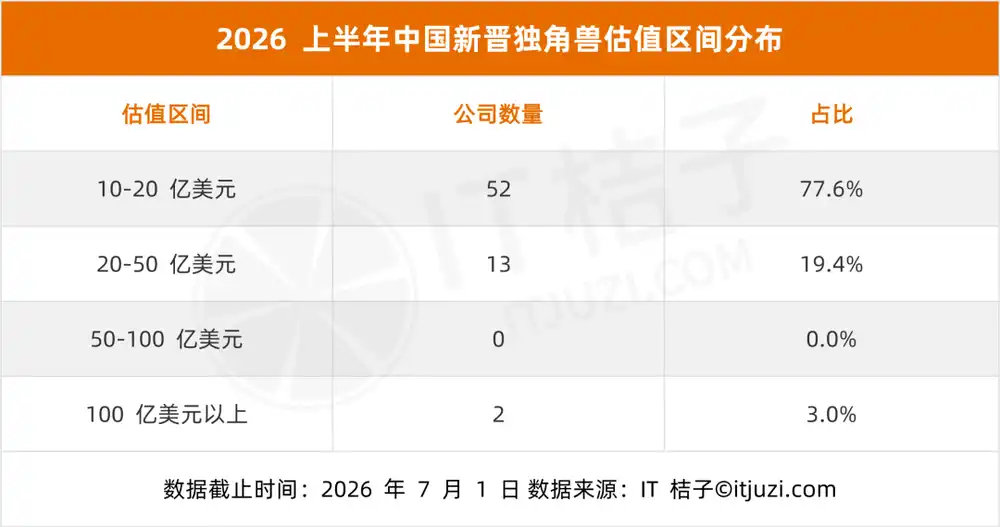
The 67 new unicorns added in H1 2026 show a classic pyramid structure in valuation terms. About 77.6% are worth between $1 billion and $2 billion, indicating that most are still early in their scaling journey and have only recently crossed the unicorn threshold. Another 13 companies fall in the $2 billion to $5 billion range, including Huashen Zhiyiao, Origin Quantum, and Zibianliang Robot, suggesting these businesses have already reached an initial level of product-market validation and operational scale.
There is, however, a clear gap between ordinary unicorns and true mega-valuations. No newly added company fell in the $5 billion to $10 billion range. Only two exceeded $10 billion: DeepSeek and Keling AI. DeepSeek’s valuation is more than three times that of Keling AI, illustrating how quickly technical leadership and market expectations can translate into outsized private-market premiums in the foundation-model race. Compared with the entire universe of 517 unicorns, where only five are above $50 billion, the fact that one H1 2026 entrant immediately joined that group is highly unusual.
Fast and slow paths to unicorn status are diverging
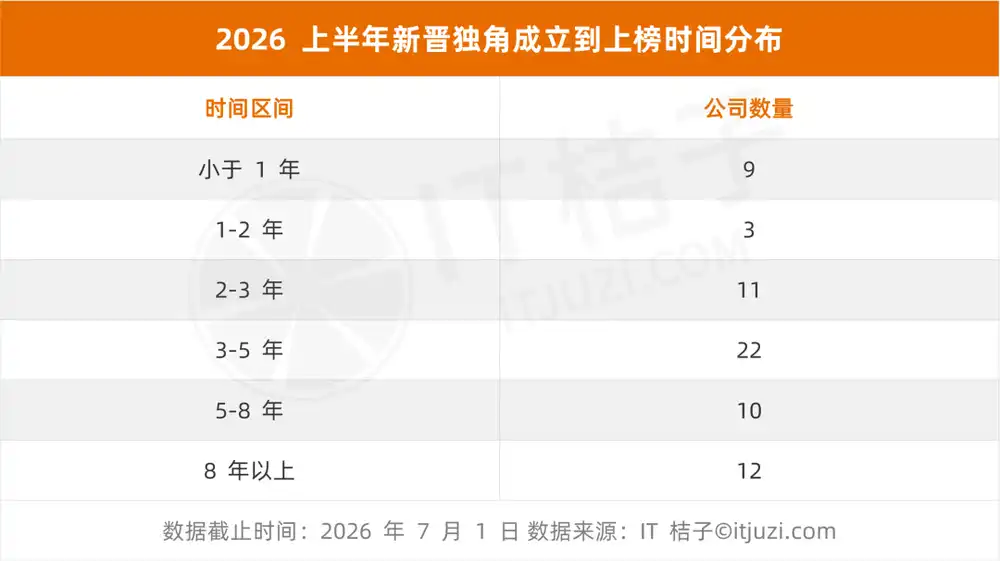
The report also highlights a widening split in the time it takes companies to become unicorns. The largest number of newly added unicorns were founded in 2023, with 14 names, followed by 10 founded in 2022 and 8 in 2021. Altogether, 32 of the 67 newcomers were established within the past three years, almost half the total. That timeline closely matches the post-2023 boom in large language models and embodied intelligence. On average, the new unicorns took 4.7 years to reach unicorn status, with a median of 3.7 years. Around 34.3% made it within three years, and 67.2% within five years.
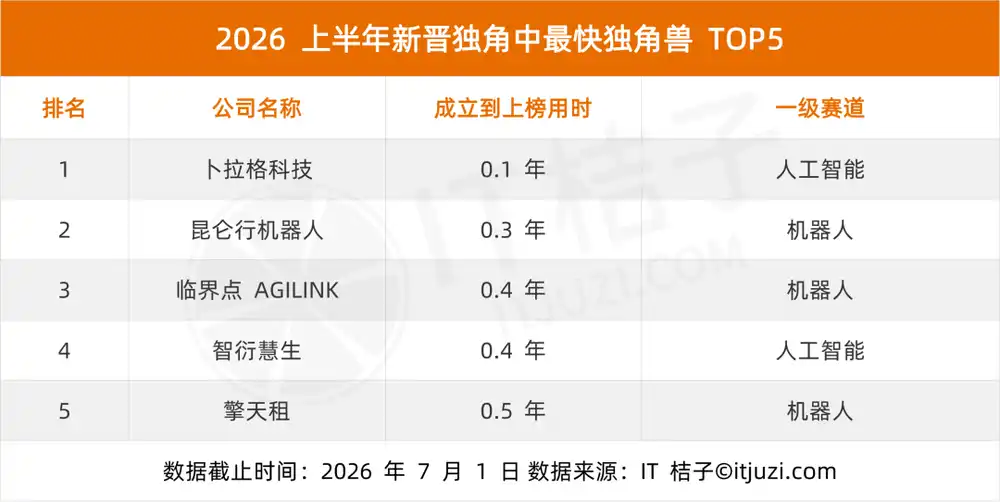
The fast-track group is concentrated in AI and robotics and often includes either spin-offs from major firms or startups founded by well-known technical leaders. Bulage Technology, founded by former Alibaba Qwen model head Lin Junyang, reportedly made the unicorn list just one month after its establishment. AGILINK came from Zhiyuan Robot’s dexterous-hand unit. Sunrise was spun out of SenseTime’s large-chip operation. Zhiyan Huisheng, founded by Tsinghua University associate professor Dai Jifeng, reached unicorn status in roughly five months. These cases point to a model where prior technical accumulation, founder reputation, and capital access can dramatically compress the time to a billion-dollar valuation.
At the other end are “slow unicorns,” mainly in semiconductors, biotech, and advanced manufacturing. Companies such as Goer Technology, Yingchuang Huizhi, Gairui, Tianji Intelligence, and Yuanqi Biology have all been operating for 8 to 14 years before reaching unicorn scale. Their path reflects longer R&D cycles, tougher engineering barriers, and slower commercialization. The result is a bifurcated market: AI and robotics can produce rapid, expectation-driven unicorns, while other hard-tech sectors still rely on patience and sustained technical execution.
A new cycle is forming, but crowding risks remain
The report concludes that the appearance of 67 new unicorns in H1 2026 marks the beginning of a new growth cycle in China’s innovation economy. Compared with the 2021–2022 period, the current cycle is more concentrated in AI and robotics, faster in the speed of unicorn formation, stronger in hard-tech representation, and even more geographically centered on the top four innovation hubs of Beijing, Shanghai, Shenzhen, and Hangzhou.
Looking ahead to the second half of the year, AI and robotics are expected to remain the largest sources of new unicorn formation. As embodied intelligence moves from laboratories toward production and deployment, more robot makers and core-component firms may cross the $1 billion threshold. Semiconductors and quantum computing are also likely to stay relevant under the domestic substitution theme, although financing conditions and policy expectations may affect the pace. At the same time, the report cautions that some of the newly emerged “lightning unicorns” still need to prove commercialization over the next one to two years, and that a crowded field could eventually trigger valuation resets.
Overall, the H1 2026 unicorn wave offers a snapshot of China’s broader transition from internet-led growth to hard-tech innovation. The surge did more than set a fresh record for recent years. It also showed that large models and embodied intelligence are moving beyond concept status and increasingly becoming an industrial reality, at a speed that may exceed previous technology cycles.