
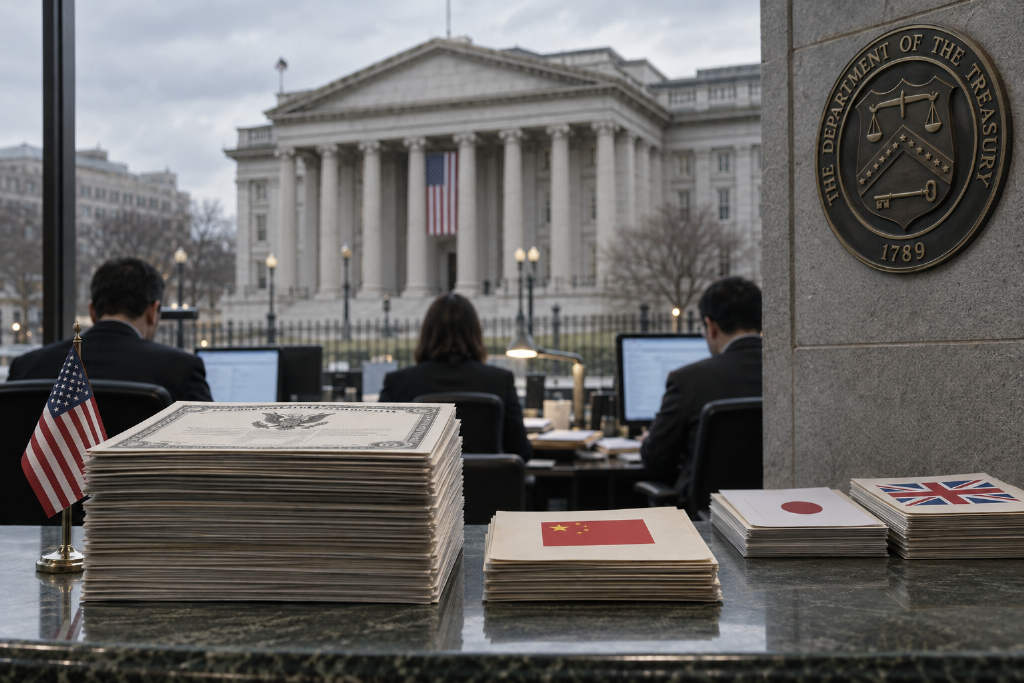
China’s holdings of US Treasuries dropped to $618 billion in July from $633.4 billion in June, according to the Treasury International Capital (TIC) report the US Treasury Department released on Sept. 16. That $15.4 billion slide pushed China’s position down to its lowest point since August 2008, when its holdings were $573.7 billion.
The South China Morning Post said the cut came as major overseas holders, taken together, were also trimming their Treasury exposure.
Foreign Treasury holdings posted a second monthly decline
The TIC report put total foreign holdings of US Treasuries at $9.25 trillion in July, down from $9.3 trillion in June. That was a $50.4 billion monthly decline, the lowest level since October 2025, and it marked a second straight monthly drop.
Japan cut its holdings by $12.8 billion to about $1.1 trillion, though it still held the top spot among foreign owners. The UK went the other direction, adding $58.4 billion and bringing its position to $998.3 billion, just shy of $1 trillion.
Net inflows stayed positive, with official buyers adding exposure
Still, the July numbers did not point to a full-blown retreat from US assets. The TIC report said the US recorded net inflows of $83.7 billion during the month.
Looking only at long-term securities, foreign investors were net buyers of $40.6 billion. Private investors were net sellers of $3.7 billion. Foreign official institutions, including central banks and sovereign funds, were net buyers of $44.4 billion.
So treating China’s lower Treasury holdings as proof of a coordinated selloff in dollar assets would go too far. The pressure just does not look that uniform.
Custody-based reporting complicates country-by-country conclusions
The Treasury Department said TIC data are recorded by custody location. That means the figures do not fully identify Treasury positions held through foreign private asset managers.
And that opens the door to undercounting. If China holds Treasuries indirectly through custody accounts in places such as Belgium or Luxembourg, the reported $618 billion may not reflect its full exposure.
The same problem shows up in the UK data. Britain added $58.4 billion in July and its holdings neared $1 trillion. But London is a major global custody center, so those figures can include assets that belong to other countries. Which makes one-month country data a weak basis for claiming China is steadily pulling out of dollar assets.
Higher yields add to Washington’s funding pressure
The report arrived with bond markets already strained by rising rates. On Sept. 16, the Federal Reserve lifted its policy rate by 25 basis points to a range of 3.75% to 4%, the first rate increase in three years. Chair Walsh said after the meeting, "This summer’s inflation data have not told me that the underlying trend has improved in any meaningful way" and "Inflation is too high, and it has been for far too long." Most Federal Open Market Committee members expect two rate increases this year.
At the same time, the 10-year US Treasury yield rose above 5% this week to 5.016%, the highest since 2007. The 30-year yield also climbed above 5.4%, hitting its highest level since 2004.
Other sovereign bond markets saw sharp moves too. Japan’s 10-year yield rose to 3%, the UK’s moved above 5.4%, France’s reached 4.5%, its highest since 2008, and Germany’s climbed to 3.5%, the highest since 2009. The original report said higher oil prices linked to tensions in the Middle East, firmer inflation expectations, and a more hawkish shift by central banks were driving a broader selloff across global government bond markets.
For the US Treasury Department, softer foreign demand means future auctions of long-dated debt may have to offer higher yields to draw in buyers, pushing borrowing costs up. And for risk assets such as Bitcoin, yields above 5% also signal a higher cost of capital.