


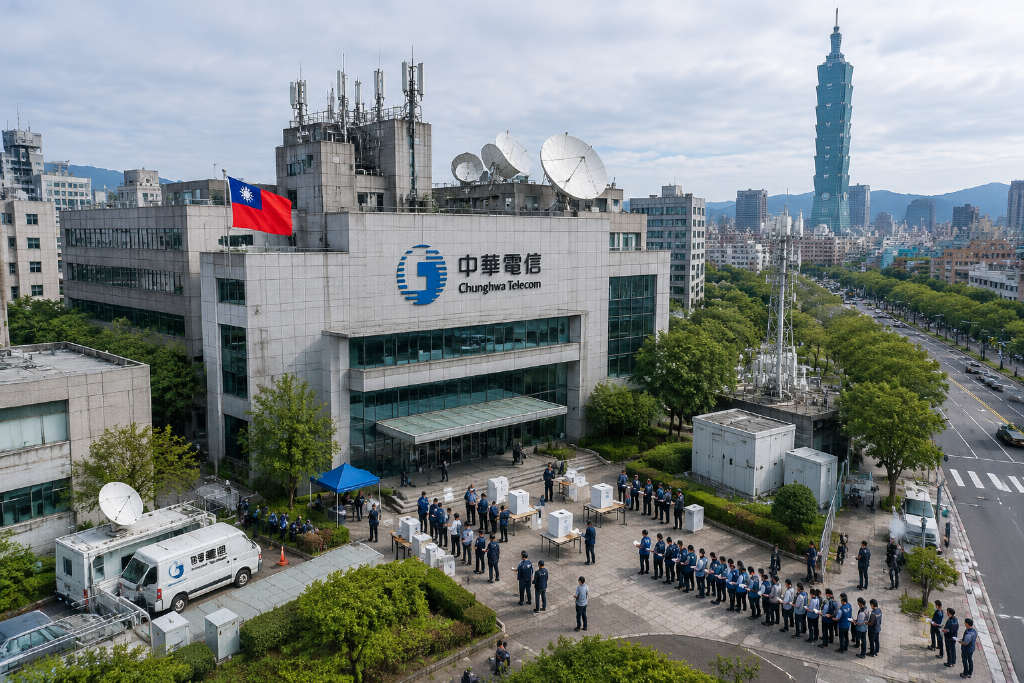
Chunghwa Telecom’s union began a staggered strike vote on Oct. 14. To secure strike authorization, the union needs approval from more than half of all members, not just those who cast ballots. With membership close to 20,000, that puts the threshold at roughly 10,000 yes votes.
Voting has started in phases, with schedules set for three regions
The vote is being held branch by branch. According to a company document, Kaohsiung is voting from Oct. 14 to Oct. 15, with counting on Oct. 15; Taoyuan is voting from Oct. 14 to Oct. 16, with counting on Oct. 16; and Taichung is voting from Oct. 20 to Oct. 22, with counting on Oct. 22. The union has not publicly explained when other regions will vote. The company document said those areas were "reportedly likely to be postponed until next year."
Article 54 of Taiwan’s Act for Settlement of Labor-Management Disputes requires a direct and secret ballot and approval from more than half of all union members. That means the denominator is the full membership, not turnout. Members who do not vote are effectively not counted as supporting the strike. For that reason, the ballots counted this week in Kaohsiung and Taoyuan will not be enough on their own to determine the final outcome. The result depends on whether the combined tally across regions clears the halfway mark for the entire union.
Company objects to early counting, union says lawyers reviewed the process
After work on Oct. 13, Chunghwa Telecom sent the union a five-page document questioning the staggered voting and the decision to count ballots in each region before all voting is complete. The company’s position is that the law requires the full membership to make one collective decision on the same issue. It also said the union had previously waited until all regions finished voting before opening ballots. Counting early this time, the company argued, means later voters could cast ballots after seeing results from other areas.
The union responded that same night with three points. It called the document a case of "malicious framing and false accusation." It also said the voting process had been discussed with lawyers and that it had written to the Ministry of Labor seeking clarification. The union added that the company still had not confirmed the size of any pay raise or the terms of a collective agreement, which it said was why it had chosen to escalate the dispute.
Strike authorization would not mean an immediate strike
Even if the vote passes, the union would only obtain the legal right to strike. That does not mean a walkout would begin at once. The report noted that in September 2023, the union had planned to start voting on Sept. 18, but reached four points of consensus with the company five days before the vote. That deal led to a NT$3,000 pay raise for all employees from New Year’s Day of the following year, and the vote was called off.
Law requires basic voice service to stay online
One of the central public questions is whether a strike could disrupt mobile service. Taiwan’s labor dispute law places a special restriction on telecom operators. Under Article 54, Paragraph 6, a union at a fixed-line or mobile telecom operator may declare a strike only under conditions where basic voice communication service remains uninterrupted. Chunghwa Telecom also said in a May 22 statement on its website that it would "ensure uninterrupted public service."
The law, however, specifically mentions basic voice communication and does not address internet access. In practical terms, the legal floor is that phone calls must still go through. Whether internet service or other telecom services would be affected is not answered in the text cited in the report. On Oct. 13, the union said that if later action affects telecom operations, or even election-related work tied to the Nov. 28 local elections one month later, Chairman Chien Chih-cheng should bear full responsibility.
What the union wants and how the company has responded
When the union protested at the Ministry of Transportation and Communications on May 22, it raised four demands: delay the mandatory retirement age, raise the contribution rate under the new labor pension system to above 15%, revise the collective agreement, and increase pay. Chunghwa Telecom responded to each point on its website the same day.
Pay
The company said it has raised pay for five consecutive years and that each employee already received a fixed NT$2,400 raise this year. On Sept. 13, Chien Chih-cheng said the company was drafting a 2027 pay plan with an expected increase of "no lower than" the 4% adjustment for civil servants. In an Oct. 13 interview, he also said the median salary for non-management full-time employees at Chunghwa Telecom was NT$1.646 million, or NT$400,000 to NT$500,000 higher than peers. The union, for its part, said the company still had not confirmed the pay increase with the union.
Labor pension contributions
The contribution rate under the new labor pension system refers to the share the company deposits each month into an employee’s pension account. The legal minimum is 6%, while the union is asking for more than 15%. The company said that from 2024 it added incentives tied to an employee stock ownership trust, bringing the effective contribution-related benefit to 9.75%, and that the figure would rise to above 10% next year.
The report also noted that the 9.75% figure includes stock trust incentives and similar programs. It is not the same as the direct contribution rate into the labor pension account itself. The company added that raising the pension contribution alone to 15% would cause retirement benefit costs to "stack repeatedly."
Retirement age
The company said it launched a retiree rehiring program last year and that there is currently no need for a blanket extension of the mandatory retirement age. But according to a union statement dated June 1, the company later agreed at a shareholder meeting to "immediately calculate a suitable retirement extension period for the company and then enter negotiations." By August, the union said the company had continued to delay, and it decided to launch the strike vote.
Collective agreement
The company said the two sides had reached consensus on certain clauses. The union said Chunghwa Telecom has not signed a collective agreement with the union for 20 years.
What comes next
The next dates to watch are Oct. 15 for the Kaohsiung count, Oct. 16 for the Taoyuan count, Oct. 19 for a labor group gathering on Ketagalan Boulevard, and Oct. 20 to Oct. 22 for voting in Taichung. Another open question is whether the Ministry of Labor will comment on the staggered counting process. As of the morning of Oct. 14, the report said no public response from the ministry could be found. On pay, the next key issue is when the company’s 2027 figures will be finalized in talks with the union.