
Arc, Circle’s stablecoin-native blockchain, is still in public testnet. The company has set summer 2026 as the window for a mainnet beta launch. Until that happens, a growing list of testnet projects has started to gain traction on X, with most of the discussion clustering around NFTs, launchpads and meme projects, where participation is relatively easy.
ArcLens, a third-party ecosystem directory, has listed 308 projects that say they are building on Arc. The projects reviewed here fall into three groups: payment infrastructure teams named by Circle and accompanied by disclosed operating data, institutional partners shown on Arc’s official ecosystem page, and community projects that are drawing more visible discussion. All figures cited in the source were current as of July 21, 2026.
Eight payment infrastructure teams backed by Circle grants
These eight teams were included in the first 2026 batch of the Circle Developer Grant program. They are focused on Africa and the Global South, and were formally introduced in an Arc blog post published on July 13, 2026. Within the current Arc ecosystem, they are among the few projects with disclosed business metrics, though most of them are enterprise-facing and leave limited room for direct retail participation.
Blockradar
Blockradar (@BlockradarHQ) offers wallet-as-a-service infrastructure for fintech companies in emerging markets. Its product stack includes non-custodial wallet creation, gasless transactions, real-time AML screening, treasury consolidation and cross-chain liquidity APIs.
According to the Arc blog, the company processed more than $600 million in payment volume in its first 12 months, serving fintech clients across Africa and Latin America. That activity covered 150,000 wallets and 700,000 transactions. On its own website, Blockradar now shows roughly $950 million in volume, 182,000 wallets and 973,000 transactions. The source notes that those figures are updated by the project and have not been independently audited.
Hurupay
Hurupay, which is preparing to rebrand as Kolan (@kolan_xyz), offers dollar accounts with real routing numbers to non-U.S. users and businesses. Funds are automatically converted into USDC after arrival, and users can cash out into local currency, spend via card, or hold stablecoins for yield.
The service says it has reached more than 50 countries, including Nigeria, Ghana, South Africa, Indonesia, the Philippines, Argentina and Brazil. It reports 50,000 active users and more than $100 million processed over 15 months.
Myaza
Myaza (@myazahq) runs a pan-African payments network with multicurrency wallets and instant transfers across 21 African currencies. Cross-border settlement is powered by USDC and EURC. The product also includes virtual dollar cards, bill payments and savings accounts.
The company says it has more than 25,000 registered users, 23% month-over-month growth and about $15 million in cumulative transaction volume. It has also formed infrastructure partnerships with Fincra, Yellow Card and Bridge.
Arrel Technology
Arrel Technology, also referred to as DAPL (@ArrelTechnology), says it brings eight years of institutional digital asset infrastructure experience. Its new product, USDC Omni-Checkout & Treasury Router, is built on Circle’s Cross-Chain Transfer Protocol, or CCTP, and is designed to let African merchants accept USDC and EURC without custom development, in a setup the source compares to Stripe.
The company is targeting the Global South and reports $180 million in annual payment volume, up 128% year over year.
Payrit
Payrit (@payritHQ) is a USDC-powered cross-border mobile wallet. Users transact in local currency on the front end while USDC conversion happens in the background, allowing near real-time settlement.
It says it has processed more than 36,000 cross-border transactions worth over $1.9 million for users in Nigeria, covering flows linked to the U.K., Canada and Africa. The wallet supports EVM, Stellar and Solana.
ViFi Labs
ViFi Labs (@ViFi_Labs) is building a decentralized foreign exchange protocol for emerging-market currencies. It uses an AMM architecture designed for correlated assets and targets near-zero slippage for pairs involving currencies such as the Nigerian naira, Brazilian real and Colombian peso.
The protocol has already been deployed on the Arc testnet and is moving toward mainnet launch. Arc is expected to serve as its main liquidity and FX execution hub.
SFx Money
SFx Money (@usesfxmoneyapp) started as a stablecoin-based digital bank for remittances used by the Turkish diaspora and African students. It has since expanded into a broader digital banking product that supports free transfers between Turkey and more than 16 African countries, as well as the U.S., the U.K. and the European Union.
Its user base grew from about 300 in December 2024 to more than 8,800 in July 2026. The report also says SFx Money is one of the few teams in this grant batch to receive Circle support for a second time.
Flezpay
Flezpay (@flezpay) is focused on African retail payments. It uses AI-driven smart QR codes to adjust product prices in real time and connect fiat and USDC at the checkout counter.
The company says it has integrated with 1,613 retail stores and is generating more than $31,000 in monthly recurring revenue.
More than 100 verified partners on Arc’s ecosystem page
Arc’s official ecosystem page lists more than 100 verified institutions and project partners across stablecoin issuance, infrastructure, trading, payments and financial services.
The roster includes BlackRock, Goldman Sachs, HSBC, Deutsche Bank, Standard Chartered, BNP Paribas, BNY Mellon, Mastercard and Coinbase. It also includes crypto-native firms and infrastructure names such as Kraken, Bybit, Aave, Chainlink, LayerZero, Fireblocks, BitGo, Centrifuge, Morpho, Curve and MetaMask.
Launchpad and DEX projects drawing stronger community attention
TowerExchange
TowerExchange is described as a native stablecoin DEX aggregator on Arc. It appears to be one of the better known projects in its category and has maintained more sustained discussion than many peers. The project was previously featured in Arc’s Builder Spotlight, and in May 2026 the official Arc account published a dedicated post introducing its functions and inviting users to a live demo.
Users can connect a testnet wallet on the project website to try swap and liquidity features.
Radar DEX
Radar DEX, formerly ArcDEXScan, presents itself as a token tracking and issuance platform on Arc mainnet. In July 2026 it rebranded and launched a new site at radardex.io, saying the platform already supports Arc mainnet.
Its feature set includes token price, market cap, volume and liquidity tracking. It also has a Uniswap v3-based token launcher with permanently locked liquidity, and aggregates data from Uniswap v2, v3 and v4, along with DyorSwap, Noxa and LiFi.
Users can either access the site directly with a connected wallet or join its Telegram group for bot alerts.
AstraPump
AstraPump combines launchpad and DEX functions, with one-click token issuance and trading as its core pitch. It ranks near the top of the Trending list on ArcLens.
The source says it stands out among similar projects for its follower base and post engagement, attracting meme-focused users and testnet participants.
Lunex
Lunex uses a Curve-style StableSwap AMM built for low-slippage swaps between stablecoin pairs such as USDC and EURC. ArcLens labels the project as Established.
Its website allows users to connect a wallet and test the swap function directly.
AI and infrastructure
hinkal_protocol
hinkal_protocol is a privacy and confidential settlement protocol. It announced its testnet launch in March 2026. Arc’s official account has reposted or mentioned its testnet updates multiple times and referred to it as a “Day One Architect.”
At the current stage, users can test its private transfer function on testnet.
NFT projects with higher visibility
Orixa and ORIXIANS
Orixa is a native NFT marketplace on Arc. After mainnet goes live, it plans to release an NFT collection called ORIXIANS. The project has not clearly stated whether it will issue a token.
Within the Arc NFT segment, Orixa appears to be among the leaders in follower base and discussion volume. To participate, users need a testnet pass, must complete verification in the project’s Discord, and then join whitelist registration.
Arc_Punks and ArcPunksNFT
Arc currently has two separate Punks-themed projects. Arc_Punks describes itself as the earliest Punks series on Arc EVM, while ArcPunksNFT positions itself as a genesis collection. Their teams and issuance plans are different, though the two are often discussed together.
Based on currently disclosed details, both projects plan to offer public minting after mainnet launch and do not require advance whitelist access.
unemployeeonarc
unemployeeonarc is a 10,000-piece NFT collection built around an “unemployed” theme. Its account style is deliberately playful, with recurring references to layoffs and job applications, making it one of the more distinct NFT projects in the ecosystem.
Whitelist rules have not yet been announced. The source suggests following the official account and website for mint timing.
ArcCitizens
ArcCitizens is positioned as a community-governed, fully onchain identity NFT. One of its whitelist announcements triggered a burst of reposts and discussion in a short period, making it one of the clearest examples of real user engagement in Arc’s NFT category. The source points to publicly available evidence such as open whitelist rules and user participation through the stated process.
To take part, users were asked to quote the whitelist announcement, add the phrase “Arc is coming,” switch their profile image to one of the project’s official PFPs and leave a wallet address in the comments. One earlier round offered 100 slots. Future rounds depend on updates from the project account.
Meme category: CatBatHatFatRat
CatBatHatFatRat has 10,000 followers and revolves around the five-word phrase “Cat Bat Hat Fat Rat.” The report says its inspiration may trace back to a video shared by the official USDC account.
The website includes a PFP generator, a community message wall, and interactive features such as a waitlist and leaderboard.
Security warning over fake “Arc mainnet bridge” sites
The source flags a recent wave of third-party websites claiming to be “ARC Bridge,” including onbridge.xyz. These pages say “Arc Mainnet live” and prompt users to connect wallets and bridge at least 1,000 USDC into the so-called Arc mainnet.
That claim does not match Arc’s official public infrastructure. The official Arc block explorer is still clearly marked as Testnet, and there has been no official mainnet explorer or launch announcement.
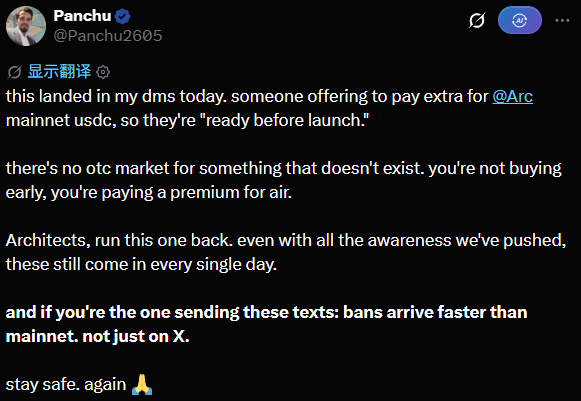
Arc ecosystem contributor Panchu recently posted on X that the underlying Arc mainnet chain is in fact producing blocks, with chain ID 5042, block height above 10.4 million, and a deployed USDC contract. But he said this is only Circle’s internal pre-release testing infrastructure and has not been opened to the public.
He also explained why the bridge claims are dangerous. USDC cross-chain transfers rely on CCTP’s burn-and-mint flow. A third-party site can at most trigger the burn on the source chain. If Arc mainnet is not publicly live, the attestation needed for minting on the destination side cannot be generated, which means the funds disappear and cannot be recovered.
Panchu added that some people are already buying so-called “mainnet USDC” at premiums of 30x to 100x.
When Arc mainnet is actually launched, the announcement will be made publicly through @arc and Circle’s official channels, according to the report. It will not be distributed through direct messages or private tips. For now, the only meaningful way to engage with the ecosystem is through the public testnet, and users are being told not to move assets through any third-party “mainnet bridge.”